
Test 4 of 10 · 20 questions · Free 2026
MN Permit Practice Test 4
Jump to the test ↓A fixed 20 question set from the Minnesota bank with answers and plain English explanations.
Question 1 of 20 · 0 right so far
All 20 questions in test 4
Every question below comes from the Minnesota question bank on this page. Open a question to see the correct answer and the explanation. Nothing here is hidden behind a signup.
1. What happens to a Minnesota driver who drives over 100 mph?
- A $25 surcharge only
- Driving privileges are revoked for at least six months
- A warning on a first offense
- A 30 day suspension
Show answer
Driving privileges are revoked for at least six months. Minnesota fines drivers who exceed the posted limit, adds extra fines at 20 mph or more over, and revokes driving privileges for at least six months for anyone driving over 100 mph. A $25 surcharge is the added penalty for failing to slow down near a stopped emergency vehicle. There is no first offense warning in this rule. A 30 day suspension is the first Not a Drop penalty for drivers under 21, a different offense.
Study this in the handbook: Speed limits and the basic speed law
2. What does a green arrow allow a driver to do?
- Turn in any direction without checking the roadway
- Turn safely in the direction of the arrow, subject to people already in the intersection
- Treat the arrow exactly like a flashing yellow signal
- Wait until the arrow changes to red before moving
Show answer
Turn safely in the direction of the arrow, subject to people already in the intersection. A green arrow authorizes movement in the arrow’s direction and protects the turn from oncoming or crossing traffic. It does not erase the obligation to account for people or vehicles already in the intersection, and it does not authorize unrelated turns. The flashing-yellow choice applies a different signal rule and would improperly add a general caution requirement against the protected movement. Check the path before entering, then complete the indicated turn smoothly. The cue is direction plus protection: follow the arrow, while clearing the intersection remains part of safe execution.
Study this in the handbook: Traffic signals, lane use signals and ramp meters
3. Which group may use strobe lamps under the Minnesota vehicle-equipment rules?
- Any truck weighing more than 10,000 pounds
- All delivery vans making a daytime stop
- Passenger vehicles with a roof-mounted warning sticker
- School buses, snow removal equipment, and rural mail carrier vehicles
Show answer
School buses, snow removal equipment, and rural mail carrier vehicles. The manual names school buses, snow removal equipment, and rural mail carrier vehicles as vehicles that can use strobe lamps. The other options replace that specific list with broad categories based on delivery work, a sticker, or vehicle weight. None of those conditions creates the authorization described in the text. Strobe lamps therefore signal a limited group of road users and work activities, not a general visibility option for heavy or commercial vehicles. Use the vehicle type and its operating role as your recognition cue when reviewing this equipment rule.
Study this in the handbook: Headlights, special lights and required equipment
4. When a school bus displays flashing red lights on a divided highway, which traffic is excepted from stopping?
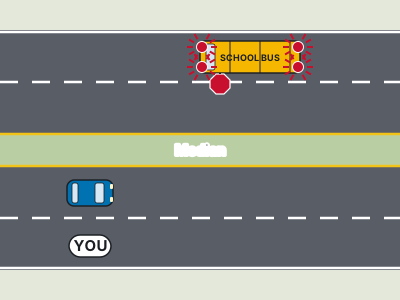
- Traffic approaching behind the bus on the same roadway
- Traffic following the bus in its lane
- Traffic traveling in the opposite direction on the other side of the divider
- Every vehicle because the roadway is divided
Show answer
Traffic traveling in the opposite direction on the other side of the divider. The school-bus exception is narrow: on a divided highway, a driver traveling in the opposite direction is not required to stop for the bus on the other side of the divider. Vehicles behind the bus or approaching in its direction remain subject to the red-light stop requirement. Division of the roadway does not excuse every vehicle. Identify which side of the physical divider your vehicle occupies before deciding whether the exception applies.
Study this in the handbook: Stop rules, school buses and fleeing police
5. Which farm trucks may a Minnesota Class D license holder drive?
- Any truck used for business
- Farm trucks carrying agricultural products, machinery or supplies within 150 miles of the farm, driven by the farmer, family or employee
- No trucks over 10,000 pounds
- Only pickups
Show answer
Farm trucks carrying agricultural products, machinery or supplies within 150 miles of the farm, driven by the farmer, family or employee. With a Class D license you may drive any farm truck transporting agricultural products, farm machinery or farm supplies, including hazardous materials, within 150 miles of the farm, provided you are the farmer, an immediate family member or a farm employee. Class D otherwise excludes single vehicles of 26,001 pounds or more and covers cars, pickups and small trucks, plus authorized emergency vehicles regardless of weight.
6. Where should a driver stop for a stop sign when a stop line and crosswalk are present?
- In the center of the intersection to improve visibility
- After the crosswalk so the front bumper reaches the intersection
- Only beside the sign, even if that is beyond the intersection
- At the stop line, before the crosswalk, or before entering the intersection
Show answer
At the stop line, before the crosswalk, or before entering the intersection. The stop must occur before the vehicle enters the conflict area. Minnesota identifies the stop line, the area before the crosswalk, or the point before entering the intersection as the stopping locations. Stopping after the crosswalk can interfere with pedestrians, and stopping in the intersection blocks other movements. The sign itself does not require a driver to stop beside its post if the marked stopping point is elsewhere. The cue is the order of the markings: stop first, scan for people and traffic, then proceed only after the intersection is clear enough.
Study this in the handbook: Traffic signals, lane use signals and ramp meters
7. What alcohol rule applies to a Minnesota driver under age 21 who operates a motor vehicle?
- The rule applies only when passengers are present
- Only 0.08 percent or more is illegal
- Alcohol is allowed if the driver stays below 0.04 percent
- Any detectable amount is illegal
Show answer
Any detectable amount is illegal. Minnesota's underage rule prohibits operating a motor vehicle with any detectable alcohol in the system. That is stricter than the 0.08 percent level at which an adult driver can be arrested for DWI, and it is not changed by the presence or absence of passengers. The 0.04 percent choice borrows the commercial-vehicle threshold and does not apply here. A second conviction also brings a longer suspension, so the safest operating cue for anyone under 21 is no detectable alcohol before driving.
Study this in the handbook: How alcohol affects you and the DWI law
8. An emergency vehicle with flashing red lights and a siren approaches on a two-way road. What should you do?
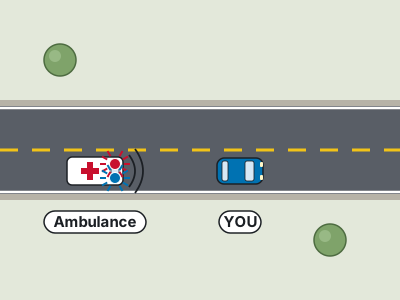
- Pull to the right and stop
- Turn left and stop in the nearest travel lane
- Keep driving and let the emergency vehicle use the shoulder
- Stop immediately in the middle of the intersection
Show answer
Pull to the right and stop. On a two-way road, an approaching emergency vehicle using flashing red lights and a siren requires other drivers to pull to the right and stop. If the driver is already in an intersection, the driver should first proceed through it before stopping, so the intersection remains clear. Continuing at the same speed or stopping in the middle of the intersection can block the emergency response. The left-side choice moves toward the vehicle's expected path. The cue is lights plus siren: signal, move right safely, stop, and remain stopped until the emergency vehicles pass.
Study this in the handbook: Emergency vehicles, the Move Over Law and traffic stops
9. If a tire blows out while you are driving, what should you do before braking?
- Release the steering wheel so the vehicle can settle itself
- Brake hard and turn sharply toward the shoulder
- Hold the wheel firmly, steer straight, and ease off the accelerator
- Accelerate briefly to keep the damaged tire turning
Show answer
Hold the wheel firmly, steer straight, and ease off the accelerator. A blowout can abruptly disturb the vehicle, so the first priority is maintaining directional control. Hold the steering wheel tightly, keep the vehicle straight, and gradually remove your foot from the accelerator. The hard-braking choice can worsen the loss of control, and the manual specifically says to delay braking until control returns. Once stable, pull completely off the road at the nearest safe location. A useful cue is control before stopping: steady the path, reduce power gently, then brake only after the vehicle responds normally again.
Study this in the handbook: Blowouts, brake failure and other vehicle emergencies
10. How should a driver respond when confronted by an aggressive driver?
- Brake repeatedly to punish the tailgater
- Challenge the driver so the conflict ends quickly
- Stay out of the way, avoid eye contact, and keep the situation from escalating
- Follow the vehicle closely to report its behavior
Show answer
Stay out of the way, avoid eye contact, and keep the situation from escalating. Aggressive driving can involve following too closely, abrupt lane changes, threats, or other angry behavior. The safest response is nonconfrontational: stay out of the driver’s way, avoid eye contact, and do not allow the encounter to escalate. Challenging, retaliatory braking, or pursuing the vehicle turns another person’s poor decision into a shared hazard. Focus on creating separation and maintaining a predictable path. If the driver passes, let that happen rather than trying to establish control over the interaction.
Study this in the handbook: Distraction, aggression, winter driving and skids
11. What maximum criminal penalty does the Minnesota manual list for felony DWI?
- One year in jail and a $3,000 fine
- Up to seven years in prison with five years of conditional release and a $14,000 fine
- 90 days in jail and a $1,000 fine
- Up to 10 years in prison and a $20,000 fine
Show answer
Up to seven years in prison with five years of conditional release and a $14,000 fine. Felony DWI can be charged for a fourth DWI in 10 years, a previous felony DWI, or criminal vehicular homicide while impaired. The penalties can include up to seven years in prison with a five-year conditional release and a $14,000 fine, and a fourth offense may bring license loss for four years. One year and $3,000 is the second and third offense level. Ninety days and $1,000 is the first offense. Ten years and a $20,000 fine is not a DWI penalty level listed in the manual.
Study this in the handbook: How alcohol affects you and the DWI law
12. How long does a new Minnesota resident have to get a Minnesota license or permit?
- One year
- 10 days
- 60 days, or 30 days for commercial drivers
- Six months
Show answer
60 days, or 30 days for commercial drivers. You have 60 days once you become a Minnesota resident to get your Minnesota license or permit, and commercial drivers have only 30 days. A new resident 21 or older with a valid, unexpired license from another state usually needs only a vision test and an application. If the former license expired less than one year ago, you must pass the written test, and if it expired more than one year ago, you must pass the written and road tests.
Study this in the handbook: The written test, vision screening and road test
13. What does a flashing yellow arrow permit a driver to do at an intersection?
- Treat the arrow as a protected green turn
- Make the turn without checking oncoming traffic
- Stop and wait until a red arrow disappears
- Turn with caution after yielding to an immediate hazard
Show answer
Turn with caution after yielding to an immediate hazard. A flashing yellow arrow signals caution rather than a protected movement. Drivers may proceed through the intersection carefully, but a left turn or U-turn requires yielding to oncoming vehicles that are close enough to pose an immediate hazard. The arrow does not authorize a blind turn, and it is not the same as a green arrow that protects the movement from oncoming or crossing traffic. Stopping is not automatically required by the flashing yellow indication. Before turning, reduce speed, search the opposing approach, and yield whenever another vehicle could create a conflict.
Study this in the handbook: Traffic signals, lane use signals and ramp meters
14. What does the X-shaped sign identify?
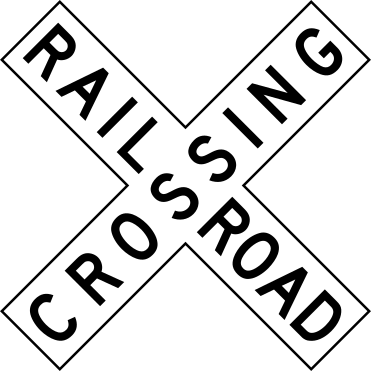
- A school crossing
- A railroad crossing
- A four-way intersection
- A no-passing zone
Show answer
A railroad crossing. The crossbuck is the railroad-crossing marker. It tells a driver that tracks cross the roadway, so the driver should search in both directions and be prepared to stop. A school crossing uses a pentagon-shaped warning sign, a crossroad uses a diamond warning sign, and a no-passing zone uses a pennant on the left side. When a crossbuck is visible, do not treat the X as a general intersection symbol. Look for additional tracks, signals, gates, and trains.
Study this in the handbook: Sign colors, shapes and regulatory signs
15. What is the additional fine for speeding in a Minnesota work zone?
- $1,000 instead of any regular speeding ticket
- $50 in addition to the regular speeding ticket
- $300 in addition to the regular speeding ticket
- No additional fine when workers are not visible
Show answer
$300 in addition to the regular speeding ticket. Minnesota adds a $300 fine to the regular speeding ticket when a driver disobeys the speed limit in a work zone. The extra penalty applies because workers and equipment may be close to moving traffic, even when a worker is not immediately visible. The $50 and $1,000 figures are not the stated work-zone addition, and the absence of visible workers does not remove the obligation to obey the posted limit. The cue is the work-zone setting and its signs: slow down, watch for altered lanes, and follow the posted restriction throughout the zone.
Study this in the handbook: Commercial vehicles, railroad crossings and work zones
16. What does the number on a Minnesota speed-limit sign represent?
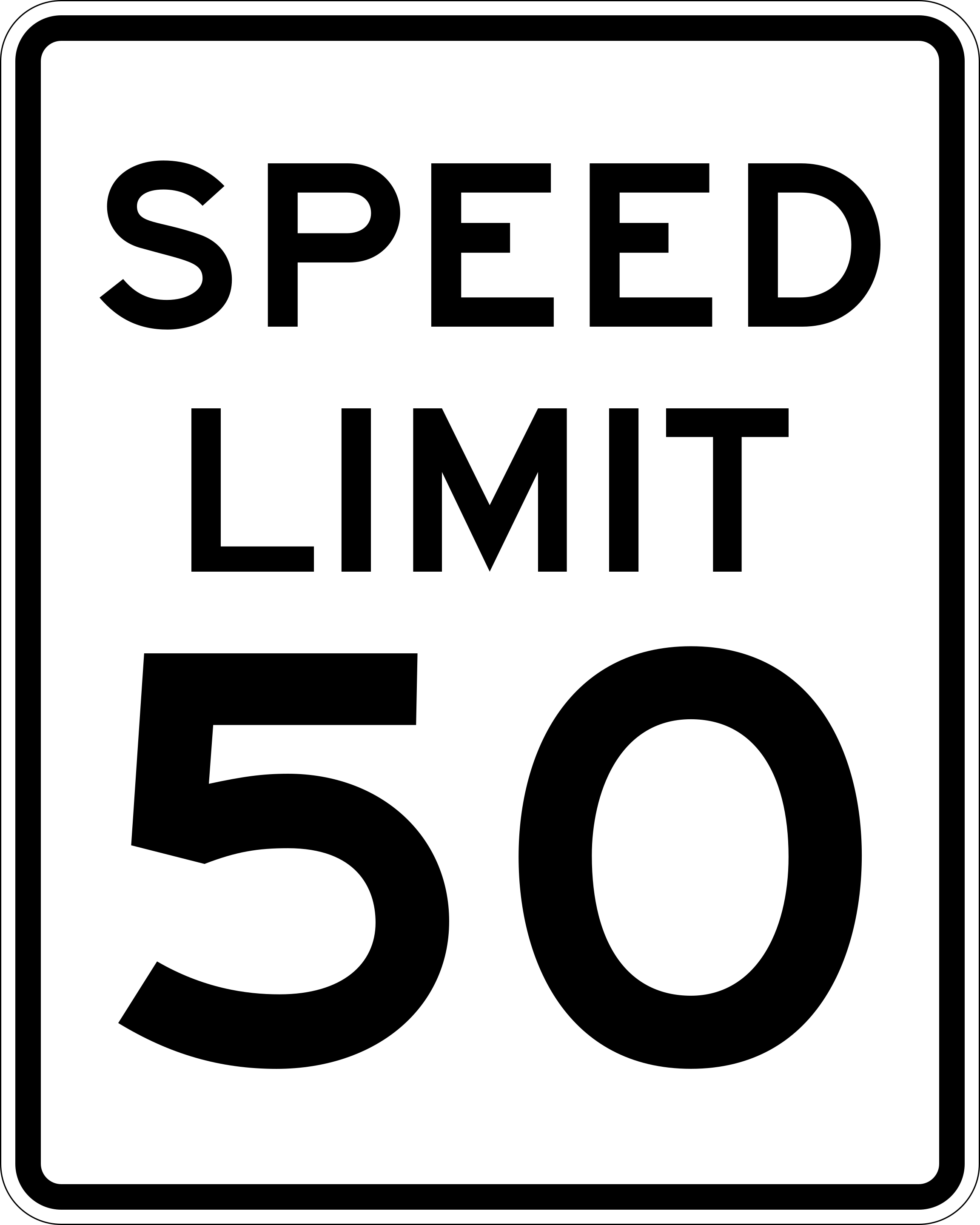
- The maximum speed you may drive on that road
- The minimum speed required in all weather
- A suggested speed that may be exceeded when traffic is light
- The speed reserved for commercial vehicles
Show answer
The maximum speed you may drive on that road. The posted number is the maximum lawful speed for that road under ordinary conditions. It is not merely advice, and it does not become a minimum just because traffic is moving quickly. A driver may need to travel below that maximum when weather, visibility, pavement, or traffic makes the posted speed unsafe. The commercial-vehicle choice invents a vehicle-specific rule that the sign does not show. Use the number as an upper boundary, then reduce speed whenever conditions require more control.
Study this in the handbook: Sign colors, shapes and regulatory signs
17. What must window tint applied to Minnesota side or rear windows after August 1, 1985 show?
- The percentage of light transmitted and reflected
- The installer's name
- The date of application
- Nothing, tint is unregulated
Show answer
The percentage of light transmitted and reflected. Any window tint applied to the side or rear windows after August 1, 1985 must show the percentage of light transmitted and reflected. If the tint transmits less than 50 percent or reflects more than 20 percent of available light, the manual says it can be used only on the rear window of a pickup truck or on the rear and side windows of a van, limousine, or vehicle used by a funeral home. The installer's name or a date is not the marking the rule names, and tint is regulated.
Study this in the handbook: Seat belts, child seats, airbags and window rules
18. How should you position your vehicle after seeing this divided-highway warning?

- Drive left of the center island to keep the shortest route
- Stay to the right as the road divides
- Use either side because opposing traffic remains together
- Turn around before reaching the divider
Show answer
Stay to the right as the road divides. A divided-highway-begins warning means the roadway will separate around a center island or median. Stay to the right so your vehicle follows the proper side of the divided road. Driving left of the island can place you in opposing traffic, and the roadway is not offering free choice between directions. Turning around is neither required nor a safe response. As the divider approaches, reduce speed if needed, follow the lane arrows, and watch for the physical separation that confirms the intended path.
19. By how much does the zipper merge reduce traffic backups, according to the Minnesota manual?
- Up to 40 percent
- About 5 percent
- It lengthens backups
- About 90 percent
Show answer
Up to 40 percent. The zipper merge means staying in your current lane until the point of merge when a lane closes and traffic is backing up, then taking turns with other drivers. The manual says it reduces the overall length of traffic backups by up to 40 percent, reduces speed differences between lanes, eases congestion at freeway interchanges, increases worker safety, and reduces road rage. Early merging, by contrast, leads to longer backups, more crashes and road rage incidents.
Study this in the handbook: Commercial vehicles, railroad crossings and work zones
20. A Minnesota instruction permit holder is 19. How old must the supervising driver be?
- 18 or older
- 21 or older
- 25 or older
- Any licensed driver, at any age
Show answer
18 or older. The supervision age depends on the learner's age. A permit holder who is 18 or older must be supervised by a driver aged 18 or older, while a permit holder under 18 needs a supervisor 21 or older. Twenty-five is tied to the provisional license night rule. A supervisor of any age is too loose, since the handbook sets 18 as the floor. Everyone in the vehicle still must wear a seat belt or use a child restraint.
Study this in the handbook: The instruction permit and provisional license
QualitySpace is expanding to Minnesota
We are a California-based independent insurance brokerage working on licensing in more states. We cannot help with Minnesota insurance yet. Leave your email and we will let you know when we can.
Every question is written from the official Minnesota Driver's Manual. Need paper? Printable MN practice test with answer key.
Last verified 2026-10-05. How we check every question · Study all 208 as flashcards
Frequently asked questions
How many questions are on this Minnesota practice test?
This fixed set has 20 questions. It is test 4 of 10 from the 208 question Minnesota bank.
How does this fixed test relate to the full Minnesota bank?
Each numbered test is a fixed set of questions in a fixed order, so you can retake the same test later and compare. Every test mixes road signs and the other topics in about the same proportion as the full bank. Tests 1 to 10 together cover 200 of the 208 questions in the Minnesota bank, each once. The full practice page mixes the whole bank at random.
Last verified 2026-10-05. See the Minnesota DMV facts page for sourced state details.
Return to the full Minnesota practice test · Study road signs