
Test 18 of 25 · 20 questions · Free 2026
MN Permit Practice Test 18
Jump to the test ↓A fixed 20 question set from the Minnesota bank with answers and plain English explanations.
Question 1 of 20 · 0 right so far
All 20 questions in test 18
Every question below comes from the Minnesota question bank on this page. Open a question to see the correct answer and the explanation. Nothing here is hidden behind a signup.
1. An emergency vehicle with lights and siren comes up behind you on the freeway. What should you avoid?
- Using your turn signal
- Moving to the nearest side
- Slamming the brakes or swerving
- Staying stopped until it passes
Show answer
Slamming the brakes or swerving. If flashing lights and a siren come up from behind on the freeway, move to the nearest side of the road and stop. Do not slam on the brakes or swerve into other lanes, which could cause a crash or block the emergency vehicle. Use your turn signal so others know what you are doing, and remain stopped until the emergency vehicle has completely passed. The other three choices are all things you should do.
Study this in the handbook: Following distance, night driving and freeways
2. When turning left, which approaching vehicles must a Minnesota driver yield to?
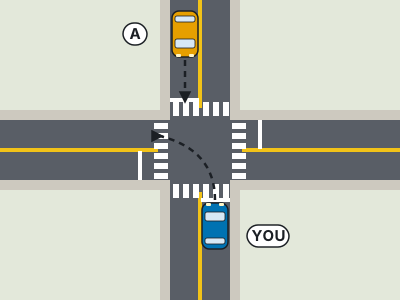
- Vehicles from the opposite direction that are in or close enough to the intersection to pose a crash risk
- Only vehicles already stopped in the intersection
- Only oncoming vehicles that are signaling left
- No vehicles, because the turning driver entered first
Show answer
Vehicles from the opposite direction that are in or close enough to the intersection to pose a crash risk. A left-turning driver must yield to vehicles approaching from the opposite direction when they are in the intersection or close enough to pose a risk of a crash. The rule is broader than waiting for an oncoming vehicle to stop, and it does not depend on that driver's turn signal. Entering first does not remove the duty to yield. Before crossing the opposing lane, judge both distance and speed, then wait whenever the approaching vehicle could create a collision risk.
Study this in the handbook: Right of way and yielding
3. You are about to turn left into a driveway from a road with a center left-turn lane. An oncoming driver moves into the same lane. What should you know?
- Drivers from both directions may use it to turn left
- Only you may use it, since you entered first
- It is for passing slow traffic
- It is reserved for buses
Show answer
Drivers from both directions may use it to turn left. A center left-turn lane may be used by vehicles traveling in either direction to make left turns onto another roadway or a driveway. That means an oncoming driver may enter the same lane to turn, so move in early, watch ahead, and do not drive long distances in it. It is not a passing lane, and it is not reserved for buses. Entering first does not give you ownership of the whole lane.
Study this in the handbook: Lines and lane markings
4. You are following a semi truck at night. Why should you dim your headlights?
- Truck taillights are too bright to look at
- It saves your battery
- Trucks have no rear window
- Its big mirrors reflect light at the driver
Show answer
Its big mirrors reflect light at the driver. Commercial vehicles have large side mirrors that can reflect your headlights straight into the driver's eyes. When following one at night, always dim your headlights so you do not blind the driver. Low beams also help you see the road without glare. Bright taillights and battery use have nothing to do with the rule. Trucks may lack a rear window, but the danger comes from light bouncing off the side mirrors.
Study this in the handbook: Commercial vehicles, railroad crossings and work zones
5. When is it safe to pass a working snowplow?
- Whenever it slows below 30 mph
- On the right shoulder where it is clear
- Only when you can see the entire plow
- As soon as its blue lights flash
Show answer
Only when you can see the entire plow. Never crowd a snowplow, and pass one only when you can see the entire vehicle. Plows throw up clouds of snow that can hide the road, other cars, and the plow itself, so a pass into a cloud is a blind pass. The plow's speed does not make passing safe, and the shoulder is not a passing lane. Flashing white, yellow, and blue lights warn you that a plow is working; they are not a signal to pass.
6. You are stranded in extreme cold with the engine idling now and then. What should you do with the windows?
- Keep every window shut tight
- Leave at least one partly open
- Open all of them fully
- Cover them with snow to insulate
Show answer
Leave at least one partly open. Even in extremely cold weather, leave at least one window partly open to let in fresh air. People in an idling vehicle can suffer carbon monoxide poisoning if there is not enough ventilation, and the gas has no smell or color. Sealing every window traps the gas inside. Opening them all lets out the heat you need. Packing snow around the car can also block the exhaust pipe, which must be kept clear.
Study this in the handbook: Distraction, aggression, winter driving and skids
7. After parallel parking, your curbside wheels sit about 2 feet from the curb. What does the manual say?
- That is too far; the limit is 12 inches
- That is fine; the limit is 3 feet
- That is fine; there is no distance limit
- That is too far; the limit is 6 inches
Show answer
That is too far; the limit is 12 inches. Minnesota says that when you parallel park, the wheels closest to the side of the road should be no more than 12 inches from the curb. Two feet is 24 inches, which is twice that limit. After parking, turn the front wheels toward the curb or shoulder, place the vehicle in park, and engage the parking brake. The manual does not allow 3 feet, does not leave the distance open, and does not set the limit at 6 inches.
Study this in the handbook: Passing, backing up and parking
8. You have been drinking at a party. Which choice does Minnesota's manual list as an alternative to driving impaired?
- Drive on quiet back roads and keep your speed low
- Wait one hour per drink you had, then drive
- Drink a cup of coffee, then drive home slowly
- Call a taxi, a rideshare service, or someone you know
Show answer
Call a taxi, a rideshare service, or someone you know. Minnesota lists several alternatives to driving impaired: designate a driver who will not drink, call a taxi or rideshare service, call a friend or family member for a ride, stay overnight at a friend's house, or take away the keys from an impaired friend. Slow driving on quiet roads is still driving impaired. Waiting an hour per drink is not offered as a safe plan, and coffee does not speed up how fast the body clears alcohol.
Study this in the handbook: How alcohol affects you and the DWI law
9. Your friend has been drinking and insists on driving home. Which step does Minnesota list as an alternative?
- Follow behind to keep watch
- Let them drive slowly on side streets
- Give them coffee before they leave
- Take away their keys
Show answer
Take away their keys. Minnesota lists several alternatives to driving impaired: designate a driver who will not drink, call a taxi or rideshare, call a friend or family member for a ride, stay overnight at a friend's house, and take away the keys from a friend who is impaired. Coffee does not lower alcohol concentration; only time does. Side streets and slow speeds do not make impaired driving safe or legal, and following behind does not stop a crash.
Study this in the handbook: How alcohol affects you and the DWI law
10. A yellow diamond sign shows your road running straight into a crossing road, forming a T. What should you prepare to do?
- Continue straight through
- Merge with traffic on your right
- Turn right or left and yield
- Expect a railroad crossing
Show answer
Turn right or left and yield. The T-intersection sign warns that the road you are on will end soon. Prepare to turn right or left, and yield to cross traffic on the road you are joining. You cannot continue straight because the road stops at the crossbar of the T. A merge sign shows two roads joining side by side, and railroad crossings use the round yellow sign or the X-shaped crossbuck.
Study this in the handbook: Warning, school, construction and guide signs
11. You are about to turn onto a freeway ramp and see this sign facing you. What does it tell you?

- Enter it as long as traffic is light
- Yield to ramp traffic before entering
- Do not enter; that way is closed to you
- Trucks may not use this ramp at all
Show answer
Do not enter; that way is closed to you. This sign means do not enter that lane or road when the sign is facing you. Seeing it at a ramp usually means you are at the wrong end, such as the bottom of an exit ramp, where traffic will come toward you. Turn away and find the correct entrance. Light traffic does not make it safe. A yield sign has a triangle shape, and truck restrictions use different signs.
Study this in the handbook: Sign colors, shapes and regulatory signs
12. You realize too late that your lane is marked with a left arrow and the word ONLY, but you wanted to go straight. What must you do?
- Go straight if no one is beside you
- Turn left as the lane requires
- Stop and wait to change lanes
- Cross the solid line into the next lane
Show answer
Turn left as the lane requires. White arrows, sometimes with the word ONLY, mean drivers must stay in the designated lane while turning onto the cross street. If you are in that lane, you must turn. Going straight from a turn-only lane surprises other drivers and can cause a crash. Turn lanes are separated from through lanes by solid white lines to discourage last-second lane changes. Make the turn, then find another route back.
Study this in the handbook: Lines and lane markings
13. You are driving a long motor home on a dry, clear day. What following count should you use?
- Two seconds
- Three seconds, as for cars
- Four or five seconds
- One second per 10 mph
Show answer
Four or five seconds. The three-second rule is meant for standard-length vehicles in ideal conditions. Minnesota says to increase your following distance to a four- or five-second count when road conditions are poor or when you drive a vehicle longer than standard length. A long motor home needs that extra time even on a dry day, because it takes longer to stop. Two seconds is too short, and the one-second-per-10-mph idea is not Minnesota's rule.
Study this in the handbook: Following distance, night driving and freeways
14. Without a seat belt, how low can a crash speed be and still kill you, according to Minnesota's manual?
- As low as 25 mph
- As low as 45 mph
- As low as 35 mph
- As low as 12 mph
Show answer
As low as 12 mph. The manual warns that an unbelted person can be killed in a crash at speeds as low as 12 mph. Many people believe slow city driving is safe enough to skip the belt, but even a parking lot speed can throw you into the dashboard or windshield. Twenty-five, thirty-five, and forty-five mph are all higher than the figure Minnesota gives. Buckle up for every trip, no matter how short or slow.
Study this in the handbook: Seat belts, child seats, airbags and window rules
15. Can two Minnesota drivers be guilty of racing if neither one goes over the speed limit?
- Yes, racing is about contesting speeds
- No, racing requires going over the limit
- Only if they reach 20 mph over
- Only on a closed track
Show answer
Yes, racing is about contesting speeds. Minnesota defines racing as intentionally comparing or contesting relative speeds with one or more vehicles, whether or not anyone exceeds the speed limit. Racing is listed as a form of reckless driving, which means knowingly ignoring a serious risk to others. So two cars dragging away from a light at legal speeds can still be racing. The 20 mph figure relates to extra speeding fines, not the racing definition, and a closed track is not a public road.
Study this in the handbook: Emergency vehicles, the Move Over Law and traffic stops
16. A line of children is crossing the road, but no safety patrol or crossing guard is there. What does Minnesota law say?
- You may go between them if you slow down
- You may not drive through the line
- Without a patrol, the children must yield
- You may pass if none are in your lane
Show answer
You may not drive through the line. It is illegal to drive through a line of children crossing the road, even when no school safety patrol is present. Children may not watch traffic carefully, and a gap in the line does not mean the crossing is over. The absence of a guard does not shift the duty to the children. Wait until the whole group has crossed. A violation is a misdemeanor, and a second one within a year is a gross misdemeanor.
Study this in the handbook: Right of way and yielding
17. What does this orange work zone sign tell you?
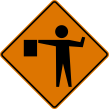
- A person with a flag is ahead
- The road is closed ahead
- A detour starts at the next turn
- The work zone ends here
Show answer
A person with a flag is ahead. This orange sign warns that a person with a flag is ahead, so drive cautiously and be ready to stop. Flaggers direct traffic around work, and you must always follow their directions. Failing to obey a flag person in a work zone results in a violation and a fine. A road closure, a detour, and the end of a work zone each use different signs with words or arrows rather than a person holding a flag.
Study this in the handbook: Warning, school, construction and guide signs
18. You are circling in a roundabout when an ambulance with lights and siren comes up. What should you do?
- Stop right where you are in the circle
- Exit the roundabout, then pull over
- Pull onto the center island
- Keep circling until it is gone
Show answer
Exit the roundabout, then pull over. Minnesota says that if an emergency vehicle approaches while you are in a roundabout, you leave the roundabout right away and then pull over. Stopping inside the circle blocks the very lane the ambulance may need. Driving onto the center island is unsafe and may trap you. Circling around and around keeps you in its path. Getting out at the next exit and then moving to the side gives the emergency vehicle a clear route.
Study this in the handbook: Signaling, turns, roundabouts and U turns
19. When does Minnesota allow a left turn on a steady red light?
- From a two-way road onto a one-way street
- From a one-way road onto a one-way street
- From any road once oncoming traffic clears
- Never; left turns on red are always illegal
Show answer
From a one-way road onto a one-way street. A left turn on red is allowed in Minnesota only from a one-way road onto a one-way cross street, and only when the listed conditions are met. You must come to a complete stop, make sure the intersection is clear, and yield to people and vehicles. Some states also allow a left on red from a two-way road onto a one-way street, but Minnesota's rule does not include that case. Saying it is never legal is also wrong, and a clear road alone does not make it legal.
Study this in the handbook: Traffic signals, lane use signals and ramp meters
20. You are leaving a freeway. Where should you do most of your slowing down?
- In the right travel lane
- On the shoulder before the ramp
- In the left lane before crossing over
- In the deceleration lane
Show answer
In the deceleration lane. As you near your exit, signal, move into the deceleration lane when it is safe, and slow down there. This gives you room to lose speed before the exit ramp without blocking faster traffic on the freeway. Braking hard in a travel lane can cause a rear-end crash. The shoulder is not a slowing lane, and waiting in the left lane means a late, dangerous cut across traffic. If you miss your exit, go on to the next one.
Study this in the handbook: Distraction, aggression, winter driving and skids
Every question is written from the official Minnesota Driver's Manual. Need paper? Printable MN practice test with answer key.
Last verified 2026-10-05. How we check every question · Study all 500 as flashcards
Frequently asked questions
How many questions are on this Minnesota practice test?
This fixed set has 20 questions. It is test 18 of 25 from the 500 question Minnesota bank.
How does this fixed test relate to the full Minnesota bank?
Each numbered test is a fixed set of questions in a fixed order, so you can retake the same test later and compare. Every test mixes road signs and the other topics in about the same proportion as the full bank. Tests 1 to 25 together cover every question in the Minnesota bank once. The full practice page mixes the whole bank at random.
Last verified 2026-10-05. See the Minnesota DMV facts page for sourced state details.
Return to the full Minnesota practice test · Study road signs