
Test 8 of 10 · 20 questions · Free 2026
MN Permit Practice Test 8
Jump to the test ↓A fixed 20 question set from the Minnesota bank with answers and plain English explanations.
Question 1 of 20 · 0 right so far
All 20 questions in test 8
Every question below comes from the Minnesota question bank on this page. Open a question to see the correct answer and the explanation. Nothing here is hidden behind a signup.
1. What right-of-way consequence follows when a driver approaches a Minnesota intersection at an unlawful speed?
- The driver loses the privilege associated with lawful speed
- The driver gains priority over vehicles traveling legally
- The driver may disregard all yielding rules
- The driver keeps every right-of-way privilege unchanged
Show answer
The driver loses the privilege associated with lawful speed. A driver who approaches an intersection at an unlawful speed loses the right-of-way privilege that would have been associated with driving lawfully. Speeding does not create priority, erase yielding duties, or preserve the same privilege. The rule links right-of-way to lawful conduct, so a driver cannot use another vehicle's expected yield as protection for an illegal approach. Reduce speed before the intersection and be prepared to yield rather than trying to claim priority after speeding.
Study this in the handbook: Speed limits and the basic speed law
2. After two consecutive failures of the Minnesota written test, what applies to the third and later attempts?
- A $10 fee is charged
- A six-month testing ban begins
- The applicant must take a road test instead
- The applicant permanently loses testing eligibility
Show answer
A $10 fee is charged. Minnesota charges a $10 fee for the third written-test attempt and every subsequent attempt after two consecutive failures. The manual does not impose a six-month ban, replace the written test with a road test, or end eligibility permanently. The key sequence is two consecutive failures followed by the fee on attempt three and beyond. Track consecutive results carefully, because this consequence is tied to that sequence rather than to one isolated unsuccessful test.
Study this in the handbook: The written test, vision screening and road test
3. When may a Minnesota driver use hand and arm signals instead of the vehicle's turn signals?
- At night whenever the road has streetlights
- During daylight hours, when the hand signal can be seen
- Only while driving on a freeway
- Any time the vehicle's signal bulbs work
Show answer
During daylight hours, when the hand signal can be seen. Minnesota permits hand and arm signals during daylight, either in addition to or instead of the vehicle's turn signals. The permission has limits: hand signals should not be used at night or when the vehicle blocks other drivers from seeing the driver’s hand. Streetlights do not change the night restriction, and the rule is not limited to freeways. A working signal bulb does not make hand signals universally acceptable. Use the vehicle signal whenever practical, and reserve a visible arm signal for a daylight situation in which other road users can actually see it.
Study this in the handbook: Signaling, turns, roundabouts and U turns
4. When must Minnesota drivers turn on their headlights?
- Only after midnight on roads outside cities
- At sunset until sunrise, and during listed weather or visibility conditions
- Only while driving in snow
- Only when another driver flashes headlights first
Show answer
At sunset until sunrise, and during listed weather or visibility conditions. Minnesota requires headlights from sunset through sunrise, but the obligation also covers rain, snow, hail, sleet, fog, and any time the road ahead cannot be clearly seen for at least 500 feet. Restricting the rule to snow misses several weather conditions and poor-visibility situations. The nighttime window begins at sunset, not midnight, and it does not depend on another driver’s behavior. Use both time and visibility as the check: if darkness or weather reduces what you can see, switch the lights on.
Study this in the handbook: Following distance, night driving and freeways
5. When a school zone warning sign is present, what should a driver be prepared to do?
- Stop only if a crossing guard is holding a sign
- Accelerate before children reach the crosswalk
- Watch for children and be prepared to stop
- Treat the area as a railroad crossing
Show answer
Watch for children and be prepared to stop. The school zone warning tells drivers to watch for children and be prepared to stop. The warning does not invite acceleration, and a crossing guard is not required before a driver needs to respond to children or a crosswalk. A railroad crossing has different warnings and hazards. The pentagon shape and yellow or fluorescent yellow-green color help identify the school-related warning, but the important driving response is active scanning and readiness to stop. Reduce speed as needed, look for young pedestrians near the roadway, and yield when the crossing rules require it.
Study this in the handbook: Warning, school, construction and guide signs
6. What does Minnesota's fast track license service cost, and how quickly is the card processed?
- Free, same day
- $5, within 30 days
- $100, within one day
- An additional $20, processed within three business days
Show answer
An additional $20, processed within three business days. You can fast track your driver's license or state ID card for an additional fee of $20. Fast tracked cards are processed within three business days and should arrive by UPS within 10 business days, and an adult must sign for the card. The manual also limits the service: it is not available for a first application, for enhanced licenses and ID cards, or when upgrading a license.
7. A Minnesota driver's license is canceled as inimical to public safety. How long must the driver stay in the Ignition Interlock Device Program to regain full privileges?
- 90 days
- 12 months
- Ten years
- Three to six years
Show answer
Three to six years. Drivers whose licenses are canceled and whose privileges are denied as inimical to public safety are required to enroll in the Ignition Interlock Device Program for a period of three to six years to regain full driving privileges. Ninety days and one year are revocation minimums for first and second DWI offenses. Ten years is the look-back window for counting DWI offenses, not an interlock term.
Study this in the handbook: How alcohol affects you and the DWI law
8. How should you approach the crossing shown by this pedestrian warning sign?

- Maintain speed because pedestrians must always wait
- Slow down and be prepared to stop for pedestrians
- Sound the horn so pedestrians leave the roadway
- Stop only at a marked crosswalk with painted lines
Show answer
Slow down and be prepared to stop for pedestrians. A pedestrian crossing warning calls for slower, more attentive driving. Be prepared to stop and yield to pedestrians at intersections and crosswalks. Pedestrians do not lose their protection merely because the pavement lacks bright paint, and using the horn as a command can startle someone. Maintaining speed removes the time needed to react. The concrete cue is to scan beyond parked vehicles and toward both edges of the road, then stop before the crosswalk if a person is crossing.
Study this in the handbook: Warning, school, construction and guide signs
9. What does the five-sided fluorescent sign warn you about?

- A school or approved school crosswalk ahead
- A railroad crossing with multiple tracks
- A hospital entrance on the next block
- A lane reserved for vehicles with two occupants
Show answer
A school or approved school crosswalk ahead. The pentagon shape and fluorescent yellow-green color identify a school-area warning. The driver should watch for children and be prepared to stop near the school or approved crosswalk. A railroad crossing is identified by a crossbuck and related markings, hospitals use service signs, and a high-occupancy lane uses a diamond symbol. The shape is a useful first check when the wording is difficult to read. Once recognized, scan sidewalks, driveways, and the crosswalk for children who may enter unexpectedly.
Study this in the handbook: Warning, school, construction and guide signs
10. What proof is required for a veteran designation on a Minnesota license?
- A letter from a commanding officer
- Any military ID
- Proof of at least 181 days of active service with an Honorable or General under Honorable conditions discharge
- Proof of reserve enlistment only
Show answer
Proof of at least 181 days of active service with an Honorable or General under Honorable conditions discharge. To add the veteran indicator to a Minnesota license or ID card you must be separated from the military and provide proof of veteran status showing at least 181 total days of active military service with either an Honorable or General (under Honorable conditions) discharge. People who retired from the National Guard or Reserve and veterans of the Secret War in Laos are also eligible. The indicator is optional and does not give or prevent VA benefits.
11. A stopped school bus is displaying flashing red lights. When may traffic that is required to stop begin moving?
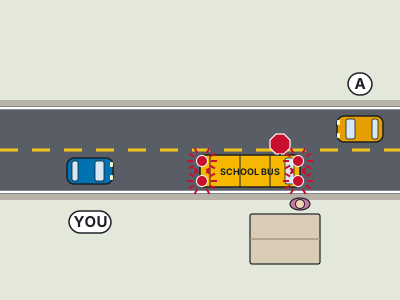
- Immediately after stopping for one second
- As soon as the bus door closes
- When no children are visible, even if the lights continue
- After the red lights stop flashing and the roadway is safe
Show answer
After the red lights stop flashing and the roadway is safe. A vehicle subject to the school bus stop must remain stationary while the red lights flash. Movement may resume only after those lights stop flashing and the roadway is safe. A closed bus door does not release traffic, and the absence of visible children does not cancel the signal. Stopping for one second is not a substitute for waiting through the warning period. Watch the bus lights, then check for students, pedestrians, and other traffic before moving. On a divided highway, the manual provides a separate exception for opposite-direction traffic, but that does not change this duty for vehicles required to stop.
Study this in the handbook: Stop rules, school buses and fleeing police
12. What does a double solid yellow center line prohibit?
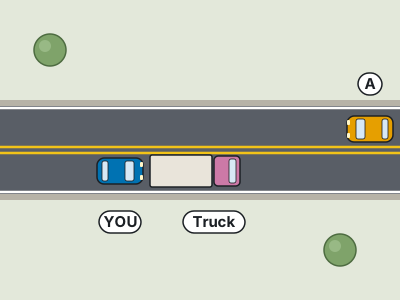
- Turning into a driveway at any time
- Passing from either direction
- Driving during daylight hours
- Using the lane on the right
Show answer
Passing from either direction. Double solid yellow lines separate opposing traffic and prohibit passing regardless of which side of the roadway you occupy. The marking is not a general ban on driving, and it does not mean that every turn into a driveway is automatically forbidden. It specifically removes passing as an option for both directions. Watch for a permitted turn location and obey any additional signs or markings before crossing the center area. The visual cue is two continuous yellow lines, which means opposing traffic is separated and neither direction may cross to overtake.
Study this in the handbook: Passing, backing up and parking
13. At a stop sign, how long must you remain stopped before proceeding?
- Until pedestrians and vehicles with the right of way have cleared the intersection
- Only until your vehicle’s front wheels reach the crosswalk
- Until the driver behind you honks
- Only long enough to check traffic on the left
Show answer
Until pedestrians and vehicles with the right of way have cleared the intersection. A stop sign requires a complete stop and continued waiting until road users with the right of way have cleared. If there is a marked stop line, stop before it, and if there is a pedestrian crosswalk, stop before entering it. The choice about reaching the crosswalk reverses the safety boundary, while a horn from behind has no legal effect. Look in every relevant direction and yield before moving. The cue is stop before the line or crosswalk, wait for priority users to clear, then proceed with caution.
Study this in the handbook: Sign colors, shapes and regulatory signs
14. What defines a commercial vehicle in Minnesota?
- Any vehicle used for business
- Any vehicle with a trailer
- Any vehicle over 10,000 pounds
- A vehicle or combination weighing more than 26,000 pounds used to transport passengers or property
Show answer
A vehicle or combination weighing more than 26,000 pounds used to transport passengers or property. A commercial vehicle is a motor vehicle or combination of motor vehicles that weighs more than 26,000 pounds and is used to transport passengers or property. Commercial vehicles need more stopping distance than cars, have large blind spots, and may use speed limiters. Give them room, pass promptly, and never linger beside a truck or cut in front of one.
Study this in the handbook: Commercial vehicles, railroad crossings and work zones
15. If your vehicle has anti-lock brakes, what should you do during hard braking?
- Pump the brake pedal rapidly
- Use only the emergency brake
- Press the brake pedal and continue steering
- Shift into reverse before braking
Show answer
Press the brake pedal and continue steering. Anti-lock brakes are an electronic system that helps keep the vehicle under control while braking. The manual says not to pump them as you would regular brakes; instead, press down on the brake pedal and continue to steer the vehicle until you regain control. The emergency brake is not a substitute for that technique, and shifting into reverse is not part of it. If you are not sure whether your vehicle has anti-lock brakes, the manual says to read the owner's manual for specific instructions before you drive.
Study this in the handbook: Distraction, aggression, winter driving and skids
16. When emergency lights appear behind you, where should you pull over if it can be done safely?
- Onto a bridge or around a curve
- Into the center of the roadway
- To the right shoulder as soon as possible
- Directly in front of the emergency vehicle
Show answer
To the right shoulder as soon as possible. When emergency lights are behind the vehicle, Minnesota advises slowing down, activating the turn signal, and pulling to the right shoulder as soon as safely possible. A driver on a multilane road who is closer to the left shoulder may use that side if there is a full lane available for parking. Avoid stopping on a bridge, curve, or in a traffic lane because those locations restrict visibility and emergency access. The goal is a visible, stable position outside the moving path. Signal early, check the shoulder, and stop only where the vehicle can remain clear of traffic.
Study this in the handbook: Emergency vehicles, the Move Over Law and traffic stops
17. When an intersection signal flashes yellow, what is the driver expected to do?
- A complete stop before every movement
- Caution, with careful movement and yielding when required
- Immediate acceleration through the crossing
- A protected turn with no need to check traffic
Show answer
Caution, with careful movement and yielding when required. Flashing yellow tells a driver to treat the intersection cautiously. Movement is allowed, but it is not protected from every conflict. Vehicles and pedestrians already in the intersection retain priority, and a left turn or U-turn must yield to a nearby oncoming vehicle that creates an immediate hazard. The stop-only choice describes a red condition, while acceleration would defeat the warning. Enter slowly enough to identify conflicts, then continue only after the path is safe and any required yielding is complete.
Study this in the handbook: Traffic signals, lane use signals and ramp meters
18. When must a driver stop for a school bus with flashing red lights?
- Only when the bus is on an undivided highway
- Only when the stop arm swings out and traffic is behind the bus
- Even when the stop arm does not swing out
- Only when children are visible in the roadway
Show answer
Even when the stop arm does not swing out. Minnesota requires a driver to stop for flashing red school bus lights even if the stop arm does not swing out. The arm is an additional warning device, not a condition that must appear before the stopping rule applies. Whether children are visible does not matter either, because the flashing red lights mean the bus is loading or unloading students. Stop at least 20 feet from the bus. The only exception is on a divided highway when you are traveling in the opposite direction.
Study this in the handbook: Stop rules, school buses and fleeing police
19. A Minnesota driver with a revoked license receives a limited license. What trips does it allow?
- Any trip during daylight hours
- Travel to and from work, chemical dependency treatment, or a post-secondary school, and transporting dependents for listed needs
- Only trips to the grocery store
- Any trip with a licensed passenger
Show answer
Travel to and from work, chemical dependency treatment, or a post-secondary school, and transporting dependents for listed needs. A limited license may be issued after a revocation or suspension once requirements like mandatory waiting periods are met. It restricts the driver to travel to and from work, to and from chemical dependency treatment or counseling, to and from a post-secondary school where enrolled, and transporting dependent children and household dependents for medical, educational or nutritional needs. General daylight driving and driving with any passenger are not allowed. Grocery trips alone are not the stated list.
20. A Minnesota provisional license holder has the license revoked for an alcohol violation. When can a license be regained?
- After 30 days, regardless of age
- At age 21
- After passing a new written test the next day
- At age 18 or the end of the withdrawal period, whichever is longer
Show answer
At age 18 or the end of the withdrawal period, whichever is longer. For a provisional license holder whose privilege is revoked because of a crash-related moving violation or an alcohol or controlled substance violation, Vanessa's Law says the license cannot be regained until age 18 or until the withdrawal period is over, whichever is longer. Thirty days ignores both conditions. Age 21 is not the rule. A written test is part of reinstatement, but passing it does not shorten the wait.
Study this in the handbook: Provisional license limits, Vanessa's Law and the under 21 license
QualitySpace is expanding to Minnesota
We are a California-based independent insurance brokerage working on licensing in more states. We cannot help with Minnesota insurance yet. Leave your email and we will let you know when we can.
Every question is written from the official Minnesota Driver's Manual. Need paper? Printable MN practice test with answer key.
Last verified 2026-10-05. How we check every question · Study all 208 as flashcards
Frequently asked questions
How many questions are on this Minnesota practice test?
This fixed set has 20 questions. It is test 8 of 10 from the 208 question Minnesota bank.
How does this fixed test relate to the full Minnesota bank?
Each numbered test is a fixed set of questions in a fixed order, so you can retake the same test later and compare. Every test mixes road signs and the other topics in about the same proportion as the full bank. Tests 1 to 10 together cover 200 of the 208 questions in the Minnesota bank, each once. The full practice page mixes the whole bank at random.
Last verified 2026-10-05. See the Minnesota DMV facts page for sourced state details.
Return to the full Minnesota practice test · Study road signs