
Test 14 of 25 · 20 questions · Free 2026
MN Permit Practice Test 14
Jump to the test ↓A fixed 20 question set from the Minnesota bank with answers and plain English explanations.
Question 1 of 20 · 0 right so far
All 20 questions in test 14
Every question below comes from the Minnesota question bank on this page. Open a question to see the correct answer and the explanation. Nothing here is hidden behind a signup.
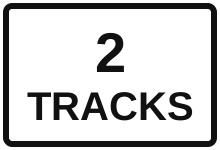
1. This sign is mounted below a railroad crossbuck. After one train passes, what does it warn you to check?
- That the crossing gates have risen all the way up
- That another train is not coming on another track
- That the passing train has finished ringing its bell
- That the lights have stopped flashing
Show answer
That another train is not coming on another track. An X-shaped crossbuck marks a railroad crossing. If there is more than one track, a sign below the crossbuck shows the number of tracks. That matters most after a train passes: a second train may be coming on another track, hidden behind the first. Do not cross until you are sure no other train is approaching. Gates rising and bells stopping do not by themselves prove the crossing is clear.
Study this in the handbook: Sign colors, shapes and regulatory signs
2. While driving on a Minnesota freeway, you see a steady red X appear above your lane ahead. What must you do?
- Keep going but slow down
- Move out of that lane; you cannot use it
- Use the lane only to turn left
- Use the lane if traffic is light
Show answer
Move out of that lane; you cannot use it. A steady red X over a lane means you cannot drive in that lane. Usually a steady yellow X appears first, warning you to move over before the red X comes on. Slowing down while staying in the lane is not enough. A flashing yellow X is the signal that allows left turns from a lane, and light traffic never makes a red X lane open. Signal and move safely into a lane with a green arrow.
Study this in the handbook: Traffic signals, lane use signals and ramp meters
3. You have stopped at this sign. A pedestrian is crossing in front of you and a car on the cross street is approaching. When may you go?

- Right after your full stop
- Once the pedestrian is out of your lane
- As soon as you have stopped for 3 seconds
- After the pedestrian and car have cleared
Show answer
After the pedestrian and car have cleared. At a stop sign, come to a complete stop and remain stopped until pedestrians and vehicles with the right of way have cleared the intersection. Then proceed with caution. Stopping alone does not let you go, and neither does counting seconds. The approaching car on the cross street has the right of way too, so waiting only for the pedestrian can put you in its path.
Study this in the handbook: Sign colors, shapes and regulatory signs
4. A front tire blows out at highway speed. When should you begin braking?
- Once the car is back under your control
- Immediately and as hard as you can
- Before the car starts to pull
- Never; just coast to a stop
Show answer
Once the car is back under your control. After a blowout, hold the steering wheel tightly, steer straight ahead, and slowly ease off the gas. Do not brake until the vehicle is back under your control, then pull completely off the road at the nearest safe place. Hard, immediate braking can make the car swerve or spin. You cannot brake before the blowout pulls the car, and you may brake gently once you have control.
Study this in the handbook: Distraction, aggression, winter driving and skids
5. You must stop and park on a state highway or freeway. Where does Minnesota say to put the vehicle?
- Partly in the right lane with hazard lights on
- In the right lane when traffic is light enough
- Away from the main part of the road
- Anywhere, if your headlights stay on
Show answer
Away from the main part of the road. On state highways and freeways, Minnesota requires you to move your parked vehicle away from the main part of the road. If the vehicle cannot be moved, use visible markers or signals to prevent damage and harm to other drivers. At night, the vehicle needs a white or amber front light and a red taillight visible from 500 feet. Staying in a lane, even with hazard lights flashing, leaves the car where traffic is moving.
Study this in the handbook: Seat belts, child seats, airbags and window rules
6. The car ahead of you is slow, and the paved shoulder on the right is empty. May you pass on the shoulder?
- No, passing on the shoulder is not allowed
- Yes, if you signal and keep under the limit
- Yes, but only on a four-lane highway
- Only when the car ahead is turning left
Show answer
No, passing on the shoulder is not allowed. Minnesota allows passing on the right only in limited cases, and even then you may not do it by driving in a bicycle lane, on the shoulder, or off the main part of the road. A shoulder is for emergencies and stopped vehicles, and drivers do not expect traffic there. Signaling or staying under the limit does not make it legal. A four-lane highway lets you pass in a second travel lane, not on the shoulder. Even when the car ahead is turning left, you must stay on the pavement.
Study this in the handbook: Passing, backing up and parking
7. On a wide two-way road, when may you drive left of the right side of the road?
- When the right side is closed for repair
- When the left side has lighter traffic than yours
- When you plan to turn left about a mile ahead
- When you are driving on the road after dark
Show answer
When the right side is closed for repair. On all wide roads you must drive on the right side, with a few exceptions. One is when the right side is closed for construction or repair. Others include passing a vehicle going the same way, roads with three marked lanes, one-way roads, and moving over for a stopped authorized vehicle under the Move Over Law. Less traffic on the left, an upcoming turn far ahead, and darkness are not exceptions.
Study this in the handbook: Speed limits and the basic speed law
8. At night, how should your speed relate to your headlights?
- Match the car ahead, whatever you can see
- Drive at the limit; headlights do not matter
- Slow enough to stop within the lit distance
- Use high beams so you can drive faster
Show answer
Slow enough to stop within the lit distance. You should be able to stop within the distance your headlights light up the road. For most vehicles, that distance is no more than 350 feet on high beam, and less on low beam. If you drive faster than that allows, an object can appear in your lights when it is already too late to stop. Keeping pace with other cars or simply driving the limit ignores what you can actually see.
Study this in the handbook: Following distance, night driving and freeways
9. What reinstatement fee comes with an alcohol-related license revocation in Minnesota?
- $30
- $275
- $1,000
- $680
Show answer
$680. Penalties for an alcohol-related revocation include a $680 reinstatement fee, a new license application, and possibly the Ignition Interlock Device Program. Thirty dollars is the fee after an insurance revocation. Two hundred seventy-five dollars is the extra fine for repeat texting. One thousand dollars is the fine for a first DWI offense or for driving uninsured, not the reinstatement fee. Criminal penalties are added on top of these administrative sanctions.
Study this in the handbook: Implied consent and DWI penalties
10. At a corner with no painted crosswalk, a pedestrian steps off the curb to cross in front of you. What must you do?
- Drive on; only painted crosswalks count
- Honk so the person steps back
- Steer around the person slowly
- Stop and wait until they pass your lane
Show answer
Stop and wait until they pass your lane. Where a road meets a sidewalk, there is a crosswalk even if no lines are painted. If a pedestrian is in a marked or unmarked crosswalk, Minnesota requires you to stop and wait until the person has passed your lane. Painted lines are not what creates the duty. Honking to push someone back, or steering around them, puts the person at risk. Violating pedestrian right-of-way laws is a misdemeanor.
Study this in the handbook: Pedestrians, bicyclists and motorcycles
11. What do shorter, thicker white dashes between traffic lanes mean?
- Passing into opposing traffic is permitted
- The lane is ending
- The lane is reserved for bicycles
- Parking is allowed beside the line
Show answer
The lane is ending. Shorter, thicker white dashes indicate that a lane is ending. They differ from ordinary white dashes that show where a driver can change lanes. White lines separate traffic traveling in the same direction, so this marking does not give permission to pass into opposing traffic. A bicycle lane has its own insignia. Look at the length and thickness of the marks to recognize the ending-lane message.
Study this in the handbook: Lines and lane markings
12. Many motorcycle-car crashes at city intersections happen when a driver does what?
- Changes lanes on a freeway
- Backs out of a parking space
- Turns left in front of an oncoming motorcycle
- Follows a motorcycle too closely at night
Show answer
Turns left in front of an oncoming motorcycle. Crashes at urban intersections are the most common motorcycle-car collisions, and many happen when a driver fails to yield and turns left in front of an oncoming motorcycle. Motorcycles are small, which makes their speed and distance hard to judge. Before turning left, look carefully for motorcycles and assume one may be closer than it seems. Freeway lane changes, backing, and following too closely are risks too, but they are not the pattern the manual describes.
Study this in the handbook: Pedestrians, bicyclists and motorcycles
13. Before making a right turn, where should you position your vehicle?
- In the center of your lane
- In the left lane for a wider turn
- Close to the right curb
- Over the lane line to block bikes
Show answer
Close to the right curb. Minnesota's steps for a right turn are to check traffic behind you, signal, and move close to the right curb. Being near the curb keeps other vehicles from slipping into the gap on your right and makes your intent obvious. Swinging out into the left lane for a wide turn is something large trucks may have to do, not a passenger car. Staying in the middle of the lane or straddling the line leaves room for confusion and conflicts with bicyclists.
14. At a J-turn, you reach the median opening to make your U-turn. What must you do before entering the through lanes?
- Merge at once; traffic yields to you
- Sound your horn and complete the turn
- Use the shoulder to gain speed first
- Yield to oncoming traffic, stopping if needed
Show answer
Yield to oncoming traffic, stopping if needed. The U-turn at a J-turn puts you into lanes where traffic is moving at highway speed. Minnesota requires you to yield to that oncoming traffic and stop if necessary before you enter the through lanes. Through traffic does not have to yield to you. A horn does not give you the right of way, and the shoulder is not an acceleration lane. Wait for a safe gap, then finish the U-turn.
15. A yellow diamond sign shows your road splitting into a Y shape ahead. What should you prepare for?
- Two roads merging into one
- Turning one way or the other
- A road that winds back and forth
- The start of a divided highway
Show answer
Turning one way or the other. The Y-intersection sign means the road ahead splits into two directions. Be prepared for traffic crossing your path and get ready to turn one way or the other, because the road will not continue straight. A merge sign shows two roads joining, which is the opposite. A winding road sign shows a snaking arrow, and a divided highway sign shows lanes separated by an island but continuing ahead.
Study this in the handbook: Warning, school, construction and guide signs
16. A train is in sight and you are unsure you can cross before it arrives. What should you do?
- Cross quickly, since trains slow down at crossings
- Cross only if the road ahead looks clear
- Stop and wait for the train to pass first
- Stop on the tracks until you can judge its speed
Show answer
Stop and wait for the train to pass first. If you feel hesitation about crossing when a train is in sight, Minnesota says to stop and wait for the train to pass before proceeding. A train's distance and speed are hard to judge, especially at night, and trains cannot stop as quickly as motor vehicles. Never race a train to the other side, and never stop on the tracks. A vehicle that gets stuck on the crossing can lead to severe injury or death.
Study this in the handbook: Commercial vehicles, railroad crossings and work zones
17. Traffic is backing up after a lane closed ahead sign. What does Minnesota's zipper merge ask you to do?
- Merge into the open lane right away
- Speed up in the closing lane to pass
- Stop and wait for a gap in the open lane
- Stay in your lane to the merge point, then take turns
Show answer
Stay in your lane to the merge point, then take turns. The zipper merge, or late merge, asks drivers to stay in their current lane until the point of merge when traffic is backing up, and then take turns with other drivers. Merging early leads to longer backups, more crashes, and road rage. Speeding up in the closing lane to cut ahead is not the idea; both lanes move at the same speed and alternate. Stopping in the lane to wait for a gap disrupts the orderly turns.
Study this in the handbook: Commercial vehicles, railroad crossings and work zones
18. According to Minnesota's manual, what is the only cure for driver fatigue?
- Drinking strong coffee
- Getting rest
- An energy drink or pill
- Cold air and loud music
Show answer
Getting rest. The manual says not to use any drug to hide fatigue, because the only cure for fatigue is rest. Coffee, energy drinks, pills, cold air, and music may make you feel more awake for a short time, but they do not remove the tiredness and the effects do not last. If you feel sleepy, let someone else drive, or stop and rest in a safe place away from traffic.
Study this in the handbook: How alcohol affects you and the DWI law
19. Your car gets stuck in a snowstorm far from town. What does Minnesota advise?
- Stay with your vehicle and wait for help
- Walk along the road to the nearest farmhouse
- Run the engine nonstop for heat
- Leave a note and follow the road
Show answer
Stay with your vehicle and wait for help. If you are stranded in cold weather, stay with your vehicle. Most deaths in these situations happen when people leave the vehicle, get lost, and are exposed to the cold for too long. Stay calm, turn on hazard lights, and attach a red flag to the antenna or a door handle. Running the engine nonstop wastes fuel and risks carbon monoxide; run it in short periods instead. Walking for help, even along the road, is the dangerous choice.
Study this in the handbook: Distraction, aggression, winter driving and skids
20. Your car starts to hydroplane on a wet highway. What should you do?
- Take your foot off the gas
- Brake hard to slow down
- Steer sharply toward the shoulder
- Speed up to push through
Show answer
Take your foot off the gas. When your tires hydroplane, you cannot brake, accelerate, or change direction, because the tires have lost contact with the road. Minnesota says to take your foot off the gas pedal so the car slows and the tires can regain grip. Braking hard or steering sharply while the tires ride on water can send the car into a skid once they touch down. Speeding up makes hydroplaning worse. To prevent it, keep tires in good condition and slow down on wet roads.
Study this in the handbook: Distraction, aggression, winter driving and skids
Every question is written from the official Minnesota Driver's Manual. Need paper? Printable MN practice test with answer key.
Last verified 2026-10-05. How we check every question · Study all 500 as flashcards
Frequently asked questions
How many questions are on this Minnesota practice test?
This fixed set has 20 questions. It is test 14 of 25 from the 500 question Minnesota bank.
How does this fixed test relate to the full Minnesota bank?
Each numbered test is a fixed set of questions in a fixed order, so you can retake the same test later and compare. Every test mixes road signs and the other topics in about the same proportion as the full bank. Tests 1 to 25 together cover every question in the Minnesota bank once. The full practice page mixes the whole bank at random.
Last verified 2026-10-05. See the Minnesota DMV facts page for sourced state details.
Return to the full Minnesota practice test · Study road signs