
Test 25 of 25 · 20 questions · Free 2026
MN Permit Practice Test 25
Jump to the test ↓A fixed 20 question set from the Minnesota bank with answers and plain English explanations.
Question 1 of 20 · 0 right so far
All 20 questions in test 25
Every question below comes from the Minnesota question bank on this page. Open a question to see the correct answer and the explanation. Nothing here is hidden behind a signup.
1. Children have finished crossing in front of a stopped school bus, but its red lights are still flashing. What should you do?
- Go once the children reach the curb
- Stay stopped until the lights stop flashing
- Go slowly if you are behind the bus
- Wait 10 seconds, then proceed
Show answer
Stay stopped until the lights stop flashing. Whether you are facing the front or the back of the bus, you must remain stopped until the red lights stop flashing. The driver may still be loading or unloading, and another child may run out. Seeing children reach the curb does not end your duty to stop. Being behind the bus does not change the rule, and there is no timed wait. Failing to stay stopped is a misdemeanor with a fine of at least $500.
Study this in the handbook: Stop rules, school buses and fleeing police
2. A recycling truck with its warning lights on is stopped in the right lane of a road with two lanes in your direction. What should you do?
- Move to the far lane if it is safe
- Pass close to save time
- Honk until it moves
- Follow it until it turns off
Show answer
Move to the far lane if it is safe. The Move Over Law covers more than police, fire, and ambulances. You must follow the same rule when passing stalled or disabled vehicles and parked service vehicles such as road maintenance, utility, construction, postal, and solid waste and recycling vehicles stopped with warning lights on. Move to the lane farthest away when safe, or slow down and pass with caution if you cannot. Workers may step out without warning, so passing close is dangerous.
Study this in the handbook: Emergency vehicles, the Move Over Law and traffic stops
3. You are behind a slow tractor. The center line on your side is solid yellow, and no cars are coming. May you pass?
- Yes, if you can see 700 feet ahead
- Yes, if the tractor driver waves you by
- No, not with a solid line on your side
- Yes, if you finish within 100 feet
Show answer
No, not with a solid line on your side. A solid yellow line on your side of the center line means you must not pass; passing in a no-passing zone is illegal. An empty oncoming lane does not change the marking, because the line is there for hills, curves, or driveways you may not see. A wave from the tractor driver is not permission. Seeing 700 feet ahead or finishing quickly does not make passing legal where the solid line is on your side. Wait until the marking changes to dashes.
Study this in the handbook: Lines and lane markings
4. In Minnesota, your light turns green, but a funeral procession with headlights on is still passing through the intersection. What should you do?
- Go once the hearse has passed
- Go, since your light is green
- Merge into gaps in the procession
- Wait until the whole procession passes
Show answer
Wait until the whole procession passes. When a funeral procession identifies itself with headlights or hazard warning lights, you must yield to the entire procession. A green light does not change that duty. Cutting in after the hearse, or into a gap between cars, can split the procession and cause a crash. Wait until the last car in the line has gone through. Be patient; processions usually move slowly and close together.
Study this in the handbook: Right of way and yielding
5. There is no sidewalk, and a pedestrian must walk along the road. Which side should they use?
- The left side, facing oncoming traffic
- The right side, with traffic behind
- Either side, if wearing light colors
- Near the center line, to be seen
Show answer
The left side, facing oncoming traffic. Minnesota tells pedestrians to use sidewalks when available. If walking on the road is necessary, stay on the left side, facing oncoming traffic, and keep out of traffic lanes when possible. Facing traffic lets the walker see cars coming and step aside. Walking with traffic behind you means you cannot see a car drifting toward you. Light clothing helps at night but does not replace the side rule, and the center of the road is never a safe place to walk.
Study this in the handbook: Pedestrians, bicyclists and motorcycles
6. A pedestrian with a white cane is waiting to cross in front of you. What should you avoid doing?
- Stopping before the crosswalk
- Waiting until the person has crossed
- Honking or revving your engine
- Keeping your foot on the brake
Show answer
Honking or revving your engine. Watch for blind pedestrians, who may use a white or metallic cane or a guide dog. Minnesota tells drivers not to use the horn or rev the engine near them, because the noise can distract them while they listen for traffic. Stopping before the crosswalk, holding the brake, and waiting until the person has passed your lane are all correct. A horn that seems like a friendly signal to you may confuse someone who cannot see.
Study this in the handbook: Pedestrians, bicyclists and motorcycles
7. You park facing uphill on a road with no curb. Which way should your front wheels be turned?
- Toward the center of the road
- Straight ahead
- Toward the shoulder of the road
- Away from the shoulder
Show answer
Toward the shoulder of the road. With no curb to catch the tire, turning toward the shoulder is the safe choice when parked uphill. If the car rolls backward, it will move off the road instead of into traffic. Turning toward the center of the road would send a rolling car into the travel lanes. Turning away from the shoulder does the same thing. Straight wheels offer no protection. Remember that the away-from-the-curb rule only applies when there is a curb to stop the tire.
Study this in the handbook: Passing, backing up and parking
8. Who may back up on a Minnesota freeway or expressway?
- Any driver who stays on the shoulder
- Drivers who have just missed an exit
- Any vehicle with hazard lights flashing
- Only emergency vehicles on duty
Show answer
Only emergency vehicles on duty. Backing up is not allowed on freeways or expressways in Minnesota. The only exception is for emergency vehicles on duty. Traffic on these roads moves fast and does not expect a vehicle coming toward it in reverse, even on the shoulder. Missing an exit is not a reason to back up; you go on to the next exit. Flashing hazard lights warn others but do not make backing legal. Backing on public roads can also lead to a careless or reckless driving charge.
Study this in the handbook: Passing, backing up and parking
9. How does alcohol affect a driver's vision?
- It narrows peripheral vision
- It sharpens night vision
- It improves depth perception
- It has no effect below 0.08
Show answer
It narrows peripheral vision. Alcohol reduces the range of eye movement, which decreases peripheral, or side, vision. At high alcohol levels, blurred vision may also occur. A driver with narrowed side vision may miss a car pulling out or a pedestrian stepping off the curb. Alcohol does not sharpen night vision or improve depth perception, and its effects start well before the 0.08 legal limit.
Study this in the handbook: How alcohol affects you and the DWI law
10. A police officer directing traffic waves you through while your light is red. What should you do?
- Wait for the light to turn green
- Stop first, then turn right only
- Use your own judgment of which is safer
- Follow the officer's signal and go
Show answer
Follow the officer's signal and go. When a law enforcement officer or other authorized person is directing traffic, obey their hand signals rather than traffic signals, signs, or pavement markings. Officers take over when lights fail or when a crash, event, or emergency calls for it. Waiting for green ignores the officer and can jam the intersection. The officer's signal replaces the light, so you do not choose for yourself or limit yourself to a right turn.
Study this in the handbook: Lines and lane markings
11. Is it legal in Minnesota to drive while wearing earbuds in both ears to listen to music?
- Yes, if the volume is kept low
- Yes, if the earbuds are wireless
- Only with noise canceling off
- No, earphones in both ears are illegal
Show answer
No, earphones in both ears are illegal. Minnesota makes it illegal to wear headphones or earphones in both ears at the same time to listen to a radio or other sound-producing device while driving. With both ears covered you may miss sirens, horns, or train warnings. Low volume, wireless earbuds, and settings like noise canceling do not create an exception. The rule is about having both ears covered, so do not wear earbuds in both ears while you drive.
Study this in the handbook: Distraction, aggression, winter driving and skids
12. You are driving at 55 mph on a rural road when you see this sign. What should you do?

- Keep 55; the turn is gradual
- Slow to a safe speed before the turn
- Brake hard once you are in the turn
- Move to the left edge for a wider path
Show answer
Slow to a safe speed before the turn. This sign warns that the road ahead sharply changes direction, so slow to a safe speed. The right-angle arrow means a tight turn, not a gentle curve, so 55 mph would be far too fast. Do your braking before the turn; braking hard in the middle of it can cause a skid. Drifting toward the left edge puts you in the path of oncoming traffic.
13. You have been driving on a one-way street and see this sign ahead. How should you drive after it?
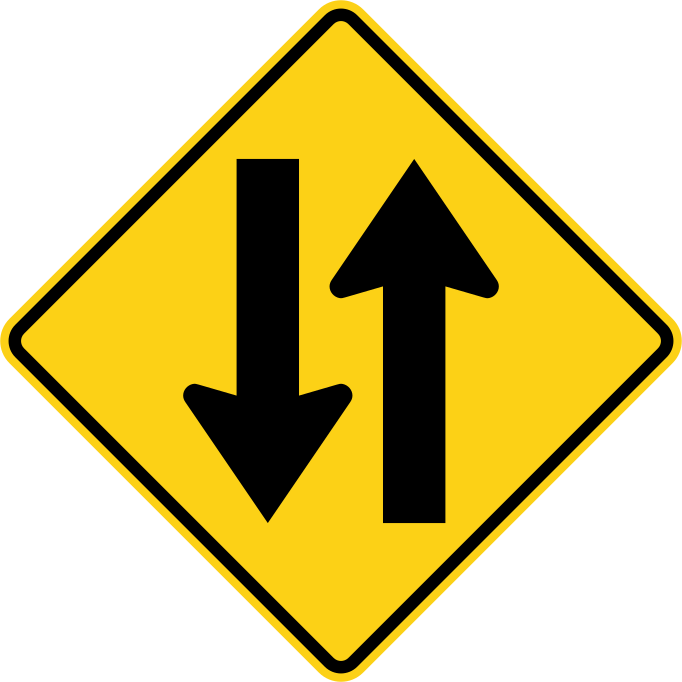
- Use any lane you like, as before
- Stay to the right; traffic will come toward you
- Drive in the center lane to see better
- Keep to the left lane for passing
Show answer
Stay to the right; traffic will come toward you. The two-way traffic sign means you are leaving a one-way road and entering a two-way road. Stay to the right, because traffic will soon be coming toward you in the other lanes. On a one-way street you may have used any lane, but that is no longer safe. Driving in the center or keeping left puts you in the path of oncoming vehicles.
14. Which of these places does Minnesota say calls for driving slower?
- A straight, dry four-lane highway
- A freeway acceleration lane
- Approaching a hilltop
- Leaving a school zone
Show answer
Approaching a hilltop. Minnesota tells drivers to slow down on narrow or winding roads and when coming up to a curve, a hilltop, or a railroad crossing. Each of these hides what is ahead, so a lower speed gives you time to react to a stopped car, an animal, or a train. An acceleration lane is where you build speed to match freeway traffic, not where you slow. A straight, dry highway and the end of a school zone do not, by themselves, call for extra caution under this rule.
Study this in the handbook: Speed limits and the basic speed law
15. You pass a Reduced Speed Ahead sign beside the road. What should you do?
- Hold your speed until you reach the new limit sign
- Start slowing down, since a lower limit is ahead
- Speed up so you clear the area before it starts
- Stop at the sign and wait for cross traffic
Show answer
Start slowing down, since a lower limit is ahead. This sign warns that a slower speed limit is posted farther along the road. Minnesota's manual tells drivers to begin slowing down when they see it. Holding your speed until the new limit sign means you ignore that instruction. Speeding up works against the warning. The sign is not a stop sign, so you do not need to halt or wait for cross traffic. Always follow posted limits, which are the maximum speed allowed on that road.
Study this in the handbook: Sign colors, shapes and regulatory signs
16. In a car with a manual transmission, when should you shift gears at a railroad crossing?
- Shift up on the tracks to clear faster
- Shift into neutral and coast across
- Shift down before entering the crossing
- Shift whenever the engine needs it
Show answer
Shift down before entering the crossing. Minnesota says not to shift gears while your vehicle is within a railroad crossing. In a manual transmission car, shift down before you enter the crossing so you can cross without changing gears. Never stop on railroad tracks, and look both ways before you cross. Coasting in neutral reduces your control. Shifting whenever the engine seems to need it ignores the specific danger of the tracks.
Study this in the handbook: Commercial vehicles, railroad crossings and work zones
17. A deer has just crossed the road ahead of you at night. What should you expect?
- More deer may follow
- The road is now clear
- It will not come back
- Deer cross only in pairs
Show answer
More deer may follow. Minnesota tells drivers to always watch for more than one deer. When you see eye reflections on the side of the road, slow down, blow the horn, and be ready to stop. A single deer crossing is often followed by others from the same group, so the road is not clear just because one has passed. There is no rule that deer travel in pairs; there may be one or several.
Study this in the handbook: Blowouts, brake failure and other vehicle emergencies
18. Going down a steep hill, which of these should you not do?
- Check your speedometer often on the way down
- Coast with the transmission in neutral
- Keep your foot ready to brake
- Stay alert for speed building
Show answer
Coast with the transmission in neutral. Minnesota says not to coast down steep hills with the transmission in neutral. In neutral you lose engine braking and some control, and the car can pick up speed fast. Your speed increases on a steep downgrade even when your foot is off the accelerator, so check the speedometer often. Keeping a foot ready to brake and watching for speed buildup are good habits, not mistakes.
Study this in the handbook: Distraction, aggression, winter driving and skids
19. Your brake pedal sinks to the floor, and pumping it does not help. What should you try next?
- Slowly apply the parking brake
- Yank the parking brake hard
- Turn off the engine
- Shift into park
Show answer
Slowly apply the parking brake. If the brake pedal sinks to the floor, first pump it to build pressure. If that does not work, slowly apply the emergency or parking brake. Pulling it too abruptly can throw the vehicle into a skid. If the road lets you coast, shift into a lower gear and keep downshifting as you slow until you can pull over. Turning off the engine or shifting into park while moving can cause loss of control or damage.
Study this in the handbook: Blowouts, brake failure and other vehicle emergencies
20. How deep must water be to reach the bottom of most passenger cars and risk loss of control?
- About 1 inch
- About 2 feet
- About 3 feet
- About 6 inches
Show answer
About 6 inches. Minnesota warns that 6 inches of water will reach the bottom of most passenger cars, which can cause loss of control or stalling. Do not drive through flooded areas; turn around and find another route. Even shallow-looking water can hide dips or a washed-out road. One inch is not enough to reach the car's underside. Two feet is the depth of moving water that can carry away most vehicles, and three feet is deeper still.
Study this in the handbook: Distraction, aggression, winter driving and skids
Every question is written from the official Minnesota Driver's Manual. Need paper? Printable MN practice test with answer key.
Last verified 2026-10-05. How we check every question · Study all 500 as flashcards
Frequently asked questions
How many questions are on this Minnesota practice test?
This fixed set has 20 questions. It is test 25 of 25 from the 500 question Minnesota bank.
How does this fixed test relate to the full Minnesota bank?
Each numbered test is a fixed set of questions in a fixed order, so you can retake the same test later and compare. Every test mixes road signs and the other topics in about the same proportion as the full bank. Tests 1 to 25 together cover every question in the Minnesota bank once. The full practice page mixes the whole bank at random.
Last verified 2026-10-05. See the Minnesota DMV facts page for sourced state details.
Return to the full Minnesota practice test · Study road signs