
Test 11 of 25 · 20 questions · Free 2026
MN Permit Practice Test 11
Jump to the test ↓A fixed 20 question set from the Minnesota bank with answers and plain English explanations.
Question 1 of 20 · 0 right so far
All 20 questions in test 11
Every question below comes from the Minnesota question bank on this page. Open a question to see the correct answer and the explanation. Nothing here is hidden behind a signup.
1. On a narrow street with steady oncoming traffic, you cannot leave 3 feet when passing a bicyclist. What should you do?
- Wait behind until you can leave 3 feet
- Pass with whatever space there is
- Honk so the rider moves to the curb
- Pass on the rider's right side
Show answer
Wait behind until you can leave 3 feet. When passing a bicyclist, you must keep at least 3 feet between the side of your car and the rider. If oncoming traffic keeps you from giving that space, slow down and wait behind the bicyclist until it is safe to pass with the full 3 feet. Squeezing past is illegal and can knock a rider over. Honking to push the rider aside or passing on their right is dangerous.
Study this in the handbook: Pedestrians, bicyclists and motorcycles
2. On a two-lane road, a police car with flashing lights is stopped on the shoulder ahead. You have no lane to move into. What should you do?
- Speed up to get past quickly
- Stop in your lane until it leaves
- Slow down and pass with caution
- Cross into the oncoming lane at once
Show answer
Slow down and pass with caution. When you cannot move a lane away, or you are on a road with only one lane in your direction, Minnesota says to slow down and pass with caution. Failing to slow down near a stopped emergency vehicle with flashing lights can add a surcharge to a speeding fine. Speeding past is the opposite of what is required. Stopping in your lane is not required, and swerving into the oncoming lane without checking is dangerous.
Study this in the handbook: Emergency vehicles, the Move Over Law and traffic stops
3. You pulled over for a fire truck on the freeway, and it has just passed. What should you do before pulling back into traffic?
- Pull out right away and speed up
- Look for more emergency vehicles following it
- Follow close behind the fire truck
- Honk to tell others it is safe
Show answer
Look for more emergency vehicles following it. Remain stopped until the emergency vehicle has completely passed. Before pulling out, look for other emergency vehicles that may be following it, since ambulances and police cars often travel together to the same scene. Pulling out right away can put you in front of the next one. Following a fire truck is not allowed within 500 feet, and honking does not tell anyone whether the road is clear.
Study this in the handbook: Following distance, night driving and freeways
4. To begin parallel parking behind an empty space, where should you stop your car?
- Even with the car ahead, about 1.5 feet away
- Behind the empty space, against the curb
- Even with the car ahead, about 4 feet away
- Halfway into the space, angled at the curb
Show answer
Even with the car ahead, about 1.5 feet away. Minnesota's parallel parking steps start by stopping even with the car ahead of the space and about one and a half feet away from it. Then turn the wheel sharply right and back up slowly; when you clear the car ahead, turn sharply left and keep backing; finally turn right and pull toward the curb in the center of the space. Four feet away leaves you too far out, and starting behind the space or halfway in skips the setup.
Study this in the handbook: Passing, backing up and parking
5. You see this sign on a weekday morning near a playground. What should you do?

- Watch for children and be ready to stop
- Honk to warn children you are coming
- Keep your speed if no guard is present
- Change lanes to pass slower cars
Show answer
Watch for children and be ready to stop. This pentagon-shaped yellow or fluorescent yellow-green sign means a school or an approved school crosswalk is ahead. Watch for children and be prepared to stop. Children can be unpredictable and may dart into the road. A crossing guard is not required for the warning to matter. Honking can startle children, and changing lanes to pass in a school area adds risk; in school zones you must slow down when children are present.
Study this in the handbook: Warning, school, construction and guide signs
6. You are turning right on a green light. A person is crossing the street you are turning onto. What must you do?
- Turn; green gives you the right of way
- Honk so the person speeds up
- Yield to the person crossing
- Turn wide around the person
Show answer
Yield to the person crossing. A green light lets you cross when the intersection is clear, but you must yield to vehicles or pedestrians already in it. Minnesota adds that when turning right or left, you must yield to pedestrians crossing in front of your vehicle. Wait for the person to get past your path before you finish the turn. Honking or swinging wide around a pedestrian puts them at risk.
Study this in the handbook: Traffic signals, lane use signals and ramp meters
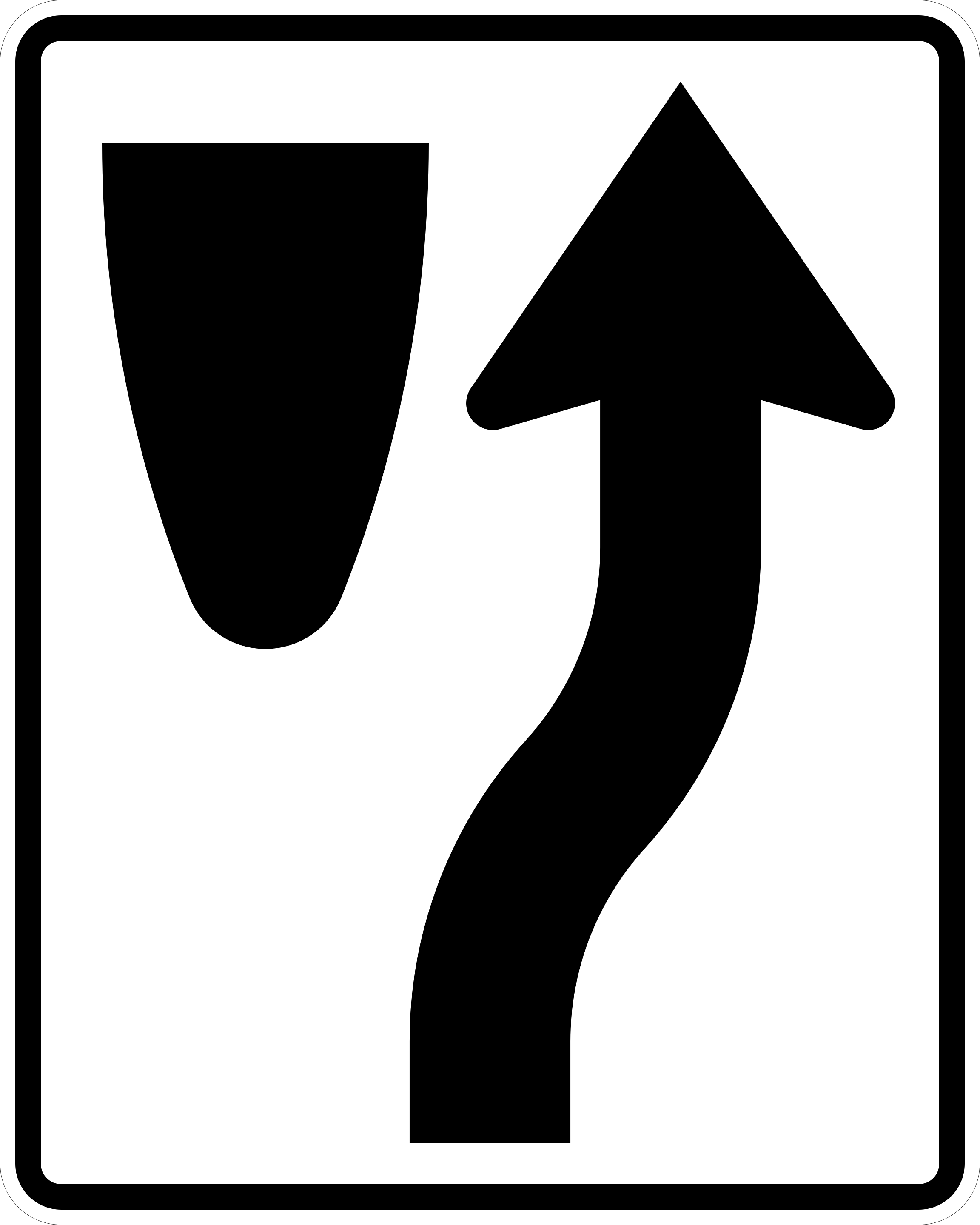
7. This sign stands on a raised median where a road splits around it. Which side of the median should you drive on?
- Either side
- The left side
- Whichever side is shorter
- The right side
Show answer
The right side. The keep right sign tells you to stay to the right of a traffic island, median, or obstruction ahead. Passing on the left side would put you in the lanes for traffic coming the other way. It does not matter which side looks shorter or less crowded. Watch for these signs at the start of medians and divided sections, and position your car on the right in good time.
8. In heavy rain, at what speed may an ordinary car begin to hydroplane?
- 15 mph
- 55 mph
- 70 mph
- 35 mph
Show answer
35 mph. At speeds of 35 mph or less, most tires wipe water off the road and stay in contact. Minnesota warns that in heavy rain, standard cars may begin to hydroplane at 35 mph, when water builds up under the tires and lifts them. Hydroplaning can happen at any speed if the water is deeper than the tire tread. Fifteen mph is too low for normal tires, and waiting until 55 or 70 mph to worry leaves you at risk.
Study this in the handbook: Distraction, aggression, winter driving and skids
9. Being lost in thought while driving is which type of distraction?
- Cognitive
- Visual
- Mechanical
- Auditory
Show answer
Cognitive. Minnesota lists three types of driver distraction. Visual distraction is looking away from the road. Mechanical or physical distraction is taking your hands off the wheel. Cognitive distraction is being lost in thought, such as daydreaming, even while your eyes are on the road. Auditory is not one of the three types in the manual. Knowing that your mind can wander while you look ahead helps you notice and refocus.
Study this in the handbook: Distraction, aggression, winter driving and skids
10. You stop behind a large truck on an uphill grade. Why should you leave extra space?
- So you can pass it on the shoulder
- The truck may roll back slightly as it starts
- Trucks often back up at traffic lights
- So its exhaust stays out of your car
Show answer
The truck may roll back slightly as it starts. If you stop behind a commercial vehicle on an upgrade, leave room for the truck to roll back a little when it starts moving. Also position your car on the left side of your lane so the driver can see you in the side mirror. Passing on the shoulder is not allowed either. Trucks do not routinely back up at lights, and exhaust is not the reason given; the risk is the truck drifting back into your car.
Study this in the handbook: Commercial vehicles, railroad crossings and work zones
11. How far behind a large truck can the driver's blind spot reach?
- Up to 20 feet
- Up to 50 feet
- Up to 200 feet
- Up to 500 feet
Show answer
Up to 200 feet. Commercial vehicles have no zones, which are blind spots to the front, sides, and rear. Some truck drivers may not be able to see up to 200 feet behind the trailer. If you follow too closely, the driver cannot see you, and you cannot see the road ahead. Twenty feet is the blind area in front of the cab, so it is the figure for the front, not the rear. Fifty and five hundred feet are not the numbers given.
Study this in the handbook: Commercial vehicles, railroad crossings and work zones
12. Your car stalls on railroad tracks and a train is coming. After you get out, which way should you walk?
- Straight along the tracks, away from the train
- Stay beside the car and wave at the train
- At an angle away, toward the coming train
- At an angle away, in the train's direction
Show answer
At an angle away, toward the coming train. If your car stalls on the tracks with a train approaching, leave it at once. Walk quickly away from the tracks at a 45-degree angle, in the direction the train is coming from. When the train hits your car, debris is thrown forward in the train's direction of travel, so moving toward the train keeps you out of that path. Walking along the tracks or staying near the car puts you in danger.
Study this in the handbook: Distraction, aggression, winter driving and skids
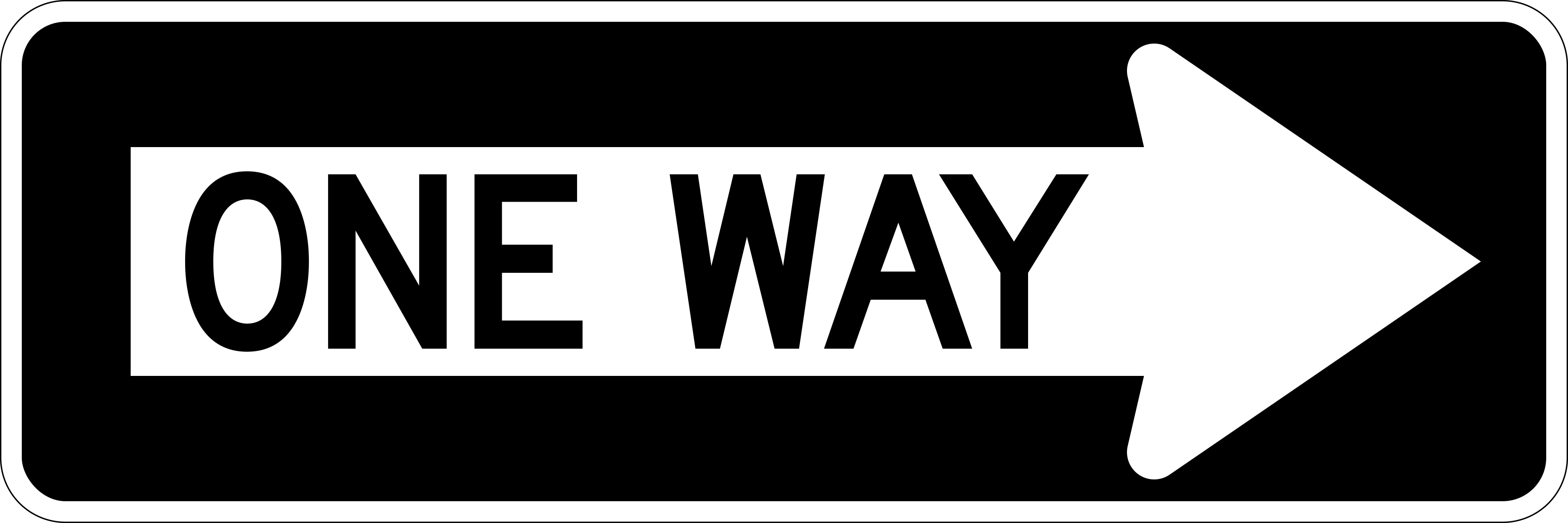
13. You reach a cross street with this sign on the corner. Which way may traffic on that street travel?
- Both ways; the arrow shows the busier side
- Only in the direction of the arrow
- The arrow way during rush hour only
- Either way, if you keep right
Show answer
Only in the direction of the arrow. This sign means traffic in the specified lane or street flows only in the direction of the arrow. If you turn onto that street, you must turn so you travel the way the arrow points. Turning the other way would put you head-on with traffic. The arrow is not a hint about which side is busier, it does not change by time of day, and keeping right does not make wrong-way travel legal.
14. On a two-lane road with double solid yellow center lines, you are behind a car going 10 mph under the limit. What may you do?
- Pass if you can see far ahead
- Stay behind it; passing is not allowed
- Pass, since it is under the limit
- Pass using the right shoulder
Show answer
Stay behind it; passing is not allowed. Double solid yellow lines mean no passing is allowed in either direction. A car going below the limit does not give you permission to cross them, and a long clear view does not override the marking. The shoulder is never a passing lane. Stay behind the slower car, keep a safe following distance, and wait for a section with broken yellow lines on your side.
Study this in the handbook: Passing, backing up and parking
15. In the SIPDE system used by Minnesota drivers, what does the P stand for?
- Prepare
- Position
- Predict
- Proceed
Show answer
Predict. SIPDE is a five-step process for making good driving judgments: Scan, Identify, Predict, Decide, and Execute. In the Predict step, you consider the speed, distance, and direction of hazards to anticipate how they may affect you. Words like prepare, position, and proceed sound like driving terms, but they are not part of the name. Scanning ahead, identifying hazards, and predicting their moves let you decide early and act smoothly.
16. A 1-year-old has grown too tall for the rear-facing car seat's height limit. What does Minnesota require?
- Keep using it until age 2 anyway
- Switch to a front-facing car seat
- Move the child to a booster seat
- Use an adult seat belt
Show answer
Switch to a front-facing car seat. Children under 2 must ride rear-facing until they reach the seat's weight or height limit. If they are too heavy or too tall for that seat, they must switch to a front-facing car seat. Continuing to use a seat the child has outgrown defeats its protection. Booster seats are for older children, usually 4 to 9, and an adult belt cannot protect a toddler.
Study this in the handbook: Seat belts, child seats, airbags and window rules
17. Which vehicles may use a Minnesota high-occupancy vehicle (HOV) lane?
- Buses and taxis only, at any time of day
- Cars with three or more people, plus buses
- Any vehicle outside peak travel hours
- Motorcycles, buses, and cars with two or more people
Show answer
Motorcycles, buses, and cars with two or more people. Minnesota's high-occupancy vehicle lanes are for motorcycles, buses, and vehicles carrying two or more people. A driver alone in a car does not qualify. Some states set the bar at three occupants, but Minnesota's figure is two. Taxis do not get special access, and the manual does not open these lanes to everyone at off-peak times. Carpool lanes are often marked with a diamond symbol.
18. When does alcohol begin to impair your driving ability?
- Only above 0.08 percent
- After about three drinks
- Only once you feel drunk
- After just one drink
Show answer
After just one drink. Alcohol is a depressant that slows the body and impairs motor skills. Higher alcohol concentration means greater impairment, and Minnesota's manual says your driving ability becomes impaired after just one drink. The 0.08 figure is a legal limit for arrest, not the point where impairment starts. Waiting until you feel drunk is unreliable, because alcohol also makes you misjudge how impaired you are.
Study this in the handbook: How alcohol affects you and the DWI law
19. Transit buses may drive on the shoulder of some Minnesota freeways. When is that allowed?
- When main traffic is slower than 35 mph
- Any time at all during the rush hour
- Whenever freeway traffic is under 55 mph
- Only on weekends and holidays
Show answer
When main traffic is slower than 35 mph. Transit and metro mobility buses are permitted to use the shoulder of a freeway or expressway only when main-line traffic is moving slower than 35 mph. On the shoulder, the bus may not go more than 15 mph faster than main-line traffic and never over 35 mph, and it must yield to merging, entering, and exiting traffic. Knowing this helps you expect a bus beside you in a jam. Rush hour alone, 55 mph, and weekends are not the rule.
20. How does Minnesota treat bicycles on the road?
- As pedestrians who must stay on the shoulder
- As vehicles that must yield to all motor vehicles
- As vehicles with fewer rights than cars
- As legal vehicles with the same rights and responsibilities
Show answer
As legal vehicles with the same rights and responsibilities. Minnesota's manual says bicycles are legal vehicles on its roads and share the same rights and responsibilities as other vehicles. Bicycle riders must also obey all traffic laws, signal their turns, and obey traffic control signs, signals, and devices. They are not treated as pedestrians, and they are not required to give way to every motor vehicle. Drivers should treat a bicyclist as another vehicle sharing the road and watch for riders at intersections.
Study this in the handbook: Pedestrians, bicyclists and motorcycles
Every question is written from the official Minnesota Driver's Manual. Need paper? Printable MN practice test with answer key.
Last verified 2026-10-05. How we check every question · Study all 500 as flashcards
Frequently asked questions
How many questions are on this Minnesota practice test?
This fixed set has 20 questions. It is test 11 of 25 from the 500 question Minnesota bank.
How does this fixed test relate to the full Minnesota bank?
Each numbered test is a fixed set of questions in a fixed order, so you can retake the same test later and compare. Every test mixes road signs and the other topics in about the same proportion as the full bank. Tests 1 to 25 together cover every question in the Minnesota bank once. The full practice page mixes the whole bank at random.
Last verified 2026-10-05. See the Minnesota DMV facts page for sourced state details.
Return to the full Minnesota practice test · Study road signs