
Test 21 of 25 · 20 questions · Free 2026
MN Permit Practice Test 21
Jump to the test ↓A fixed 20 question set from the Minnesota bank with answers and plain English explanations.
Question 1 of 20 · 0 right so far
All 20 questions in test 21
Every question below comes from the Minnesota question bank on this page. Open a question to see the correct answer and the explanation. Nothing here is hidden behind a signup.
1. When you parallel park in Minnesota, how far from the curb may your curbside wheels be?
- No more than 12 inches
- No more than 18 inches
- No more than 6 inches
- No more than 24 inches
Show answer
No more than 12 inches. After parallel parking, the wheels closest to the side of the road should be no more than 12 inches from the curb. Turning the front wheels toward the curb and setting the parking brake complete the job. Eighteen inches is a figure some other states use, but Minnesota's manual says 12. Six inches is a fine goal but is not the limit, and 24 inches would leave your car sticking out into traffic.
Study this in the handbook: Passing, backing up and parking
2. A bus ahead of you stops at a railroad crossing even though no train is coming. What should you do?
- Pass it, since no train is coming
- Honk to tell the driver it is clear
- Pass on the right if there is room
- Wait behind it; do not pass
Show answer
Wait behind it; do not pass. Some vehicles, such as passenger vans, buses, and larger trucks, must stop at all railroad tracks whether or not a train is present. Minnesota tells drivers not to pass these vehicles. The bus driver is following the law, so honking to hurry them is wrong. Passing on either side near a crossing is also illegal, because you may not pass any vehicle within 100 feet of a railroad crossing.
Study this in the handbook: Commercial vehicles, railroad crossings and work zones
3. You realize you just passed your freeway exit. What should you do?
- Stop on the shoulder and back up to the exit
- Make a U-turn at the next gap in traffic
- Continue to the next exit and return from there
- Stop and wait for a break in traffic to turn around
Show answer
Continue to the next exit and return from there. If you miss your freeway exit, Minnesota tells you to proceed to the next one. Do not back up or make a U-turn to return to the exit you wanted. Backing up or turning around on a freeway is illegal, with an exception only for emergency and road repair vehicles doing their duties. The manual also says to learn where you need to exit before you start driving, and to watch for signs that give information about upcoming exits.
Study this in the handbook: Distraction, aggression, winter driving and skids
4. Which of these usually contains about the same amount of alcohol as a 12-ounce beer?
- A 12-ounce glass of wine
- A 5-ounce glass of wine
- A full bottle of wine
- A 20-ounce wine cooler
Show answer
A 5-ounce glass of wine. A 12-ounce beer, a 5-ounce glass of wine, a typical mixed drink, and a 9-ounce wine cooler usually contain about the same amount of alcohol. A 12-ounce glass of wine holds more than twice a standard serving, and a full bottle is several drinks. A 20-ounce wine cooler is more than double the 9-ounce size. Remember that mixed drinks may hold more than 1.5 ounces of alcohol, and beers can vary by as much as 40 percent.
Study this in the handbook: How alcohol affects you and the DWI law
5. Unless it is truly necessary, where should you not stop when getting on a freeway?
- At a ramp meter showing red
- At a yield sign when freeway traffic is heavy
- On the ramp or in the acceleration lane
- Behind a car waiting at the meter
Show answer
On the ramp or in the acceleration lane. Minnesota says not to stop on the entrance ramp or in the acceleration lane unless it is absolutely necessary, because drivers behind you expect to keep moving and build speed. There are cases where stopping is required: at a ramp meter showing red, behind a car waiting at the meter, or at a yield sign on a ramp with no acceleration lane when no gap is open. Outside those cases, keep moving and merge.
Study this in the handbook: Following distance, night driving and freeways
6. Why are turn lanes near an intersection often separated from through lanes by solid white lines?
- To show where bicycles ride
- To mark where parking is allowed
- To mark the edge of a crosswalk
- To discourage late lane changes
Show answer
To discourage late lane changes. Turn lanes near intersections keep turning traffic apart from through traffic. To discourage drivers from changing lanes close to the intersection, these lanes are separated from through lanes by solid white lines. Pick your lane before the solid line begins; if you are in a turn lane marked with an arrow, you must turn. Bicycle lanes use a white line with a bicycle symbol, and crosswalk lines run across the road.
Study this in the handbook: Lines and lane markings
7. On a two-lane highway posted at 55 mph, you are lawfully passing a slow truck. What is the most you may drive while passing?
- 55 mph
- 65 mph
- 60 mph
- 70 mph
Show answer
65 mph. On two-lane highways with a speed limit of 55 mph or higher, Minnesota lets you increase your speed by 10 mph while lawfully passing another vehicle. With a 55 mph limit, that means up to 65 mph during the pass. The extra 10 mph applies only while passing, so return to the posted limit afterward. Sixty mph understates the allowance, and seventy mph exceeds it.
Study this in the handbook: Speed limits and the basic speed law
8. Your 11-year-old wants to ride in the front seat, and the seat behind the driver is empty. Where must the child ride in Minnesota?
- In the back seat
- In front, if the airbag is on
- In front, if belted snugly
- Wherever the child prefers
Show answer
In the back seat. The back seat is the safest place in most vehicles, and Minnesota requires children under 13 to ride in the back if one is available. An 11-year-old is under that age, and here the back seat has room. A front airbag can injure a child, which is one reason for the rule. A snug belt in front does not satisfy it, and the child's preference does not change the law.
Study this in the handbook: Seat belts, child seats, airbags and window rules
9. About how much distance may a fully loaded tractor-trailer need to stop from 55 mph?
- More than 400 feet
- About 130 feet
- About 200 feet
- About 50 feet
Show answer
More than 400 feet. Commercial vehicles need much more stopping distance than cars. An average passenger car at 55 mph can stop within 130 to 140 feet, but a fully loaded tractor-trailer may need more than 400 feet. That is why cutting in front of a truck and braking is so dangerous. The 130-foot figure belongs to cars. Two hundred and fifty feet badly understate what a heavy truck needs.
Study this in the handbook: Commercial vehicles, railroad crossings and work zones
10. Why do drivers often misjudge an approaching semi truck at an intersection?
- Trucks must yield at every crossing
- Big trucks seem slower than they really are
- Truck lights make them look farther off
- Trucks always stop well short of corners
Show answer
Big trucks seem slower than they really are. Because of their large size, commercial vehicles often appear to travel slower than they actually are. Many car and truck collisions happen at intersections when the car driver misjudges the truck's speed and distance and pulls out in front of it. Trucks also need much more distance to stop than cars. Trucks do not have to yield at every crossing, and you cannot count on them stopping early.
Study this in the handbook: Commercial vehicles, railroad crossings and work zones
11. A yellow diamond sign shows a straight arrow with a shorter line joining it from the right. What does it warn?
- The road ends at a T ahead
- Your lane is ending on the right
- Traffic may enter from the right
- A divided highway begins ahead
Show answer
Traffic may enter from the right. This is a side road warning sign. It tells you a road joins from the right, so traffic may come from that side. Watch for vehicles entering the roadway and be ready to slow. A T-intersection sign shows your road ending at a crossbar, and a lane ends sign shows lanes narrowing. A divided highway sign shows the road splitting around an island. The short line on one side is the clue for a side road.
Study this in the handbook: Warning, school, construction and guide signs
12. When driving in heavy fog, which headlight setting should you use?
- High beams
- Parking lights only
- No lights during the day
- Low beams
Show answer
Low beams. Headlights must be on when you cannot see more than 500 feet ahead and when it is raining, snowing, sleeting, or hailing. Keep them on low beam to reduce glare. High beams reflect off fog, rain, and snow back into your eyes and make it harder to see. Parking lights alone do not light the road or make you visible enough, and daytime fog still calls for headlights.
Study this in the handbook: Distraction, aggression, winter driving and skids
13. Your hood flies up while you are driving and blocks the windshield. Where might you still be able to see?
- Through the rear window
- Through the sunroof
- Through the gap under the hood
- In the side mirrors only
Show answer
Through the gap under the hood. If the hood suddenly opens and blocks your view, you may be able to see through the space between the hood and the dashboard. If that is not possible, roll down the window and lean over to look past the side of the hood. Turn on your hazard lights, slow down, and steer off the road safely. The rear window, sunroof, and mirrors do not show the road ahead.
Study this in the handbook: Blowouts, brake failure and other vehicle emergencies
14. You stop at a red light to turn right. Which other traffic should you watch for before turning?
- Only the cars that are stopped directly behind you
- Cars parked along the far curb
- Cars waiting to go straight on your left
- Oncoming cars turning left on a green arrow
Show answer
Oncoming cars turning left on a green arrow. Before a right turn on red, stop completely, make sure no No Turn on Red sign is posted, and check for pedestrians and traffic in every direction. Minnesota warns you to watch for oncoming cars turning left in front of you, because oncoming traffic sometimes gets a green arrow before your light turns green. Those drivers have the right of way and may be heading into the same lane you want. Parked cars and cars behind you are not the hazard here.
Study this in the handbook: Signaling, turns, roundabouts and U turns
15. On a cold morning, is it safe to warm up your car in the garage with the garage door fully open?
- Yes, an open garage door lets all of the gas escape
- Yes, for up to 30 minutes
- No, the gas can still build up; use the driveway
- Only with the car windows rolled up
Show answer
No, the gas can still build up; use the driveway. When it is cold, carbon monoxide can get trapped inside a garage even with the door fully open, and it can seep into an attached house and knock a person out within minutes. Minnesota says to avoid idling a vehicle in a garage; the driveway is a safer place to warm it up. An open door does not clear all the gas, no time limit makes it safe, and closed car windows do not protect people in the house.
16. You approach this sign, and the cross traffic is far away with a clear view both ways. Must you come to a full stop?
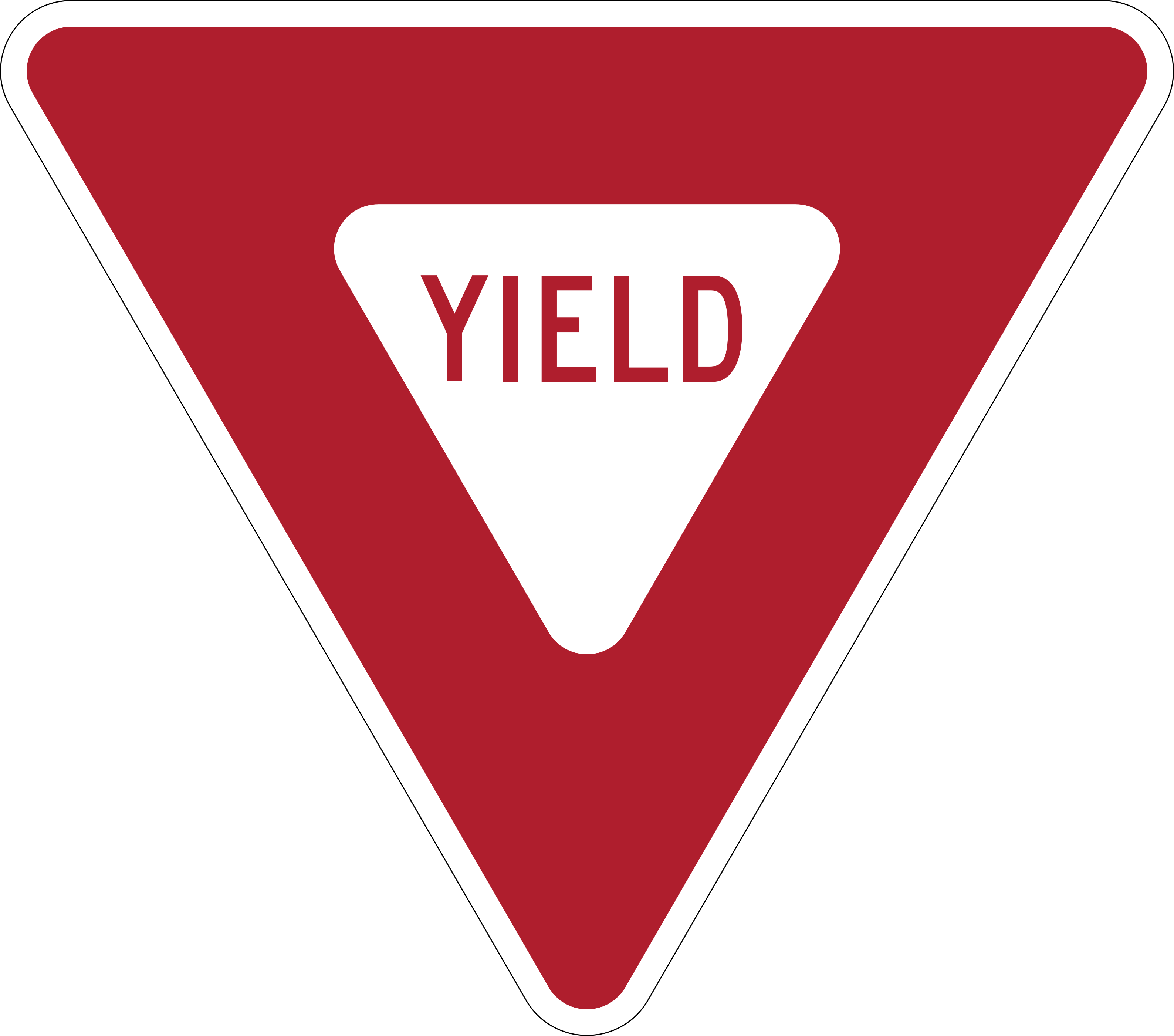
- Yes, every time
- No, slow and go if it is safe
- Yes, if any car is in sight
- Only at night
Show answer
No, slow and go if it is safe. A yield sign tells you to slow down and stop only if necessary, giving the right of way to all other vehicles and pedestrians. If the road is clear and no one is close enough to be affected, you may continue without stopping once it is safe. A full stop is required at a stop sign, not at every yield sign. The time of day does not matter; what matters is whether others are coming.
Study this in the handbook: Sign colors, shapes and regulatory signs
17. You are on a highway and pass this sign. A car is speeding up on the entrance ramp to your right. What should you do?

- Speed up to stay ahead of it
- Be prepared to let it in
- Move onto the shoulder
- Brake hard to stop
Show answer
Be prepared to let it in. The merging traffic sign means vehicles will merge onto the road you are traveling on, and you should be prepared to allow them to enter. Adjust your speed or change lanes if it is safe so the merging driver has room. Racing to stay ahead squeezes the other driver out. The shoulder is not a travel lane, and hard braking on a highway can cause a rear-end crash.
Study this in the handbook: Warning, school, construction and guide signs
18. Your signal is flashing yellow, and a car from the cross street is already partway through the intersection. What should you do?
- Let it clear, then go through with caution
- Go, since flashing yellow is your green
- Stop and wait for a steady green
- Honk so the other car speeds up
Show answer
Let it clear, then go through with caution. A flashing yellow light means caution. You may go through the intersection, but you must yield the right of way to vehicles and pedestrians already in it. Here the cross-street car got there first, so let it clear before you continue. A flashing yellow is not the same as a green, and you do not need to wait for a steady green. Honking does not change who must yield.
Study this in the handbook: Traffic signals, lane use signals and ramp meters
19. On a street with a 30 mph limit, at least how far before stopping will a Minnesota school bus turn on its flashing yellow lights?
- 100 feet
- 50 feet
- 300 feet
- 500 feet
Show answer
100 feet. In a speed zone of 35 mph or less, the bus driver turns on the flashing yellow lights at least 100 feet before the bus stops. On roads with a limit above 35 mph, the warning starts at least 300 feet ahead, so 300 feet is the answer for faster roads, not this one. Fifty feet would give too little warning, and 500 feet is not a school bus figure. Yellow lights mean the bus is about to stop, so slow down and get ready.
Study this in the handbook: Stop rules, school buses and fleeing police
20. Which people riding in a Minnesota vehicle must wear a seat belt?
- The driver and front passenger only
- Only riders under age 18
- Only the driver; passengers may choose for themselves
- The driver and all passengers, front and back
Show answer
The driver and all passengers, front and back. Minnesota law requires the driver and every passenger, including people in the back seat, to wear a properly adjusted and fastened seat belt. Many people think back seat riders are exempt, but they are not. Age does not matter for this rule; adults must buckle up too. An unbelted back seat passenger can be thrown forward into the people in front during a crash, so belting everyone protects the whole car.
Study this in the handbook: Seat belts, child seats, airbags and window rules
Every question is written from the official Minnesota Driver's Manual. Need paper? Printable MN practice test with answer key.
Last verified 2026-10-05. How we check every question · Study all 500 as flashcards
Frequently asked questions
How many questions are on this Minnesota practice test?
This fixed set has 20 questions. It is test 21 of 25 from the 500 question Minnesota bank.
How does this fixed test relate to the full Minnesota bank?
Each numbered test is a fixed set of questions in a fixed order, so you can retake the same test later and compare. Every test mixes road signs and the other topics in about the same proportion as the full bank. Tests 1 to 25 together cover every question in the Minnesota bank once. The full practice page mixes the whole bank at random.
Last verified 2026-10-05. See the Minnesota DMV facts page for sourced state details.
Return to the full Minnesota practice test · Study road signs