
Test 1 of 10 · 20 questions · Free 2026
MN Permit Practice Test 1
Jump to the test ↓A fixed 20 question set from the Minnesota bank with answers and plain English explanations.
Question 1 of 20 · 0 right so far
All 20 questions in test 1
Every question below comes from the Minnesota question bank on this page. Open a question to see the correct answer and the explanation. Nothing here is hidden behind a signup.
1. What is the recommended response to Minnesota warning signs?
- Ignore them until a traffic signal changes
- Recognize and react to the possible hazards they identify
- Use them only to locate motorist services
- Assume they prohibit every movement ahead
Show answer
Recognize and react to the possible hazards they identify. Minnesota says drivers must recognize and react to warning signs for their own safety and the safety of others. Warning signs identify possible hazards, so the response is to look ahead, assess the roadway, and adjust speed or position when needed. They are not traffic signals, service signs, or blanket prohibitions on every movement. Yellow is common for warning signs, but color alone does not replace reading the symbol or message. Use the sign as an early cue to prepare, then confirm what hazard is ahead and choose a safe response.
Study this in the handbook: Sign colors, shapes and regulatory signs
2. What is the alcohol content of 80-proof whiskey?
- 40 percent
- 80 percent
- 8 percent
- 20 percent
Show answer
40 percent. Proof measures a drink's strength and equals twice the percentage of alcohol it contains. So 80-proof whiskey is 40 percent alcohol. Eighty percent confuses proof with percent. Eight and 20 percent are not what the formula gives. Standard servings of beer, wine and a typical mixed drink hold about the same alcohol, though mixed drinks can contain more than 1.5 ounces and beers vary by as much as 40 percent.
Study this in the handbook: How alcohol affects you and the DWI law
3. What must a driver do at a flashing red traffic light before proceeding?
- Come to a complete stop, yield, and proceed when the intersection is clear
- Slow down but continue without stopping if no car is close
- Treat it as a green light for the major roadway
- Stop only when a pedestrian is already crossing
Show answer
Come to a complete stop, yield, and proceed when the intersection is clear. A flashing red light has the same stopping behavior as a stop sign. Come to a complete stop, yield to vehicles and pedestrians that reached the intersection before you, and continue only after the intersection is clear. The slow-and-continue choice removes the required stop, even if the road appears empty. Do not assume the major roadway has priority without evaluating the intersection and other road users. The cue is red plus flashing still means stop: full stop first, then yield and proceed when safe.
Study this in the handbook: Traffic signals, lane use signals and ramp meters
4. When driving in bad weather or poor road conditions, what speed choice is required?
- Drive exactly at the posted limit regardless of visibility
- Reduce speed as conditions require
- Increase speed to spend less time on the wet pavement
- Use the shoulder to avoid slowing in the travel lane
Show answer
Reduce speed as conditions require. The posted limit is a maximum, not a command to maintain that speed when conditions become hazardous. Minnesota specifically directs drivers to slow down in bad weather and poor road conditions. Rain, snow, fog, glare, ice, or gravel can reduce traction and visibility, giving a driver less time to react. Increasing speed makes that problem worse, and using the shoulder creates a separate danger. The cue is a change in conditions: compare the available sight distance and traction with the speed, then choose a slower pace and more space when needed.
Study this in the handbook: Speed limits and the basic speed law
5. What criminal penalty does the Minnesota manual list for a first DWI offense?
- 90 days in jail, a $1,000 fine, or both
- One year in jail, a $3,000 fine, or both
- Seven years in prison and a $14,000 fine
- A $275 fine only
Show answer
90 days in jail, a $1,000 fine, or both. The manual lists 90 days in jail, a $1,000 fine, or both for a first DWI offense, alongside the minimum 90-day revocation and optional ignition interlock. One year in jail and a $3,000 fine is the level for second and third offenses. Seven years and $14,000 is the felony DWI maximum. Two hundred seventy-five dollars is the repeat texting fine.
Study this in the handbook: Implied consent and DWI penalties
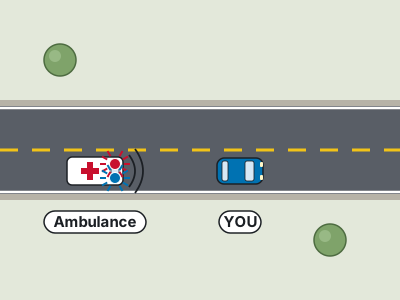
6. When an emergency vehicle is approaching on a two-way road, when may a driver resume movement?
- After all emergency vehicles have passed
- As soon as the first vehicle reaches the intersection
- When the driver behind begins moving
- Immediately after pulling onto the right shoulder
Show answer
After all emergency vehicles have passed. A driver who has pulled right and stopped for an approaching emergency vehicle must remain stopped until all emergency vehicles have passed. Moving after only the first vehicle reaches the intersection can put the driver in the path of another responder following behind. The actions of a trailing driver do not establish permission, and reaching the shoulder is only the required position, not the end of the stop. The cue is to keep watching for the complete response group: stay stopped, keep the route open, and move again only after every emergency vehicle has cleared.
Study this in the handbook: Emergency vehicles, the Move Over Law and traffic stops
7. Which vehicles may deviate from the lane in a Minnesota roundabout?
- Any vehicle in a hurry
- Motorcycles only
- Vehicles longer than 40 feet or wider than 10 feet, or any combination vehicle
- No vehicle may leave its lane
Show answer
Vehicles longer than 40 feet or wider than 10 feet, or any combination vehicle. A vehicle longer than 40 feet or wider than 10 feet, or any combination vehicle, may deviate from the lane as needed to drive through a roundabout while being cautious of other traffic. In a multilane roundabout, if two large vehicles drive through at the same time, the driver on the right must yield to the vehicle on the left, reducing speed or stopping if necessary. Other drivers may not stop, pass, or change lanes within the roundabout. If an emergency vehicle approaches, exit the roundabout immediately and then pull over.
Study this in the handbook: Signaling, turns, roundabouts and U turns
8. Who is registered with the Selective Service when applying for a Minnesota license or ID?
- All applicants over 16
- Only commercial drivers
- U.S. citizens or residents between the ages of 18 and 26
- Only male applicants over 30
Show answer
U.S. citizens or residents between the ages of 18 and 26. If you are a U.S. citizen or resident between the ages of 18 and 26, you will be registered with the U.S. Selective Service, commonly known as the draft, when you apply for any Minnesota license or ID card. For applicants under 18, DVS withholds the registration until the 18th birthday. The manual says consent to registration at the time of application complies with the federal Military Selective Service Act, so it is tied to age and citizenship or residency, not to license class.
9. A Minnesota driver tests at 0.08 percent or above. What may the driver receive before the revocation begins?
- A 30-day temporary license
- A seven-day temporary license
- A work permit valid for one year
- Nothing; driving stops at the roadside
Show answer
A seven-day temporary license. If you are found at 0.08 percent or above, or you refuse to take a test, you may receive a seven-day temporary license, and at the end of that seven-day period your license will be revoked. Thirty days is not the temporary license length. A work permit is not issued right away; after a first offense none is issued until 15 days of revocation have passed and reinstatement steps are met.
Study this in the handbook: Implied consent and DWI penalties
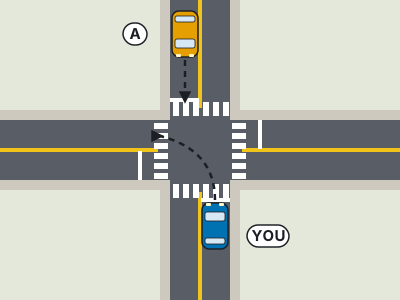
10. With a round green light, what must a driver do before completing a left turn?
- Enter the turn from the far-right lane
- Turn immediately because green always protects the movement
- Wait until the signal becomes a green arrow
- Yield to oncoming traffic and pedestrians crossing in front
Show answer
Yield to oncoming traffic and pedestrians crossing in front. A round green light permits movement through the intersection, but a left-turning driver must still yield to oncoming traffic and pedestrians crossing in front of the vehicle. Enter only when the intersection is clear and the opposing gap is safe. A green arrow provides protected movement in its direction, but waiting for an arrow is not required when the ordinary turn can be completed legally. The green signal also does not justify an immediate turn across an approaching vehicle. Look straight ahead and across the crosswalk before turning.
Study this in the handbook: Pedestrians, bicyclists and motorcycles
11. If convicted of failing to stay stopped for a school bus with flashing red lights in Minnesota, what is the minimum fine?
- At least $100
- At least $50
- At least $500, plus loss of driving privileges
- At least $2,000
Show answer
At least $500, plus loss of driving privileges. You must stop at least 20 feet from a school bus with red lights flashing and stay stopped until they stop flashing. If you do not, you can be charged with a misdemeanor, and if convicted you must pay a fine of at least $500 and lose your driving privileges. Amounts of $50 or $100 are far below that minimum, and $2,000 is not the stated figure. Officers with probable cause can arrest you within four hours of the violation.
Study this in the handbook: Stop rules, school buses and fleeing police
12. Where must Minnesota children under 13 ride?
- Anywhere with a belt
- In the front seat with the air bag on
- In the back seat if it is available
- On a parent's lap
Show answer
In the back seat if it is available. The back seat is the safest place in most vehicles, and children under 13 must ride in the back if it is available. Car seats and boosters must be federally approved and installed according to the manufacturer's instructions. Children who outgrow a rear facing seat use a forward facing seat until about 40 to 60 pounds, and children 4 to 9 who are too big for a car seat use a booster.
Study this in the handbook: Seat belts, child seats, airbags and window rules
13. Once a teen is reinstated under Vanessa's Law, how long must the new Minnesota instruction permit be held?
- Six months with a 50 hour log
- 90 days, while completing six hours of behind-the-wheel driver education
- Two weeks
- A full year
Show answer
90 days, while completing six hours of behind-the-wheel driver education. Reinstatement under Vanessa's Law usually means serving the withdrawal period, passing the Class D written test, paying the $680 reinstatement fee, completing a 30-hour classroom course that cannot be taken online, and applying for a permit. Once reinstated, the permit must be held for 90 days, and six hours of behind-the-wheel driver education are completed during that time. Six months with a log describes the normal GDL route. Two weeks and one year are not in the rule.
Study this in the handbook: Provisional license limits, Vanessa's Law and the under 21 license
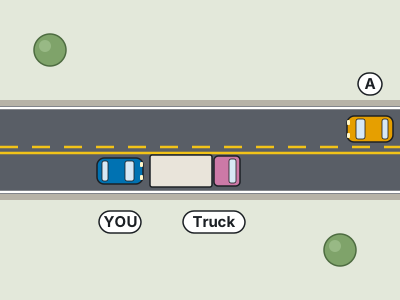
14. What restriction accompanies a solid yellow centerline beside your lane?
- Passing is prohibited in that direction
- Passing is required before the next intersection
- Traffic may cross it whenever the road is empty
- The lane is reserved for emergency vehicles
Show answer
Passing is prohibited in that direction. Yellow lines separate traffic moving in opposite directions, and a solid yellow line on your side means you must not pass. The manual adds that passing in a no passing zone is illegal, so an empty looking road does not create an exception. The marking is a centerline, not a special use lane reserved for emergency vehicles, and it never requires a pass. When the yellow line is solid on your side, stay behind the slower vehicle until yellow dashes on your side permit a lawful pass.
Study this in the handbook: Passing, backing up and parking
15. How far ahead must a Minnesota driver be able to see before passing on a curve or hill?
- At least 100 feet
- At least 300 feet
- At least one mile
- At least 700 feet
Show answer
At least 700 feet. Do not pass on a curve or hill where you cannot clearly see the road ahead for at least 700 feet, within 100 feet of an intersection, underpass, tunnel or railroad crossing, when you are about to meet an oncoming vehicle, or when another driver is trying to pass you. Double solid yellow lines mean no passing in either direction.
Study this in the handbook: Passing, backing up and parking
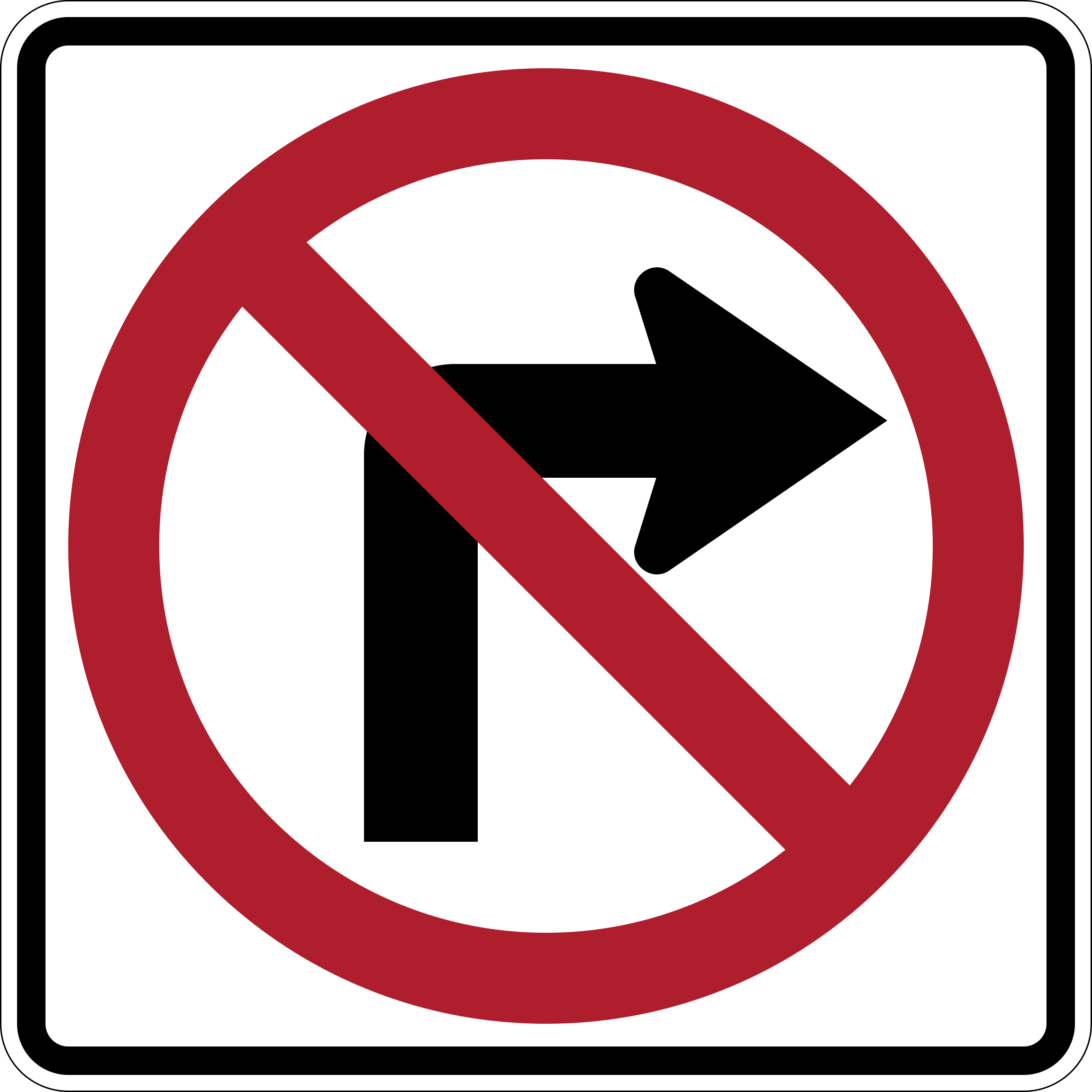
16. What does a red circle with a red slash across a symbol indicate?
- The symbol marks a route to a public facility
- You may take the action after stopping twice
- The pictured action is required during construction
- You should not take the pictured course of action
Show answer
You should not take the pictured course of action. The manual uses a red circle with a red slash to show that the pictured course of action should not be taken. That instruction applies to the movement represented by the symbol, such as a prohibited turn, rather than to every possible movement at the intersection. Stopping twice does not cancel a prohibition, construction does not turn the symbol into a requirement, and the sign is not a route marker. Identify the crossed-out symbol, then choose a legal movement that is allowed by the signal, lane markings, and other signs. The cue is slash means do not take the pictured action.
Study this in the handbook: Sign colors, shapes and regulatory signs
17. How far above the posted speed limit must a Minnesota driver travel before additional fines apply?
- 5 mph or more
- 20 mph or more
- 15 mph or more
- 10 mph or more
Show answer
20 mph or more. Minnesota adds additional fines when a driver travels 20 mph or more above the posted speed limit. The lower thresholds in the other choices do not match the figure stated in the manual, although speeding below that point can still bring a regular fine. The rule concerns the amount over the posted limit, not a special permission to exceed it. Read the sign first, compare the vehicle's speed with that number, and treat a 20 mph gap as a serious penalty threshold.
Study this in the handbook: Speed limits and the basic speed law
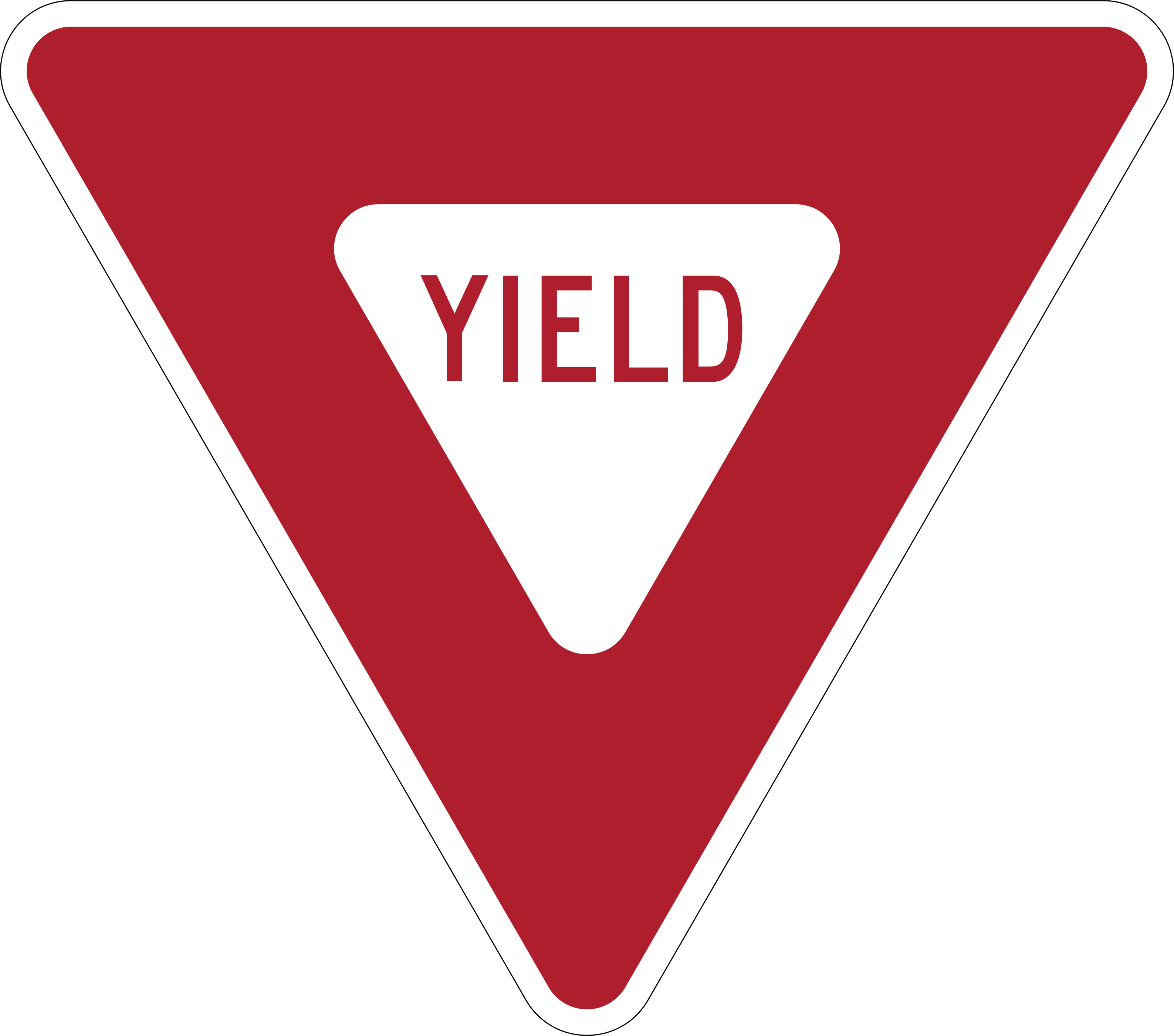
18. What does this YIELD sign direct you to do?
- Enter first because the sign protects your lane
- Stop for a fixed five seconds before moving
- Slow down or stop if necessary and give right of way to vehicles and pedestrians
- Ignore pedestrians if no traffic signal is visible
Show answer
Slow down or stop if necessary and give right of way to vehicles and pedestrians. The YIELD sign directs a driver to slow down or stop if necessary, then give the right of way to all other vehicles and pedestrians until it is safe to proceed. A fixed five second stop is invented, and entering first reverses the sign's priority because the sign protects the other traffic, not your lane. Ignoring pedestrians when no signal is visible wrongly removes them from the rule. Approach with enough speed control to stop smoothly, check the crossing path and traffic stream, and continue only after the road users who have priority are clear.
Study this in the handbook: Sign colors, shapes and regulatory signs
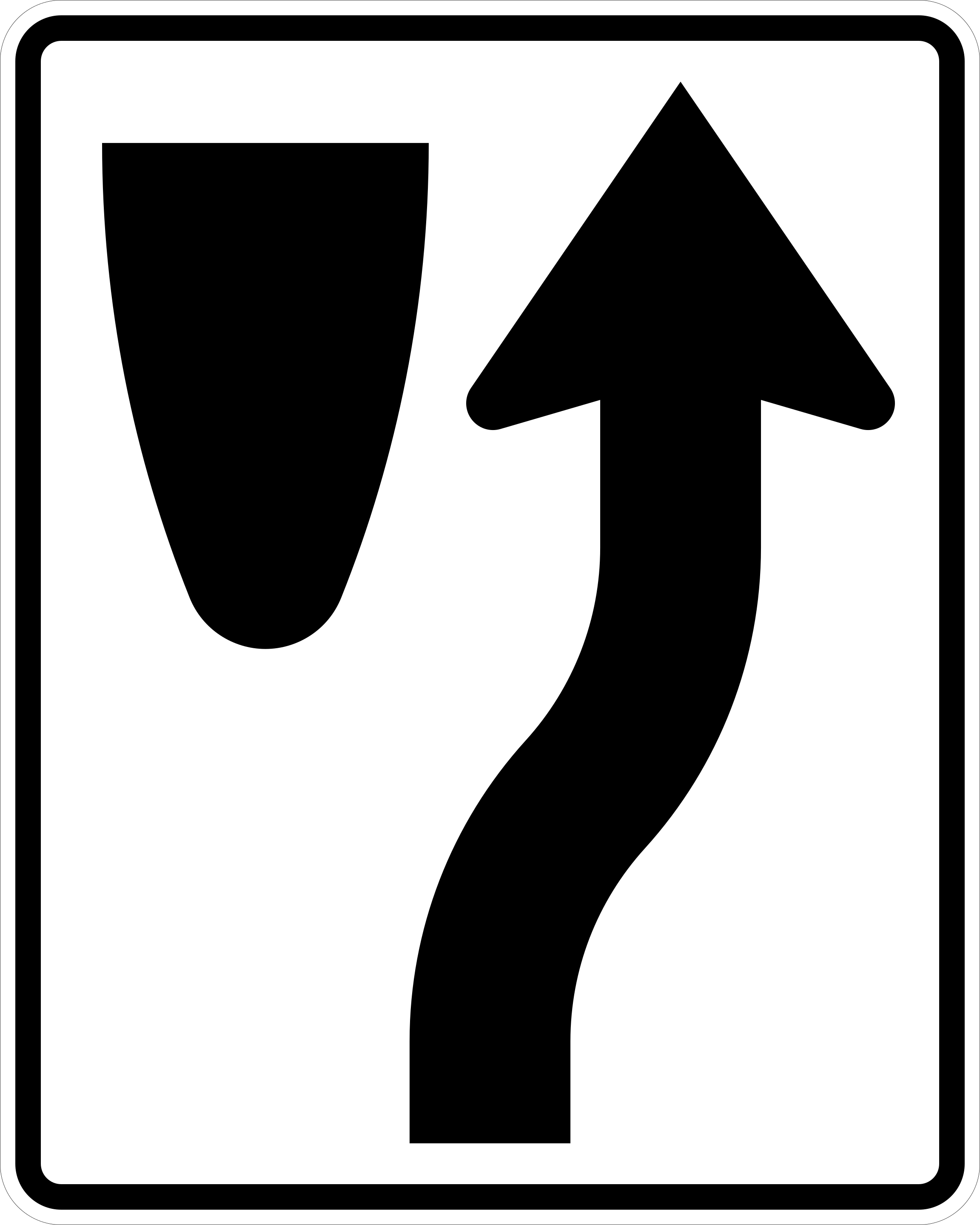
19. What should you do when this sign appears beside a traffic island or median?
- Use the center lane for a two-way left turn
- Move left and pass the obstruction on its left side
- Stop and wait for a green arrow before continuing
- Stay to the right of the island, median, or obstruction
Show answer
Stay to the right of the island, median, or obstruction. The keep-right instruction directs traffic around an obstruction, so the vehicle should remain on its right side. Moving left could place the driver in the wrong path or against an opposing flow. A green arrow is not required by this sign, and a center turn lane serves a different purpose. The practical cue is to locate the island or median, reduce speed if needed, and follow the arrow around the safe side while staying within the roadway.
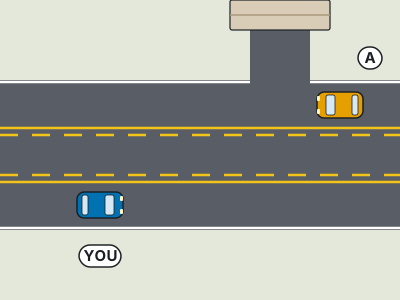
20. What is the permitted purpose of a center lane marked for two-way left turns?
- Traveling continuously as a normal lane
- Passing slower traffic straight through
- Long-term parking between intersections
- Left turns from either direction
Show answer
Left turns from either direction. A center lane between opposing traffic lanes may be reserved for left turns in either direction. Drivers use it to prepare for a left turn onto another roadway or driveway, not as a through lane for passing or ordinary travel. Parking there blocks a lane intended for turning vehicles and creates a conflict with traffic approaching from the opposite direction. Look for the parallel solid and dashed yellow lines and any white turn arrows. Enter only for the left-turn maneuver, then leave the center lane as soon as that maneuver is complete.
Study this in the handbook: Lines and lane markings
QualitySpace is expanding to Minnesota
We are a California-based independent insurance brokerage working on licensing in more states. We cannot help with Minnesota insurance yet. Leave your email and we will let you know when we can.
Every question is written from the official Minnesota Driver's Manual. Need paper? Printable MN practice test with answer key.
Last verified 2026-10-05. How we check every question · Study all 208 as flashcards
Frequently asked questions
How many questions are on this Minnesota practice test?
This fixed set has 20 questions. It is test 1 of 10 from the 208 question Minnesota bank.
How does this fixed test relate to the full Minnesota bank?
Each numbered test is a fixed set of questions in a fixed order, so you can retake the same test later and compare. Every test mixes road signs and the other topics in about the same proportion as the full bank. Tests 1 to 10 together cover 200 of the 208 questions in the Minnesota bank, each once. The full practice page mixes the whole bank at random.
Last verified 2026-10-05. See the Minnesota DMV facts page for sourced state details.
Return to the full Minnesota practice test · Study road signs