
Test 10 of 10 · 20 questions · Free 2026
MN Permit Practice Test 10
Jump to the test ↓A fixed 20 question set from the Minnesota bank with answers and plain English explanations.
Question 1 of 20 · 0 right so far
All 20 questions in test 10
Every question below comes from the Minnesota question bank on this page. Open a question to see the correct answer and the explanation. Nothing here is hidden behind a signup.
1. What must you do before entering a roundabout?
- Stop inside the circle before selecting an exit
- Yield to vehicles already circulating from the left
- Enter first because circulating traffic must yield
- Change lanes after entering to reach any exit
Show answer
Yield to vehicles already circulating from the left. Entering traffic must yield to vehicles already in the roundabout and wait until traffic from the left has cleared. Once inside, drive counterclockwise toward your exit. Stopping in the circle interrupts traffic, and circulating vehicles do not yield to a vehicle that has not entered. Lane changes within the roundabout are also prohibited, so choose the needed lane before arrival when the design has multiple lanes. Scan left, reduce speed, and be prepared to stop at the entry line if a circulating vehicle has priority.
Study this in the handbook: Signaling, turns, roundabouts and U turns
2. When must headlights be turned on for the normal daily cycle?
- At sunset and continuously until sunrise
- Only at midnight and during the morning commute
- Only when driving on an unlit freeway
- From sunrise until sunset
Show answer
At sunset and continuously until sunrise. Minnesota requires headlights from sunset through sunrise, so the normal cycle begins when daylight ends and continues until it returns. The unlit-freeway choice is too narrow because the requirement is based on time as well as other conditions. Headlights are also needed in rain, snow, hail, sleet, fog, or when the road cannot be seen clearly for at least 500 feet. Turn them on before sunset rather than waiting for darkness to deepen. The cue is sunset to sunrise, with poor visibility adding more situations that require them.
Study this in the handbook: Following distance, night driving and freeways
3. If your headlights suddenly go out on a dark road, which action is recommended first?
- Stop in the traffic lane and turn off every electrical system
- Use the parking lights, hazard warning lights, or turn signals and guide the vehicle off the road
- Accelerate until another vehicle illuminates the roadway
- Open the hood immediately while the vehicle is moving
Show answer
Use the parking lights, hazard warning lights, or turn signals and guide the vehicle off the road. A sudden loss of headlights does not mean you should remain exposed in a travel lane. Try the parking lights, hazard warning lights, or turn signals, since one may still provide enough illumination to guide you away from danger. On a dark, deserted road, reduce speed and keep the vehicle on the pavement until moving safely onto the shoulder. The choice to accelerate is hazardous because it shortens reaction time in darkness. Think of the remaining lights as a temporary guide, then reach a safe stopping place rather than attempting to continue normally.
Study this in the handbook: Blowouts, brake failure and other vehicle emergencies
4. What action is prohibited inside a Minnesota roundabout?
- Changing lanes
- Yielding to vehicles already circulating
- Following the lane selected before entry
- Exiting when the driver's route is reached
Show answer
Changing lanes. Once inside a Minnesota roundabout, a driver must not stop, pass, or change lanes. Lane selection belongs before entry, especially in a multilane roundabout where signs indicate which lane serves each movement. Yield to vehicles already circulating, enter only after traffic from the left has cleared, and continue around to the appropriate exit. Changing lanes within the circle can cut across another vehicle’s path and defeats the predictable design. Choose the lane early, hold it through the roundabout, and signal as needed when leaving so the next driver understands the exit movement.
Study this in the handbook: Signaling, turns, roundabouts and U turns
5. What should a driver maintain between the vehicle and the vehicle ahead?
- A safe following distance
- A fixed distance of exactly one car length at every speed
- No gap when traffic is moving below the speed limit
- A position beside the other vehicle's rear wheel
Show answer
A safe following distance. Minnesota requires a driver to maintain a safe distance from the vehicle ahead. The gap must give the driver time and space to react if the lead vehicle slows or stops, so a single car length cannot be safe at every speed or in every condition. Eliminating the gap in slow traffic removes that reaction space, and driving beside a rear wheel is a lane-position tactic rather than following distance. Use the cue of changing risk: increase the space when speed, weather, traffic, or road surface makes stopping harder.
Study this in the handbook: Emergency vehicles, the Move Over Law and traffic stops
6. What must a driver do after seeing a stop sign?
- Yield without stopping whenever the driver can see both directions
- Slow down only if a vehicle is approaching from the left
- Stop beyond the crosswalk so the front wheels enter the intersection
- Come to a complete stop and remain stopped until priority traffic clears
Show answer
Come to a complete stop and remain stopped until priority traffic clears. A stop sign requires a complete stop. The vehicle remains stopped until pedestrians and vehicles with the right of way have cleared the intersection, after which the driver proceeds cautiously. Slowing only for traffic from one direction overlooks people and vehicles approaching elsewhere. Stopping past the crosswalk can put the vehicle in the crossing area, and a clear view does not cancel the stop requirement. The cue is the octagonal sign: stop at the stop line, before the crosswalk, or before entering the intersection, then check all relevant traffic before moving.
Study this in the handbook: Sign colors, shapes and regulatory signs
7. What hazard is indicated by this yellow signal symbol?
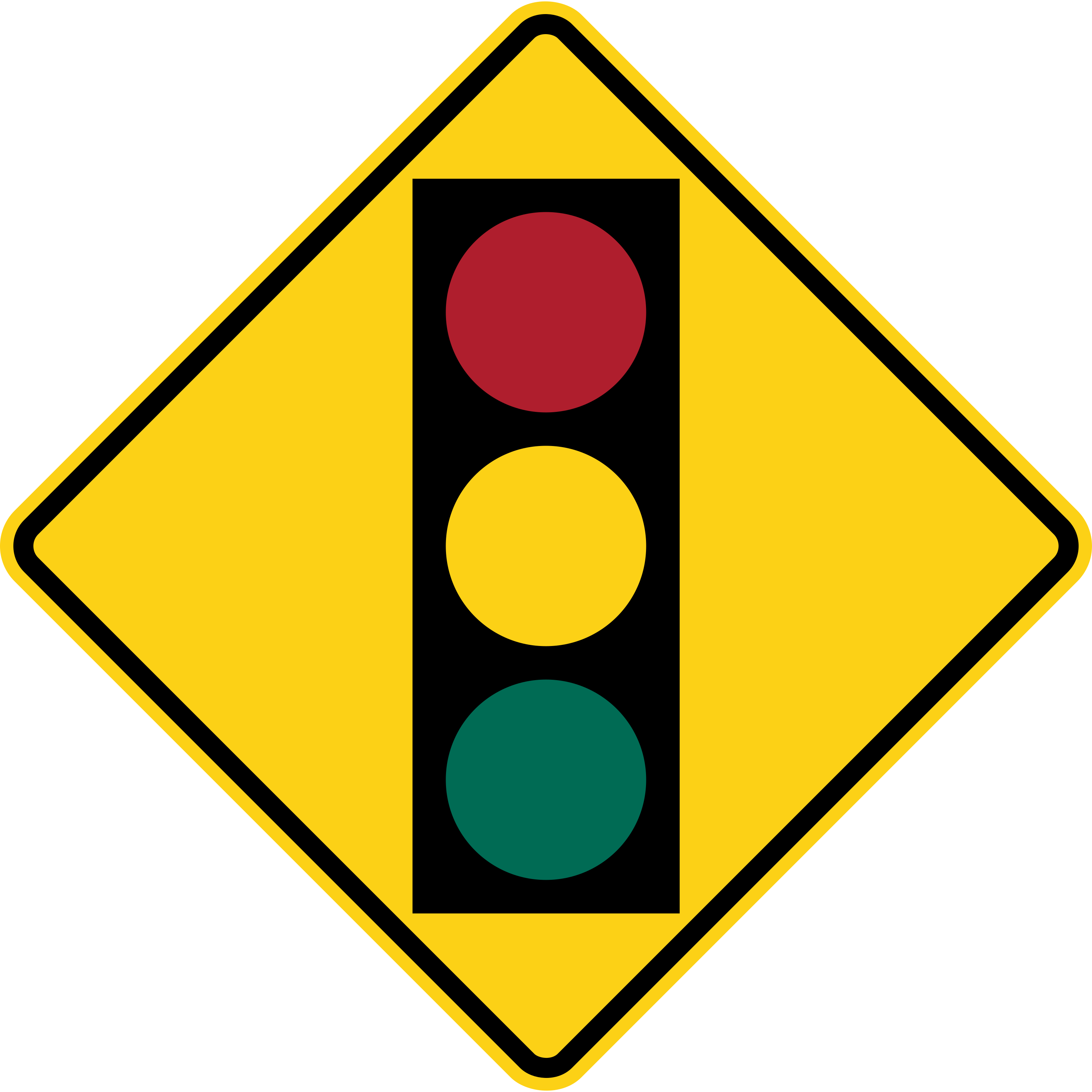
- A lane that is reserved for buses
- A railroad crossing immediately at the sign
- A school crosswalk that requires a full stop now
- A traffic light at the next intersection
Show answer
A traffic light at the next intersection. The signal-ahead warning tells the driver that a traffic light is located at the next intersection. It is advance information, so the driver should watch for the signal and be ready to respond, not stop automatically at the warning sign itself. A railroad crossing requires railroad symbols and devices, a school warning uses a pentagon, and bus restrictions use lane signs. Use the extra distance to check traffic, identify the stop line, and adjust speed smoothly if the light changes.
8. Under Minnesota law as revised in 2025, what is the license revocation period for refusing a required chemical test when the driver has no qualified prior impaired driving incidents in the past 20 years?
- A 30-day suspension
- Not less than one year
- A warning with no effect on driving privileges
- Exactly six years
Show answer
Not less than one year. Minnesota moved its implied consent revocation periods into section 171.178 in 2025. A driver who refuses the test and has no qualified prior impaired driving incidents within the past 20 years loses the license for not less than one year. With one or more qualified prior incidents, full privileges return only after the driver uses an ignition interlock device for a set period, which can run two, six, or ten years depending on the record. Test refusal can also be charged as a crime. The 30-day figure belongs to the underage no-tolerance suspension.
Study this in the handbook: Implied consent and DWI penalties
9. What does Minnesota's posted speed limit represent?
- The minimum speed required in every condition
- The maximum speed allowed on that road
- A recommended speed that may be exceeded when traffic is light
- A speed that applies only when no warning signs are present
Show answer
The maximum speed allowed on that road. Minnesota describes a posted speed limit as the maximum speed allowed on that road. It is not merely a suggestion that can be exceeded when traffic is light, and it does not become a minimum requirement. The basic speed law still requires a reasonable speed for weather, traffic, and road conditions, so the posted number is an upper boundary rather than a promise that the road is safe at that pace. A driver should scan for a lower posted limit, then reduce speed when conditions worsen. The practical cue is maximum allowed speed, not automatic safe speed.
Study this in the handbook: Speed limits and the basic speed law
10. What does a WRONG WAY sign indicate about your vehicle's direction?
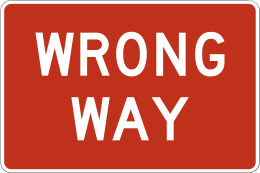
- A rough surface begins beyond the sign
- You are approaching a permitted passing zone
- The lane is reserved for trucks during daylight
- You have entered a lane of oncoming traffic
Show answer
You have entered a lane of oncoming traffic. A WRONG WAY sign tells you that you have entered a lane of oncoming traffic and are traveling in the wrong direction. A permitted passing zone is the opposite message, since the danger here is the direction of travel itself. The truck lane and rough surface choices describe restrictions or road conditions this sign does not communicate. The manual pairs this sign with DO NOT ENTER, which means do not enter that lane or road if the sign is facing you. Treat WRONG WAY as an urgent warning that your vehicle is facing traffic coming toward it.
Study this in the handbook: Sign colors, shapes and regulatory signs
11. Below 0.08 percent, when can a Minnesota driver of a regular car still be arrested for DWI?
- At 0.04 percent or more, if an officer can prove alcohol caused driving errors
- Never below 0.08 percent
- Only at exactly 0.07 percent
- Only if the car is parked
Show answer
At 0.04 percent or more, if an officer can prove alcohol caused driving errors. Minnesota's DWI line is 0.08 percent, or 0.04 percent in a commercial vehicle. The manual adds that if an officer can prove alcohol caused the driver to commit driving errors, the driver can be arrested for DWI with an alcohol concentration as low as 0.04 percent. Saying never below 0.08 ignores this. A single exact number or a parked car is not the condition. The law also covers off-road recreational vehicles and motorboats.
Study this in the handbook: How alcohol affects you and the DWI law
12. A Minnesota driver under 21 is convicted of driving with a detectable amount of alcohol for the first time. How long is the suspension?
- 180 days
- 90 days
- 30 days
- A full year
Show answer
30 days. It is illegal for anyone under 21 to operate a motor vehicle with any detectable amount of alcohol. A first conviction brings a 30 day suspension of driving privileges, and a second conviction brings a 180 day suspension. Ninety days is the first adult DWI revocation minimum, and one year the second. Vanessa's Law also applies to teens convicted of an alcohol-related violation, and it works differently for a provisional license holder than for an unlicensed teen.
Study this in the handbook: How alcohol affects you and the DWI law
13. What score must an applicant earn to pass Minnesota's Class D written test?
- 70 percent
- 75 percent
- 80 percent
- 90 percent
Show answer
80 percent. The Class D written test requires a score of 80 percent to pass. The 70 and 75 percent choices set the bar too low, while 90 percent demands more than the manual specifies. This score requirement is separate from the test format, identification check, and daily testing limit. Prepare for both traffic laws and road signs, then use 80 percent as the number to remember when evaluating the result.
Study this in the handbook: The written test, vision screening and road test
14. If windshield wipers fail during heavy rain, what should the driver do?
- Brake hard in the lane and leave the vehicle there
- Slow down, turn on hazard warning lights, and pull off to a safe location
- Speed up so the rain passes over the windshield faster
- Turn off all lights and continue at the posted speed
Show answer
Slow down, turn on hazard warning lights, and pull off to a safe location. Wiper failure during heavy rain removes a major part of the driver’s view, so speed should come down immediately. Hazard warning lights alert nearby traffic while the driver looks for a safe place away from the travel path. Sudden braking can create a rear-end collision, particularly when vehicles are following. Increasing speed does not restore visibility and makes any hidden obstacle harder to handle. Treat the loss of wipers as a visibility emergency: warn others, reduce pace, and leave the roadway when a safe location is available.
Study this in the handbook: Blowouts, brake failure and other vehicle emergencies
15. What credit does a Minnesota driver receive when upgrading from a provisional license with a clean record?
- No credit
- A free license
- A $20 credit
- A $3.50 credit toward the fee
Show answer
A $3.50 credit toward the fee. If you upgrade from a provisional license with no violations on your record, you receive a $3.50 credit toward the license fee. If you are under 21 the license is marked Under 21, expires on your 21st birthday, and then expires every four years on your birthday. A driver with violations on the provisional record does not receive the credit, so the $3.50 is tied to that clean record rather than given to everyone. The credit reduces the fee; it does not make the new license free.
Study this in the handbook: Provisional license limits, Vanessa's Law and the under 21 license
16. During the first six months of a Minnesota provisional license, how many passengers under 20 who are not immediate family members may ride without a parent or guardian accompanying the driver?
- Any number of passengers under age 20
- Two passengers under age 20
- Three passengers under age 20
- One passenger under age 20
Show answer
One passenger under age 20. For the first six months, a provisional license holder may have only one passenger under 20 unless accompanied by a parent or guardian. The choices “Two passengers under age 20” and “Three passengers under age 20” increase the number beyond the first-period limit and belong to neither the stated rule nor its exception. The choice “Any number of passengers under age 20” removes the passenger restriction entirely. Immediate family members under 20 are treated separately under the manual's note, so do not count them the same way as unrelated young passengers. Before starting the trip, identify who is riding and whether the required adult exception is present.
Study this in the handbook: Provisional license limits, Vanessa's Law and the under 21 license
17. During the second six months of a Minnesota provisional license, how many passengers under 20 who are not immediate family members may ride without a parent or guardian accompanying the driver?
- One
- Two
- No more than three
- No numerical limit
Show answer
No more than three. The second six-month period permits no more than three passengers under 20 unless a parent or guardian accompanies the provisional driver. The choice “One” is the tighter limit for the first six months. The choice “Two” understates the allowance, while the choice “No numerical limit” ignores the continuing restriction. The timing matters, so a driver cannot apply the second-period number immediately after receiving the license. Keep the license date in mind, count young passengers before departure, and remember that the manual separately allows immediate family members under 20 during both periods.
Study this in the handbook: Provisional license limits, Vanessa's Law and the under 21 license
18. Which single unit vehicles are excluded from a Minnesota Class D license?
- Those with a gross vehicle weight of 26,001 pounds or more
- Any vehicle with a trailer
- Pickups over 6,000 pounds
- Vans carrying more than five people
Show answer
Those with a gross vehicle weight of 26,001 pounds or more. With a Class D license, the standard Minnesota license, you may drive all single unit vehicles such as cars, pickups and small trucks, with three exceptions: those with a gross vehicle weight of 26,001 pounds or more, vehicles designed to carry more than 15 passengers including the driver, and vehicles that carry hazardous materials. Qualifying farm trucks within 150 miles of the farm and authorized emergency vehicles of any weight are also allowed on a Class D license.
19. What does a solid white line beside your lane generally tell you?
- Change lanes immediately before the line ends
- Opposing traffic is directly beside you
- Avoid changing lanes across the line
- Passing is required in that lane
Show answer
Avoid changing lanes across the line. White lines separate lanes moving in the same direction, and a solid white line means you should not change lanes across it. It can also mark a crosswalk, stop line, parking stall, or roadway edge, so consider the surrounding layout before moving. It does not divide opposing traffic, which is the role of yellow lines. A solid boundary is not an instruction to cross before it ends. Treat the line as a lane boundary and remain positioned until a legal opening or broken marking permits a move.
Study this in the handbook: Lines and lane markings
20. A Minnesota driver under 18 wants to move from a provisional license to an under 21 license. What must the driver certify?
- At least 50 more night hours
- A second road test
- At least 10 hours of driving supervised by a licensed driver at least 21
- A signed letter from a teacher
Show answer
At least 10 hours of driving supervised by a licensed driver at least 21. To get the under 21 Class D license, a driver must be at least 18 or have held a provisional license for 12 consecutive months with no alcohol, controlled substance or crash-related convictions and no more than one other moving violation. A driver under 18 must also certify at least 10 hours of driving supervised by a licensed driver at least 21. Fifty extra night hours, a second road test and a teacher's letter are not requirements.
Study this in the handbook: Provisional license limits, Vanessa's Law and the under 21 license
QualitySpace is expanding to Minnesota
We are a California-based independent insurance brokerage working on licensing in more states. We cannot help with Minnesota insurance yet. Leave your email and we will let you know when we can.
Every question is written from the official Minnesota Driver's Manual. Need paper? Printable MN practice test with answer key.
Last verified 2026-10-05. How we check every question · Study all 208 as flashcards
Frequently asked questions
How many questions are on this Minnesota practice test?
This fixed set has 20 questions. It is test 10 of 10 from the 208 question Minnesota bank.
How does this fixed test relate to the full Minnesota bank?
Each numbered test is a fixed set of questions in a fixed order, so you can retake the same test later and compare. Every test mixes road signs and the other topics in about the same proportion as the full bank. Tests 1 to 10 together cover 200 of the 208 questions in the Minnesota bank, each once. The full practice page mixes the whole bank at random.
Last verified 2026-10-05. See the Minnesota DMV facts page for sourced state details.
Return to the full Minnesota practice test · Study road signs