
Test 6 of 10 · 20 questions · Free 2026
MN Permit Practice Test 6
Jump to the test ↓A fixed 20 question set from the Minnesota bank with answers and plain English explanations.
Question 1 of 20 · 0 right so far
All 20 questions in test 6
Every question below comes from the Minnesota question bank on this page. Open a question to see the correct answer and the explanation. Nothing here is hidden behind a signup.
1. When is driving below a posted minimum speed limit illegal under normal conditions?
- Whenever the driver is traveling below that posted minimum
- Only when a police officer is directing traffic
- Only on roads with a 55 mph maximum
- Never, because minimum limits are advisory
Show answer
Whenever the driver is traveling below that posted minimum. The manual says some roads have minimum speed limits and that it is illegal to drive slower than the posted minimum under normal conditions. The rule does not depend on a police officer directing traffic, and it is not tied to roads with a particular maximum such as 55 mph. Calling minimum limits advisory turns a legal requirement into a suggestion. Minimum limits may appear on interstate freeways with controlled access, and the manual says not to drive slower than the posted minimum unless bad weather or other conditions make it unsafe to drive that fast.
Study this in the handbook: Speed limits and the basic speed law
2. What do Minnesota sign shapes and colors help a driver do before reading a sign up close?
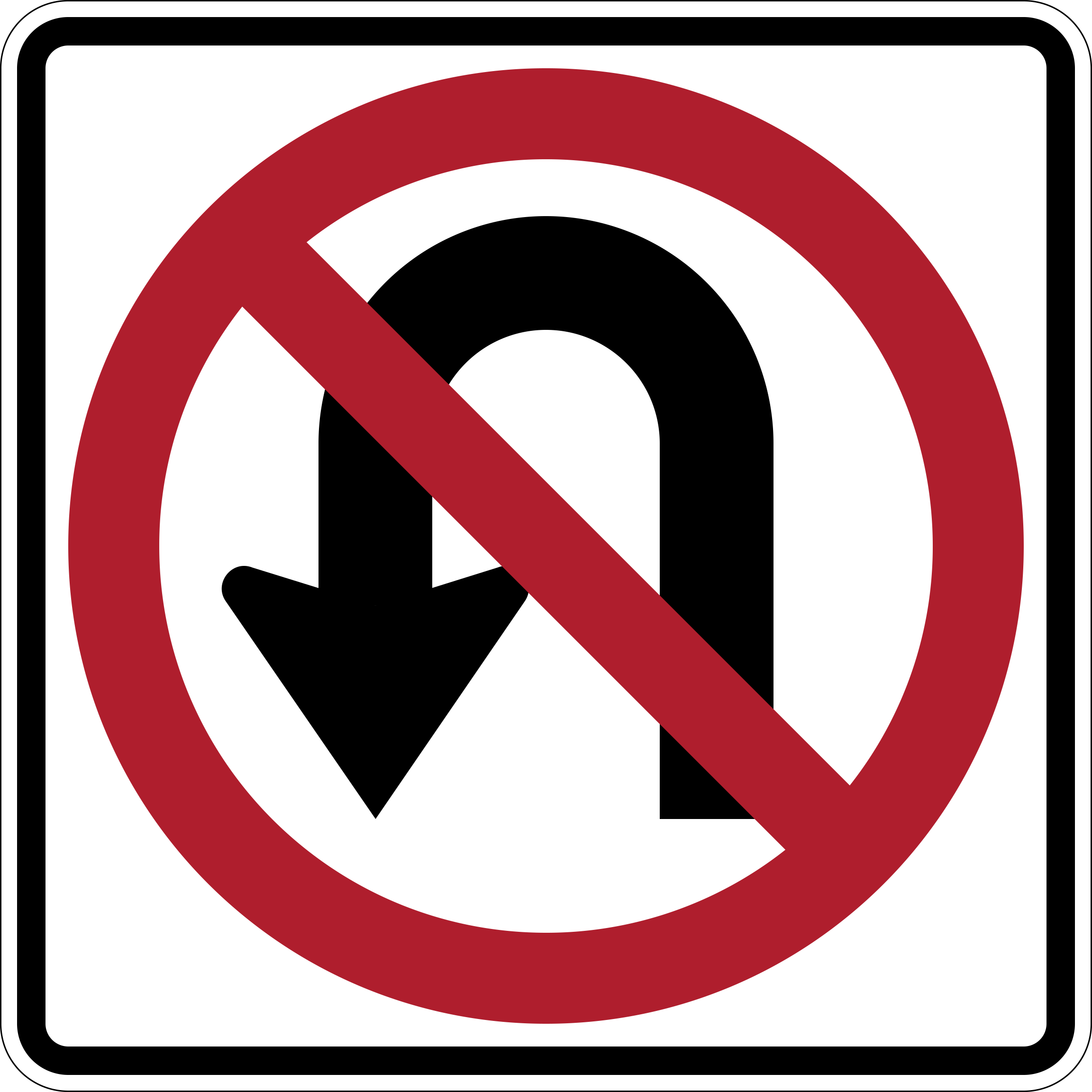
- Know that the sign applies only during construction
- Identify the exact fine for violating the sign
- Determine the distance to the nearest service station
- Get a general idea of what the sign means
Show answer
Get a general idea of what the sign means. Minnesota codes sign shapes and colors so drivers can get a general idea of a sign's meaning before reading its wording up close. The visual system is an early recognition aid, not a substitute for the symbol, message, or roadway conditions. The choices about fines, service-station distance, and construction timing add information that this passage does not assign to every sign. Use the outline and color to form an initial expectation, then confirm the instruction by reading the sign and checking lane markings or signals. The cue is quick classification first, detailed interpretation second.
Study this in the handbook: Sign colors, shapes and regulatory signs
3. What does a steady downward green arrow over a reversible lane tell you?
- You must leave that lane immediately
- The lane is reserved for emergency vehicles
- You may drive in the lane below it
- Traffic may use the lane only to pass
Show answer
You may drive in the lane below it. A steady downward green arrow authorizes travel in the lane directly beneath the signal. It is a lane use instruction, not a direction to leave the lane, an emergency only reservation, or a special passing permission. A steady yellow X means a lane control change is being made and you should prepare to move safely into another lane, while a steady red X means you cannot drive in the lane. You must also follow all other traffic signs and signals that apply.
Study this in the handbook: Traffic signals, lane use signals and ramp meters
4. If the vehicle behind you is following too closely, what response does the manual recommend?
- Speed up until you are beyond its headlights
- Brake sharply to force it to increase space
- Slow down slightly and allow that vehicle to pass
- Move into the oncoming lane to block the driver
Show answer
Slow down slightly and allow that vehicle to pass. A tailgater creates a stressful situation, but retaliation can turn it into a crash. Minnesota recommends slowing slightly and allowing the following vehicle to pass. That gives the impatient driver an opportunity to move ahead while reducing the chance that your own vehicle will be struck if traffic changes. Sharp braking is dangerous, and racing away or blocking the lane escalates the encounter. Keep your attention on the road ahead, preserve control, and let the other driver create distance by going around when conditions permit.
Study this in the handbook: Following distance, night driving and freeways
5. A green light is showing, but a pedestrian is crossing in front of your vehicle. What must you do?
- Yield to the pedestrian before proceeding
- Proceed because the green light always overrides the crossing
- Sound the horn until the pedestrian leaves the crosswalk
- Drive around the pedestrian in the opposing lane
Show answer
Yield to the pedestrian before proceeding. A green light permits movement only when the intersection is clear. A pedestrian already crossing in front of the vehicle has priority in that conflict, so the driver must wait and yield before proceeding. The signal does not erase the duty to check the intersection. Sounding the horn is not a substitute for giving way, and entering the opposing lane to go around a person creates an additional hazard. The practical cue is the occupied path ahead: pause, allow the pedestrian to clear, and then continue after checking the rest of the intersection.
Study this in the handbook: Traffic signals, lane use signals and ramp meters
6. How long must a Minnesota applicant age 19 or older hold an instruction permit before the road test?
- One year
- At least three months, compared with six months for younger applicants
- No permit is required at 19
- Two weeks
Show answer
At least three months, compared with six months for younger applicants. After the required six months of practice driving, or three months if you are 19 years old or older, you may take the road test. Applicants 18 and older must be supervised by a driver aged 18 or older while on the permit, and everyone in the vehicle must wear a seat belt or child restraint. Road test scheduling is covered in Chapter 9 of the manual.
Study this in the handbook: The instruction permit and provisional license
7. What information do most yellow warning signs provide?
- The name of the next county road
- A legal speed limit that applies only to commercial vehicles
- The location of a fuel or lodging service
- A possible hazard ahead
Show answer
A possible hazard ahead. Warning signs alert drivers to possible hazards ahead, and most of them are yellow. Their purpose is to prompt recognition and a timely response, such as reducing speed or preparing for a change in the road. A speed limit is a regulatory message, while fuel and lodging services use motorist service signs. A county road name is route or guidance information. The practical cue is the yellow diamond: expect something about the roadway or traffic pattern to require attention, then adjust early instead of waiting until the hazard is immediately alongside the vehicle.
Study this in the handbook: Warning, school, construction and guide signs
8. When towing a trailer or camper in wet or windy weather, how should the driver adjust speed?
- Use cruise control so the trailer follows smoothly
- Drive faster to keep the trailer stable
- Maintain the posted limit regardless of weather
- Slow down more than usual for those conditions
Show answer
Slow down more than usual for those conditions. Extra weight changes how a vehicle responds to wind and rain, and a trailer can make steering and stopping more difficult. The manual therefore calls for slowing down more than a driver normally would in the same weather. Driving faster or holding the posted limit treats the sign as a target when conditions make control harder. The manual also says to allow plenty of room for turns, since long trailers swing closer to the edge of the road, and to watch the cooling system when towing extra weight.
9. When can Minnesota penalties become more severe based on alcohol concentration?
- At 0.08 percent or above
- At 0.04 percent or above
- At 0.16 percent or above
- At 0.12 percent or above
Show answer
At 0.16 percent or above. Minnesota lists 0.16 percent or greater as a threshold that can remove the option of receiving a work permit after a first offense. That figure is higher than the 0.04 percent commercial-vehicle threshold and the 0.08 percent figure used in the ordinary DWI arrest rule. The 0.12 percent choice is not the concentration named for this restriction. Separate the concentration that triggers arrest from the higher concentration tied to tougher consequences. When reviewing an alcohol question, look for whether it asks about basic arrest, commercial operation, or an enhanced penalty, then match the number to that category.
Study this in the handbook: Implied consent and DWI penalties
10. You approach a steady yellow traffic light and can stop safely. What should you do?
- Enter the intersection quickly before the signal changes
- Turn on hazard lights and continue without slowing
- Treat the light as a flashing red signal and stop, then go immediately
- Stop before entering the intersection
Show answer
Stop before entering the intersection. A steady yellow light warns that the signal is about to turn red. When stopping can be done safely, the driver should remain out of the intersection and stop before entering it. The choice “Enter the intersection quickly before the signal changes” encourages rushing into a changing signal, while the flashing-red choice adds a stop-sign procedure that does not describe a steady yellow. Hazard lights do not give permission to continue. The useful cue is the combination of color and stopping distance: yellow means caution, and a safe stop takes priority over trying to beat the red light.
Study this in the handbook: Traffic signals, lane use signals and ramp meters
11. A 15 year old in Minnesota wants an instruction permit. What driver education must be done first?
- The full behind-the-wheel course
- 30 hours of classroom instruction plus enrollment in behind-the-wheel instruction
- No driver education until the road test
- Six hours of behind-the-wheel only
Show answer
30 hours of classroom instruction plus enrollment in behind-the-wheel instruction. To get a Minnesota instruction permit, an applicant must be at least 15 and must complete 30 hours of classroom instruction and be enrolled in behind-the-wheel instruction, or be in a concurrent course with the first 15 classroom hours done. Finishing the whole behind-the-wheel course is not required first, because enrollment is enough. Skipping driver education applies only to applicants 18 or older. Six hours of behind-the-wheel is part of the Vanessa's Law reinstatement steps, not the permit rule.
Study this in the handbook: The instruction permit and provisional license
12. Which of these makes Minnesota DWI penalties more severe?
- Having a passenger over 65
- Having a child younger than 16 in the vehicle at the stop
- Driving a car with an automatic transmission
- Being stopped on a weekday
Show answer
Having a child younger than 16 in the vehicle at the stop. Minnesota lists factors that make DWI penalties more severe: prior DWI arrests, an alcohol concentration of 0.16 percent or above, a child younger than 16 in the vehicle at the time of the stop, being under 21, and refusing a pre-arrest breath test. An older passenger, the type of transmission and the day of the week are not aggravating factors in the manual.
Study this in the handbook: Implied consent and DWI penalties
13. What roadway pattern does the winding-arrow sign identify?

- A road that winds back and forth
- A single sharp turn followed by a straight road
- A bridge with a reduced clearance
- A lane that changes direction at each signal
Show answer
A road that winds back and forth. The winding-road warning indicates a series of bends rather than one isolated corner. Slow to a safe or posted advisory speed and maintain control through the sequence. The sign does not describe bridge clearance, signal timing, or a single turn followed by a straight segment. Look beyond the first bend because later curves may hide traffic, animals, or changing pavement. The practical cue is to choose a manageable speed before the first curve and hold it smoothly until the winding section ends.
14. A white sign that posts a speed limit belongs to which category?
- Construction warning signs
- Motorist services signs
- Regulatory signs
- Historic and recreational signs
Show answer
Regulatory signs. A speed limit sign is regulatory because it directs drivers to obey a traffic law. The posted number is the maximum speed allowed on that road, and some controlled-access interstate freeways may also display a minimum speed. Blue signs point to services, orange signs control construction areas, and brown signs identify historic or recreational destinations. Reading the white rectangular sign is therefore an instruction to regulate your driving, not merely information about what lies ahead. Apply the displayed limit while also considering conditions that require a slower speed.
Study this in the handbook: Sign colors, shapes and regulatory signs
15. Which vehicles does Minnesota list as examples of emergency vehicles covered by the Move Over Law?
- Only snowplows and road maintenance vehicles
- Only privately owned passenger cars
- Tow trucks, ambulances, fire trucks, and police cars
- Only buses carrying emergency workers
Show answer
Tow trucks, ambulances, fire trucks, and police cars. Minnesota names tow trucks, ambulances, fire trucks, and police cars as examples of emergency vehicles in the Move Over Law section. The list matters because the protective response is not limited to a police car or fire truck. A service vehicle stopped with warning lights can also create a roadside danger. The other choices omit covered vehicle types or invent categories that the passage does not identify. When you see flashing lights at a roadside scene, treat the vehicle as protected, reduce nearby risk, and look for a safe way to create space before passing.
Study this in the handbook: Emergency vehicles, the Move Over Law and traffic stops
16. A traffic signal at an intersection is not functioning. How should you approach the intersection?
- Treat it like an uncontrolled intersection and proceed only after yielding as required
- Treat it like a stop sign and wait for a police officer
- Continue through without slowing because no signal is active
- Give priority only to vehicles on the larger roadway
Show answer
Treat it like an uncontrolled intersection and proceed only after yielding as required. Minnesota treats a failed signal as an uncontrolled intersection, so normal right-of-way rules govern your movement. That is different from the stop-sign response in the choice “Treat it like a stop sign and wait for a police officer”, which would impose a full stop on every approach even when the manual does not say to do that. Slow down, scan for vehicles, bicyclists, and pedestrians, and yield according to who has priority. A dark signal is a reason to increase observation, not permission to drive through without checking. The useful cue is simple: signal failure changes the type of intersection, while it does not erase the duty to yield.
Study this in the handbook: Traffic signals, lane use signals and ramp meters
17. What is Vanessa's Law in Minnesota?
- A law about school bus stop arms
- A law setting the 0.08 limit
- A law requiring child seats
- A law passed after a 15 year old unlicensed driver's crash killed a passenger, tightening consequences for underage driving violations
Show answer
A law passed after a 15 year old unlicensed driver's crash killed a passenger, tightening consequences for underage driving violations. Vanessa Weiss was killed before her 16th birthday in May 2003 while riding as a passenger in a vehicle driven by an unlicensed 15 year old, and Vanessa's Law was passed a year later in her memory. It applies to all teens who commit an impaired driving crime or a crash related moving violation. An unlicensed teen cannot get a permit or license until 18, and a provisional license holder waits until 18 or the end of the withdrawal period, whichever is longer.
Study this in the handbook: Provisional license limits, Vanessa's Law and the under 21 license
18. What should you do if the windshield wipers fail during heavy rain or snow?
- Slow down, activate hazard lights, and pull off the road safely
- Brake suddenly in the travel lane to warn vehicles behind you
- Speed up so the weather is behind you more quickly
- Continue at the same speed while watching through the side window
Show answer
Slow down, activate hazard lights, and pull off the road safely. A wiper failure removes an important part of your visibility system, so reduce speed and make your vehicle conspicuous with hazard warning lights. Pull off the road and reach a safe location as soon as possible. Sudden braking in the lane, listed in the choice “Brake suddenly in the travel lane to warn vehicles behind you”, can create a rear-end collision when following drivers have little warning. Do not treat the problem as something to overcome by driving faster. The immediate cue is visibility first: slow down, signal the hazard, and leave the moving stream when you can do so safely.
Study this in the handbook: Blowouts, brake failure and other vehicle emergencies
19. At about what weight does a Minnesota child outgrow a forward facing car seat?
- 20 pounds
- Typically 40 to 60 pounds, depending on the manufacturer
- Weight does not matter, only age
- 100 pounds
Show answer
Typically 40 to 60 pounds, depending on the manufacturer. Children older than 2 who exceed the rear facing limit must sit in a forward facing car seat until they reach its height or weight limit, typically 40 to 60 pounds depending on the manufacturer. A child from 4 to 9 who is too tall or heavy for the car seat must use a booster secured with a safety belt, and all children under 13 ride in the back when available.
Study this in the handbook: Seat belts, child seats, airbags and window rules
20. A pedestrian is in a marked crosswalk as you approach. What is the required response?
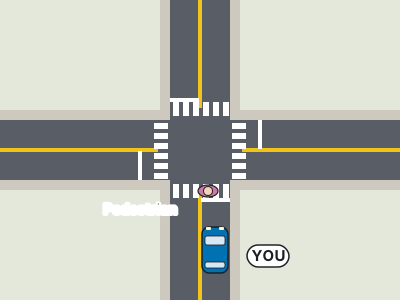
- Continue if your vehicle reaches the crosswalk first
- Stop and wait until the pedestrian has passed your lane
- Sound the horn and pass before the pedestrian moves farther
- Stop only when the crosswalk has a flashing beacon
Show answer
Stop and wait until the pedestrian has passed your lane. Minnesota requires a driver to stop for a pedestrian in either a marked or unmarked crosswalk and remain stopped until the person has passed the vehicle's lane. The choice “Continue if your vehicle reaches the crosswalk first” changes the rule into a race for space, but a driver's arrival first does not cancel the pedestrian's protection. The choice “Sound the horn and pass before the pedestrian moves farther” treats the horn as permission to proceed, which it is not. The choice “Stop only when the crosswalk has a flashing beacon” incorrectly limits the duty to crosswalks with special equipment. A useful cue is to look at the pedestrian's lane, stop before blocking the crossing, and wait until that lane is clear.
Study this in the handbook: Pedestrians, bicyclists and motorcycles
QualitySpace is expanding to Minnesota
We are a California-based independent insurance brokerage working on licensing in more states. We cannot help with Minnesota insurance yet. Leave your email and we will let you know when we can.
Every question is written from the official Minnesota Driver's Manual. Need paper? Printable MN practice test with answer key.
Last verified 2026-10-05. How we check every question · Study all 208 as flashcards
Frequently asked questions
How many questions are on this Minnesota practice test?
This fixed set has 20 questions. It is test 6 of 10 from the 208 question Minnesota bank.
How does this fixed test relate to the full Minnesota bank?
Each numbered test is a fixed set of questions in a fixed order, so you can retake the same test later and compare. Every test mixes road signs and the other topics in about the same proportion as the full bank. Tests 1 to 10 together cover 200 of the 208 questions in the Minnesota bank, each once. The full practice page mixes the whole bank at random.
Last verified 2026-10-05. See the Minnesota DMV facts page for sourced state details.
Return to the full Minnesota practice test · Study road signs