
Test 15 of 25 · 20 questions · Free 2026
MN Permit Practice Test 15
Jump to the test ↓A fixed 20 question set from the Minnesota bank with answers and plain English explanations.
Question 1 of 20 · 0 right so far
All 20 questions in test 15
Every question below comes from the Minnesota question bank on this page. Open a question to see the correct answer and the explanation. Nothing here is hidden behind a signup.
1. You are driving in a lane when a steady yellow X lights up above it. What will most likely come next?
- A green arrow for your lane
- A flashing yellow arrow
- A steady red X over that lane
- The lane opening to both directions
Show answer
A steady red X over that lane. A steady yellow X means you should prepare to move safely into another lane, because a lane-control change is being made in the lane below it. A steady red X will be displayed next, and you cannot be in the lane at that time. So use the yellow X as your warning to signal and change lanes now. It does not lead to a green arrow, and a flashing yellow arrow is a freeway signal with a different meaning.
Study this in the handbook: Traffic signals, lane use signals and ramp meters
2. You have four standard drinks over two hours. What happens to your alcohol concentration during that time?
- It stays level, since the liver keeps up with it
- It rises, since that is over one drink per hour
- It drops as long as you eat while drinking
- It stops rising after the second drink
Show answer
It rises, since that is over one drink per hour. The body generally eliminates alcohol at about one drink per hour, and the time over which you drink affects your alcohol concentration. If you have more than one standard drink per hour, your concentration will increase. Four drinks in two hours is twice that rate, so the level keeps climbing. The liver cannot speed up to keep pace, food does not make the level fall while you keep drinking, and it does not stop rising after a set number of drinks.
Study this in the handbook: How alcohol affects you and the DWI law
3. A driver tests at 0.05 percent alcohol and was weaving across lanes. The officer can prove alcohol caused the weaving. Can the driver be arrested for DWI?
- No, the limit is 0.08 for everyone
- Yes, errors caused by alcohol allow it
- No, only commercial drivers at 0.05
- Only if there was a crash
Show answer
Yes, errors caused by alcohol allow it. Minnesota's DWI limit is generally 0.08 percent. But if an officer can prove that alcohol caused the driver to commit driving errors, the driver can be arrested for DWI with an alcohol concentration as low as 0.04 percent. A 0.05 reading with alcohol-caused weaving fits that rule. Staying under 0.08 is not a safe harbor, and no crash is required.
Study this in the handbook: How alcohol affects you and the DWI law
4. This curve sign has a speed plate below it. What should you do?
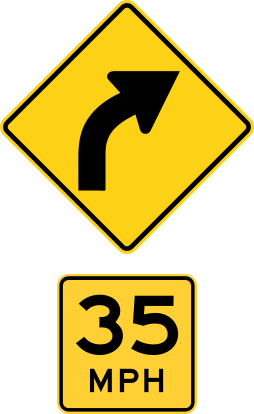
- Slow to the speed shown
- Keep the posted road speed
- Ignore the plate in dry weather
- Speed up to the plate speed
Show answer
Slow to the speed shown. A curve sign shows that the road curves in the direction indicated. When the sign displays a speed, slow to that indicated speed before you enter the curve. Keeping the regular posted limit can carry you wide or off the road. The plate applies in dry weather too; in rain or snow you may need to go even slower. Braking before the curve, not in it, helps keep the car stable.
Study this in the handbook: Warning, school, construction and guide signs
5. You want to turn left at an intersection where this sign is posted. What should you do?

- Go straight or right and find another route
- Turn left if no cars are coming
- Turn left after a full stop
- Turn left on a green arrow only
Show answer
Go straight or right and find another route. A red circle with a red slash across a symbol means you should not take that course of action. With a left-turn arrow under the slash, left turns are not allowed at this intersection. Clear traffic, a full stop, or a green light do not override the sign. Continue straight or turn right where allowed, then find another way to reach your destination. Regulatory signs like this must be obeyed, or you may receive a citation.
Study this in the handbook: Sign colors, shapes and regulatory signs
6. You plan to turn right into a driveway ahead. When should you start signaling?
- Just as you begin turning
- About 20 feet before it
- At least 100 feet before it
- Only if a car is behind you
Show answer
At least 100 feet before it. Minnesota requires you to turn on your signal at least 100 feet before turning, whether at an intersection or a driveway. That gives drivers behind you and pedestrians time to see what you plan to do and adjust. Signaling as you turn, or only 20 feet ahead, gives almost no warning. Signal even when you think no one is behind you, because bicyclists, pedestrians, and unseen cars rely on it too.
Study this in the handbook: Speed limits and the basic speed law
7. Smoke and flames come from under your hood after you pull over. What should you not do?
- Turn off the ignition
- Get out of the vehicle
- Move well away from the car
- Pour water on the fire
Show answer
Pour water on the fire. If smoke rises from beneath the hood, pull off the road, turn off the ignition, and get out right away. Minnesota warns not to use water to put out the fire, because it will actually spread the blaze. Moving well away from the car protects you if the fire grows. The other three actions are what you should do; throwing water on an engine fire is the mistake.
Study this in the handbook: Distraction, aggression, winter driving and skids
8. On a narrow road, trees block your view around a curve ahead. What may you do to warn others you are coming?
- Flash your high beams
- Turn on your hazard lights
- Use your horn
- Drive in the center of the road
Show answer
Use your horn. When you approach curves on narrow roads, or where brush and trees block your view, Minnesota says you can use your horn to warn other drivers or pedestrians that you are on the road. A short horn tap can be heard around the bend where lights cannot be seen. Hazard lights are for stopped or slow emergencies, and high beams do not carry around a corner. Driving in the center puts you in the path of oncoming traffic.
Study this in the handbook: Distraction, aggression, winter driving and skids
9. Your right wheels drift off the pavement onto the shoulder. What should you do?
- Swerve back onto the pavement as fast as you can
- Stay on the shoulder, ease off, then return
- Brake hard while on the shoulder
- Speed up and steer back sharply
Show answer
Stay on the shoulder, ease off, then return. If your wheels drift onto the shoulder, do not try to swerve back onto the pavement. Stay on the shoulder and slowly release the gas pedal. After you have slowed down, turn back onto the pavement and then speed up again. Jerking the wheel at speed can send you across the road into oncoming traffic. Hard braking on a loose shoulder can cause a skid, and speeding up makes the return more dangerous.
Study this in the handbook: Blowouts, brake failure and other vehicle emergencies
10. Why does Minnesota say never to leave a child alone in a parked vehicle?
- It is only dangerous during hot summer months
- It is fine for any stop shorter than 10 minutes
- It is safe as long as a window is cracked open
- The child could move the car or suffer heat or cold
Show answer
The child could move the car or suffer heat or cold. Never leave children or vulnerable adults alone in a motor vehicle. An unattended child could put the vehicle in motion and cause a crash, and temperatures inside a car can reach dangerous extremes, causing death or serious injury from heat or cold. The car could also be stolen or broken into with the child inside. The risk is not limited to summer, short stops are not safe, and a cracked window does not keep the inside cool.
Study this in the handbook: Seat belts, child seats, airbags and window rules
11. A highway work zone has no reduced speed limit signs posted. Which speed limit applies there?
- Whatever speed feels safe near the workers
- Ten miles per hour under the usual limit
- The speed of the traffic ahead of you
- The regular posted speed limit still applies
Show answer
The regular posted speed limit still applies. Many Minnesota work zones post reduced speed limits, and those lower limits must be obeyed. When no reduced limit is posted, the manual tells you to obey the regular posted speed limit. Disobeying the speed limit in a work zone results in a violation and a financial penalty. The manual also says to watch for workers and equipment, so choosing your own speed or copying other drivers is not the rule.
Study this in the handbook: Commercial vehicles, railroad crossings and work zones
12. You are stopped, waiting for oncoming traffic to clear so you can turn left. How should your front wheels point?
- Turned left so you can go quickly
- Angled slightly toward the center
- Straight ahead until you start
- Turned right toward the curb
Show answer
Straight ahead until you start. While you wait to turn, keep the wheels straight and your foot on the brake. If someone hits you from behind, straight wheels push you forward instead of swinging you into the oncoming lanes. Turning the wheels left early feels like it saves time, but it aims your car at the traffic you are waiting for. Angling toward the center does the same on a smaller scale. Pointing right toward the curb is not the rule either; wait with the wheels straight and turn only when the path is clear.
Study this in the handbook: Signaling, turns, roundabouts and U turns
13. Once inside a Minnesota roundabout, which direction do you travel?
- Counterclockwise to your exit
- Clockwise, island on your right
- The shortest way to your exit
- Clockwise in single-lane circles
Show answer
Counterclockwise to your exit. After you yield and enter, you drive counterclockwise around the roundabout until you reach your exit. That keeps the center island on your left and keeps all traffic flowing the same way. Going clockwise would put you head-on against everyone else in the circle, whether it has one lane or two. Taking a shortcut the other way to reach a nearby exit is never allowed; you follow the circle until your exit comes up.
Study this in the handbook: Signaling, turns, roundabouts and U turns
14. Your car has anti-lock brakes, and a deer jumps out ahead. Should you pump the brakes?
- Yes, pump them quickly
- Yes, but only on ice
- Release the brakes and coast
- No, press down firmly and steer
Show answer
No, press down firmly and steer. If you have anti-lock brakes, do not pump them as you would regular brakes. Instead, press down on the brake pedal and keep steering until you regain control. The system pumps the brakes for you far faster than you can, and you may feel the pedal pulse. Pumping on ice is also wrong with ABS. If you are not sure whether your car has ABS, check the owner's manual before you drive.
Study this in the handbook: Distraction, aggression, winter driving and skids
15. What happens to a vehicle when its tires hydroplane?
- The vehicle's brakes automatically engage on wet pavement
- The tires gain extra traction because water cools them
- Water lifts the tires off the road and they lose contact
- The tires become more firmly attached to the road surface
Show answer
Water lifts the tires off the road and they lose contact. Hydroplaning occurs when water collects under the tires and lifts them off the road surface. With the tires no longer contacting the pavement, the driver can lose the ability to brake, accelerate, or change direction. Cooling the tires does not create traction, and wet pavement does not activate the brakes. The choice “The tires become more firmly attached to the road surface” describes the opposite of the danger. The immediate cue is a loss of tire feel or control in standing water: take the foot off the gas, avoid abrupt inputs, and reduce speed on wet roads to lower the risk.
Study this in the handbook: Distraction, aggression, winter driving and skids
16. You reach the entry of a roundabout as a car already in the circle approaches from your left. What should you do?
- Enter first; you reached the line
- Wait until it passes, then enter
- Enter and make it slow down
- Stop inside the circle to let it by
Show answer
Wait until it passes, then enter. When entering a roundabout, yield to vehicles already in it, and do not enter until all traffic from the left has cleared. The car in the circle has the right of way, so wait for it to pass and then enter into a safe gap. Reaching the line first does not give you priority. Forcing the other car to slow can cause a crash, and you must never stop inside the roundabout.
Study this in the handbook: Signaling, turns, roundabouts and U turns
17. A Minnesota child is 18 months old and still fits within the car seat's limits. How must the child ride?
- In a rear-facing car seat
- In a forward-facing car seat
- In a booster seat with a belt
- In an adult belt in the back
Show answer
In a rear-facing car seat. Children under 2 years old must ride in a rear-facing car seat until they reach that seat's height or weight limit. Only a child who is too tall or too heavy for the rear-facing seat moves to a forward-facing one. A booster seat is for older children, from about 4 to 9, who have outgrown a car seat. An adult seat belt does not fit a toddler and cannot protect them in a crash.
Study this in the handbook: Seat belts, child seats, airbags and window rules
18. With an airbag in the steering wheel, which hand position does Minnesota recommend?
- 9 and 3 o'clock
- 10 and 2 o'clock
- 11 and 1 o'clock
- One hand on top at 12
Show answer
9 and 3 o'clock. Minnesota recommends holding the wheel at the 9 and 3 or the 8 and 4 o'clock positions, with thumbs turned out, and says to avoid 10 and 2. When the airbag bursts out of the wheel, hands placed high can be thrown back toward your face. Many older drivers learned 10 and 2, which is why it is a common trap. Eleven and one and a single hand on top put your arms right over the airbag.
Study this in the handbook: Seat belts, child seats, airbags and window rules
19. On a one-way street, an ambulance with lights and siren comes up behind you. What should you do?
- Cross to the right side, whatever the lanes
- Pull to the nearest side and stop
- Speed up to clear the road ahead
- Stop in your lane right where you are
Show answer
Pull to the nearest side and stop. On a two-way road you pull to the right and stop for an emergency vehicle. On a one-way road the rule is different: pull to the nearest side, left or right, and stop. Cutting across several lanes to reach the right side can put you in the ambulance's path. Speeding up is dangerous and does not clear the way, and stopping in the middle of a lane blocks it. Stay stopped until the emergency vehicles have passed.
Study this in the handbook: Emergency vehicles, the Move Over Law and traffic stops
20. What information is commonly shown by a green highway sign?
- Fuel, lodging, and emergency medical services
- No-passing restrictions at the next hill
- Roadwork hazards and lane closures
- Exits, distances, interchanges, and route names
Show answer
Exits, distances, interchanges, and route names. Green guidance and information signs help drivers navigate. They can identify exits, distances to cities, interstate interchanges, street or route names, and bicycle routes. Orange signs are associated with construction hazards, blue signs identify motorist services, and no-passing instructions are regulatory or warning messages shown through other signs and markings. Use a green sign to plan a route decision, checking the distance and exit information before reaching the point where a lane change is needed. The green color signals guidance rather than a prohibition or hazard warning.
Study this in the handbook: Warning, school, construction and guide signs
Every question is written from the official Minnesota Driver's Manual. Need paper? Printable MN practice test with answer key.
Last verified 2026-10-05. How we check every question · Study all 500 as flashcards
Frequently asked questions
How many questions are on this Minnesota practice test?
This fixed set has 20 questions. It is test 15 of 25 from the 500 question Minnesota bank.
How does this fixed test relate to the full Minnesota bank?
Each numbered test is a fixed set of questions in a fixed order, so you can retake the same test later and compare. Every test mixes road signs and the other topics in about the same proportion as the full bank. Tests 1 to 25 together cover every question in the Minnesota bank once. The full practice page mixes the whole bank at random.
Last verified 2026-10-05. See the Minnesota DMV facts page for sourced state details.
Return to the full Minnesota practice test · Study road signs