
Test 19 of 25 · 20 questions · Free 2026
MN Permit Practice Test 19
Jump to the test ↓A fixed 20 question set from the Minnesota bank with answers and plain English explanations.
Question 1 of 20 · 0 right so far
All 20 questions in test 19
Every question below comes from the Minnesota question bank on this page. Open a question to see the correct answer and the explanation. Nothing here is hidden behind a signup.
1. On a curve, oncoming drivers can see you from only about 600 feet away. May you make a U-turn there?
- Yes, if you signal first
- Yes, if no car is in sight
- No, they must see you from 1,000 feet
- Yes, anything over 500 feet is enough
Show answer
No, they must see you from 1,000 feet. U-turns are illegal near the tops of hills and on curves where other drivers cannot see you from 1,000 feet away. At 600 feet, an oncoming car would close the gap in seconds while you are turning across the road. Signaling does not fix the short sight line, and an empty road now does not mean a car will not appear around the curve. Five hundred feet is not the legal figure.
Study this in the handbook: Signaling, turns, roundabouts and U turns
2. Your city declares a snow emergency. Why should you obey its parking rules?
- To avoid having your car towed and fined
- Because normal parking rules are paused
- Because hazard lights then exempt a parked car
- Because parking closer to the curb is then required
Show answer
To avoid having your car towed and fined. When a lot of snow piles up, city officials may declare a snow emergency, and certain parking rules may go into effect while snow is removed from the streets. Minnesota says to obey those rules to avoid towing and fines. Normal rules are not paused, and hazard lights do not exempt a parked car. Parking closer to the curb does not satisfy the snow emergency rules.
3. Your signal is flashing red at an intersection, and no other traffic is in sight. What must you do?
- Slow down and go through without stopping
- Wait until the light turns green
- Stop completely, then go when it is clear
- Proceed as you would at a flashing yellow
Show answer
Stop completely, then go when it is clear. A flashing red light is treated as a stop sign. Come to a complete stop, yield to vehicles and pedestrians who reached the intersection before you, and then go when it is clear. An empty intersection does not let you roll through. You do not wait for green, because a flashing red does not cycle like a regular signal. A flashing yellow means proceed with caution, which is a different rule.
Study this in the handbook: Stop rules, school buses and fleeing police
4. You are running into a store for one minute. What should you do with your car?
- Lock it and take the keys with you
- Leave it running with the doors locked
- Hide the keys under the floor mat
- Leave it running if you can see it
Show answer
Lock it and take the keys with you. Protect yourself from theft by locking your doors and taking your keys with you. Minnesota says not to leave the vehicle running or leave the keys in the ignition or anywhere inside the vehicle. A running car is an easy target even for a minute, and thieves know to check under mats. Also, do not leave valuables or anything that looks valuable where it can be seen.
Study this in the handbook: Seat belts, child seats, airbags and window rules
5. Where should the lap part of a seat belt sit?
- Across the soft part of your stomach
- Snug across your hipbones or upper thighs
- High across your lower ribs
- Loose so it can slide to your waist
Show answer
Snug across your hipbones or upper thighs. Adjust the lap belt so it fits snugly across your hipbones or upper thighs. It should never sit across your abdomen or the soft part of your stomach, because in a crash it can cause serious internal injuries there. A belt riding up on the ribs or left loose can slide during an impact and fail to hold you in place. The shoulder belt goes across your chest and the middle of your shoulder, and the two parts work best together.
Study this in the handbook: Seat belts, child seats, airbags and window rules
6. Which location should a driver avoid when stopping after emergency lights appear behind the vehicle?
- A visible right shoulder
- A bridge, curve, or traffic lane
- A straight section with room to park
- A full lane on the left shoulder when appropriate
Show answer
A bridge, curve, or traffic lane. A driver stopping for a traffic stop should avoid a bridge, a curve, or any position within the lane of traffic. Each location can hide the stopped vehicle from approaching drivers or leave the emergency response path blocked. A visible shoulder is normally the safer destination, and the manual allows a full left shoulder on a multilane road when that side is closer. The choice is about selecting a place that is safely out of moving traffic, not simply stopping at the first available point. Slow down, signal, and continue to a suitable shoulder when necessary.
Study this in the handbook: Emergency vehicles, the Move Over Law and traffic stops
7. Your turn signals stop working while you drive after dark. May you use hand and arm signals instead?
- No, hand signals are not used at night
- Yes, they work the same at night
- Yes, if you also flash your brake lights
- Only on roads under 30 mph
Show answer
No, hand signals are not used at night. Minnesota allows hand and arm signals in addition to or instead of turn signals during daylight hours. Do not use hand signals at night, or in a vehicle that blocks other drivers from seeing your arm, because others cannot see them. If your signals fail after dark, get them fixed before driving more; all of your turn signal lights must work. Low speed limits and brake lights do not make night hand signals acceptable.
Study this in the handbook: Speed limits and the basic speed law
8. An angry driver tailgates you, honks, and glares as you drive. What should you do?
- Brake suddenly to teach a lesson
- Stay out of the way and avoid eye contact
- Speed up and race the driver
- Gesture back so they know you are upset
Show answer
Stay out of the way and avoid eye contact. If you are confronted by an aggressive driver, do not challenge them. Stay out of their way, avoid eye contact, and do not let the situation escalate. Braking suddenly, racing, or gesturing back can turn anger into a crash or a confrontation. Safe driving depends on courtesy and cooperation, so let the other driver go and keep your attention on the road.
Study this in the handbook: Distraction, aggression, winter driving and skids
9. You are towing a camper and a car is about 300 feet ahead of you. Is that following distance enough?
- No, you must keep at least 500 feet
- Yes, 300 feet is the minimum when towing
- Yes, any distance over 100 feet is enough
- No, you must keep at least 1,000 feet
Show answer
No, you must keep at least 500 feet. When you pull a camper or trailer, Minnesota requires at least 500 feet of following distance from other vehicles. A gap of 300 feet is shorter than that. The manual also warns that your vehicle's brakes were probably not designed to handle heavy trailer loads, and that a sudden stop at high speed could flip both the trailer and the car. Leave plenty of room, and slow down more than usual in wet or windy weather.
Study this in the handbook: Distraction, aggression, winter driving and skids
10. You see this sign just before the top of a hill. What should you expect beyond the hill?
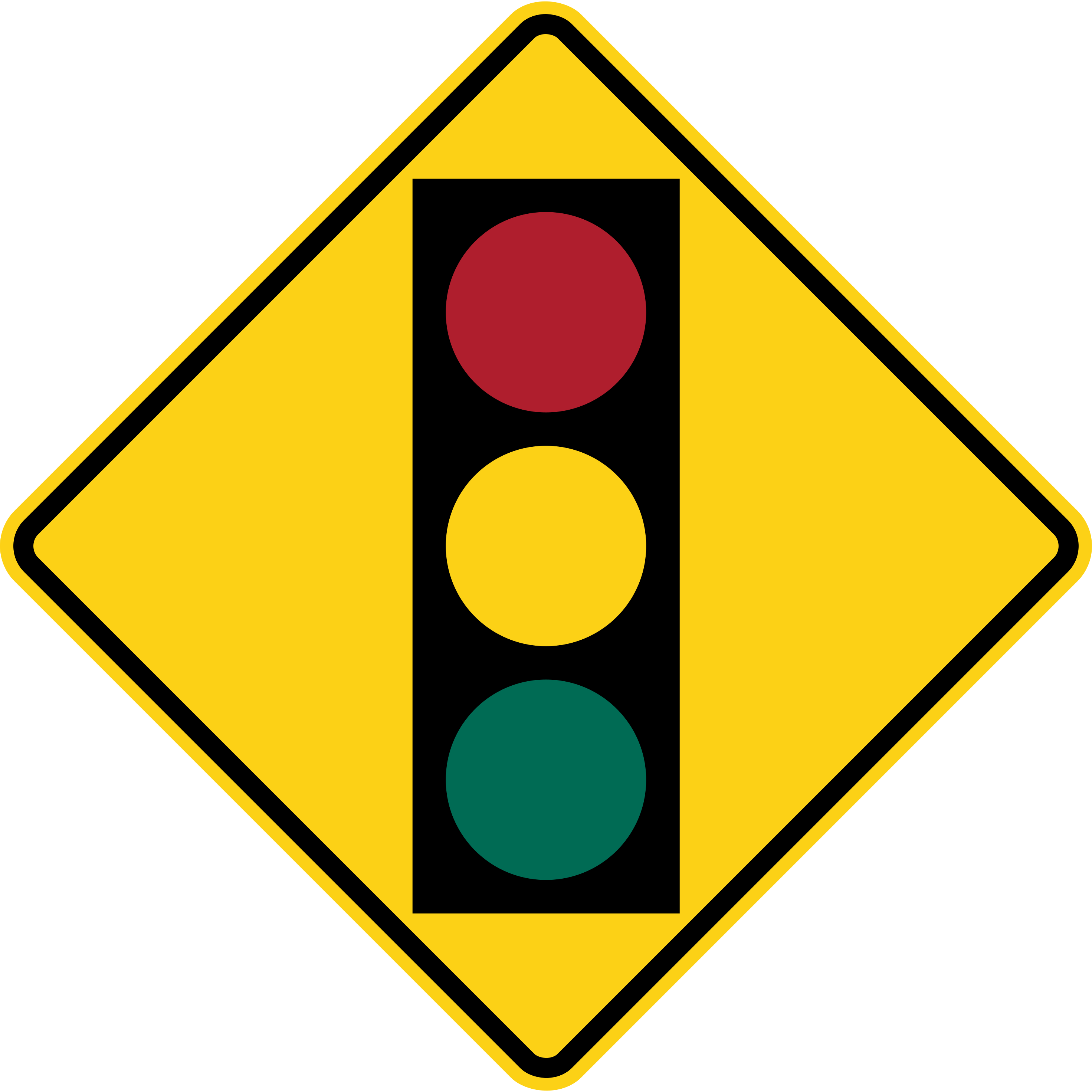
- A railroad crossing just ahead
- A stop sign at the next corner
- A school zone with children
- A traffic light that may be red
Show answer
A traffic light that may be red. This warning sign shows a traffic signal symbol and means there is a traffic light at the next intersection. Placed before a hill or curve, it warns you about a signal you cannot see yet, which could be red with traffic stopped. Ease off and be ready to stop. Railroad crossings use round signs or crossbucks, stop signs have their own warning sign with a small stop symbol, and school zones use a pentagon.
11. Just past this sign, a person is crossing at the marked crosswalk. What must you do?

- Honk and keep moving
- Speed past before they reach your lane
- Swerve around behind them
- Yield the right of way to the person
Show answer
Yield the right of way to the person. The pedestrian crossing sign tells you to watch for people crossing, slow down, and be prepared to stop. Drivers must yield the right of way to pedestrians crossing at intersections and crosswalks. A person already crossing has priority, so stop and wait until they have passed your lane. Honking, speeding up to beat them, or swerving around them all put the pedestrian in danger.
Study this in the handbook: Warning, school, construction and guide signs
12. A friend says coffee, exercise, or a cold shower will help you sober up faster. What does Minnesota's manual say?
- A cold shower works, but coffee and exercise do not
- None of them speeds up how fast the body clears alcohol
- Exercise works if it is done for at least an hour
- Coffee works if it is strong and drunk quickly
Show answer
None of them speeds up how fast the body clears alcohol. Minnesota's manual says drinking coffee, exercising, and taking cold showers do not increase the rate of oxidation, which is how the body removes most of the alcohol in the blood. The only way to reduce your alcohol concentration is to wait, and alcohol is generally eliminated at about one drink per hour. Coffee, exercise, and cold showers are not a way around waiting.
Study this in the handbook: How alcohol affects you and the DWI law
13. Why should you stay well behind a snowplow?
- To avoid breathing in the plow's exhaust fumes
- Its plow blade sweeps across lanes
- The law forbids following within a mile
- Sand, snow, and ice can fly off and hit you
Show answer
Sand, snow, and ice can fly off and hit you. Stay well behind snowplows so the sand, snow, and ice they throw do not hit your vehicle. Plows can also kick up snow clouds or whiteouts that hide the road and other hazards. They often move slowly, and in residential areas they may back up to turn around, so give operators room. Exhaust is not the reason given, and there is no one-mile following law in the manual.
14. A car passing you on a two-lane road cannot finish and must drop back behind you. What should you do?
- Slow down so it can pull ahead
- Brake hard and stop
- Speed up to give it room behind you
- Move left to block it
Show answer
Speed up to give it room behind you. Normally you hold your speed when someone passes. But if the passing driver misjudges oncoming traffic and must drop back, Minnesota says to speed up so there is enough room for that vehicle to move into the lane behind you. If instead the passing car is nearly in position ahead of you, slow down so it can finish quickly. Braking hard could cause a crash behind you, and moving left blocks the driver's escape.
Study this in the handbook: Blowouts, brake failure and other vehicle emergencies
15. Your car goes off the road into deep water. What should you do?
- Wait for it to fill, then open a door
- Stay buckled in and call 911
- Get out of the vehicle immediately
- Turn on hazards and wait for rescue
Show answer
Get out of the vehicle immediately. Most vehicles float on the surface for only 30 to 60 seconds. If your vehicle goes into deep water, get out right away, through open windows if possible before the water reaches window level. Waiting for the car to fill so the doors will open is a last resort once it is already under water, not the first plan. Staying buckled or waiting for rescue uses up the short time the car stays afloat.
Study this in the handbook: Distraction, aggression, winter driving and skids
16. What is the blue sign with a phone number at a railroad crossing for?
- Train schedules for that crossing
- Reporting problems or emergencies there
- Marking a crossing exempt from stops
- Showing how many tracks cross the road
Show answer
Reporting problems or emergencies there. Every highway-rail crossing has an Emergency Notification System sign with a 24/7 phone number for reporting problems or emergencies at that location, such as a stalled car or a broken gate. When you give the number on the sign, dispatchers can identify the exact crossing and warn trains to stop or slow down. It does not show train times. Exempt signs and the sign that shows the number of tracks are different signs.
Study this in the handbook: Commercial vehicles, railroad crossings and work zones
17. A student safety patrol is helping children cross the street ahead. What must you do?
- Slow to 15 mph and pass with care
- Stop only if the patrol holds a flag
- Yield only to children in your lane
- Come to a complete stop
Show answer
Come to a complete stop. Minnesota requires drivers to come to a complete stop when a student safety patrol is helping schoolmates cross a street or highway. You must also stop for adult crossing guards who display a stop sign or flag. Slowing down and rolling past is not enough. The rule does not depend on whether the patrol member is holding a flag, and you may not pick your way around children who are outside your lane.
Study this in the handbook: Right of way and yielding
18. The lane lines on a Minnesota road have worn away. What does the law still expect of you?
- Stay within a single lane without weaving
- Drive anywhere on the road until lines are repainted
- Straddle the center to stay visible
- Follow the car ahead wherever it goes
Show answer
Stay within a single lane without weaving. Minnesota treats a traffic lane as the part of the road wide enough for one line of vehicles, and lanes exist even when no paint marks them. You must keep your vehicle inside a single lane and not weave or straddle. Missing paint does not make the whole road open, and riding over the center to be seen puts you in the path of oncoming traffic. Simply copying the car ahead is not safe either, because that driver may be wandering out of the lane.
Study this in the handbook: Speed limits and the basic speed law
19. How do you signal a right turn by hand in Minnesota?
- Left arm out, bent downward
- Left arm straight out
- Right arm waved up and down
- Left arm out, bent upward
Show answer
Left arm out, bent upward. A right turn is signaled by holding your left arm out and bending it upward. A left arm held straight out means a left turn, and a left arm bent toward the ground means you are stopping. These are the same hand signals bicyclists use, and bicyclists may also signal a right turn by holding the right arm straight out. Waving an arm up and down is not one of the standard signals.
Study this in the handbook: Pedestrians, bicyclists and motorcycles
20. At a metered Minnesota freeway entrance ramp, how many cars may go on each green light?
- Two cars, side by side
- Up to three cars
- One car
- Every car waiting in line
Show answer
One car. Ramp meters are signals placed partway down many metro freeway entrance ramps to space out merging traffic. It is illegal to drive through the red light, and only one car may go each time the light turns green. Going two at a time or following the car ahead through the same green defeats the purpose and breaks the rule. The meter controls the flow so merging onto the freeway is easier and safer.
Study this in the handbook: Following distance, night driving and freeways
Every question is written from the official Minnesota Driver's Manual. Need paper? Printable MN practice test with answer key.
Last verified 2026-10-05. How we check every question · Study all 500 as flashcards
Frequently asked questions
How many questions are on this Minnesota practice test?
This fixed set has 20 questions. It is test 19 of 25 from the 500 question Minnesota bank.
How does this fixed test relate to the full Minnesota bank?
Each numbered test is a fixed set of questions in a fixed order, so you can retake the same test later and compare. Every test mixes road signs and the other topics in about the same proportion as the full bank. Tests 1 to 25 together cover every question in the Minnesota bank once. The full practice page mixes the whole bank at random.
Last verified 2026-10-05. See the Minnesota DMV facts page for sourced state details.
Return to the full Minnesota practice test · Study road signs