
Key points
Signal at least 100 feet before turning and keep signaling until the turn or lane change is done.
Source: Handbook p. 27
“Activate your signal at least 100 feet before turning. Keep signaling until you have completed the turn or lane change.”
Minnesota Driver's Manual, Handbook p. 27Hand and arm signals may be used in daylight, but not at night.
Source: Handbook p. 27
“During daylight hours, you can use hand and arm signals in addition to or instead of turn signals. Do not use hand signals at night”
Minnesota Driver's Manual, Handbook p. 27While waiting to turn, keep your wheels straight and your foot on the brake.
Source: Handbook p. 28
“While waiting to turn, keep your wheels straight and your foot on the brake.”
Minnesota Driver's Manual, Handbook p. 28On red, you may turn right after a complete stop unless a No Turn on Red sign is posted.
Source: Handbook p. 28
“Make sure you are in the correct lane and come to a complete stop. Do not turn if there is a "No Turn on Red" sign.”
Minnesota Driver's Manual, Handbook p. 28Enter a roundabout only after traffic from the left has cleared, and drive counterclockwise.
Source: Handbook p. 30
“Yield to vehicles already in the roundabout. Do not enter until all traffic from the left has cleared. Drive counterclockwise until you reach your exit.”
Minnesota Driver's Manual, Handbook p. 30Do not stop, pass or change lanes in a roundabout. If an emergency vehicle comes, exit and then pull over.
Source: Handbook p. 30
“Do not stop, pass or change lanes within the roundabout. If an emergency vehicle approaches, exit the roundabout immediately and then pull over.”
Minnesota Driver's Manual, Handbook p. 30Vehicles longer than 40 feet or wider than 10 feet may deviate from their lane as needed in a roundabout.
Source: Handbook p. 30
“A vehicle longer than 40 feet or wider than 10 feet, or any combination vehicle, may deviate from the lane as needed to drive through the roundabout”
Minnesota Driver's Manual, Handbook p. 30U turns are illegal on interstate freeways and near hilltops or curves where others cannot see you from 1,000 feet.
Source: Handbook p. 33
“You must not make U-turns on interstate freeways. They are also illegal near the tops of hills and on curves where other drivers cannot see you from 1,000 feet away.”
Minnesota Driver's Manual, Handbook p. 33
Numbers to know
| Number | What it means | Manual |
|---|---|---|
| 100 feet | signal at least this far before turning | Handbook p. 27 |
| 40 feet long, 10 feet wide | large vehicles that may deviate from the lane in a roundabout | Handbook p. 30 |
| 1,000 feet | U turns are illegal where others cannot see you from this far | Handbook p. 33 |
Recognize these signs

Roundabout 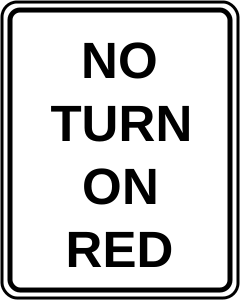
No turn on red
3 questions from the Minnesota practice test
1. When making a turn in Minnesota, how far before turning should you activate your signal?
- At least 10 feet before turning
- Only after entering the intersection
- At least 100 feet before turning
- Only when another driver is nearby
Show answer
At least 100 feet before turning. The manual sets a clear advance warning for turns: activate the signal at least 100 feet before turning, then keep signaling until the turn or lane change is complete. Waiting until the intersection or until another driver appears removes useful time for pedestrians and traffic to respond. Ten feet is far shorter than the stated distance and does not give the same warning. Signaling is not optional just because the road looks empty. A practical cue is to begin the signal before the final approach, then cancel it only after the maneuver has finished.
2. When may a Minnesota driver use hand and arm signals instead of the vehicle's turn signals?
- At night whenever the road has streetlights
- During daylight hours, when the hand signal can be seen
- Only while driving on a freeway
- Any time the vehicle's signal bulbs work
Show answer
During daylight hours, when the hand signal can be seen. Minnesota permits hand and arm signals during daylight, either in addition to or instead of the vehicle's turn signals. The permission has limits: hand signals should not be used at night or when the vehicle blocks other drivers from seeing the driver’s hand. Streetlights do not change the night restriction, and the rule is not limited to freeways. A working signal bulb does not make hand signals universally acceptable. Use the vehicle signal whenever practical, and reserve a visible arm signal for a daylight situation in which other road users can actually see it.
3. What action is prohibited inside a Minnesota roundabout?
- Changing lanes
- Yielding to vehicles already circulating
- Following the lane selected before entry
- Exiting when the driver's route is reached
Show answer
Changing lanes. Once inside a Minnesota roundabout, a driver must not stop, pass, or change lanes. Lane selection belongs before entry, especially in a multilane roundabout where signs indicate which lane serves each movement. Yield to vehicles already circulating, enter only after traffic from the left has cleared, and continue around to the appropriate exit. Changing lanes within the circle can cut across another vehicle’s path and defeats the predictable design. Choose the lane early, hold it through the roundabout, and signal as needed when leaving so the next driver understands the exit movement.
Practice this topic
Lock it in with signals and markings questions from the free Minnesota practice test. Every answer comes with a plain English explanation.
Source: the Minnesota Driver's Manual, Chapter 3: Traffic laws and vehicle operation. This lesson is a plain English summary, not the law itself; where it differs, the manual and the statute govern. Last checked 2026-09-27.