Every question below comes from the Minnesota question bank on this page. Open a question to see the correct answer and the explanation. Nothing here is hidden behind a signup.
1. When must headlights be turned on for the normal daily cycle?
- At sunset and continuously until sunrise
- Only at midnight and during the morning commute
- Only when driving on an unlit freeway
- From sunrise until sunset
Show answer
At sunset and continuously until sunrise. Minnesota requires headlights from sunset through sunrise, so the normal cycle begins when daylight ends and continues until it returns. Full explanation in Test 1
2. When must Minnesota drivers use their headlights according to the vehicle-equipment section?
- Only between midnight and dawn on rural roads
- From sunset until sunrise and whenever the road ahead cannot be seen for at least 500 feet
- Only during rain, never during snow or fog
- Whenever another driver flashes headlights
Show answer
From sunset until sunrise and whenever the road ahead cannot be seen for at least 500 feet. The manual says to turn headlights on at sunset and keep them on until sunrise. Full explanation in Test 2
3. A Minnesota driver under 21 is convicted of driving with a detectable amount of alcohol for the first time. How long is the suspension?
- 180 days
- 90 days
- 30 days
- A full year
Show answer
30 days. It is illegal for anyone under 21 to operate a motor vehicle with any detectable amount of alcohol. Full explanation in Test 3
4. What happens to a Minnesota driver who drives over 100 mph?
- A $25 surcharge only
- Driving privileges are revoked for at least six months
- A warning on a first offense
- A 30 day suspension
Show answer
Driving privileges are revoked for at least six months. Minnesota fines drivers who exceed the posted limit, adds extra fines at 20 mph or more over, and revokes driving privileges for at least si Full explanation in Test 4
5. When a vehicle is used to violate Minnesota’s school-bus stopping law, who may be penalized as the owner?
- The owner automatically receives five license points
- The owner or leaseholder may be guilty of a petty misdemeanor
- The owner is never involved if another person was driving
- The owner must surrender the vehicle permanently
Show answer
The owner or leaseholder may be guilty of a petty misdemeanor. Minnesota allows the owner or leaseholder to be guilty of a petty misdemeanor when the vehicle is used to violate the school-bus stopping st Full explanation in Test 5
6. When is driving below a posted minimum speed limit illegal under normal conditions?
- Whenever the driver is traveling below that posted minimum
- Only when a police officer is directing traffic
- Only on roads with a 55 mph maximum
- Never, because minimum limits are advisory
Show answer
Whenever the driver is traveling below that posted minimum. The manual says it is illegal to drive slower than a posted minimum speed under normal conditions. Full explanation in Test 6
7. Which of these makes Minnesota DWI penalties more severe?
- Having a passenger over 65
- Having a child younger than 16 in the vehicle at the stop
- Driving a car with an automatic transmission
- Being stopped on a weekday
Show answer
Having a child younger than 16 in the vehicle at the stop. Minnesota lists factors that make DWI penalties more severe: prior DWI arrests, an alcohol concentration of 0. Full explanation in Test 7
8. What right-of-way consequence follows when a driver approaches a Minnesota intersection at an unlawful speed?
- The driver loses the privilege associated with lawful speed
- The driver gains priority over vehicles traveling legally
- The driver may disregard all yielding rules
- The driver keeps every right-of-way privilege unchanged
Show answer
The driver loses the privilege associated with lawful speed. A driver who approaches an intersection at an unlawful speed loses the right-of-way privilege that would have been associated with driving l Full explanation in Test 8
9. About how fast does the body eliminate alcohol, according to the Minnesota manual?
- About three drinks per hour
- About one drink per hour
- Faster after coffee or a cold shower
- About one drink every 15 minutes
Show answer
About one drink per hour. The only way to reduce alcohol concentration is to wait. Full explanation in Test 9
10. When making a turn in Minnesota, how far before turning should you activate your signal?
- At least 10 feet before turning
- Only after entering the intersection
- At least 100 feet before turning
- Only when another driver is nearby
Show answer
At least 100 feet before turning. The manual sets a clear advance warning for turns: activate the signal at least 100 feet before turning, then keep signaling until the turn Full explanation in Test 10
11. When driving in bad weather or poor road conditions, what speed choice is required?
- Drive exactly at the posted limit regardless of visibility
- Reduce speed as conditions require
- Increase speed to spend less time on the wet pavement
- Use the shoulder to avoid slowing in the travel lane
Show answer
Reduce speed as conditions require. The posted limit is a maximum, not a command to maintain that speed when conditions become hazardous. Full explanation in Test 1
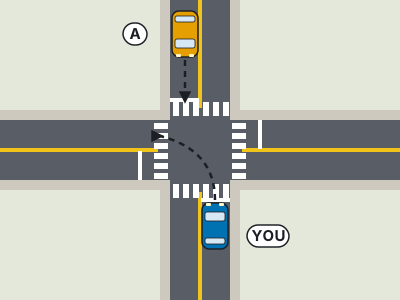
12. With a round green light, what must a driver do before completing a left turn?
- Enter the turn from the far-right lane
- Turn immediately because green always protects the movement
- Wait until the signal becomes a green arrow
- Yield to oncoming traffic and pedestrians crossing in front
Show answer
Yield to oncoming traffic and pedestrians crossing in front. A round green light permits movement through the intersection, but a left-turning driver must still yield to oncoming traffic and pedestrian Full explanation in Test 2
13. What condition does the skidding-car symbol warn about?

- The road is reserved for emergency vehicles
- The road surface may be slippery when wet
- A gravel shoulder begins immediately
- The road is closed during rain
Show answer
The road surface may be slippery when wet. The symbol warns that moisture can make the road surface slippery, often near bridges or overpasses. Full explanation in Test 3
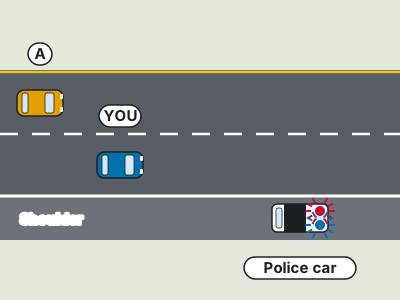
14. If you cannot move one lane away from a stopped emergency vehicle, how should you pass it?
- Maintain speed because the shoulder is separate
- Slow down and pass with caution
- Stop in the travel lane until the vehicle leaves
- Pass on the shoulder without reducing speed
Show answer
Slow down and pass with caution. Minnesota's Move Over guidance requires a driver who cannot move a lane away, or who has only one lane in that direction, to slow down and p Full explanation in Test 4
15. What does a green arrow allow a driver to do?
- Turn in any direction without checking the roadway
- Turn safely in the direction of the arrow, subject to people already in the intersection
- Treat the arrow exactly like a flashing yellow signal
- Wait until the arrow changes to red before moving
Show answer
Turn safely in the direction of the arrow, subject to people already in the intersection. A green arrow authorizes movement in the arrow’s direction and protects the turn from oncoming or crossing traffic. Full explanation in Test 5
16. Under Minnesota law as revised in 2025, what is the license revocation period for refusing a required chemical test when the driver has no qualified prior impaired driving incidents in the past 20 years?
- A 30-day suspension
- Not less than one year
- A warning with no effect on driving privileges
- Exactly six years
Show answer
Not less than one year. Minnesota moved its implied consent revocation periods into section 171.178 in 2025. Full explanation in Test 6
17. Which of these is listed as grounds for revoking a Minnesota license?
- One parking ticket
- Failing to renew registration for one week
- A single speeding ticket 10 mph over
- Pleading guilty to three violations in one year of traffic laws that require a jail sentence
Show answer
Pleading guilty to three violations in one year of traffic laws that require a jail sentence. The revocation list includes pleading guilty or forfeiting bail for three violations in a single year of any Minnesota traffic law or ordina Full explanation in Test 7
18. After two consecutive failures of the Minnesota written test, what applies to the third and later attempts?
- A $10 fee is charged
- A six-month testing ban begins
- The applicant must take a road test instead
- The applicant permanently loses testing eligibility
Show answer
A $10 fee is charged. Minnesota charges a $10 fee for the third written-test attempt and every subsequent attempt after two consecutive failures. Full explanation in Test 8
19. When may a driver exceed a 55 mph posted limit by up to 10 mph under Minnesota's speed rule?
- While lawfully passing another vehicle on a two-lane highway
- Whenever the road is empty
- When merging onto any freeway
- Whenever the driver is late
Show answer
While lawfully passing another vehicle on a two-lane highway. Minnesota permits the 10 mph increase only while lawfully passing another vehicle on a two-lane highway whose speed limit is 55 mph or highe Full explanation in Test 9
20. What must you do before entering a roundabout?
- Stop inside the circle before selecting an exit
- Yield to vehicles already circulating from the left
- Enter first because circulating traffic must yield
- Change lanes after entering to reach any exit
Show answer
Yield to vehicles already circulating from the left. Entering traffic must yield to vehicles already in the roundabout and wait until traffic from the left has cleared. Full explanation in Test 10
21. Who is registered with the Selective Service when applying for a Minnesota license or ID?
- All applicants over 16
- Only commercial drivers
- U.S. citizens or residents between the ages of 18 and 26
- Only male applicants over 30
Show answer
U.S. citizens or residents between the ages of 18 and 26. If you are a U.S. citizen or resident between the ages of 18 and 26, you will be registered with the U.S. Full explanation in Test 1
22. If the accelerator remains stuck, what sequence should you follow?
- Press the accelerator repeatedly until it releases
- Turn the key off while traveling in the lane
- Apply the brakes, shift into neutral, and steer toward the shoulder
- Pull the parking brake sharply before steering
Show answer
Apply the brakes, shift into neutral, and steer toward the shoulder. If lifting the stuck pedal does not free it, first apply the brakes and shift into neutral to disconnect engine power. Full explanation in Test 2
23. What is the alcohol content of 80-proof whiskey?
- 40 percent
- 80 percent
- 8 percent
- 20 percent
Show answer
40 percent. Proof measures a drink's strength and equals twice the percentage of alcohol it contains. So 80-proof whiskey is 40 percent alcohol. Full explanation in Test 3
24. A school bus's red lights are flashing, but its stop arm does not swing out. What must a Minnesota driver do?
- Stop at least 20 feet from the bus
- Pass slowly because the arm failed
- Stop only if a child is visible
- Continue until the driver sees a hand signal
Show answer
Stop at least 20 feet from the bus. Flashing red bus lights require a stop even when the mechanical stop arm does not extend. Full explanation in Test 4
25. A traffic signal at an intersection is not functioning. How should you approach the intersection?
- Treat it like an uncontrolled intersection and proceed only after yielding as required
- Treat it like a stop sign and wait for a police officer
- Continue through without slowing because no signal is active
- Give priority only to vehicles on the larger roadway
Show answer
Treat it like an uncontrolled intersection and proceed only after yielding as required. Minnesota treats a failed signal as an uncontrolled intersection, so normal right-of-way rules govern your movement. Full explanation in Test 5
26. What action does this STOP sign require?

- Come to a complete stop, then wait for right-of-way traffic and pedestrians to clear
- Reduce speed and continue whenever the lane looks open
- Stop only if another vehicle is approaching
- Yield without stopping when the sign is at an intersection
Show answer
Come to a complete stop, then wait for right-of-way traffic and pedestrians to clear. A Minnesota STOP sign requires a complete stop and continued waiting until pedestrians and vehicles with the right of way have cleared the i Full explanation in Test 6
27. May a Neighborhood Electric Vehicle be used for a Minnesota road test?
- No, unless it has four wheels and a roof
- Yes, if its registration is current
- Yes, but only on a 35 mph street
- No, it may not be used for a road test
Show answer
No, it may not be used for a road test. Minnesota specifically excludes NEVs from road tests. Full explanation in Test 7
28. What is the recommended response to Minnesota warning signs?
- Ignore them until a traffic signal changes
- Recognize and react to the possible hazards they identify
- Use them only to locate motorist services
- Assume they prohibit every movement ahead
Show answer
Recognize and react to the possible hazards they identify. Minnesota says drivers must recognize and react to warning signs for their own safety and the safety of others. Full explanation in Test 8
29. When may a Minnesota driver use hand and arm signals instead of the vehicle's turn signals?
- At night whenever the road has streetlights
- During daylight hours, when the hand signal can be seen
- Only while driving on a freeway
- Any time the vehicle's signal bulbs work
Show answer
During daylight hours, when the hand signal can be seen. Minnesota permits hand and arm signals during daylight, either in addition to or instead of the vehicle's turn signals. Full explanation in Test 9
30. What happens to a vehicle when its tires hydroplane?
- The vehicle's brakes automatically engage on wet pavement
- The tires gain extra traction because water cools them
- Water lifts the tires off the road and they lose contact
- The tires become more firmly attached to the road surface
Show answer
Water lifts the tires off the road and they lose contact. Hydroplaning occurs when water collects under the tires and lifts them off the road surface. Full explanation in Test 10
31. When approaching an oncoming vehicle within 1,000 feet, what beam setting is required?
- No lights until the vehicles meet
- High beams plus hazard flashers
- Parking lights only
- Low beam headlights
Show answer
Low beam headlights. Minnesota requires headlights to remain on low beam when you are within 1,000 feet of an oncoming vehicle. Full explanation in Test 1
32. Why should a Minnesota driver reduce speed on a gravel or dirt road?
- The posted limit automatically doubles on loose surfaces
- Stopping takes longer and skidding is easier when turning
- The road requires driving in the opposing lane
- Headlights cannot be used on an unpaved road
Show answer
Stopping takes longer and skidding is easier when turning. Loose road surfaces reduce traction and make vehicle response less predictable. Full explanation in Test 2
33. A Minnesota driver tests at 0.08 percent or above. What may the driver receive before the revocation begins?
- A 30-day temporary license
- A seven-day temporary license
- A work permit valid for one year
- Nothing; driving stops at the roadside
Show answer
A seven-day temporary license. If you are found at 0.08 percent or above, or you refuse to take a test, you may receive a seven-day temporary license, and at the end of th Full explanation in Test 3
34. Which vehicles does the Minnesota manual identify as permitted to use blue lights?
- Any passenger car traveling after sunset
- Snowplows, road maintenance equipment, and authorized emergency vehicles
- Taxi vehicles waiting at a curb
- Every vehicle with its hazard flashers operating
Show answer
Snowplows, road maintenance equipment, and authorized emergency vehicles. Blue lights are limited to snowplows, road maintenance equipment, and authorized emergency vehicles under the manual's prohibited-lights sec Full explanation in Test 4
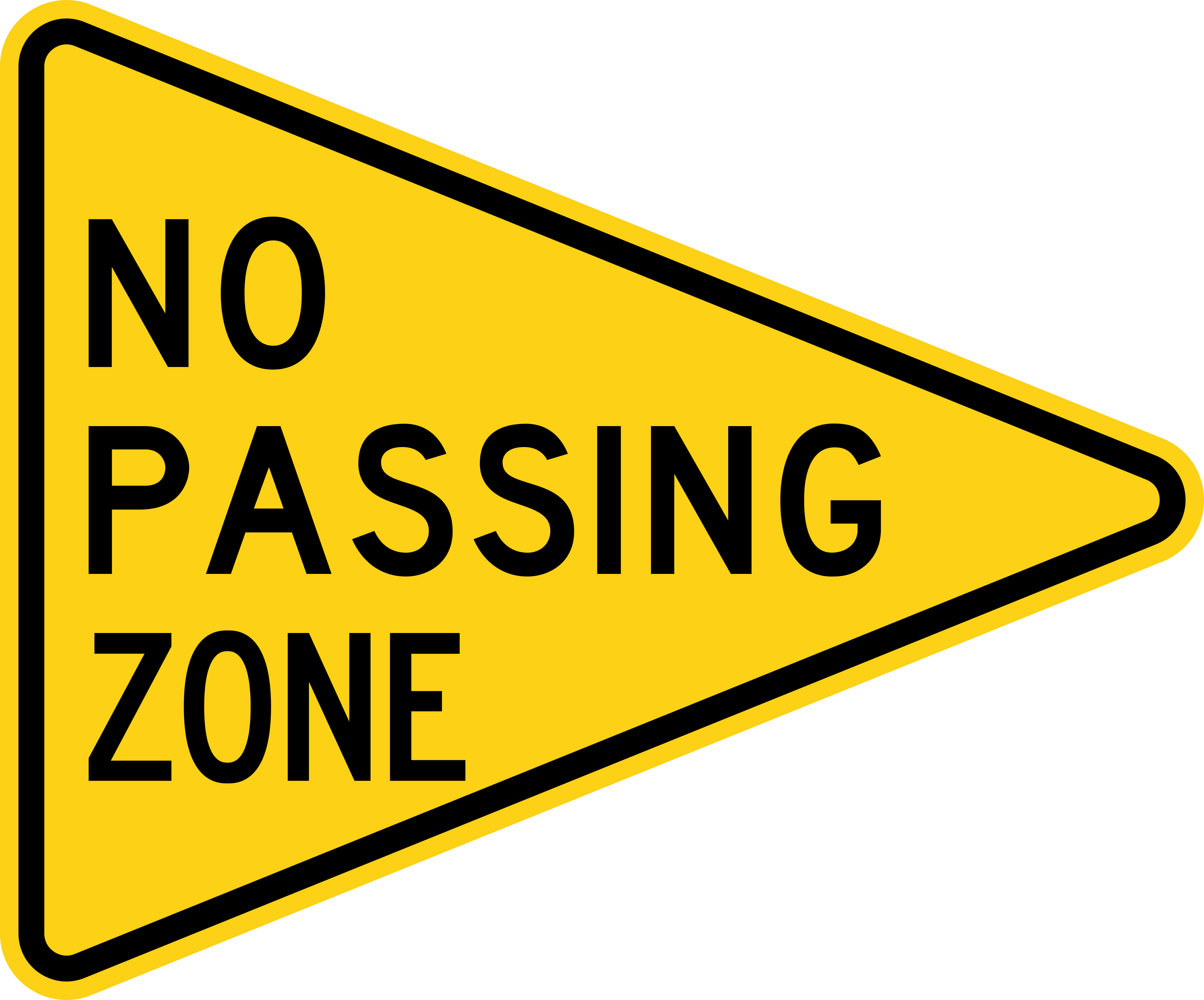
35. What does the pennant-shaped sign mark on a two-way highway?
- A bicycle route with protected crossing priority
- The end of a no-passing zone
- The beginning of a no-passing zone
- A temporary lane for construction vehicles
Show answer
The beginning of a no-passing zone. The pennant on the left side of a two-way highway marks where a no-passing zone begins. Full explanation in Test 5
36. On a road with two lanes in your direction, where should you move when a stopped emergency vehicle with flashing lights is ahead?
- Into the lane closest to the emergency vehicle to pass quickly
- To the shoulder beside the stopped vehicle
- To the lane farthest away from the stopped vehicle when safe
- Across the centerline regardless of opposing traffic
Show answer
To the lane farthest away from the stopped vehicle when safe. When a stopped emergency vehicle with flashing lights is on or next to a road with two lanes in the same direction, Minnesota's Move Over La Full explanation in Test 6
37. What may not a driver do when a vehicle ahead has stopped for a pedestrian in a crosswalk?
- Wait until the pedestrian has cleared the lane
- Remain stopped behind it
- Pass the stopped vehicle
- Yield to the pedestrian before continuing
Show answer
Pass the stopped vehicle. Passing a vehicle stopped for a pedestrian is prohibited because the stopped vehicle may be shielding someone in the crosswalk from your vie Full explanation in Test 7
38. At a blinking red signal, which sequence applies before entering the intersection?
- Continue through without reducing speed
- Wait for a police officer before moving
- Treat it as a flashing yellow and continue with caution
- Stop completely, yield to earlier traffic and pedestrians, then proceed when clear
Show answer
Stop completely, yield to earlier traffic and pedestrians, then proceed when clear. Minnesota treats a flashing red signal as a stop sign. Full explanation in Test 8
39. Which format does Minnesota use for questions on the Class D written test?
- Essay responses and oral interviews
- Multiple choice and true-or-false
- Driving demonstrations only
- Fill-in-the-blank questions only
Show answer
Multiple choice and true-or-false. Minnesota describes the Class D written test as using multiple choice and true-or-false questions. Full explanation in Test 9
40. What should a driver do after seeing a No Passing Zone sign on the left side of a two-way highway?
- Cross the center line whenever the road appears clear
- Pass quickly before reaching the next curve
- Use the shoulder to pass if the lane is busy
- Continue in your lane without passing in the no-passing zone
Show answer
Continue in your lane without passing in the no-passing zone. The No Passing Zone sign warns that the beginning of a no-passing zone is ahead, and the manual places this sign on the left side of a two-w Full explanation in Test 10
