
Test 9 of 10 · 20 questions · Free 2026
DE Permit Practice Test 9
Jump to the test ↓A fixed 20 question set from the Delaware bank with answers and plain English explanations. The real DE exam is 32 questions, 81 percent to pass; take the full length version on the main practice page.
Question 1 of 20 · 0 right so far
All 20 questions in test 9
Every question below comes from the Delaware question bank on this page. Open a question to see the correct answer and the explanation. Nothing here is hidden behind a signup.
1. During the first 12 months of Level One driving authority, how many nonfamily passengers may accompany the permit holder besides the adult supervisor?
- Two other passengers
- One other passenger
- No passengers at all
- As many passengers as the vehicle's seat belts allow
Show answer
One other passenger. During the entire first 12 months, Delaware allows an adult supervisor and one other passenger. Immediate family members are an exception when the adult supervisor is in the vehicle, so the one-passenger figure applies to the nonfamily situation described here. A total ban is too restrictive, and seat-belt capacity does not expand the graduated license limit. The cue to remember is one additional nonfamily passenger, not one passenger per available seat.
Study this in the handbook: The Level One Learner's Permit and GDL rules
2. Approximately how long will a Delaware road exam require the applicant to drive?
- About 10 minutes
- About 30 minutes
- About 60 minutes
- About 2 hours
Show answer
About 30 minutes. The Delaware road exam requires the applicant to drive for approximately 30 minutes and do the things that are usual in normal driving. Ten minutes is too short for the list of required maneuvers, while an hour or two hours overstates the stated time. During the drive you may be asked to back 50 feet, make a three point turn, change lanes, merge, and respond to signs and signals. Arrive with your permit, the accompanying driver's license, registration, and insurance card.
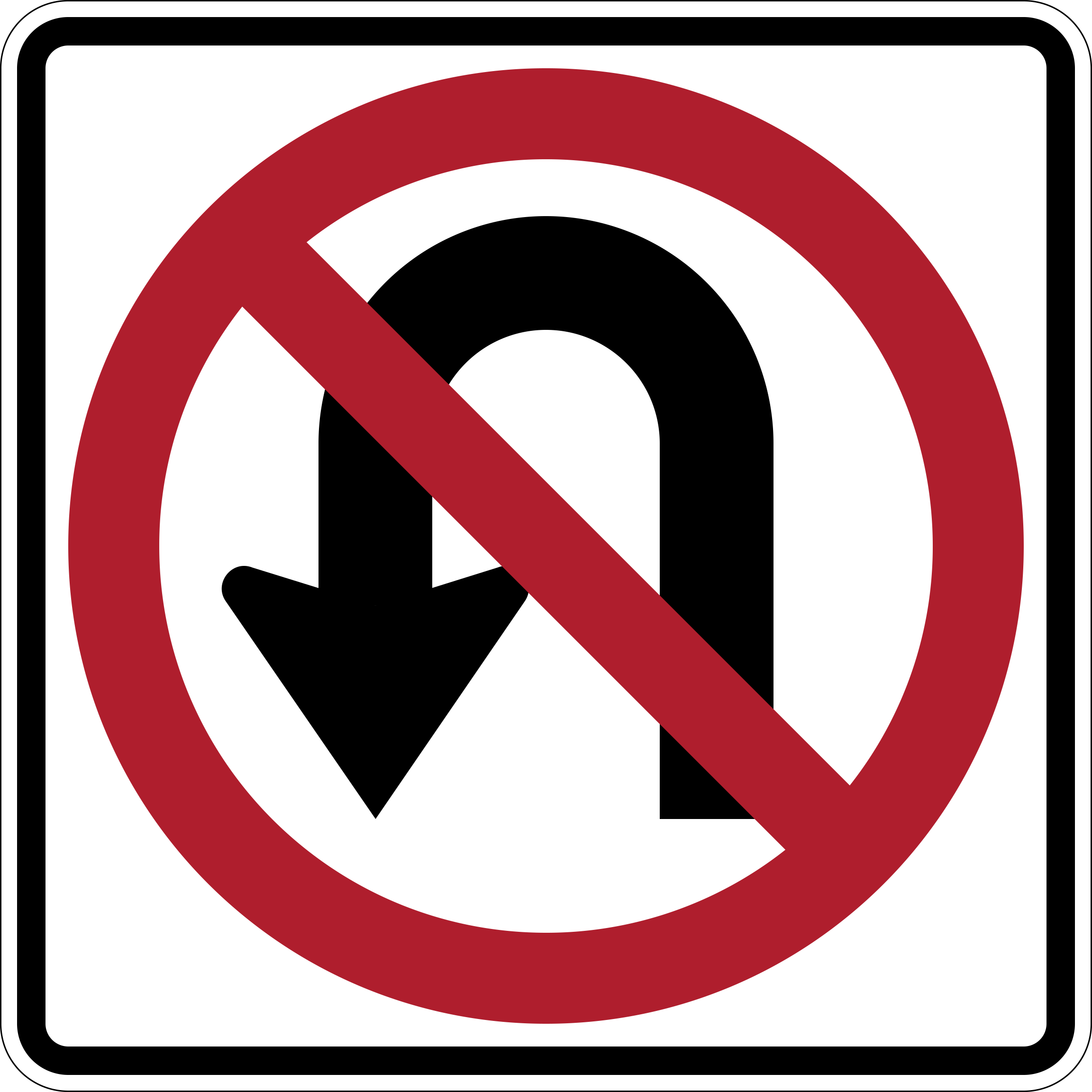
3. Which maneuver is prohibited by the crossed U-shaped arrow sign shown here?
- Driving straight through the intersection
- Turning left at the intersection
- Passing a slower vehicle
- Making a U-turn at that location
Show answer
Making a U-turn at that location. The crossed U-shaped arrow bans a U-turn at the posted location. It does not automatically prohibit every left turn, passing movement, or straight-through trip. Read the pictured maneuver rather than treating every red slash as a general ban on movement. A driver may still need to obey other signs, signals, or pavement markings nearby, but this particular sign addresses the reversal represented by the U-shaped arrow. The visual cue is direct: identify the arrow's movement first, then apply the slash to that movement only.
Study this in the handbook: Road signs by shape and color
4. After a chemical-test refusal, what license consequence may Delaware impose under its implied-consent law?
- A permanent revocation for every first refusal
- A fixed 30-day warning with no license action
- A one- to two-year revocation depending on the driver's record and circumstances
- Only a vehicle registration suspension, never a license revocation
Show answer
A one- to two-year revocation depending on the driver's record and circumstances. Delaware's implied-consent law allows the Division to revoke a driver's license or driving privilege for one to two years after a chemical-test refusal. The length depends on prior DUI offenses, probable cause, and earlier refusal offenses, so the law does not impose one identical period on every driver. A warning, permanent first-refusal loss, or registration-only penalty misstates the consequence. The cue is the refusal report sent to DMV: declining the designated test can trigger a license action even before other court penalties are considered.
Study this in the handbook: Alcohol, BAC and implied consent
5. Besides a BAC of .08 or greater, what can be conclusive evidence that a Delaware driver is under the influence?
- The presence of any illicit or recreational drug
- A cup of coffee before driving
- A prescription taken exactly as directed
- Being tired after a long workday
Show answer
The presence of any illicit or recreational drug. Delaware treats the presence of any illicit or recreational drug as conclusive evidence under the same sentence that names a BAC of .08 or greater. The other choices describe fatigue, caffeine, or a medication fact that the quoted rule does not identify as this conclusive trigger. The manual separately warns that a driver can still be charged when BAC is under .08, so the listed standard is not a safe-driving threshold. The key cue is that impaired-driving rules cover drugs as well as alcohol, and chemical testing refusal can also cause license consequences.
Study this in the handbook: Alcohol, BAC and implied consent
6. Which of these is a mandatory license revocation in Delaware?
- Two speeding tickets in one year
- A single seat belt violation
- An expired registration
- Three reckless driving convictions within 12 consecutive months
Show answer
Three reckless driving convictions within 12 consecutive months. Delaware lists mandatory revocations, including DUI, hit-and-run involving death or injury, fleeing a police officer after a signal to stop, contributing to a death by operating a vehicle, and three convictions for reckless driving in a period of 12 consecutive months. Two speeding tickets, a seat belt violation, and an expired registration are handled through points, fines, or other actions, not mandatory revocation. Skipping court after posting bond on a listed offense also leads to revocation as if convicted.
Study this in the handbook: Points, suspensions and serious speeding
7. What does a flashing beacon supplementing a warning sign do?
- It draws attention to the sign or indicates when its message applies
- It replaces the sign's message with a speed recommendation
- It authorizes drivers to ignore the sign after dark
- It marks a lane reserved for buses
Show answer
It draws attention to the sign or indicates when its message applies. A flashing beacon can emphasize a sign's critical message or show when the associated message applies. It does not erase the underlying sign, turn a warning into a recommendation, or create a bus lane. For example, a flashing indication may make a warning more noticeable or identify when a restriction is active. Treat the beacon as added emphasis and read the attached sign before proceeding.
Study this in the handbook: Road signs by shape and color
8. What do regulatory signs tell drivers?
- The location of recreational attractions
- The weather expected later in the day
- The recommended scenic route through a town
- The speed limit and other laws and regulations
Show answer
The speed limit and other laws and regulations. Regulatory signs communicate enforceable traffic controls, including speed limits and other laws and regulations. Recreation and guide signs serve different purposes, and a sign cannot be treated as a weather notice. Read the shape, color, and wording together, then follow the posted restriction even when traffic is light. The key distinction is that a regulatory message governs what road users may or must do.
Study this in the handbook: Road signs by shape and color
9. What does a Delaware Driving Privilege Card cost, and how long is it valid?
- $40, valid for 8 years
- Free, valid for 1 year
- $20, valid for 4 years
- $72, valid for 2 years
Show answer
$20, valid for 4 years. The fee for the Driving Privilege Card is $20 and it is valid for 4 years. The card is for residents who cannot prove legal presence and is marked Driving Privilege Only and Not Valid for Identification; U.S. citizens and persons with valid legal presence documents are not eligible. Applicants must first schedule fingerprinting with the State Bureau of Identification, which collects a $72 fee. The card is for driving within Delaware only and is not to be used as a form of identification.
10. What should a Delaware driver do before turning right or changing lanes?
- Use the turn signals before the maneuver
- Turn first and signal afterward
- Use hazard lights instead of a turn signal
- Signal only if another vehicle is beside you
Show answer
Use the turn signals before the maneuver. Delaware's driver guidance says to use turn signals before changing lanes or turning right. Signaling first gives nearby road users time to anticipate the movement and decide whether they need to slow or yield. Turning before signaling reverses that order, while hazard lights do not identify the direction of a planned maneuver. Another vehicle does not need to be beside you before signaling. Make the signal part of the preparation, then check mirrors, blind spots, and the path before steering. The useful cue is simple: signal before the vehicle changes position or direction.
11. When may driving slowly enough to impede normal traffic be justified in Delaware?
- Whenever another driver could use the shoulder to pass
- Whenever the driver wants to read roadside advertisements
- When safety or compliance with the law requires it
- Only when a police vehicle is directly behind
Show answer
When safety or compliance with the law requires it. Unnecessarily holding up normal traffic by driving too slowly is prohibited, but safety and legal requirements can justify a slower pace. Poor visibility or a duty to yield may require reducing speed even when following drivers want to move faster. The possibility of a shoulder pass does not excuse obstructing traffic. Assess the actual road hazard or legal obligation, maintain a predictable position, and avoid using convenience or distraction as a reason to delay other vehicles.
Study this in the handbook: Delaware speed limits
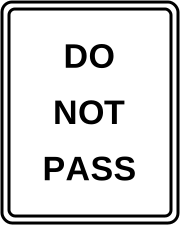
12. What does the white rectangular DO NOT PASS sign shown here require a Delaware driver to do?
- Ignore the sign when the road ahead is clear
- Pass immediately if the vehicle ahead is slow
- Use the shoulder to pass traffic safely
- Obey the sign and look for double solid lines
Show answer
Obey the sign and look for double solid lines. The DO NOT PASS sign is a regulatory sign, so the driver must obey it and also look for the double solid lines on the highway that mark the same restriction. Passing because the vehicle ahead is slow defeats the rule, and using the shoulder is not a lawful substitute for a passing lane. A clear view of the road ahead does not cancel the sign. Keep your lane, hold a safe following distance, and wait until passing is clearly permitted again.
Study this in the handbook: Road signs by shape and color
13. When two solid yellow lines separate opposing traffic, a driver may cross them to:
- Pass a slow vehicle
- Turn into a driveway when it is safe
- Change lanes for convenience
- Use the opposing lane to avoid traffic
Show answer
Turn into a driveway when it is safe. Two solid yellow lines separate opposing traffic and mean neither side may pass. Delaware nevertheless permits a driver to cross a solid yellow line to turn into a driveway when it is safe to do so. Passing a slow vehicle, changing lanes for convenience, or using the opposing lane to avoid traffic is not that limited exception. Check for oncoming vehicles, pedestrians, and the driveway opening before crossing. The cue is the purpose of the movement: a safe driveway turn may be allowed, but an overtaking maneuver remains prohibited.
Study this in the handbook: Pavement markings, signaling and roundabouts
14. What does a Delaware Class B commercial license cover?
- Any single vehicle with a GVWR of 26,001 pounds or more, towing no more than 10,000 pounds
- Buses only
- Any combination over 26,001 pounds towing more than 10,000
- Passenger cars
Show answer
Any single vehicle with a GVWR of 26,001 pounds or more, towing no more than 10,000 pounds. A CDL Class B license is required for any single vehicle with a gross vehicle weight rating of 26,001 pounds or more, or any such vehicle towing a vehicle not in excess of 10,000 pounds. Class A covers combinations of 26,001 pounds or more where the towed units exceed 10,000 pounds. School bus drivers need a CDL with passenger and school bus endorsements.
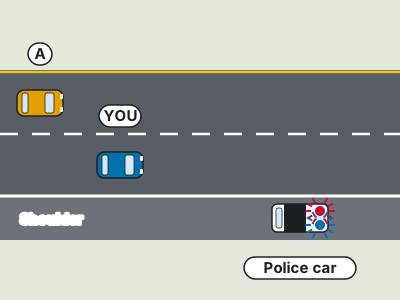
15. What must a driver do when approaching a stationary authorized emergency vehicle with warning lights?
- Use the shoulder to pass regardless of traffic
- Maintain speed and pass in the same lane without caution
- Stop beside the emergency vehicle and wait for its driver
- Make an appropriate lane change when possible, or reduce to a safe speed if changing lanes is unsafe
Show answer
Make an appropriate lane change when possible, or reduce to a safe speed if changing lanes is unsafe. For a stationary authorized emergency vehicle displaying warning lights, Delaware requires caution and a yield of right-of-way. Change lanes when that can be done safely. If a lane change is impossible or unsafe, reduce speed to a safe level instead. Maintaining speed ignores workers in the roadway, stopping beside the vehicle can obstruct the scene, and using the shoulder regardless of traffic creates another hazard. The cue is to assess the lane first, then choose a safe move or safe speed.
Study this in the handbook: Emergency vehicles and the Move Over law
16. What do orange warning signs in a work zone alert drivers to?
- A pedestrian-only route through the zone
- A reserved lane for emergency vehicles
- Unusual or potentially hazardous conditions
- A mandatory stop at every work vehicle
Show answer
Unusual or potentially hazardous conditions. Orange work-zone warning signs alert drivers that conditions in or near the work area may be unusual or hazardous. The roadway may have lane closures, shifting traffic, rough pavement, equipment, workers, or stopped vehicles. A reserved emergency lane, a pedestrian-only route, and a required stop at every work vehicle are not what this warning means. Slow down, stay alert for changing patterns, follow signs and flaggers, and avoid sudden lane changes. Orange is the cue to expect an active work area where normal traffic flow may be altered.
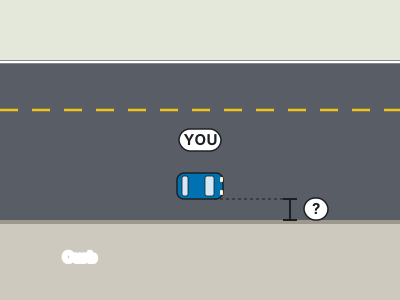
17. How close to the curb or edge must a Delaware driver park parallel on a two-way highway?
- Within 3 feet
- Within 12 inches
- Within 24 inches only on a one-way street
- As far from the curb as the driver prefers
Show answer
Within 12 inches. Parallel parking on a two-way highway requires the vehicle to be parallel to and within 12 inches of the curb or edge. A three-foot gap leaves the vehicle too far into the roadway, and the rule is not limited to one-way streets. Choosing any distance would ignore the safety and space requirement. The cue is the curb beside the parking space: align the vehicle, finish within one foot, set the brake, and check that it is not obstructing moving traffic.
18. When must a Delaware driver yield to a pedestrian crossing at a sidewalk or driveway?
- Only when the pedestrian is carrying a sign
- Only when a police officer is present
- When crossing a sidewalk while entering or exiting a driveway, alley, or parking lot
- Never, because the sidewalk is not a roadway
Show answer
When crossing a sidewalk while entering or exiting a driveway, alley, or parking lot. A driver crossing a sidewalk while entering or leaving a driveway, alley, or parking lot must yield to pedestrians. The manual also says driving on a sidewalk is illegal except to cross it, so the crossing must be brief and controlled. Police presence or a pedestrian's sign is not a condition of the duty. Calling the sidewalk irrelevant reverses the rule. The useful cue is to stop the vehicle's path before the sidewalk, look for people, and cross only after yielding, including when the entrance appears quiet at first glance.
Study this in the handbook: Right of way at intersections
19. What is the Delaware fine for a first offense of underage possession or consumption of alcohol?
- $100
- $500 to $1,500
- $200 to $500
- $1,000
Show answer
$100. Anyone under 21 who possesses or consumes alcoholic liquor is fined $100 for a first offense and not less than $200 nor more than $500 for each later offense. The first and second violations are civil offenses, which may not appear on a certified criminal record. The $200 to $500 range applies to repeat offenses, and $500 to $1,500 is the court fine for a first DUI. The rule does not cover religious services or family members in a private home.
Study this in the handbook: Alcohol, BAC and implied consent
20. A fully licensed adult Delaware driver wants to take a phone call while driving. What does the law require?
- Nothing, calls are allowed if brief
- Use a hands-free device
- Hold the phone below the window
- Pull onto the shoulder for every call
Show answer
Use a hands-free device. Delaware's law prohibits hand-held cell phone use and texting while driving. Drivers who want to talk must use a hands-free device; they may dial or turn the device on or off and then must put it down. Holding the phone low is still hand-held use, and brief calls are not exempt. The law does not require pulling over for every call. Drivers with a Graduated Driver License may not use any phone, even hands-free.
Study this in the handbook: Headlights, seat belts, phones and insurance
QualitySpace is expanding to Delaware
We are a California-based independent insurance brokerage working on licensing in more states. We cannot help with Delaware insurance yet. Leave your email and we will let you know when we can.
Every question is written from the official Delaware Driver Manual. Need paper? Printable DE practice test with answer key.
Last verified 2026-10-05. How we check every question · Study all 205 as flashcards
Frequently asked questions
How many questions are on this Delaware practice test?
This fixed set has 20 questions. It is test 9 of 10 from the 205 question Delaware bank. The real DE exam asks 32 questions and you need 26 correct.
What is the passing score for the real Delaware test?
26 of 32 correct (approximately 81%) That figure comes from the official Delaware source cited on the DMV facts page.
How does this fixed test relate to the full Delaware bank?
Each numbered test is a fixed set of questions in a fixed order, so you can retake the same test later and compare. Every test mixes road signs and the other topics in about the same proportion as the full bank. Tests 1 to 10 together cover 200 of the 205 questions in the Delaware bank, each once. The full practice page mixes the whole bank at random.
Last verified 2026-10-05. See the Delaware DMV facts page for sourced state details.
Return to the full Delaware practice test · Study road signs