
Test 1 of 10 · 20 questions · Free 2026
DE Permit Practice Test 1
Jump to the test ↓A fixed 20 question set from the Delaware bank with answers and plain English explanations. The real DE exam is 32 questions, 81 percent to pass; take the full length version on the main practice page.
Question 1 of 20 · 0 right so far
All 20 questions in test 1
Every question below comes from the Delaware question bank on this page. Open a question to see the correct answer and the explanation. Nothing here is hidden behind a signup.
1. How should a driver respond to a flashing yellow arrow?
- Make the indicated movement only after yielding to opposing traffic and pedestrians
- Treat it as a mandatory full stop in every direction
- Turn without checking because opposing traffic must stop
- Wait for a red arrow before entering the intersection
Show answer
Make the indicated movement only after yielding to opposing traffic and pedestrians. A flashing yellow arrow allows the indicated movement after the driver yields to opposing traffic and pedestrians. It is not a mandatory stop signal, and it does not guarantee that opposing traffic has stopped. Waiting for red would reverse the signal's meaning. Approach with caution, identify the direction permitted by the arrow, and complete the movement only after the conflicting road users have been given priority.
Study this in the handbook: Traffic lights and arrows
2. What is the meaning of the orange triangular emblem on a slow-moving vehicle?

- The vehicle is authorized to travel at highway speed
- The vehicle is warning approaching drivers that it is slow moving
- The vehicle is carrying hazardous material
- The vehicle is stopped and cannot be passed
Show answer
The vehicle is warning approaching drivers that it is slow moving. The fluorescent reflective orange triangle identifies a slow-moving vehicle and warns approaching drivers to slow down immediately and proceed with caution. It does not indicate hazardous cargo, a total ban on passing, or permission to travel at normal highway speed. Tractors and similar equipment may turn or maneuver unexpectedly, so increase following space, reduce speed, and watch the vehicle's signals and path.
Study this in the handbook: School buses, pedestrians and bicyclists
3. What is the Delaware minimum clearance when passing a cyclist?
- Five feet only on roads with two lanes
- One foot unless the cyclist is in a marked lane
- Three feet at all times
- No set clearance if the driver uses a turn signal
Show answer
Three feet at all times. When a motorist passes a cyclist, Delaware law requires a minimum of three feet of clearance at all times. A turn signal does not replace physical space, and the one-foot option is too close for the stated rule. Five feet is not the manual's minimum. On a multilane road, the driver should also move to the adjacent lane whenever possible, which provides an additional buffer. The cue is the cyclist's vulnerable position: slow as needed, leave three feet, and change lanes when that can be done safely.
Study this in the handbook: Headlights, seat belts, phones and insurance
4. A Delaware teen violates Level One Learner's Permit restrictions for the first time. What is the result?
- A written warning
- A two-month suspension, treated as driving without a license
- A $25 fine only
- Permanent loss of the permit
Show answer
A two-month suspension, treated as driving without a license. Delaware treats a violation of the Level One restrictions as driving without a license. The first offense brings a two-month suspension and later offenses a four-month suspension. No warning or small fine is offered instead, and the permit is not lost permanently. Because suspended time does not count toward the 12 months of valid driving authority, a suspension also pushes back the date the permit converts to a Class D license.
Study this in the handbook: The Level One Learner's Permit and GDL rules
5. What does the five-sided yellow sign shown here warn drivers about?

- A school or school crossing
- A public park entrance
- An adult pedestrian crossing
- A highway service area
Show answer
A school or school crossing. The five-sided black-on-yellow shape is reserved for school and school-crossing warnings. As you approach, slow down, watch for children, and stop if necessary. A park entrance or service area uses a different type of information sign, and the adult-crossing choice misses the special school warning conveyed by the pentagon. Fluorescent yellow-green versions may also appear, so rely on the shape and child-related symbol rather than shade alone. The practical cue is to expect unpredictable movement near the crossing and keep enough control to stop promptly.
Study this in the handbook: Road signs by shape and color
6. What general message does a yellow warning sign like the one pictured convey?

- The driver has priority at the next intersection
- A special situation or hazard is ahead
- The same speed is safe throughout the next mile
- The road is closed to every motor vehicle
Show answer
A special situation or hazard is ahead. A yellow warning sign alerts drivers to a situation ahead that needs attention. It does not grant priority over crossing traffic or promise that maintaining speed will be safe. Use the warning to look farther ahead and prepare for the control or hazard indicated by the symbol. A road closure would need its own traffic control. With this sign, early scanning and a controlled approach give you time to respond before reaching the next intersection.
Study this in the handbook: Road signs by shape and color
7. Under what circumstances does Delaware say its listed speed limits may be changed?
- Whenever a vehicle has advanced braking equipment
- Whenever an individual driver is late
- Whenever most drivers exceed the limit
- Under emergency conditions
Show answer
Under emergency conditions. Emergency conditions can lead to changes in the listed speed limits, and limits that are unsafe for conditions may also be reduced, with signs posted along the highway. That provision gives drivers a reason to watch for updated traffic controls, not permission to select a personal maximum. Being late or following a fast group of vehicles does not change the applicable limit. When approaching an emergency area, scan ahead for posted instructions and reduce speed as conditions require. Better brakes also do not authorize exceeding a limit that remains in effect.
Study this in the handbook: Delaware speed limits
8. What is the Delaware document fee on a mobile home?
- 5.25 percent
- A flat $25
- 3.75 percent of the purchase price or NADA book value, whichever is greater
- No document fee
Show answer
3.75 percent of the purchase price or NADA book value, whichever is greater. Delaware's document fee on most vehicles is calculated as 5.25 percent of the purchase price or NADA book value, whichever is greater, while the mobile home document fee is 3.75 percent of the purchase price or NADA book value, whichever is greater. The title fee is a separate charge, $35 without a lien or $55 with one. Read the percentage carefully, because mobile homes use the lower rate.
9. For a driver age 21 or older operating a noncommercial vehicle in Delaware, what is the lowest BAC covered by the general alcohol per se threshold?
- .02 or greater
- .04 or greater
- .08 or greater
- .10 or greater
Show answer
.08 or greater. For Delaware's conclusive-evidence rule, a BAC of .08 or greater qualifies, and the same sentence mentions the presence of an illicit or recreational drug. The .02 figure belongs to the zero tolerance rule for underage drivers, while .04 is the commercial vehicle threshold. A BAC below .08 can still lead to a DUI charge, so the threshold is not a promise that lower alcohol levels are safe or lawful. The key cue is the driver's category: adult general rule, underage rule, and commercial rule are different.
Study this in the handbook: Alcohol, BAC and implied consent
10. What must Delaware GDL passengers do while the vehicle is in motion?
- Wear a safety belt or use a child safety seat or booster seat
- Remain in the back seat without restraint
- Wear a belt only on highways
- Use a booster seat only when the permit holder is under 16
Show answer
Wear a safety belt or use a child safety seat or booster seat. During Level One GDL driving, the permit holder and all passengers must wear a safety belt or be secured in a child safety seat or booster seat while the vehicle moves. The rule does not limit restraint use to highways, and sitting in the back does not replace a belt or appropriate child restraint. The age condition in the choice “Use a booster seat only when the permit holder is under 16” is invented. A concrete cue is to check every occupant before moving, because the wording covers both the young driver and passengers and gives two restraint paths based on the occupant's needs.
Study this in the handbook: The Level One Learner's Permit and GDL rules
11. When may a first offense Delaware DUI convict who did not elect the First Offense program apply for an ignition interlock license?
- Immediately
- After one year
- After 30 to 45 days, depending on BAC
- Never
Show answer
After 30 to 45 days, depending on BAC. Under Title 21, Section 4177C, a driver who enters the First Offense Election program is immediately eligible for an ignition interlock license, a first offense conviction without the program waits 30 to 45 days depending on BAC, a second conviction waits 60 days, a third 90 days, and fourth and later convictions six months. The IID license is not available for CDL class vehicles or valid for any peripheral endorsements.
12. How many people died in drowsy driving crashes over the last decade, according to the Delaware manual?
- About 100
- More than 7,000
- About 500
- About 1 million
Show answer
More than 7,000. Over the last decade, more than 7,000 people have been killed in drowsy driving related crashes. Long drives can bring on highway hypnosis, which the manual describes as being unaware of your surroundings, caused by the monotony of wind, tires, and engine hum. Warning signs include eyes that close or lose focus, constant yawning, not remembering the last few miles, a missed exit, and drifting out of your lane. When you are tired, the manual's advice is to rest or change drivers.
Study this in the handbook: Seeing ahead and adjusting to conditions
13. What do the shape and color of a Delaware warning sign help a driver recognize?
- The route number assigned by the state
- The exact legal speed limit for the road
- The distance to the next fuel station
- The type of information the sign provides
Show answer
The type of information the sign provides. Delaware uses sign shape and color as quick clues about the message ahead. A warning sign is commonly yellow and diamond shaped, signaling an unusual condition or hazard that calls for reduced speed and readiness to stop. A white rectangular sign is used for legal restrictions such as speed limits, while blue service signs point toward amenities. Route numbers appear on guide markers with their own designs. When the yellow diamond appears, read the symbol and adjust your driving before the hazard, rather than treating the sign as a command to continue at the same pace.
Study this in the handbook: Road signs by shape and color
14. On a Delaware two-lane roadway, what must you do when approaching a stationary authorized emergency vehicle with warning lights?
- Proceed cautiously and reduce to a safe speed until completely past it
- Move into the opposite lane at any speed
- Stop in the travel lane and wait for a signal
- Maintain the posted speed if no worker is visible
Show answer
Proceed cautiously and reduce to a safe speed until completely past it. On a two-lane roadway, a lane change may be unsafe because of opposing traffic, so the required response is a cautious approach below the posted speed and a safe passage beyond the stopped vehicle. Moving into the opposite lane without checking creates a head-on risk, while keeping full speed ignores the protected roadside activity. A complete stop in the lane can create another hazard unless traffic conditions require it. Scan ahead for flashing lights, cones, flares, or hazard flashers, then ease off the accelerator before reaching the vehicle.
Study this in the handbook: Emergency vehicles and the Move Over law
15. What happens to a Delaware suspension when a driver is convicted of driving during it?
- Nothing additional
- It is reduced by half
- It is extended for a like period, up to one year, with no driving authority during the balance
- It becomes permanent
Show answer
It is extended for a like period, up to one year, with no driving authority during the balance. A conviction for driving during suspension or revocation extends the period of suspension or revocation for a like period, up to one year, and no driving authority is permitted during the balance of the initial period and the extension. Any driving authority previously issued by the Division must be surrendered. Driving while suspended therefore lengthens the time without a license instead of shortening it, and it never makes the suspension permanent or cuts it in half.
Study this in the handbook: Points, suspensions and serious speeding
16. Under Delaware's First Offender Election IID program, what minimum period must the participant remain on the device?
- 30 days from the date of arrest
- Four months from the date the IID license was issued
- Six months from the date of conviction
- The full 24-month revocation period in every case
Show answer
Four months from the date the IID license was issued. A participant who elects Delaware's First Offender Election IID program must remain on the device for four months, measured from the date the IID license was issued. The clock does not begin at arrest or conviction, and the program does not automatically require serving a full 24-month period in every case. The manual also requires program completion and reinstatement steps. The cue is both parts of the rule: four months and the IID license issue date.
Study this in the handbook: DUI penalties and underage laws
17. Two Delaware vehicles reach a four-way stop at the same time. After both stop completely, which vehicle proceeds first?
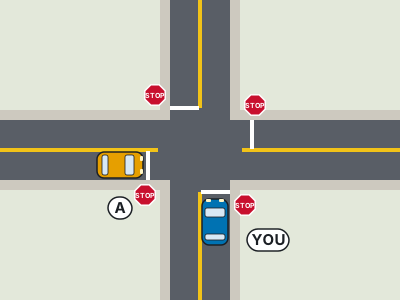
- The vehicle that entered the intersection without stopping
- The vehicle on the left
- The vehicle with the larger engine
- The vehicle on the right
Show answer
The vehicle on the right. When vehicles arrive together at a four-way stop, Delaware gives priority to the vehicle on the right after a complete stop. The left-side vehicle must wait, even if its driver believes the lane is wider or the vehicle is moving faster. A larger engine creates no priority, and entering without stopping violates the stop requirement. The useful cue is simultaneous arrival: identify the vehicle to your right, let it go, then proceed only when the intersection is clear.
Study this in the handbook: Right of way at intersections
18. What changed about medical condition reporting for Delaware drivers in August 2024?
- Drivers must retest yearly
- Reporting became mandatory for all conditions
- Doctors must now report every patient
- The DMV no longer requires mandatory reporting, though practitioners are encouraged to report dangerous drivers
Show answer
The DMV no longer requires mandatory reporting, though practitioners are encouraged to report dangerous drivers. As of August 2024, the Delaware DMV no longer requires mandatory reporting of medical conditions, but licensed practitioners are encouraged to report patients who may pose a danger driving. Section 2714 still lets the Division accept requests from family, law enforcement, or a licensed practitioner to test a driver again, and a license may be voluntarily surrendered when a favorable medical report cannot be obtained, with no reinstatement fee if it is surrendered before the suspension date.
Study this in the handbook: Points, suspensions and serious speeding
19. What is Delaware's recommended response when fatigue makes driving hazardous?
- Rest or change drivers
- Open a window and continue indefinitely
- Drive faster to reach the destination sooner
- Use loud music instead of stopping
Show answer
Rest or change drivers. When tiredness dulls the mind and slows reactions, Delaware's safety guidance says to rest or change drivers. Fresh air, music, and speed may make the driver feel temporarily more alert without restoring reliable judgment or response time. Continuing while struggling to keep the eyes focused increases the chance of drifting, missing an exit, or reacting late. Treat yawning, wandering thoughts, or lane wandering as an immediate warning. Pull off in a safe place or hand over the driving task before fatigue becomes a roadway emergency.
Study this in the handbook: Seeing ahead and adjusting to conditions
20. As a driver approaches a Delaware roundabout, the manual advises slowing to approximately:
- 30 to 35 mph
- 5 to 10 mph
- 20 to 25 mph
- 10 to 15 mph
Show answer
10 to 15 mph. The approach to a roundabout should be slow enough for the driver to read the entry, observe pedestrians and bicyclists, and yield to vehicles already circulating. Delaware gives an approximate approach speed of 10 to 15 mph. The lower range is not the manual's figure, while the two higher ranges reduce the time available to respond to traffic at the entry. Stay to the right of the splitter island as you approach, then enter only after yielding. The speed range is an approach cue, not a target for racing through the circle.
Study this in the handbook: Pavement markings, signaling and roundabouts
QualitySpace is expanding to Delaware
We are a California-based independent insurance brokerage working on licensing in more states. We cannot help with Delaware insurance yet. Leave your email and we will let you know when we can.
Every question is written from the official Delaware Driver Manual. Need paper? Printable DE practice test with answer key.
Last verified 2026-10-05. How we check every question · Study all 205 as flashcards
Frequently asked questions
How many questions are on this Delaware practice test?
This fixed set has 20 questions. It is test 1 of 10 from the 205 question Delaware bank. The real DE exam asks 32 questions and you need 26 correct.
What is the passing score for the real Delaware test?
26 of 32 correct (approximately 81%) That figure comes from the official Delaware source cited on the DMV facts page.
How does this fixed test relate to the full Delaware bank?
Each numbered test is a fixed set of questions in a fixed order, so you can retake the same test later and compare. Every test mixes road signs and the other topics in about the same proportion as the full bank. Tests 1 to 10 together cover 200 of the 205 questions in the Delaware bank, each once. The full practice page mixes the whole bank at random.
Last verified 2026-10-05. See the Delaware DMV facts page for sourced state details.
Return to the full Delaware practice test · Study road signs