
Test 8 of 10 · 20 questions · Free 2026
DE Permit Practice Test 8
Jump to the test ↓A fixed 20 question set from the Delaware bank with answers and plain English explanations. The real DE exam is 32 questions, 81 percent to pass; take the full length version on the main practice page.
Question 1 of 20 · 0 right so far
All 20 questions in test 8
Every question below comes from the Delaware question bank on this page. Open a question to see the correct answer and the explanation. Nothing here is hidden behind a signup.
1. An emergency vehicle approaches while you are already in an intersection. Where should you pull over?
- Beside the left curb before clearing the intersection
- In the middle of the intersection
- Across the nearest crosswalk inside the intersection
- Beyond the intersection after driving through it
Show answer
Beyond the intersection after driving through it. Clear the intersection before pulling over for the approaching emergency vehicle. Stopping in the middle can block its path and leave other traffic unable to move around you. A crosswalk inside the intersection is not a suitable waiting place either. Continue through with care, then move to the right edge or as near to the right as possible. Watch mirrors and follow any instructions from responders while leaving the intersection open for their approach.
Study this in the handbook: Right of way at intersections
2. On a Delaware road with fewer than four lanes, who must stop for a school bus displaying flashing red lights and its stop arm?
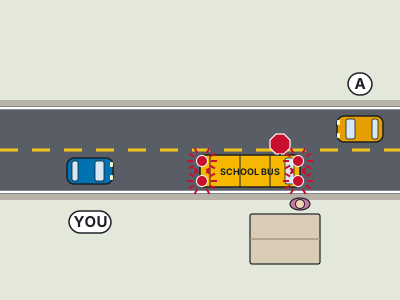
- Only vehicles traveling toward the bus
- Only vehicles traveling behind the bus
- Traffic approaching from both directions
- Only vehicles in the bus's immediate lane
Show answer
Traffic approaching from both directions. On a roadway with fewer than four lanes, vehicles in both directions must stop before reaching a school bus that is loading or unloading children. The exception for traffic moving the opposite way applies only when the vehicle is on the opposite side of a highway having four or more lanes, and even that traffic must proceed slowly. A clear lane or absence of visible children does not cancel the stop. Watch for the yellow warning lights, prepare early, and remain stopped until the red lights end and the stop arm retracts.
Study this in the handbook: School buses, pedestrians and bicyclists
3. Under Delaware law, how far before a planned stop, turn, or lane change must you signal?
- At least 300 feet
- At least 200 feet
- At least 100 feet
- Only during the final 50 feet
Show answer
At least 300 feet. The Delaware requirement is at least 300 feet before the intended action. That distance gives traffic behind you time to recognize whether you will stop, turn, or move sideways. The 100-foot option shortens the warning period, and 200 feet still falls below the stated minimum. Waiting until the final 50 feet leaves little time for another driver to react. Count the rule as a fixed distance, not merely a suggestion to signal sometime before moving. The manual also suggests signaling at least three seconds ahead, but waiting until you pass any driveway or side street before your turn so no one is misled.
Study this in the handbook: Pavement markings, signaling and roundabouts
4. What does the square red and white sign shown here tell a driver?
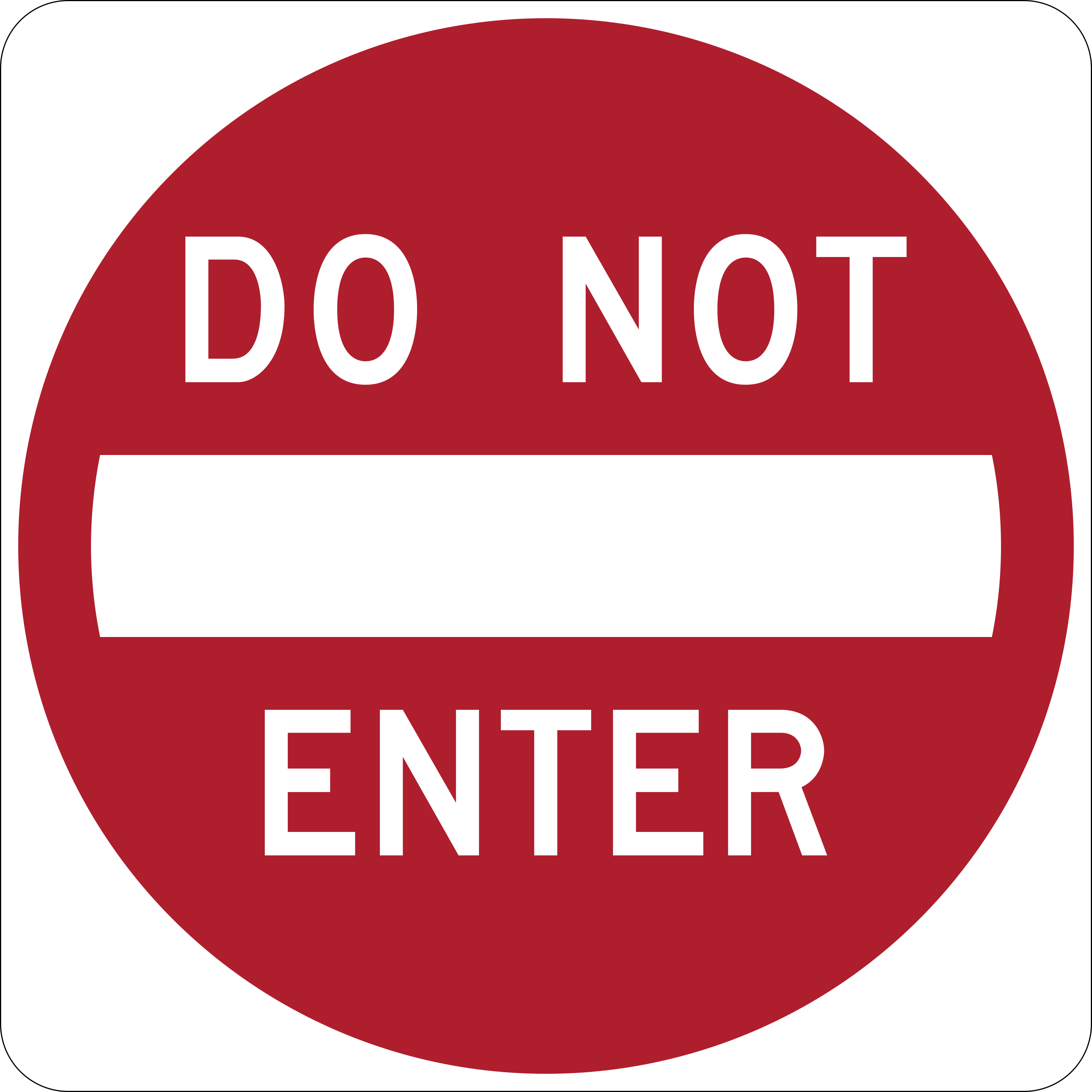
- Traffic must turn around only after sunset
- Parking is prohibited on the next block
- The road ends ahead but entry is allowed
- Do not enter the marked street
Show answer
Do not enter the marked street. The sign prohibits entry into the street it marks. The manual notes that the street may run one way in the opposite direction or that all vehicular traffic may be prohibited. It is not a parking restriction, so the parking choice names a different rule. A dead-end warning would describe the road ahead rather than forbid entering, and the time-based option has no connection to the sign. Treat this red and white message as an immediate access restriction: do not drive past it into the marked roadway.
Study this in the handbook: Road signs by shape and color
5. What legal responsibility does the sponsor who signs a Delaware GDL application take on?
- None, the sponsor only confirms the applicant's age
- Only the duty to pay the license fee
- Joint liability with the GDL driver for damages caused by the driver's negligence
- Responsibility only for parking tickets
Show answer
Joint liability with the GDL driver for damages caused by the driver's negligence. Every GDL application must be signed by a sponsor, and the sponsor is held jointly liable with the GDL applicant for any damages resulting from the applicant's negligence. The sponsor also has final authority to judge whether the teen is ready, to designate who may supervise, and to withdraw the endorsement. So the sponsor's role is far more than confirming age or paying a fee, and the liability is not limited to parking tickets.
Study this in the handbook: The Level One Learner's Permit and GDL rules
6. A Delaware Level One permit holder is suspended for two months during the GDL program. How does that affect the 12 months needed for a Class D license?
- An equal period is added to the end of the 12 months, and complete testing is required
- The 12 months restart from zero
- It has no effect
- The suspension counts as driving time
Show answer
An equal period is added to the end of the 12 months, and complete testing is required. Suspended, revoked, canceled, denied, or surrendered time does not count toward the 12 months of valid driving authority. A period of extra driving experience equal to the suspension is added to the end of the original 12 month period, and the permit holder must undergo complete testing. The clock does not restart from zero, and suspended time is not credited as driving time. Without a suspension, the permit converts to a Class D license automatically after 12 full months.
Study this in the handbook: The Level One Learner's Permit and GDL rules
7. Under Delaware's Zero Tolerance Law, how long is the license revoked for a first offense by a driver under 21 who drove after drinking?
- Six to 12 months
- Two months
- 30 days
- Until age 21
Show answer
Two months. Delaware's Zero Tolerance Law revokes the license of anyone under 21 who drives, operates, or controls a vehicle, off-highway vehicle, or moped while consuming or after consuming alcohol: two months for a first offense, and not less than six nor more than 12 months for each later offense. Six to 12 months is the repeat offense range. Revocation until 21 is what Family Court orders for a juvenile convicted under the DUI law, a separate rule. Thirty days is not listed.
Study this in the handbook: Alcohol, BAC and implied consent
8. How many supervised driving hours must a Delaware Level One permit holder document during the first six months?
- 20 hours, including 2 at night
- 40 hours, including 5 at night
- 60 hours, including 20 at night
- 50 hours, including 10 at night
Show answer
50 hours, including 10 at night. During the first six months after a Level One permit is issued, the sponsor must certify 50 hours of driving, including 10 hours at night. The lower totals in the other choices do not meet the manual's required log, and the 60 hour choice inflates both the overall and night figures. The certification goes to the Department of Education after the first six months or may be emailed to the listed address. A strong cue is to keep a detailed log from the first day, separating the required nighttime hours from the total.
Study this in the handbook: The Level One Learner's Permit and GDL rules
9. After an unfavorable Delaware administrative hearing on a first offense chemical test refusal, how long is the license revoked?
- 3 months
- 12 months
- 5 years
- 6 months
Show answer
12 months. The administrative hearing table lists two columns. For probable cause, revocation is 3 months for a first offense, 12 for a second, and 18 for a third or more. For a refused chemical test, it is 12 months for a first offense, 18 for a second, and 24 for a third or more. So a first refusal means 12 months at the hearing stage. Three months is the first offense probable cause period, six months is not in the table, and five years is far beyond any hearing revocation.
Study this in the handbook: DUI penalties and underage laws
10. After changing a name with the Social Security Administration, how long must a Delaware applicant wait before going to the DMV?
- 30 days
- No wait
- 48 hours
- One week
Show answer
48 hours. You must change your name with the Social Security Administration and wait 48 hours before appearing at the DMV, so the records match electronically. Bring the old license and every name change document, such as a government issued marriage license with a raised seal, a finalized court order, or a finalized divorce decree; the new card costs $10. Marriage certificates signed only by clergy are not accepted, and multiple name changes need every document in the chain.
11. After becoming a Delaware resident, a driver moving from another state must apply for a Delaware driver license within:
- 30 days
- 45 days
- 90 days
- 60 days
Show answer
60 days. If you move into Delaware from another state, you must apply for a Delaware driver's license within 60 days after becoming a resident. The deadline is not 30, 45, or 90 days, so do not wait for your old license to expire. You turn in the out-of-state license or a certified copy of your driving record, show proof of legal presence, your Social Security number, and two proofs of Delaware residency, and pass an eye screening. Written and road exams are normally waived if your license is valid.
Study this in the handbook: Exams, renewal and license rules
12. What does a solid white line between lanes generally indicate on Delaware roads?
- Changing lanes is discouraged
- Changing lanes is encouraged
- The lanes carry opposing traffic
- The lane is reserved for buses
Show answer
Changing lanes is discouraged. A solid white line between lanes moving in the same direction means changing lanes is discouraged. A broken white line may be crossed for a safe lane change, while double solid white lines prohibit changing lanes. The marking does not identify opposing traffic or create a bus-only lane. Keep the vehicle in its lane, check mirrors and blind spots, and change only when the marking and surrounding conditions permit it. The visual cue is the unbroken single white line: treat it as a reason to maintain lane position unless a necessary lawful movement can be made safely.
Study this in the handbook: Road signs by shape and color
13. What is the purpose of a five-sided black-on-yellow warning sign?
- It marks a highway rail intersection
- It warns of a school or school crossing
- It announces a mandatory speed limit
- It identifies a recreational facility
Show answer
It warns of a school or school crossing. Delaware reserves the five-sided black-on-yellow sign for schools and school crossings. When it appears, drivers should reduce speed, watch for children, and be ready to stop. The round yellow sign with an X and RR letters serves as the advance warning for a highway rail intersection, so the choice “It marks a highway rail intersection” describes a different sign. Speed limits use regulatory signs, while recreational facilities use other guide or information signs. The pentagon is the recognition cue: expect children near the roadway and give yourself time to react.
Study this in the handbook: Road signs by shape and color
14. What should a driver do when a vehicle ahead is stopped to let a pedestrian cross the highway?
- Pass the stopped vehicle slowly on its left
- Move onto the shoulder to get around the vehicle
- Sound the horn until the pedestrian reaches the curb
- Wait and do not pass the vehicle stopped for the pedestrian
Show answer
Wait and do not pass the vehicle stopped for the pedestrian. A stopped vehicle may be yielding to a person who is crossing outside your view. Delaware prohibits passing that vehicle because going around it can put the pedestrian directly in your path. The horn is not a substitute for yielding, and the shoulder is not a safe bypass. Pause behind the stopped vehicle, watch for the pedestrian to clear the roadway, and continue only when the full crossing area is visible and safe.
Study this in the handbook: School buses, pedestrians and bicyclists
15. What does the crossbuck sign at a highway rail intersection mean?
- It has the same meaning as a yield sign, so yield to crossing trains
- It guarantees the tracks are clear
- It requires drivers to accelerate across the tracks
- It marks a school bus loading zone
Show answer
It has the same meaning as a yield sign, so yield to crossing trains. The white X-shaped railroad crossbuck carries the same meaning as a yield sign, so drivers must yield to crossing trains. It is not a guarantee that tracks are clear, and accelerating to beat a train is dangerous. A school bus loading zone is unrelated to the crossbuck. The cue is to scan and listen at every crossing, obey flashing lights or gates, and cross only when you can do so without having to stop on the tracks.
Study this in the handbook: Road signs by shape and color
16. A steady red light is displayed, no sign forbids the turn, and no steady red arrow is displayed. When may a Delaware driver turn right?
- Without stopping if no pedestrians are visible
- After a full stop, when the turn is safe
- Only after waiting for a green arrow
- Before reaching the intersection to avoid the red light
Show answer
After a full stop, when the turn is safe. Delaware permits a right turn on a steady red light after the driver makes a full stop, unless a posted sign prohibits it or a steady red arrow is displayed. The stop comes first, at the stop line, before the crosswalk, or before entering the intersection, so a rolling turn is not allowed even when no pedestrians are in view. No green arrow is needed for this turn. After stopping, make the turn with caution and only when it is safe to do so.
Study this in the handbook: Traffic lights and arrows
17. What speed limit does Delaware list for Route 1 and Interstate 495?
- 65 miles per hour
- 55 miles per hour
- 50 miles per hour
- 70 miles per hour
Show answer
65 miles per hour. Delaware's speed table lists 65 miles per hour for Route 1 and Interstate 495. The 50 mile figure belongs to two-lane roads, while 55 applies to divided roads, roads with four or more lanes, and controlled access highways in the table. The 70 mile option exceeds the listed Delaware maximum for this entry. Check the posted sign and current conditions as well, because the manual's general rule still requires a reasonable speed.
Study this in the handbook: Delaware speed limits
18. If you need to change lanes near the merge warning shown here, when should you use your turn signal?

- Only after the front wheels cross the lane line
- Before starting the lane change
- After completing the lane change
- Only if the entering driver sounds a horn
Show answer
Before starting the lane change. Give nearby drivers notice before moving into another lane. A signal started after crossing the lane line arrives too late to communicate the movement in advance. Near merging traffic, another driver may be deciding whether to accelerate, slow, or join the same gap, so clear notice helps everyone anticipate the next movement. Signal first, check mirrors and the blind spot, and change position only when space is available. A turn signal communicates intent but does not reserve a gap.
19. What happens when a Delaware driver's calculated points reach 14?
- A 2-month suspension that can be avoided by paying a fee
- An advisory letter
- A mandatory 4-month license suspension
- Nothing until 20 points
Show answer
A mandatory 4-month license suspension. At 14 calculated points Delaware imposes a mandatory 4-month license suspension, and to be reinstated the driver must have completed a behavior modification/attitudinal driving course within the previous two years. Suspensions then grow by two months per two point step: 6 months at 16, 8 at 18, 10 at 20, and 12 at 22. An advisory letter is the 8 point step, and no fee avoids the suspension.
Study this in the handbook: Points, suspensions and serious speeding
20. What does completing an approved defensive driving course do for a Delaware driver?
- Erases all existing DMV points
- Removes a DUI from the record
- Gives a three-point credit applied only to future violations
- Lowers the fine on any pending ticket
Show answer
Gives a three-point credit applied only to future violations. Delaware may treat completion of an approved defensive driving course as a three-point credit used when calculating DMV penalties. The credit is applied only to future violations for administrative action and does not remove or reduce existing DMV points, and it does not change the overall point value used for employment and insurance review. It has no effect on DUI records or pending fines. The course credit stays valid for three years from completion.
Study this in the handbook: Points, suspensions and serious speeding
QualitySpace is expanding to Delaware
We are a California-based independent insurance brokerage working on licensing in more states. We cannot help with Delaware insurance yet. Leave your email and we will let you know when we can.
Every question is written from the official Delaware Driver Manual. Need paper? Printable DE practice test with answer key.
Last verified 2026-10-05. How we check every question · Study all 205 as flashcards
Frequently asked questions
How many questions are on this Delaware practice test?
This fixed set has 20 questions. It is test 8 of 10 from the 205 question Delaware bank. The real DE exam asks 32 questions and you need 26 correct.
What is the passing score for the real Delaware test?
26 of 32 correct (approximately 81%) That figure comes from the official Delaware source cited on the DMV facts page.
How does this fixed test relate to the full Delaware bank?
Each numbered test is a fixed set of questions in a fixed order, so you can retake the same test later and compare. Every test mixes road signs and the other topics in about the same proportion as the full bank. Tests 1 to 10 together cover 200 of the 205 questions in the Delaware bank, each once. The full practice page mixes the whole bank at random.
Last verified 2026-10-05. See the Delaware DMV facts page for sourced state details.
Return to the full Delaware practice test · Study road signs