
Test 24 of 25 · 20 questions · Free 2026
DE Permit Practice Test 24
Jump to the test ↓A fixed 20 question set from the Delaware bank with answers and plain English explanations. The real DE exam is 32 questions, 81 percent to pass; take the full length version on the main practice page.
Question 1 of 20 · 0 right so far
All 20 questions in test 24
Every question below comes from the Delaware question bank on this page. Open a question to see the correct answer and the explanation. Nothing here is hidden behind a signup.
1. A driver passing you on a two-lane road runs short of room as an oncoming car appears. What should you do?
- Speed up so the passing driver has to drop back
- Hold your speed; the mistake is not yours to fix
- Slow down and let the passing driver return to the lane
- Move left to block the pass
Show answer
Slow down and let the passing driver return to the lane. If another driver makes a mistake, do not make it worse. One example the manual gives is a driver who passes you without enough room: slow down and let them return to the driving lane safely. Likewise, if another driver needs to change lanes suddenly, slow down and let them merge. These gestures keep traffic moving and help you avoid a crash.
2. How do truck side blind areas compare with those of a passenger car?
- They are much larger on both sides of the truck
- They are smaller because mirrors are higher
- They exist only on the right side of the truck
- They disappear when the truck signals
Show answer
They are much larger on both sides of the truck. Trucks have much larger blindspots on both sides of their vehicles than passenger vehicles. Driving in those side blindspots for any length of time means the truck driver cannot see the car. Higher mirrors do not shrink the areas below and beside a long trailer, and the blind areas exist on both sides rather than only the right. A turn signal does not make a hidden car visible to the truck driver.
Study this in the handbook: Following distance, trucks and motorcycles
3. You come up behind a farm tractor showing the pictured emblem on its back. What should you do first?

- Pass quickly before it reaches a hill
- Honk to move it onto the shoulder
- Slow down at once and proceed with caution
- Follow closely to read the emblem
Show answer
Slow down at once and proceed with caution. The triangular fluorescent and reflective orange emblem warns approaching drivers that the vehicle ahead is slow moving. When a driver sees that emblem, the immediate response is to slow down and proceed with caution. The speed difference can close quickly, especially on rural roads with limited sight distance. Passing quickly, honking to force shoulder use, and following closely all reduce the margin created by early slowing.
Study this in the handbook: School buses, pedestrians and bicyclists
4. Which description fits the usual look of a regulatory sign in Delaware?
- Always yellow diamonds with black symbols or words
- Green rectangles with white letters and town distances
- Square, rectangular, or special shapes, usually white, red, or black
- Round blue signs that point to gas, food, and lodging
Show answer
Square, rectangular, or special shapes, usually white, red, or black. Regulatory signs tell you the laws for traffic direction, lane use, turning, speed, parking, and other special situations. They are square, rectangular, or a special shape, and usually white, red, or black with black, red, white, or green letters or symbols. The stop sign, with its eight sides, and the yield sign, an upside-down triangle, are special shapes in this group.
Study this in the handbook: Road signs by shape and color
5. You want to parallel park on a busy street and traffic is coming up behind you. What should you do?
- Stop and back in quickly before traffic arrives
- Signal, pull next to the space, and let traffic pass
- Back up along the curb to the space from further ahead
- Wave the following drivers around you as you back
Show answer
Signal, pull next to the space, and let traffic pass. To keep a safe distance behind you, help following drivers know your plan. If you want to parallel park and traffic is coming behind you, put on your turn signal, pull next to the space, and allow the following vehicles to pass before you park. If a car is following too closely, do not stop suddenly; continue driving and find another space instead.
Study this in the handbook: Following distance, trucks and motorcycles
6. You are entering a highway from an on-ramp. How should you use the ramp?
- Stop at the end of the ramp and wait for a gap
- Use the ramp to reach the speed of highway traffic
- Drive the ramp slowly and speed up on the highway
- Merge as soon as the ramp starts, at any speed
Show answer
Use the ramp to reach the speed of highway traffic. When you merge, try to enter at the same speed traffic is moving. High-speed roads usually have ramps so you can build up speed; use the ramp to match the other vehicles before pulling onto the road. Do not drive to the end of the ramp and stop. You will not have room to reach traffic speed, and drivers behind you, watching the main road, may hit you from the rear.
Study this in the handbook: Seeing ahead and adjusting to conditions
7. Inside a diverging diamond interchange, you notice traffic traveling briefly on the opposite side of the road from usual. Why is the traffic shifted that way?
- To let drivers choose either side based on which queue is shorter
- To route all traffic around a permanent closure of the left lanes
- To allow drivers to stop mid-interchange and change their exit
- To let left-turning traffic complete the turn without crossing opposing flow
Show answer
To let left-turning traffic complete the turn without crossing opposing flow. A diverging diamond shifts traffic within the interchange so part of the travel briefly uses the left side of the road. That shift lets left turn movements occur without crossing oncoming traffic or stopping for it. The pattern is fixed by the interchange design, not a driver choice between queues. Following the signs, markings, and signals through the crossover points keeps the vehicle on the intended shifted path.
Study this in the handbook: Pavement markings, signaling and roundabouts
8. You are stopped at a steady red light on a one-way street and want to turn left onto another one-way street. No sign or red arrow prohibits it. What may you do?
- Turn after a full stop when the turn can be made safely and with caution
- Turn without stopping because cross traffic also faces a red light
- Turn only if a green arrow appears for the cross street traffic
- Wait for a green light in every case, even when no sign prohibits the turn
Show answer
Turn after a full stop when the turn can be made safely and with caution. Delaware allows this turn after the vehicle has come to a full stop, provided no posted sign forbids it and no steady red arrow controls the movement. The driver still has to check for pedestrians and other vehicles and complete the turn only when a safe gap exists. A green light is not required in this narrow situation, but rolling through the stop or turning into an occupied path is not permitted under the exception.
Study this in the handbook: Traffic lights and arrows
9. You are on an empty road with no one else in sight. You are about to turn. Should you still signal?
- No, signals are needed only when other cars are near
- Yes, signal every time you change direction
- Only if you are turning left
- Only at night
Show answer
Yes, signal every time you change direction. Get into the habit of signaling every time you change direction, even when you do not see anyone else around. It is easy to miss someone who needs to know what you are doing. Signal as early as you can, and be careful not to signal too early if streets or driveways lie between you and the turn. After a turn or lane change, make sure your signal is off, since small turns may not cancel it.
10. In heavy rain, at about what speed can tires lose all traction with the road through hydroplaning?
- About 35 mph on any tire
- About 75 mph with new tires
- About 65 mph in light rain
- About 50 mph
Show answer
About 50 mph. As speed rises on a wet road, tires begin to ride up on the water like water skis. Most tires keep good traction to about 35 mph, but in heavy rain all traction can be lost near 50 mph. Bald or badly worn tires lose traction at much lower speeds. Slowing down in rain or on a wet road is the main defense against this loss of grip.
Study this in the handbook: Seeing ahead and adjusting to conditions
11. At 55 mph, how much time do you need in oncoming traffic to complete a pass safely?
- About 10 seconds of clear oncoming traffic
- About four seconds if the road looks straight
- About six seconds on a two lane road
- About two seconds when no vehicle is visible
Show answer
About 10 seconds of clear oncoming traffic. At 55 mph a pass takes about ten seconds, during which your vehicle covers over 800 feet while an oncoming vehicle covers a similar distance. Together that calls for over 1600 feet, about one third of a mile, of clear space and sight distance. Distant vehicles can look almost stationary while closing fast. When the available gap is in doubt, waiting is the safer choice.
12. Unless a sign posts a different speed, what is the limit in a Delaware residential district?
- 20 miles per hour
- 30 miles per hour
- 35 miles per hour
- 25 miles per hour
Show answer
25 miles per hour. Delaware sets 25 miles per hour in both business districts and residential districts, unless a sign posts a different speed. School zones are 20 miles per hour, two-lane roads 50, divided roads and roads with four or more lanes 55, controlled access highways 55, and Route 1 and Interstate 495 65. You must also obey the general rule not to drive faster than is reasonable for existing conditions.
Study this in the handbook: Delaware speed limits
13. Your car breaks down with a flat rear tire while traffic moves in the lane beside it. What does the manual say about changing the tire?
- Change it quickly while your emergency flashers are on
- Change it only if you wear bright clothing
- Do not change it if you would have to stand in a traffic lane
- Change it from the traffic side to see the lug nuts
Show answer
Do not change it if you would have to stand in a traffic lane. Never stand in the roadway. Do not try to change a tire if it means you have to be in a traffic lane. Get the vehicle off the road and away from traffic if possible, and turn on your emergency flashers. If you cannot get off the roadway, stop where other drivers have a clear view, not just over a hill or around a curve, and stand by the side of the road where you are safe.
14. Why should you never run your car's motor in a closed garage?
- Exhaust gases can cause death in a very short time
- The engine will overheat within seconds
- It drains the battery too quickly
- It wears out the tires faster
Show answer
Exhaust gases can cause death in a very short time. Gases from a leaky exhaust can cause death inside a vehicle in a very short time. Never run the motor in a closed garage. If you sit in a vehicle with the motor running for a long time, open a window. Many exhaust leaks cannot be heard, which is why the exhaust system should be checked from time to time.
15. Late in the day you are driving away from the setting sun. What does the Delaware manual advise?
- Turn on your headlights so oncoming drivers can see you
- Keep headlights off until the sun has fully set
- Use parking lights only until it is dark
- Switch on high beams so drivers ahead notice you
Show answer
Turn on your headlights so oncoming drivers can see you. When you drive away from a rising or setting sun, turn on your headlights. Drivers coming toward you are looking into the sun and may have trouble seeing your vehicle, and your headlights help them see you. The same idea applies when it begins to get dark: turning headlights on a little early helps other drivers. Parking lights are for parked vehicles only.
16. You are on a one-way road and see the pictured sign ahead. What does it tell you?
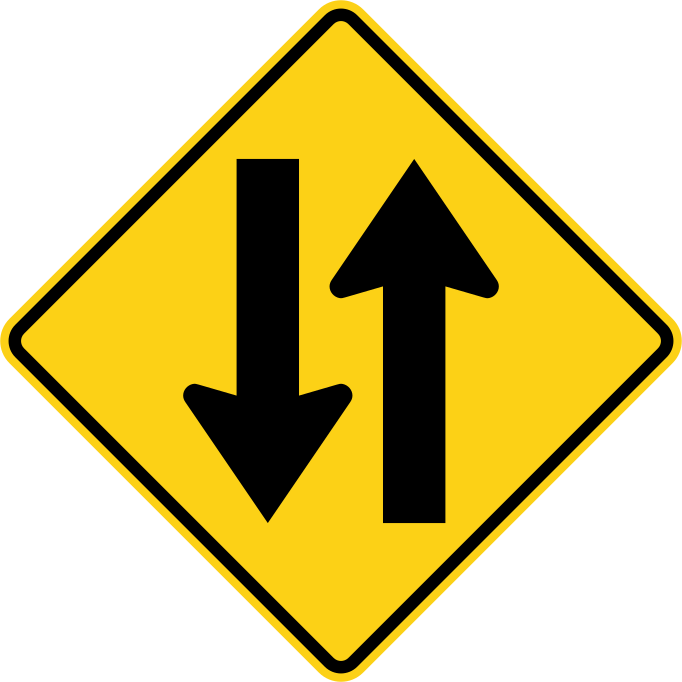
- Two lanes ahead will go your way
- One-way traffic ends; expect oncoming traffic
- You must turn around at the next exit
- A divided highway with a median begins
Show answer
One-way traffic ends; expect oncoming traffic. The two-way traffic sign warns that one-way traffic ends and reminds you of oncoming traffic. After it, vehicles will be coming toward you in the other lane. Keep to the right, do not use the opposite lane as if it were yours, and pass only where markings allow it. Read the sign by its yellow diamond shape and the two opposite arrows.
17. Your vehicle breaks down at night and you have emergency flares. Where should you place them?
- Inside the car on the dashboard
- In front of the car, facing oncoming traffic
- Behind the vehicle to warn approaching drivers
- On the roof so they can be seen from far away
Show answer
Behind the vehicle to warn approaching drivers. Try to warn other road users that your vehicle is there by placing emergency flares behind the vehicle. That gives approaching drivers time to change lanes if necessary. If you have no flares or other warning devices, stand by the side of the road where you are safe and wave traffic around your vehicle, using a white cloth if you have one. Never stand in the roadway.
18. At a crash scene, where must you avoid standing or walking, even while helping?
- On the sidewalk beside the road
- In traffic lanes
- Behind a guardrail off the road
- Inside your own parked vehicle
Show answer
In traffic lanes. Traffic lanes at a crash scene remain open to moving vehicles unless traffic is controlled. Standing or walking there exposes helpers to being struck by another vehicle. Turning off ignitions of wrecked vehicles, avoiding smoking near spilled fuel, and keeping clear of downed power lines also reduce scene dangers. Warning devices or flares placed to alert traffic protect both helpers and people in the wrecked vehicles.
19. You note when the car ahead passes a sign, and you reach the same sign two seconds later on a dry road in daylight. What should you do?
- Keep your position, since two seconds is a safe cushion
- Move up to one second so no one else can cut in
- Speed up and pass the sign before the count ends
- Drop back, then count again at another spot
Show answer
Drop back, then count again at another spot. The three-second rule tells you whether you are following too closely. You are following too closely if you pass the mark before you finish counting. In that case, drop back and then count again at another spot to check your following distance, and repeat until you follow no closer than three seconds. Slippery roads, poor visibility, and some other situations can call for a four-second distance.
Study this in the handbook: Following distance, trucks and motorcycles
20. You are ready to leave a parallel parking space. What does the manual tell you to do?
- Back out quickly so passing drivers will notice you leaving
- Turn the wheels toward the curb and pull straight out
- Sound your horn and pull out when other drivers yield
- Signal, watch for traffic, and steer toward the open lane
Show answer
Signal, watch for traffic, and steer toward the open lane. To leave a parallel parking space, signal your move. Watch for traffic and turn your steering wheel toward the open lane, easing your way out into traffic. Before you park, the same rules apply in reverse: check traffic behind you, signal, and if a car is following too closely, keep driving and find another space. Also remember that it is against the law to leave the keys in a running, unattended vehicle.
Every question is written from the official Delaware Driver Manual. Need paper? Printable DE practice test with answer key.
Last verified 2026-10-05. How we check every question · Study all 500 as flashcards
Frequently asked questions
How many questions are on this Delaware practice test?
This fixed set has 20 questions. It is test 24 of 25 from the 500 question Delaware bank. The real DE exam asks 32 questions and you need 26 correct.
What is the passing score for the real Delaware test?
26 of 32 correct (approximately 81%) That figure comes from the official Delaware source cited on the DMV facts page.
How does this fixed test relate to the full Delaware bank?
Each numbered test is a fixed set of questions in a fixed order, so you can retake the same test later and compare. Every test mixes road signs and the other topics in about the same proportion as the full bank. Tests 1 to 25 together cover every question in the Delaware bank once. The full practice page mixes the whole bank at random.
Last verified 2026-10-05. See the Delaware DMV facts page for sourced state details.
Return to the full Delaware practice test · Study road signs