
Test 22 of 25 · 20 questions · Free 2026
DE Permit Practice Test 22
Jump to the test ↓A fixed 20 question set from the Delaware bank with answers and plain English explanations. The real DE exam is 32 questions, 81 percent to pass; take the full length version on the main practice page.
Question 1 of 20 · 0 right so far
All 20 questions in test 22
Every question below comes from the Delaware question bank on this page. Open a question to see the correct answer and the explanation. Nothing here is hidden behind a signup.
1. A pedestrian signal shows a steady DON'T WALK, and a person has not yet left the curb. What does the signal tell that person?
- Start crossing and finish as quickly as possible
- Cross only if no cars are turning
- Wait for cars to stop, then cross
- Do not start to cross the street at all
Show answer
Do not start to cross the street at all. The steady DON'T WALK signal means that the pedestrian should not start to cross the street at all. A flashing DON'T WALK works differently: a person who has already started should finish crossing as rapidly as possible, and a person who has not started should not begin. The WALK signal means the pedestrian may proceed but must watch for vehicles turning across the crosswalk, and drivers must yield to pedestrians who have it.
2. A driver took a painkiller exactly as the doctor prescribed and then drove while impaired. Under Delaware's DUI law, does the prescription protect the driver?
- Yes, a prescription is a full defense
- Yes, if the pharmacy label did not warn
- No, legal use of the drug is no defense
- Only if the trip was short
Show answer
No, legal use of the drug is no defense. Delaware's DUI law covers driving under the influence of drugs as well as alcohol. The fact that a person is, or has been, legally entitled to use the alcohol or drug is not a defense. That is why you should check a medicine's label for warnings about driving and ask your doctor or pharmacist about side effects before you drive.
Study this in the handbook: Alcohol, BAC and implied consent
3. At a crash scene, a person is bleeding from a leg wound. What does the manual say will slow the bleeding?
- Pressing directly on the wound with a hand or a cloth
- Giving the person water so they stay calm and awake
- Moving them into your car right away
- Waiting for the police before touching anything
Show answer
Pressing directly on the wound with a hand or a cloth. If there is bleeding, apply pressure directly on the wound with your hand or with a cloth. Even severe bleeding can almost always be stopped or slowed this way. First help anyone who is not already walking and talking, and check for breathing before bleeding. Do not move injured people unless they are in a burning vehicle or in danger of being hit, and do not give them anything to drink.
Study this in the handbook: Railroad crossings, vehicle emergencies and crashes
4. Before backing up, what should you check before you get into the vehicle?
- That the parking brake holds on a slope
- Children or small objects behind the vehicle
- That the mirrors are set for highway driving
- Whether the fuel gauge shows a full tank
Show answer
Children or small objects behind the vehicle. Children and small objects behind a vehicle cannot be seen from the driver seat. Walking behind the vehicle first reveals them before backing begins. Backing slowly helps as well, because the vehicle is harder to steer in reverse. Using a person outside to guide the move adds another check where one is available. Mirror settings and fuel level do not show what is directly behind the vehicle.
5. On packed snow, how should you adjust your speed?
- Reduce it by about 10 mph only
- Keep posted speed with snow tires fitted
- Cut your speed in half
- Slow to a crawl as on ice
Show answer
Cut your speed in half. Packed snow gives tires far less grip than dry pavement, so halving speed matches the longer stopping distance. Snow tires or chains help when snow covers the road. Ice is worse still and calls for slowing to a crawl, with avoiding the trip where possible. A ten mile per hour cut suits a wet road but leaves too much speed for packed snow.
Study this in the handbook: Seeing ahead and adjusting to conditions
6. Unless a sign says otherwise, how close to a railroad crossing may you stop or park?
- No closer than 50 feet
- No closer than 20 feet
- No closer than 30 feet
- No closer than 100 feet
Show answer
No closer than 50 feet. Delaware does not allow you to stop or park within 50 feet of a railroad crossing unless the area is otherwise posted. This keeps the approach to the tracks clear for drivers who must stop there and who need to see the signals. The same list prohibits parking within 30 feet of a stop sign or traffic signal, within 20 feet of a crosswalk at an intersection, and within 15 feet of a fire hydrant.
Study this in the handbook: Delaware speed limits
7. You are unsure where to turn and feel like stopping in your lane to work it out while traffic is moving. What does the manual say?
- Keep moving until you can safely pull off the road
- Stop briefly with your flashers on until you decide
- Stop only if no one is close behind you in traffic
- Back up to the last intersection and start over
Show answer
Keep moving until you can safely pull off the road. Delaware's lane rules say not to stop in a travel lane for any reason, including confusion, a breakdown, or letting out a passenger. Keep moving until you can safely pull off the road. Backing up is no answer either, because drivers do not expect a vehicle to be backing toward them and may not see it until it is too late. If you miss your turn or exit, go on to a place where you can safely turn around.
8. A large truck ahead of you swings left before turning right at a corner. What should you do?
- Pull up on the truck's right side to get around it
- Stay back and keep out of the space to the truck's right
- Pass the truck on the left while it swings wide
- Honk so the driver knows you are behind
Show answer
Stay back and keep out of the space to the truck's right. Truck drivers sometimes need to swing wide to the left to safely make a right turn, and they cannot see cars directly behind them. Cutting in between the commercial vehicle and the curb or shoulder to the right increases the possibility of a crash, because the truck will swing back into that space. Stay back, leave room, and wait until the truck finishes the turn.
Study this in the handbook: Following distance, trucks and motorcycles
9. After passing the pictured sign, you reach the entry as a person starts across the crosswalk and a car circles toward you. What should you do?

- Enter ahead of the car, then watch for the person
- Yield to both the person and the circulating car
- Wave the person back and go first
- Honk so both of them wait for you
Show answer
Yield to both the person and the circulating car. The roundabout sign tells you to reduce speed and yield to pedestrians and to vehicles already in the circle. At the entry, wait for the person to clear the crosswalk and let the circulating car go by. Enter only when there is a safe gap, then travel counterclockwise without stopping except to avoid a collision. Watch for pedestrians and bicyclists again as you exit.
10. You follow a motorcycle toward a rough railroad crossing that runs at an angle across the road. What should you expect the rider to do?
- Speed up to clear the tracks quickly
- Cross at the same angle and speed as cars
- Slow or turn to cross the tracks head on
- Stop on the tracks to check for trains
Show answer
Slow or turn to cross the tracks head on. Road surfaces that do not bother cars can create problems for motorcyclists. Railroad crossings may be rough or cross the road at an angle, so the rider may slow down or change direction to cross the tracks head on, and may rise off the seat to cushion the shock. Leave extra following room so a sudden change in the rider's speed or path does not catch you off guard.
Study this in the handbook: Following distance, trucks and motorcycles
11. You must back out of a long driveway. How should you look behind you?
- Turn around and look directly through the rear window
- Use the side mirrors, which show the area behind the car
- Use only the rearview mirror
- Back quickly so the move takes less time
Show answer
Turn around and look directly through the rear window. It is hard to see behind your vehicle. Before getting in, check behind it for children or small objects. When backing, place your right arm on the back of the seat and turn around so you can look directly through the rear window. Do not depend on your rearview or side mirrors, because you cannot see directly behind the vehicle with them. Back slowly.
12. A truck is passing your car. How can you help and what must you avoid?
- Speed up to shorten time beside the truck
- Reduce speed slightly and do not speed up during the pass
- Move toward the truck to guide its path
- Flash your high beams so the truck driver knows you are there
Show answer
Reduce speed slightly and do not speed up during the pass. When a truck passes, the car driver can help by keeping to the far side of the lane and reducing speed slightly, and must not speed up while the truck is passing. Speeding up prolongs side by side travel and can trap the truck in the passing lane. Moving toward the truck and continuous high beam flashing reduce space and visibility. A slight slowdown lets the pass finish and the truck signal its return.
Study this in the handbook: Following distance, trucks and motorcycles
13. A small child suddenly starts to run toward the street from a yard ahead of you. How should you use your horn?
- Do not use it, since horns are only for vehicles
- Give a light tap and keep your speed
- Wait until the child is in your lane, then tap it
- Sound a sharp blast as a danger warning
Show answer
Sound a sharp blast as a danger warning. If there is no immediate danger, a light tap on the horn is usually enough. When there is danger, do not be afraid to sound a sharp blast. One example the manual gives is a child or older person about to walk, run, or ride into the street. Sound the horn and also be ready to slow or stop, since the horn alone may not stop the child.
14. A yellow diamond warning sign shows the outline of a bicycle. What should you do on that road?
- Watch left and right for cyclists
- Expect bicycles only on the right edge
- Stay out of the right lane entirely
- Use the horn when you see a rider
Show answer
Watch left and right for cyclists. The bicycle warning sign is used on roads that are shared with bicycles. It tells drivers to watch left and right for cyclists, since riders may be on either side or crossing. When you pass a bicyclist, leave at least three feet of clearance. Do not honk at a rider unless there is an imminent danger, because Delaware law forbids it otherwise.
15. You face a steady red light where a painted stop line and a crosswalk are both present before the intersection. Where must your vehicle stop?
- With the front bumper inside the crosswalk so you can see cross traffic better
- At the edge of the intersection even when an earlier line is painted
- Past the crosswalk but before any turning vehicle reaches your lane
- At the painted line that comes before the pedestrian crossing area
Show answer
At the painted line that comes before the pedestrian crossing area. The stopping order puts the painted line first when one is present. A driver facing red halts there rather than rolling into the area reserved for people on foot. Only when no line exists does the crosswalk become the stopping reference, and only when neither exists does the vehicle stop before entering the intersection itself. Stopping farther forward blocks pedestrians and can place the vehicle in the path of turning traffic.
Study this in the handbook: Traffic lights and arrows
16. A Delaware driver cuts across a gas station lot to get around a red light. What does Delaware law say about this?
- It is legal if the driver does not speed through the lot
- It is legal if the lot is empty
- It is legal only when the driver is turning right
- It is illegal to evade a traffic signal or road sign by crossing private property
Show answer
It is illegal to evade a traffic signal or road sign by crossing private property. Delaware's general traffic laws say you must not try to evade a traffic signal or road sign by leaving the road and traveling across private property. Cutting through a gas station, store lot, or similar property to skip a red light is exactly that, no matter how slowly you drive or how empty the lot looks. Turning right does not create an exception either. The same list of general laws says you must obey a police officer's instructions even when they differ from signs and signals. Wait for the signal like everyone else on the road.
Study this in the handbook: Pavement markings, signaling and roundabouts
17. Your route turns left at the next corner, but the pictured sign is posted there. What should you do?
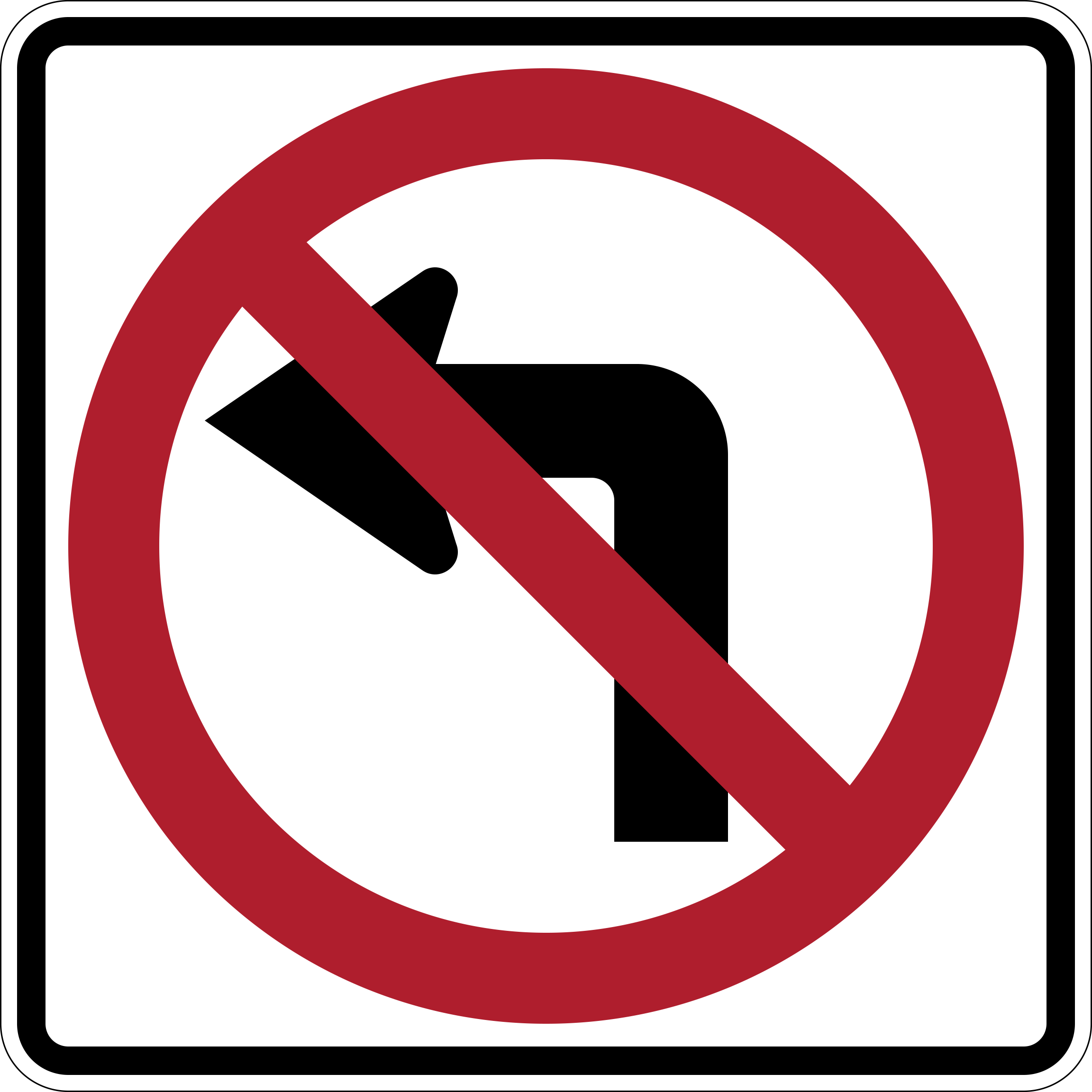
- Turn left if no oncoming traffic is in sight
- Go on and use a route that does not need that turn
- Turn left from the right lane to stay clear of others
- Stop at the corner and wait for the sign to change
Show answer
Go on and use a route that does not need that turn. The crossed-out left arrow is one of the international signs adopted in Delaware and the other states, and it means No Left Turn at that location. Do not make the turn, even if no traffic is coming. Continue to another street where a left turn is allowed, or plan a route that reaches your destination with legal turns. Never stop in a travel lane to wait.
Study this in the handbook: Road signs by shape and color
18. You miss the exit you wanted on a highway. What should you do?
- Back up slowly on the shoulder to reach the exit
- Stop in the lane and wait for a gap to reverse
- Back up in the travel lane with hazard lights on
- Go on to a place where you can safely turn around
Show answer
Go on to a place where you can safely turn around. Never back a vehicle in a travel lane except to parallel park or, if necessary, to exit a driveway. Drivers do not expect a vehicle backing toward them and may not notice until it is too late. If you miss your turn or exit, do not back up. Continue to a place where you can turn around safely and come back.
19. When is ice on the road most slippery?
- When the temperature is far below freezing
- Only late at night when it is coldest
- When the temperature is around the freezing point
- Only on roads that have been treated with salt
Show answer
When the temperature is around the freezing point. When the temperature is around the freezing point, ice can become wet, which makes conditions more slippery than at temperatures well below freezing. A road near 32 degrees can feel harmless yet be at its most slippery. Slow to a crawl on ice and avoid driving on icy roads if at all possible. Bridges and shady spots also freeze first.
Study this in the handbook: Seeing ahead and adjusting to conditions
20. A driver is tailgating you on a road with only one lane in your direction. What does the manual advise?
- Brake hard to scare the driver into backing off
- Speed up sharply to build a gap behind you
- Wait until the road ahead is clear, then slow gradually
- Stop in the lane and let them pass you
Show answer
Wait until the road ahead is clear, then slow gradually. If you are being followed closely and there is a right lane, move over to the right. If there is no right lane, wait until the road ahead is clear and then reduce speed slowly. This will encourage the tailgater to drive around you. Never slow down quickly to discourage a tailgater, because all that does is increase your risk of being hit from behind.
Study this in the handbook: Following distance, trucks and motorcycles
Every question is written from the official Delaware Driver Manual. Need paper? Printable DE practice test with answer key.
Last verified 2026-10-05. How we check every question · Study all 500 as flashcards
Frequently asked questions
How many questions are on this Delaware practice test?
This fixed set has 20 questions. It is test 22 of 25 from the 500 question Delaware bank. The real DE exam asks 32 questions and you need 26 correct.
What is the passing score for the real Delaware test?
26 of 32 correct (approximately 81%) That figure comes from the official Delaware source cited on the DMV facts page.
How does this fixed test relate to the full Delaware bank?
Each numbered test is a fixed set of questions in a fixed order, so you can retake the same test later and compare. Every test mixes road signs and the other topics in about the same proportion as the full bank. Tests 1 to 25 together cover every question in the Delaware bank once. The full practice page mixes the whole bank at random.
Last verified 2026-10-05. See the Delaware DMV facts page for sourced state details.
Return to the full Delaware practice test · Study road signs