
Printable DE Permit Practice Test
32 questions in the real DE exam format, 81 percent (26 of 32) to pass. Answer key on the last page. Last verified 2026-09-05 against the official Delaware driver manual.
1. How should a driver respond to a flashing yellow arrow?
- Make the indicated movement only after yielding to opposing traffic and pedestrians
- Treat it as a mandatory full stop in every direction
- Turn without checking because opposing traffic must stop
- Wait for a red arrow before entering the intersection
2. A Delaware commercial motor vehicle driver has a BAC of .04. What first-offense disqualification applies?
- Five years from commercial driving
- 30 days from all driving
- One year from driving a commercial vehicle
- Lifetime disqualification on the first offense
3. What penalty does Delaware set for a first aggressive driving conviction?
- A warning letter only
- A $100 to $300 fine and a behavior modification course within 90 days
- A one-year revocation
- A $1,500 fine
4. At a Delaware four-way stop, which vehicle goes first when vehicles arrive at different times?
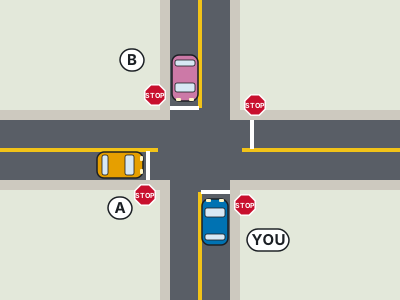
- The vehicle with the largest engine
- The vehicle that reached the intersection first after stopping
- The vehicle turning left
- The vehicle arriving last
5. What share of Delaware fatal crashes in 2019 were impaired related, according to the manual?
- 5 percent
- 35 percent, compared with about 28 percent of fatalities nationally
- 75 percent
- 50 percent
6. How many months of valid driving authority must a Delaware Level One permit holder complete before automatic Class D conversion?
- 12 months
- 6 months
- 3 months
- 24 months
7. At what ages may a Delaware applicant (without an IEP) apply for a GDL Level One Learner's Permit?
- At least 16 and less than 18
- At least 15 and less than 17
- At least 17 and less than 21
- Any age from 16 to 25
8. Your wheels run off the pavement onto the shoulder. Before steering back onto the road, how slow should you be going?
- 35 mph or less
- 25 mph or less
- 5 mph or less
- 15 mph or less
9. During the first 12 months of Level One driving authority, how many nonfamily passengers may accompany the permit holder besides the adult supervisor?
- Two other passengers
- One other passenger
- No passengers at all
- As many passengers as the vehicle's seat belts allow
10. How does Delaware classify a third DUI offense occurring after two prior offenses?
- Civil offense only
- Class E felony
- Class C felony
- Class G felony
11. You approach an intersection where people may cross but you see no painted crossing lines. What should you expect?
- People may still cross there, so stay alert for them at the intersection
- No one may cross where painted lines are missing from the roadway
- Only people with a push-button beacon may cross at that corner
- Drivers may treat the corner as having no crossing activity at all
12. You stop at a crash where fuel may have spilled from a wrecked car. What should you do about its engine, and what should you avoid?
- Leave its engine running so the lights stay on
- Turn off its ignition and do not smoke near it
- Turn off its ignition and light a flare beside the fuel
- Let the engine idle but keep people away from the tailpipe
13. A passenger tucks the shoulder belt under their arm because it rubs their neck. What is the problem?
- Nothing is wrong, as long as the lap part is still fastened
- It is fine for adults but not for teens
- It is only a problem on highways
- It can cause serious injury and is not proper belt use
14. An overhead signal above a lane that changes direction during the day shows a red X over your lane. What does that display mean for you?
- You may enter if traffic in the lane is moving your direction
- You should leave the lane slowly after one more block of travel
- You cannot use the lane beneath that display at this time
- You may use the lane only for turning at the next corner
15. Your vehicle breaks down on a highway outside a business or residence area. Where should it end up?
- On the paved part of the highway with flashers on
- In the nearest travel lane while you seek help
- Blocking part of the shoulder and part of the lane
- Off to the right as far as possible
16. At a signal, the green for through and right-turning traffic has ended, but the left-turn display is still green. What should the through traffic do?
- Continue straight since the left turn is still green
- Turn left along with the other drivers
- Prepare to stop, because only the left turn may continue
- Speed up to clear the intersection before the light changes
17. After driving through deep water, your brakes feel weak. How should you check whether braking action has returned to normal?
- Test them once after a full mile
- Test them only after reaching highway speed
- Test every 200 feet until braking feels normal again
- Wait for the brakes to dry on their own overnight
18. Late at night, the signal facing you at a crossroads is flashing yellow. How should you go through?
- Stop completely, then go when safe
- Slow down, be more aware, and proceed with caution
- Treat it like a green light and keep your speed
- Wait for it to turn steady green
19. You need to cross a divided highway. When is it safe to stop halfway across, in the median?
- Whenever traffic in the far lanes is too heavy to cross at once
- Never, even on a wide median
- Any time, as long as your hazard lights are on
- Only if the median is large enough for your whole vehicle
20. At a crossing with two tracks, a train has just passed in front of you. When should you start across?
- As soon as the last car clears the road
- When the train is well down the track
- Right away if the car ahead of you goes
- Once the bells pause for a moment
21. After stopping at a stop sign, which road users deserve an extra careful look?
- Only trucks with more than two axles
- Bicycles, mopeds, and motorcycles
- Parked cars with their engines off
- Drivers who are still several blocks away
22. A pedestrian signal shows a steady DON'T WALK, and a person has not yet left the curb. What does the signal tell that person?
- Start crossing and finish as quickly as possible
- Cross only if no cars are turning
- Wait for cars to stop, then cross
- Do not start to cross the street at all
23. Traffic is stopped just past a crosswalk, and you could creep forward and stop on it. What does Delaware say?
- You may stop on it if you have a green light
- You must not block the crosswalk
- You may stop on it if you use your turn signal
- You may stop on it if no one is crossing right now
24. A driver passing you on a two-lane road runs short of room as an oncoming car appears. What should you do?
- Speed up so the passing driver has to drop back
- Hold your speed; the mistake is not yours to fix
- Slow down and let the passing driver return to the lane
- Move left to block the pass
25. A car with very bright headlights passes you at night, and for a moment you feel as though you cannot see. Why does this happen?
- Your eyes dry out from the cool night air blowing in
- Your pupils open too wide and let in too much light
- Your side vision switches off for several minutes
- Glare makes your pupils contract and they need time to readjust
26. What is the meaning of the orange triangular emblem on a slow-moving vehicle?

- The vehicle is authorized to travel at highway speed
- The vehicle is warning approaching drivers that it is slow moving
- The vehicle is carrying hazardous material
- The vehicle is stopped and cannot be passed
27. Your Delaware signal is red and the NO TURN ON RED sign shown here is posted at the corner. What must you do?
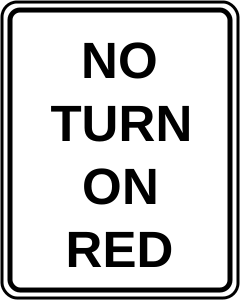
- Wait until the signal turns green before proceeding or turning
- Turn right after a full stop if no traffic is coming
- Turn left onto a one-way street after a full stop
- Go straight once no cross traffic is visible
28. After six months on a Delaware Level One permit, a teen wants to drive alone at 10:30 p.m. When is that allowed?
- When going directly to or from church, work, or school activities on school property
- Whenever a parent gives permission by phone
- Any night on weekends
- Never, under any circumstances
29. What must Delaware drivers use when they intend to stop, turn, or change lanes?
- A horn without any signal
- Hazard lights only
- Headlights only
- A hand signal or turn signal
30. How can a Delaware driver be declared a habitual offender?
- Any two speeding tickets
- One DUI conviction
- Any combination of three listed serious offenses, such as DUI or reckless driving, in five years
- Five parking tickets in a year
31. What duty does a Delaware driver have when overtaking a vehicle traveling in the same direction?
- Assume the passing vehicle automatically has priority
- Force that vehicle onto the shoulder
- Sound the horn until it stops
- Yield to the vehicle being overtaken
32. A Delaware driver is convicted of driving 100 mph on a highway posted at 65. What suspension applies?
- One year
- Three months
- Six months
- No suspension because it is under 50 mph over
Answer key
- 1. A
- 2. C
- 3. B
- 4. B
- 5. B
- 6. A
- 7. A
- 8. D
- 9. B
- 10. D
- 11. A
- 12. B
- 13. D
- 14. C
- 15. D
- 16. C
- 17. C
- 18. B
- 19. D
- 20. B
- 21. B
- 22. D
- 23. B
- 24. C
- 25. D
- 26. B
- 27. A
- 28. A
- 29. D
- 30. C
- 31. D
- 32. A