
Test 5 of 10 · 20 questions · Free 2026
DE Permit Practice Test 5
Jump to the test ↓A fixed 20 question set from the Delaware bank with answers and plain English explanations. The real DE exam is 32 questions, 81 percent to pass; take the full length version on the main practice page.
Question 1 of 20 · 0 right so far
All 20 questions in test 5
Every question below comes from the Delaware question bank on this page. Open a question to see the correct answer and the explanation. Nothing here is hidden behind a signup.
1. What share of Delaware fatal crashes in 2019 were impaired related, according to the manual?
- 5 percent
- 35 percent, compared with about 28 percent of fatalities nationally
- 75 percent
- 50 percent
Show answer
35 percent, compared with about 28 percent of fatalities nationally. Nationally in 2019 alcohol was involved in about 28 percent of traffic fatalities, and in Delaware in 2019, 35 percent of fatal crashes were impaired related. Even a little alcohol raises crash risk, and a driver can be charged with DUI with a BAC under .08. A 12 ounce can of beer, a 5 ounce glass of wine, and a cocktail with 1.5 ounces of 80 proof spirits contain the same alcohol.
Study this in the handbook: Points, suspensions and serious speeding
2. How can a Delaware driver be declared a habitual offender?
- Any two speeding tickets
- One DUI conviction
- Any combination of three listed serious offenses, such as DUI or reckless driving, in five years
- Five parking tickets in a year
Show answer
Any combination of three listed serious offenses, such as DUI or reckless driving, in five years. Any combination of three listed offenses in a five year period, including DUI, driving without a license, driving during suspension, reckless driving, and leaving a crash scene, may lead to habitual offender status. Ten convictions in three years, mixing those with lesser offenses like speeding, can also qualify. A habitual offender can lose the license for up to five years, with no work or hardship licenses. Two speeding tickets, one DUI, or parking tickets do not meet the threshold.
Study this in the handbook: Points, suspensions and serious speeding
3. What does it cost to convert a Delaware license to federally compliant status?
- A $20 replacement license fee, with the required compliant documents
- $72
- Nothing
- $150
Show answer
A $20 replacement license fee, with the required compliant documents. To convert your license to compliant status, visit any DMV and provide the required documents for a compliant license; a $20 replacement license fee is assessed. Delaware began issuing secure licenses meeting federal identification standards in 2010, and compliant cards require source documents for identity, lawful status, date of birth, Social Security number and residence address. Your existing card can be converted at any time.
4. How should a driver treat a dark traffic signal at an intersection?
- Reduce speed and prepare to yield to traffic in or approaching the intersection
- Treat it as a green light and continue without checking
- Stop only if another driver sounds a horn
- Make a U-turn before reaching the intersection
Show answer
Reduce speed and prepare to yield to traffic in or approaching the intersection. When no lighted indication is visible, the Delaware manual directs an approaching driver to reduce speed and prepare to yield to vehicles that are in or approaching the intersection. A dark signal does not authorize a free passage like a green light. Waiting for a horn is unreliable, and a U-turn is not the prescribed response. The cue is the absence of an indication: slow, scan every approach, and yield as needed before entering.
Study this in the handbook: Traffic lights and arrows
5. What does a Delaware driver need to remember about posted speed limits in poor conditions?
- Increase speed whenever visibility is reduced
- Drive at the posted limit regardless of weather
- Use the posted limit only when traffic is heavy
- Slow down when the road is wet or icy, visibility is poor, or traffic is heavy
Show answer
Slow down when the road is wet or icy, visibility is poor, or traffic is heavy. Posted limits are based on ideal conditions, so Delaware expects drivers to slow when pavement is wet or icy, visibility is reduced, or traffic is heavy. The posted number is not permission to maintain that speed when conditions make it unsafe. The choice to use the limit only in heavy traffic omits other hazards, while increasing speed with poor visibility makes stopping and scanning harder. A good cue is to compare the limit with the actual road and visibility before choosing a safe speed.
Study this in the handbook: Seeing ahead and adjusting to conditions
6. What court sanctions does Delaware list for a fourth DUI offense?
- A misdemeanor with a $1,500 fine
- A Class C felony with up to 15 years
- A Class E felony, a fine up to $7,000, and two to five years in prison
- A civil offense with community service
Show answer
A Class E felony, a fine up to $7,000, and two to five years in prison. A fourth DUI offense, occurring any time after three prior offenses, is a Class E felony with a fine of up to $7,000 and imprisonment of not less than two nor more than five years. A misdemeanor with a $1,500 fine understates it, since a first offense already carries up to $1,500. The Class C felony with up to 15 years is the seventh or greater offense. No DUI offense in the manual is a civil offense.
Study this in the handbook: DUI penalties and underage laws
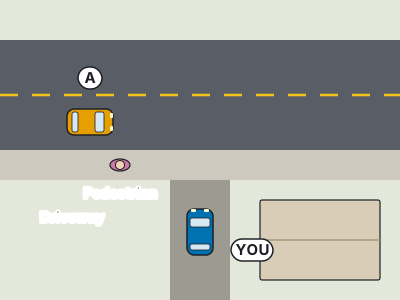
7. When entering a Delaware road from a driveway, alley, or roadside, whom must the driver yield to?
- Only pedestrians using a marked crosswalk
- Only vehicles approaching from the left
- Vehicles already on the main road
- No one if the entering vehicle signals
Show answer
Vehicles already on the main road. A driver entering from a driveway, alley, or roadside must yield to vehicles already on the main road, stopping if necessary. A turn signal announces an intention but does not remove the yielding duty. The left-only choice is too narrow because traffic on the main road can approach from either direction, and the pedestrian-only choice omits the vehicle rule. The practical cue is to treat the main road as having priority, scan both ways, and enter only after the traffic gap is safe rather than assuming an opening belongs to the entering driver.
Study this in the handbook: Right of way at intersections
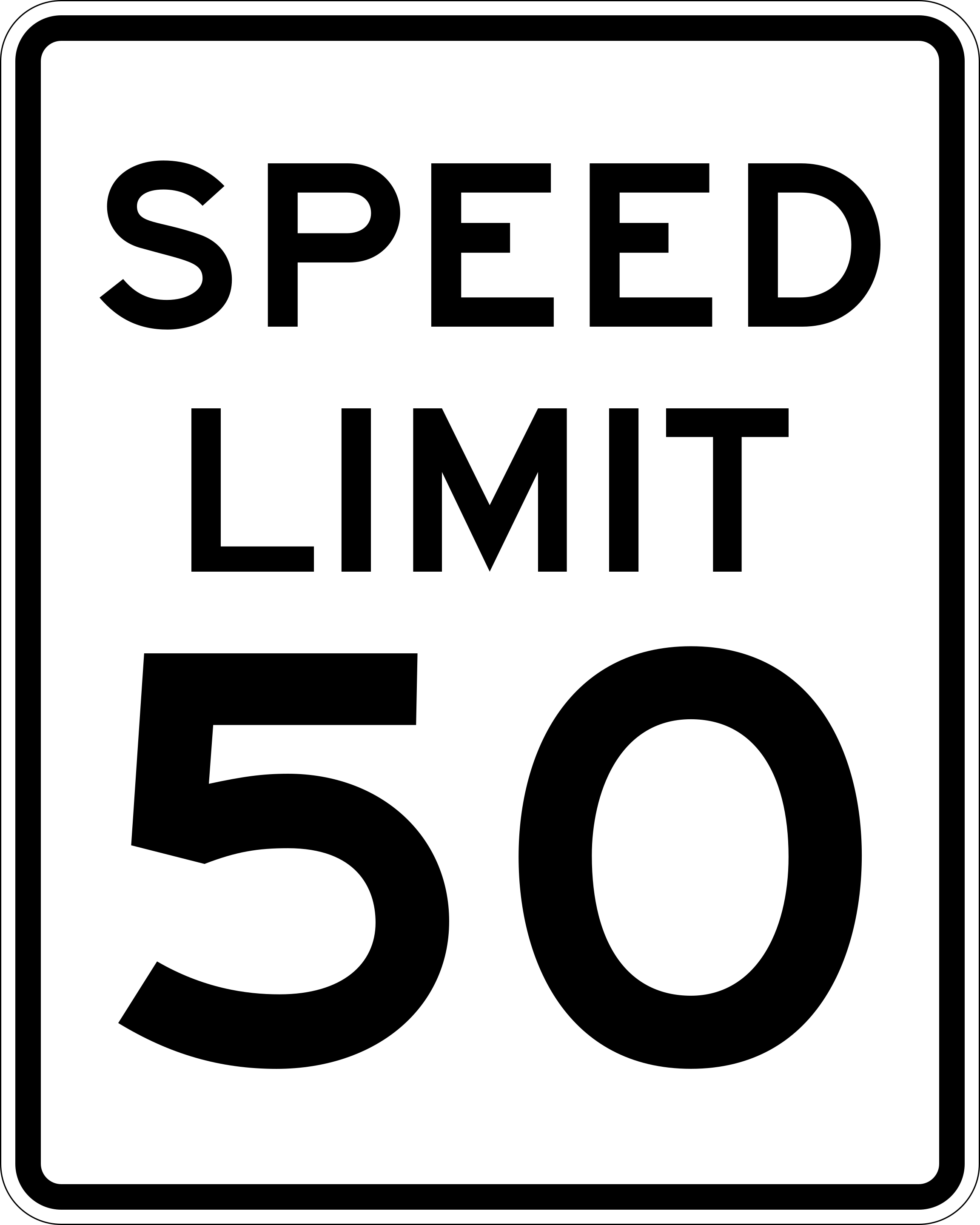
8. The white rectangular sign marked SPEED LIMIT belongs to which sign category?
- A yellow warning sign giving a suggested curve speed
- A regulatory sign stating the legal allowable limit
- A guide sign naming a destination
- An information sign for truck routes
Show answer
A regulatory sign stating the legal allowable limit. Delaware distinguishes a speed limit sign from an advisory speed sign by both color and legal effect. Black letters and numerals on a white rectangular background identify the legal allowable limit. A yellow advisory sign under a warning sign recommends a speed for conditions and is not the same category. Destination and truck-route messages are guide or information functions, not speed regulation. Remember that the posted limit is not permission to drive too fast for conditions. The manual's general speed restriction still requires a reasonable speed when weather, traffic, or visibility makes the displayed maximum unsafe.
Study this in the handbook: Road signs by shape and color
9. What hazard does the round yellow railroad warning sign shown here announce?

- A school crossing with a reduced speed zone
- A bicycle-only path beginning
- A roundabout where entering traffic has priority
- A highway rail intersection ahead
Show answer
A highway rail intersection ahead. The round black-on-yellow sign gives advance warning of a highway rail intersection. It appears before the tracks, so use the extra distance to reduce speed and prepare to look for the crossing. It is not a bicycle, roundabout, or school sign, even though each of those hazards can have its own warning symbol. The manual calls for particular caution at night so a driver does not enter the side of a train. The recognition cue is the round yellow railroad symbol: expect tracks ahead and approach with controlled attention.
Study this in the handbook: Road signs by shape and color
10. Which highway sign shape is reserved for a stop sign in Delaware?
- An eight-sided shape
- A five-sided shape
- A round shape
- A diamond shape
Show answer
An eight-sided shape. The octagon is reserved for the stop sign, making the instruction recognizable even before the driver reads its words. Delaware describes the five-sided sign as a school warning, the round sign as an advance railroad warning, and the diamond as a general warning shape. Those alternatives therefore identify different hazards or rules. The cue is the eight-sided outline: prepare for a complete stop at the required stopping point, then yield before proceeding.
Study this in the handbook: Road signs by shape and color
11. What does a round red traffic lens control compared with an arrow?
- It has no meaning unless a sign is posted below it
- It applies only to left turns
- It permits movement in every direction without yielding
- It applies to all directions, while an arrow applies only to its direction
Show answer
It applies to all directions, while an arrow applies only to its direction. Delaware distinguishes round color lenses from arrows by the area they control. A round lens applies to all directions governed by that signal, while an arrow applies only to the direction it points toward. The left-turn-only choice reverses that distinction, and a round signal never removes the duty to obey its color or yield where required. The cue is the signal shape: identify whether the display is circular or directional before deciding which movements may continue.
Study this in the handbook: Traffic lights and arrows
12. In a Delaware work zone, what happens to fines for exceeding the speed limit?
- They stay the same as ordinary speeding fines
- They are waived when workers are not visible
- They are reduced by half during daylight
- They are doubled
Show answer
They are doubled. The manual warns that speeding in a work zone carries a doubled fine. The manual lists no exception for moments when workers are out of sight, and it warns that stopped traffic may be hidden around a curve or over a hill. The reduced and waived choices invent exceptions, while the ordinary-fine choice overlooks the work-zone increase. The cue is a work-zone sign or device: lower speed, watch for changing lanes, and allow extra room for sudden stops.
Study this in the handbook: Road signs by shape and color
13. A Delaware parent who signed as GDL sponsor decides their 16-year-old is not ready to drive. What can the sponsor do?
- Nothing until the teen turns 18
- Withdraw the endorsement, cancelling the teen's driving privileges
- Ask the court to hold a hearing first
- Only remove the night driving hours
Show answer
Withdraw the endorsement, cancelling the teen's driving privileges. The sponsor may withdraw their endorsement at any time until the minor reaches age 18 (or, for an IEP applicant, until 12 months of the GDL program are completed), and doing so cancels any valid driving privileges. No court hearing is described, and the power is not limited to trimming night hours. Waiting until 18 gets the rule backward, since 18 is when the withdrawal power ends for a minor.
Study this in the handbook: The Level One Learner's Permit and GDL rules
14. A Delaware driver is convicted of going 35 mph over the posted limit. How long is the suspension under the serious speeding rule?
- One month
- Three months
- Two months
- One year
Show answer
Three months. The suspension is one month at 25 mph over the limit and grows by one month for each additional five mph over that 25 mph threshold. So 30 over is two months and 35 over is three months. At 30 mph or more over, the suspension is mandatory; only 25 to 29 over allows the behavior modification course instead. One year is reserved for 50 mph or more over the limit or 100 mph on a highway.
Study this in the handbook: Points, suspensions and serious speeding
15. How much more does a Delaware license renewal cost with a motorcycle endorsement?
- $12 more, and $10 more for a taxi endorsement
- Nothing extra
- $50 more
- $100 more
Show answer
$12 more, and $10 more for a taxi endorsement. Delaware licenses are issued for eight years, and if you have a motorcycle endorsement the renewal fee is increased by $12, while a taxi endorsement adds $10. You may renew any time during the 180 day period before expiration, and a $10 late fee applies after the expiration date. Commercial drivers and Driving Privilege Card holders have different terms, and a permanent license is no longer issued.
Study this in the handbook: Exams, renewal and license rules
16. What should a driver do on seeing a steady yellow traffic signal?
- Stop in the middle of the intersection
- Accelerate to beat the red signal
- Treat it exactly like a green signal
- Prepare to stop, unless too close to stop safely
Show answer
Prepare to stop, unless too close to stop safely. A steady yellow means the signal is changing from green to red, so the driver should prepare to stop. If the vehicle is already too close to stop safely, the manual says to continue through the intersection with care. Accelerating to beat the red encourages unsafe entry, and stopping in the intersection creates a hazard. Judge distance and braking space early rather than making a sudden decision at the line.
Study this in the handbook: Traffic lights and arrows
17. What number identifies the exact location of a Delaware railroad grade crossing for emergency responders?
- The route shield number
- The vehicle registration number
- The DOT number on the crossing sign
- The driver's license number
Show answer
The DOT number on the crossing sign. The blue emergency sign at a grade crossing includes a DOT number that identifies the crossing's physical location. That lets railroad personnel or emergency crews locate the problem and notify trains in the area. A route shield and personal vehicle or license identifiers serve other purposes. If a vehicle blocks the tracks or equipment is damaged, use the emergency dispatch information and provide the crossing's DOT number.
Study this in the handbook: Railroad crossings, vehicle emergencies and crashes
18. After the first six months of Level One permit authority, during what hours may a Delaware permit holder drive unsupervised?
- 5:00 a.m. to midnight
- 6:00 a.m. to 10:00 p.m.
- 10:00 p.m. to 6:00 a.m.
- Only from sunrise to sunset
Show answer
6:00 a.m. to 10:00 p.m.. After the first six months of valid Level One driving authority, Delaware permits unsupervised driving from 6:00 a.m. through 10:00 p.m. The overnight period from 10:00 p.m. to 6:00 a.m. generally requires supervision, with listed activity exceptions. Sunrise and sunset are not the manual's clock boundaries, and midnight is later than the permitted unsupervised ending time. A permit holder should use the exact times as a planning cue and arrange a qualified supervisor before beginning an ordinary trip during the restricted overnight window.
Study this in the handbook: The Level One Learner's Permit and GDL rules
19. What following gap should a driver allow behind a truck to reduce the truck's rear blind-spot risk?
- One car length at every speed
- Exactly one second
- At least four seconds
- Four feet regardless of speed
Show answer
At least four seconds. The manual advises allowing at least four seconds behind a truck. Large vehicles have deep rear blind spots, so the truck driver may not see a car following close behind, and the trailing driver loses a clear view of traffic ahead. One car length changes meaning with speed and is not a dependable time gap. A four-foot spacing is a distance, not the recommended interval. Pick a fixed object, note when the truck reaches it, and make sure at least four seconds pass before your vehicle reaches the same point.
Study this in the handbook: Following distance, trucks and motorcycles
20. What maneuver does the crossed right-pointing arrow sign shown here prohibit?
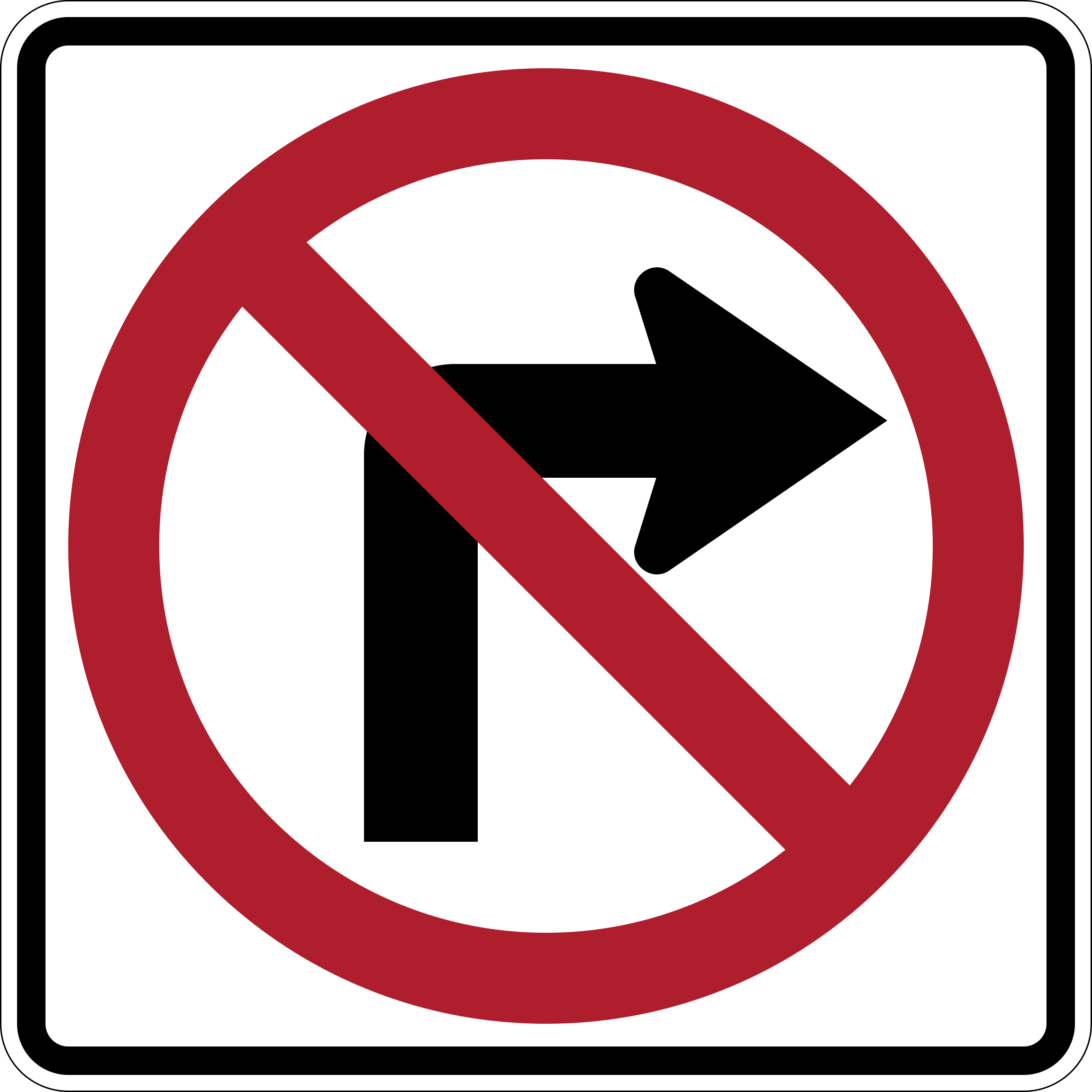
- Turning right
- Turning left
- Driving straight ahead
- Parking beside the right curb
Show answer
Turning right. The crossed arrow depicts a right turn, so the restriction applies to turning right at that location. It does not ban left turns or straight travel, and it is not a parking sign merely because the arrow points toward the curb. Continue to watch for additional lane markings and signal instructions that may control the remaining movements. The quickest way to interpret this sign is to name the arrow's action aloud: right turn. The red slash then tells you not to perform that pictured action, including a right turn that might otherwise be considered on red.
Study this in the handbook: Road signs by shape and color
QualitySpace is expanding to Delaware
We are a California-based independent insurance brokerage working on licensing in more states. We cannot help with Delaware insurance yet. Leave your email and we will let you know when we can.
Every question is written from the official Delaware Driver Manual. Need paper? Printable DE practice test with answer key.
Last verified 2026-10-05. How we check every question · Study all 205 as flashcards
Frequently asked questions
How many questions are on this Delaware practice test?
This fixed set has 20 questions. It is test 5 of 10 from the 205 question Delaware bank. The real DE exam asks 32 questions and you need 26 correct.
What is the passing score for the real Delaware test?
26 of 32 correct (approximately 81%) That figure comes from the official Delaware source cited on the DMV facts page.
How does this fixed test relate to the full Delaware bank?
Each numbered test is a fixed set of questions in a fixed order, so you can retake the same test later and compare. Every test mixes road signs and the other topics in about the same proportion as the full bank. Tests 1 to 10 together cover 200 of the 205 questions in the Delaware bank, each once. The full practice page mixes the whole bank at random.
Last verified 2026-10-05. See the Delaware DMV facts page for sourced state details.
Return to the full Delaware practice test · Study road signs