
Test 10 of 10 · 20 questions · Free 2026
DE Permit Practice Test 10
Jump to the test ↓A fixed 20 question set from the Delaware bank with answers and plain English explanations. The real DE exam is 32 questions, 81 percent to pass; take the full length version on the main practice page.
Question 1 of 20 · 0 right so far
All 20 questions in test 10
Every question below comes from the Delaware question bank on this page. Open a question to see the correct answer and the explanation. Nothing here is hidden behind a signup.
1. How does Delaware classify a third DUI offense occurring after two prior offenses?
- Civil offense only
- Class E felony
- Class C felony
- Class G felony
Show answer
Class G felony. Delaware identifies a third DUI offense after two prior offenses as a Class G felony. Class E is used for a fourth or fifth DUI in the manual, while Class C is associated with a seventh or greater offense. Calling the conduct civil only ignores the criminal classification and the listed penalties. The concrete cue is the sequence: third offense follows two priors, placing it in the Class G category.
Study this in the handbook: DUI penalties and underage laws
2. What DMV license loss does Delaware list for a seventh or greater DUI conviction?
- 12 months
- 60 months
- 24 months
- The remainder of the driver's lifetime
Show answer
60 months. A seventh or greater DUI conviction carries a 60-month loss of license by the Delaware DMV. Twelve and 24 months are shorter periods associated with other penalty categories, not this highest listed offense grouping. The manual does not state an automatic lifetime DMV loss for this entry, although the court classification and sanctions are also severe. The cue is the repeated five-year figure, which equals 60 months.
3. When approaching a stationary vehicle displaying warning signals, what does Delaware's Move Over rule require?
- Keep the same speed if the vehicle is outside your lane
- Proceed cautiously and change lanes when possible, or reduce to a safe speed
- Stop beside the vehicle to ask whether help is needed
- Pass using the shoulder whenever the adjacent lane is occupied
Show answer
Proceed cautiously and change lanes when possible, or reduce to a safe speed. The rule protects people near any stationary vehicle displaying warning signals, including hazard lights, flares, cones, or caution signs. Drivers must approach cautiously, yield by changing lanes when possible, and otherwise reduce to a safe speed. Holding speed because the vehicle is on the shoulder leaves too little margin. Stopping alongside creates a new obstruction, and using the shoulder is not the prescribed fallback. The cue is visible roadside warning equipment: make room if safe, or slow substantially when it is not.
Study this in the handbook: Emergency vehicles and the Move Over law
4. How long is a Delaware motorcycle temporary instruction permit valid, and how often can it be extended?
- Six months, extendable once for another six months for a $5 fee
- One year, not extendable
- 30 days, extendable three times
- Two years
Show answer
Six months, extendable once for another six months for a $5 fee. The motorcycle temporary instruction permit is valid for six months and can be extended only once for an additional six months; you must apply at the DMV before it expires and pay a $5 fee. While riding on the permit no passengers are allowed, riding between sunset and sunrise is prohibited, and the interstate highway system is off limits. Rider classes are offered in all three counties.
5. What must a motorist do when passing a bicyclist on a multilane road whenever possible?
- Drive on the shoulder beside the bicycle
- Move to the adjacent lane
- Sound the horn continuously while staying in lane
- Follow within one car length until the bicycle stops
Show answer
Move to the adjacent lane. Delaware's bicycle-passing rule requires motorists on multilane roads to move to the adjacent lane whenever possible, while maintaining the required clearance. Staying beside the bicycle in the same narrow lane leaves too little room, and a horn does not create safe lateral space. The shoulder and close following are also poor substitutes. Check mirrors, signal, change lanes only when clear, and return after passing safely.
Study this in the handbook: Headlights, seat belts, phones and insurance
6. At a roundabout, who has priority over a driver entering?
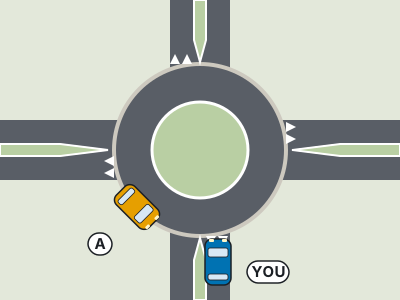
- A vehicle entering from the left in every case
- The vehicle that reaches the entry point fastest
- Traffic already in the roundabout
- Only pedestrians, never circulating vehicles
Show answer
Traffic already in the roundabout. Drivers entering a Delaware roundabout must yield to traffic already circulating in it. Reaching the entry fastest does not create priority, and the rule is not based on a universal left-side preference. Pedestrians also matter at the crosswalks, but they are not the only road users with priority. The cue is the circle itself: slow before entering, find a safe gap, and let circulating traffic clear before joining the counterclockwise flow.
Study this in the handbook: Pavement markings, signaling and roundabouts
7. When may a Delaware speeder take the behavior modification course instead of a suspension?
- At any speed over the limit
- When driving 25 to 29 mph over the limit; at 30 over the suspension is mandatory
- Never
- Only under 10 mph over
Show answer
When driving 25 to 29 mph over the limit; at 30 over the suspension is mandatory. A driver may elect to attend the behavior modification attitudinal driving course in lieu of a license suspension when convicted of driving 25 to 29 mph over the posted limit, but for speeding 30 mph or more over the limit the suspension is mandatory and the course is required before reinstatement. The course runs at least eight hours and costs $100 payable to the provider.
Study this in the handbook: Points, suspensions and serious speeding
8. What must a driver do while proceeding in the direction of a steady green arrow?
- Yield to all pedestrians and vehicles already lawfully in the intersection
- Ignore people in the crosswalk because the arrow grants absolute priority
- Wait for the arrow to become a circular green signal
- Back away from the intersection before turning
Show answer
Yield to all pedestrians and vehicles already lawfully in the intersection. A steady green arrow permits movement in the arrow's direction, but Delaware still requires the driver to yield to all pedestrians and vehicles already lawfully in the intersection. The arrow is not absolute priority, and waiting for a circular green misunderstands its purpose. Before moving, scan the crosswalk and intersection, then continue in the indicated direction only after people and vehicles already there are accommodated.
Study this in the handbook: Traffic lights and arrows
9. Which document proves completion of the required Delaware driver education course for a Level One Learner's Permit?
- A Delaware Driver Education Certificate, also called the Blue/White Certificate
- A receipt for a private defensive driving class
- A signed statement from any licensed adult
- A road test appointment confirmation
Show answer
A Delaware Driver Education Certificate, also called the Blue/White Certificate. A Level One applicant must present the Delaware Driver Education Certificate, commonly called the Blue/White Certificate, to show completion of a certified Delaware course. A private defensive driving receipt does not establish the required driver education credential. An adult's statement and a road test appointment address different matters and cannot substitute for the certificate. The useful document cue is the certificate's distinctive Blue/White name, which separates it from general traffic safety coursework.
Study this in the handbook: The Level One Learner's Permit and GDL rules
10. At what point level may the Delaware DMV take administrative action against a driver?
- 4 or more points in one year
- 6 or more points in three years
- 8 or more points within a two year period
- 12 or more points in five years
Show answer
8 or more points within a two year period. The Division may take administrative action against a driver who acquires 8 or more points within two years; at 8 calculated points the DMV sends an advisory letter. Higher levels bring a required course at 12 points and mandatory suspensions starting at 14 points. The other choices use point totals and time windows that are not in the Delaware system. This point process does not apply to Commercial Driver License holders.
Study this in the handbook: Points, suspensions and serious speeding
11. What action is required when you approach the red eight-sided sign shown here?

- Yield without stopping unless a pedestrian is visible
- Slow down and continue if the cross street appears empty
- Stop only when another vehicle is approaching
- Make a complete stop at the stop line, crosswalk, or before the intersection
Show answer
Make a complete stop at the stop line, crosswalk, or before the intersection. The red eight-sided sign is a stop sign, and Delaware requires a complete stop. Use the stop line first; if there is none, stop at the crosswalk, or before entering the intersection when neither marking exists. After stopping, yield to vehicles and pedestrians in or approaching the intersection. The empty-looking roadway does not cancel the stop requirement, and a yield-only approach is not enough. A reliable visual cue is the unique eight-sided shape, followed by the sequence stop, look, yield, and proceed only when safe.
Study this in the handbook: Road signs by shape and color
12. How long must a Delaware learner's permit holder wait after passing the knowledge exam before taking a Class D road exam?
- 15 days
- 10 days
- 30 days
- 90 days
Show answer
30 days. A Delaware Class D road exam becomes available 30 days after the applicant passes the knowledge exam. The 10-day interval applies to a motorcycle road exam, so it is an attractive but incorrect number for this Class D question. Fifteen and 90 days are not the stated waiting periods. The cue is the vehicle class: distinguish the 30-day Class D rule from the shorter motorcycle schedule.
Study this in the handbook: Exams, renewal and license rules
13. A driver sees the yellow walking-person warning sign shown here. What should the driver be prepared to do?

- Slow down and be ready to stop for pedestrians
- Accelerate to clear the area before pedestrians arrive
- Sound the horn to make pedestrians leave the road
- Use the sidewalk to bypass the crossing
Show answer
Slow down and be ready to stop for pedestrians. Yellow warning signs alert drivers to a special situation or hazard ahead. For a walking-person sign, that cue calls for reduced speed, careful scanning, and readiness to stop for people crossing. Accelerating cuts down reaction time, a horn does not replace the duty to yield, and a sidewalk is not a lawful travel lane for bypassing a crossing. Look toward both sides of the roadway and check the crosswalk before moving through the area. The sign should prompt preparation, even when no pedestrian is visible at first.
Study this in the handbook: Road signs by shape and color
14. What should you do if icy conditions make a posted minimum speed unsafe?
- Drive at the minimum with hazard lights to compensate
- Keep the minimum speed regardless of traction
- Drive slower than the minimum as conditions require
- Accelerate above the minimum to spend less time on the ice
Show answer
Drive slower than the minimum as conditions require. A posted minimum speed normally must be obeyed, but Delaware makes an exception when weather or other conditions make that speed unsafe. Ice can require a much slower pace because braking and steering depend on the available tire grip. Hazard lights cannot restore traction or make the posted minimum safe. Look for a shiny road surface and other signs of freezing, reduce speed smoothly, and allow enough room to respond without sudden braking or steering.
Study this in the handbook: Delaware speed limits
15. How does Delaware describe right-of-way in its traffic laws?
- The law grants every driver a permanent priority
- The law describes who must yield
- Only larger vehicles receive it
- The first driver to honk receives it
Show answer
The law describes who must yield. Delaware's manual explains that traffic laws do not give anyone the right-of-way as an absolute entitlement. Instead, the law describes who must yield, and a driver should yield whenever doing so can prevent a crash. That makes the permanent-priority choice inaccurate, regardless of arrival order or vehicle size. A horn also cannot create legal priority. The concrete cue is defensive decision-making: even when another road user should wait, yielding can still be the right action if proceeding would cause a collision or immediate danger.
Study this in the handbook: Traffic lights and arrows
16. In a Delaware work zone, fines for exceeding the posted speed limit are:
- Waived when workers are absent
- Reduced by half
- Doubled
- The same as parking fines
Show answer
Doubled. Fines for exceeding the speed limit in a Delaware work zone are doubled. The rule applies to speeding violations in the work zone, so a driver should obey the temporary or posted limit even when workers are not immediately visible. The fine is not waived, reduced by half, or converted into a parking penalty. Slow down before entering the marked area, watch for lane shifts and stopped traffic, and follow every temporary control device. The practical cue is the work-zone sign paired with a speed limit: the financial consequence increases.
Study this in the handbook: Road signs by shape and color
17. What should a Delaware driver anticipate when a school bus displays its overhead flashing yellow lights?
- The bus is reserving a lane for a left turn
- The bus is giving permission to pass at full speed
- The bus has finished loading and all children are clear
- The bus is about to stop to load or unload children
Show answer
The bus is about to stop to load or unload children. The overhead yellow lights warn that a school bus is preparing to stop for children. Approach cautiously and anticipate the upcoming stop rather than treating yellow as an invitation to hurry past. Children may be waiting nearby or running to board, so the area needs attention before the red lights appear. Ease off the accelerator, scan both sides of the road, and leave room to stop when the bus activates its stopping signals.
Study this in the handbook: Right of way at intersections
18. For a third Delaware DUI offense with a BAC of .20 or greater, how long is the DMV license loss?
- 24 months
- 30 months
- 60 months
- 36 months
Show answer
36 months. For a third DUI offense, the DMV license loss is 24 months for a BAC under .15 or drugs, 30 months for a BAC between .15 and .19, and 36 months for a BAC of .20 or greater or a refusal to submit to a chemical test. The 24 and 30 month figures belong to the lower BAC bands. Sixty months applies to fourth and later offenses. The court separately treats a third offense as a Class G felony.
Study this in the handbook: DUI penalties and underage laws
19. What is the Delaware fine for a first offense of operating an uninsured vehicle?
- $1,500 to $2,000
- $500
- $100
- $3,000 to $4,000
Show answer
$1,500 to $2,000. Operating an uninsured vehicle in Delaware brings a fine of not less than $1,500 nor more than $2,000. For each later offense within three years, the fine rises to $3,000 to $4,000, which is why that choice is the repeat offense amount. Providing false proof of insurance adds a $500 fine and/or 30 days in jail. The $100 figure is the DMV's audit penalty for 1 to 30 days of lapsed coverage, a separate administrative charge.
Study this in the handbook: Headlights, seat belts, phones and insurance
20. While turning left in Delaware, which traffic must the turning driver yield to?
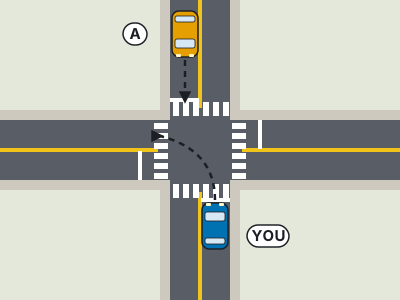
- No traffic, because a signal gives the turner priority
- Vehicles behind the turner only
- Vehicles approaching from the same direction after the turn
- Oncoming vehicles going straight ahead
Show answer
Oncoming vehicles going straight ahead. A left turn crosses the path of oncoming traffic, so Delaware requires the turning driver to yield to an oncoming vehicle going straight. Signaling announces an intention but does not transfer the right-of-way. Traffic behind the turner is not the central conflict described here, and a vehicle approaching after the turn is not automatically entitled to go first. The concrete cue is the opposing straight movement: wait for that vehicle to pass before completing the turn.
Study this in the handbook: Right of way at intersections
QualitySpace is expanding to Delaware
We are a California-based independent insurance brokerage working on licensing in more states. We cannot help with Delaware insurance yet. Leave your email and we will let you know when we can.
Every question is written from the official Delaware Driver Manual. Need paper? Printable DE practice test with answer key.
Last verified 2026-10-05. How we check every question · Study all 205 as flashcards
Frequently asked questions
How many questions are on this Delaware practice test?
This fixed set has 20 questions. It is test 10 of 10 from the 205 question Delaware bank. The real DE exam asks 32 questions and you need 26 correct.
What is the passing score for the real Delaware test?
26 of 32 correct (approximately 81%) That figure comes from the official Delaware source cited on the DMV facts page.
How does this fixed test relate to the full Delaware bank?
Each numbered test is a fixed set of questions in a fixed order, so you can retake the same test later and compare. Every test mixes road signs and the other topics in about the same proportion as the full bank. Tests 1 to 10 together cover 200 of the 205 questions in the Delaware bank, each once. The full practice page mixes the whole bank at random.
Last verified 2026-10-05. See the Delaware DMV facts page for sourced state details.
Return to the full Delaware practice test · Study road signs