
Test 20 of 25 · 20 questions · Free 2026
DE Permit Practice Test 20
Jump to the test ↓A fixed 20 question set from the Delaware bank with answers and plain English explanations. The real DE exam is 32 questions, 81 percent to pass; take the full length version on the main practice page.
Question 1 of 20 · 0 right so far
All 20 questions in test 20
Every question below comes from the Delaware question bank on this page. Open a question to see the correct answer and the explanation. Nothing here is hidden behind a signup.
1. At a crossing with two tracks, a train has just passed in front of you. When should you start across?
- As soon as the last car clears the road
- When the train is well down the track
- Right away if the car ahead of you goes
- Once the bells pause for a moment
Show answer
When the train is well down the track. At crossings with more than one track, wait until the passing train is well down the track before starting to cross. Another train may be hidden by the one that just passed, coming on the other track. Look both ways again before moving, make sure there is room on the far side, and do not shift gears while crossing in case you stall.
2. Which road users must obey traffic signals and signs in Delaware?
- Only the drivers of motor vehicles on the road
- Every person walking, driving, or riding a bike
- Drivers and bicyclists, but not people on foot
- Only drivers during the busiest rush hour traffic
Show answer
Every person walking, driving, or riding a bike. Traffic signals and signs apply to every person walking, driving, or riding a bike on a street or highway. Failing to heed the message of a signal or sign is a major cause of crashes. Drivers and bike riders must obey traffic signals, while pedestrians must obey the WALK and DON'T WALK signals or symbols. Bicyclists riding in general travel lanes follow the regular circular and arrow signals.
Study this in the handbook: Traffic lights and arrows
3. A fully licensed adult in Delaware needs to make a call while driving and has a hands-free setup. What does the law allow with the phone itself?
- Holding it to talk if the call is short
- Texting at red lights while the car is stopped in traffic
- Reading messages as long as you do not reply
- Dialing or switching it on, then putting it down
Show answer
Dialing or switching it on, then putting it down. Delaware prohibits hand-held cell phone use and texting while driving. A driver who wants to talk must use a hands-free device. The law permits dialing a number or turning the wireless equipment on or off, and then the driver must put the device down. Drivers with a Graduated Driver License may not use a phone at all, even hands-free. Texting is banned for every driver.
Study this in the handbook: Headlights, seat belts, phones and insurance
4. You are hauling yard waste in an open pickup bed. When is the load considered secure?
- When most of it sits below the top of the truck bed
- When nothing can slide, fall, or blow off
- When you keep your speed under 35 mph
- When a flag is tied to the load
Show answer
When nothing can slide, fall, or blow off. Driving with an unsecured load is extremely dangerous. A load must be securely fastened, and it is only considered secure when nothing can slide, fall, or shift onto the roadway or become airborne. Tie it down with rope, netting, or straps, tie large objects directly to the vehicle, cover the load with a sturdy tarp or netting, do not overload, and double check it.
5. On a wet road, by about how much should you reduce your speed?
- About 25 mph below your usual speed
- About 10 mph
- About 2 mph if tires look new
- No reduction if the rain just started
Show answer
About 10 mph. Wet pavement reduces tire grip, so a moderate speed cut restores a margin for stopping and turning. About ten miles per hour suits a wet road, while packed snow calls for cutting speed in half and ice calls for a crawl. The first sign of rain, snow or sleet is the time to slow down. New looking tires still lose grip on a wet surface.
Study this in the handbook: Seeing ahead and adjusting to conditions
6. A driver says a hands-free phone call is completely safe while driving. What does the Delaware manual say?
- Even hands-free, talking takes attention away from driving
- Hands-free calls are safe at any speed
- Hands-free calls are safe only on highways
- Talking on a phone improves alertness on long trips
Show answer
Even hands-free, talking takes attention away from driving. Hands-free devices are legal for adult drivers in Delaware, but the manual warns that even with hands-free equipment, talking on a phone or radio takes your attention away from driving. You become less likely to notice a dangerous situation. If you have a phone, avoid using it while the vehicle is moving, and pull safely off the road for calls that need your attention.
Study this in the handbook: Seeing ahead and adjusting to conditions
7. You want to turn left onto a street that has the pictured sign, and its arrow points to the right. What should you do?
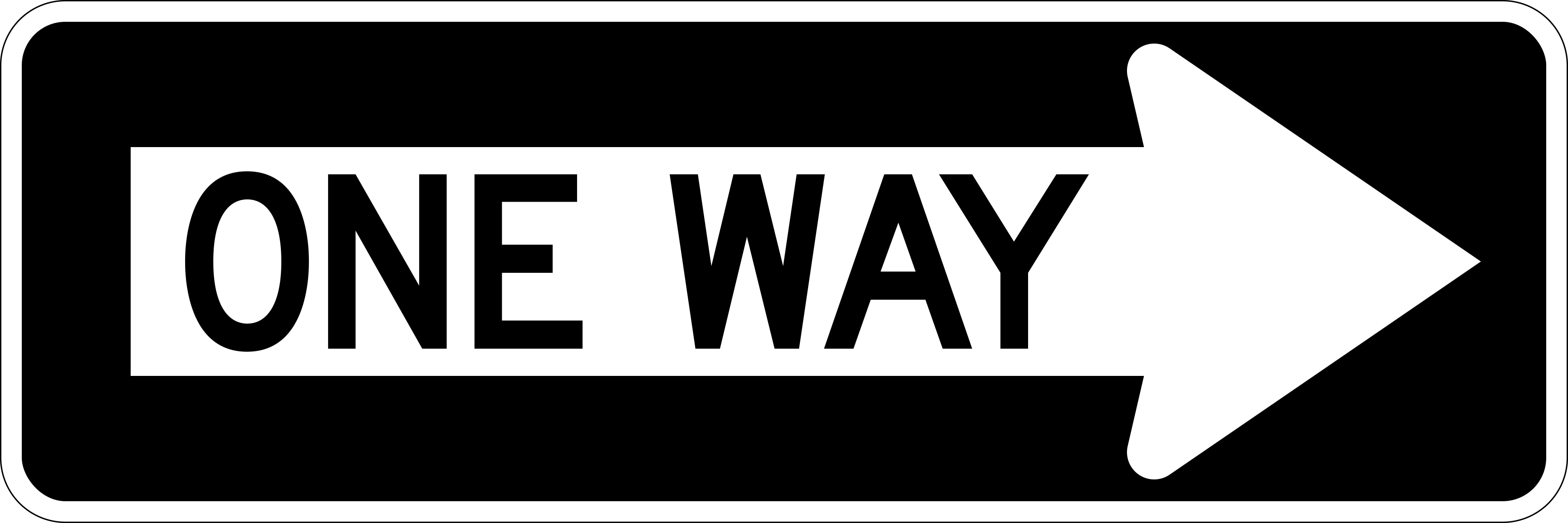
- Turn left carefully, since it is a short street
- Turn left with your hazard lights on
- Do not turn left onto it; traffic there goes the arrow's way
- Turn left only if you can see that no cars at all are coming now
Show answer
Do not turn left onto it; traffic there goes the arrow's way. Regulatory signs tell you the laws for traffic direction, lane use, turning, and similar rules. A ONE WAY sign shows the only direction traffic may travel on that street. If the arrow points right and you turn left onto the street, you would be driving against traffic. Plan a different route that lets you travel in the arrow's direction. A DO NOT ENTER sign may mark the other end of a one-way street.
Study this in the handbook: Road signs by shape and color
8. You see the pictured yellow warning sign while driving. What should you do?

- Speed up to clear the narrow stretch quickly
- Stop and wait for oncoming traffic to pass
- Move to the left edge to give trucks room
- Slow down, because the roadway ahead narrows
Show answer
Slow down, because the roadway ahead narrows. The roadway narrows sign comes with plain advice: slow down. Yellow warning signs tell you that a special situation or hazard is ahead, and they ask you to be prepared to stop if necessary. A related sign shows room for only one lane of traffic, and its advice is to slow down and prepare to yield to oncoming vehicles. In both cases, speeding up shrinks the margin you have for reacting.
9. You park facing down a hill along a curb. Which way should the front wheels point?
- Away from the curb so the car rolls into the street if brakes fail
- Toward the curb or the edge of the road
- Straight ahead to keep steering parts unstressed
- Toward the center line to balance the slope
Show answer
Toward the curb or the edge of the road. Facing downhill, gravity pulls the vehicle forward, so pointing the front wheels toward the curb lets the curb block a roll before the car reaches traffic. If no curb exists, the edge of the road serves the same purpose by steering a rolling car off the traveled way. Wheels turned away would guide a rolling car into the street. Straight wheels offer no curb contact to arrest movement. Check wheel direction before leaving any downhill space.
10. You plan a left turn and see an oncoming motorcycle. What should you confirm first?
- That its turn signal will cancel by itself
- That it is wider than a typical car
- That it will slow down for your turn
- Its presence and how fast it is approaching
Show answer
Its presence and how fast it is approaching. Before a left turn, a driver should look and look again and make sure the motorcycle is seen and its speed is known. Drivers may fail to pick a motorcycle out of traffic or may misjudge how fast it is approaching, and left turns in front of riders account for many injury crashes. A turn signal issue and an expectation that the rider will slow do not replace judging the actual approach.
Study this in the handbook: Following distance, trucks and motorcycles
11. A passenger offers the driver an open can of beer during a Delaware highway trip. What does Delaware law say?
- The driver may drink it if under the legal limit
- Drinking is allowed while stopped in traffic
- Only the passenger is barred from drinking
- It is unlawful to drink alcohol while driving
Show answer
It is unlawful to drink alcohol while driving. It is unlawful to consume alcoholic beverages while driving a motor vehicle on Delaware highways. That rule stands on its own, so a driver who sips a beer breaks the law even if the BAC stays low. Alcohol also reduces judgment, reaction time, and vision. If anyone in the group plans to drink, agree ahead of time on a designated driver who will not.
Study this in the handbook: Alcohol, BAC and implied consent
12. A yellow warning sign says the pavement ends ahead and the road surface is unknown. What should you do?
- Speed up so you cross the rough part quickly
- Keep your speed, since all road surfaces grip the same
- Slow down and check vehicle control on the new surface
- Stop and wait for another car to go first
Show answer
Slow down and check vehicle control on the new surface. The without pavement sign warns that the road surface ahead is unknown. Slow down and check how the vehicle handles on the changed surface. You do not have as much traction on gravel or dirt as on concrete or asphalt, so it takes much longer to stop and it is easier to skid when turning. Gradual, controlled moves work best.
13. You are on a multi-lane highway as traffic enters from a ramp. The lane to your left is empty. What helps the entering drivers?
- Stay in your lane and speed up to stay ahead of them
- Stay beside the ramp and tap your brakes
- Move over a lane to make room for them
- Slow down sharply so they can pass you
Show answer
Move over a lane to make room for them. Delaware asks you to make room for vehicles entering a roadway that has two or more lanes. If there is no one next to you, move over a lane. This gives the entering driver space to merge and spares everyone a last-second move. Remember that merging drivers need a gap of about four seconds, and that a small gap can quickly become even smaller. Check your mirrors before you change lanes.
Study this in the handbook: Following distance, trucks and motorcycles
14. A car has an automatic shoulder belt that fastens when the door closes. What else should the driver do?
- Buckle the lap belt as well
- Nothing, since the shoulder belt is enough
- Loosen the shoulder belt for comfort
- Tuck the shoulder belt under the arm
Show answer
Buckle the lap belt as well. Wearing either part of the belt alone greatly reduces your protection. If you have an automatic shoulder belt, be sure to buckle your lap belt as well. Otherwise, in a collision you could slide out of the belt and be hurt or killed. Putting the shoulder belt under your arm or behind you can also cause serious injury and is not proper use. Delaware requires all occupants to wear seat belts.
15. Your vehicle is about to be hit from the rear. How should you position your body, and what should you be ready to do?
- Press back, head on restraint, ready to brake
- Lean forward away from the seat back
- Turn around to watch the striking vehicle
- Brace both feet hard against the floor
Show answer
Press back, head on restraint, ready to brake. A rear strike throws the body backward. Pressing against the seat back with the head on the restraint supports the neck and spine during that motion. Being ready to apply the brakes keeps the struck vehicle from being pushed into another vehicle ahead. Leaning forward increases whipping motion, and turning around removes both support and forward control at the moment they are needed most.
16. On a multi-lane road, why is passing on the right riskier than passing on the left?
- The right lane always has a lower speed limit
- Your mirrors do not show traffic on the right side
- Passing on the right is never legal in Delaware
- The driver being passed may not see you and may move over
Show answer
The driver being passed may not see you and may move over. On multi-lane roads the left-most lane is meant for passing slower vehicles. If you pass on the right, the other driver may have trouble seeing you and might suddenly change lanes in front of you. Delaware does allow passing a left-turning vehicle on the right, but that is crash-prone and calls for great caution. Use the left lane for ordinary passing.
17. What markings are usually painted on the road before a railroad crossing?
- An X symbol with the letters RR and a stop bar
- A row of white diamonds across the lane
- Double solid yellow lines ending at the tracks
- A large arrow pointing toward the crossing
Show answer
An X symbol with the letters RR and a stop bar. Many highway-rail intersections have markings on the road surface in advance of the crossing. These usually include an X symbol with the letters RR and a stop bar. They work together with the round yellow advance warning sign, the white crossbuck at the crossing, and flashing lights, gates, or a bell at some crossings. When lights are flashing, you must stop, and you must not drive around a gate.
Study this in the handbook: Road signs by shape and color
18. Before changing lanes, how should you check the areas beside the rear corners of your vehicle that mirrors cannot show?
- Turn your head and look over your shoulder that way
- Rely only on the rearview mirror for those areas
- Sound the horn and wait for a response
- Speed up so those areas clear on their own
Show answer
Turn your head and look over your shoulder that way. Mirrors cannot show the areas near the rear corners of the vehicle. A quick turn of the head over the shoulder in the direction of the move reveals vehicles hiding there. The check should be brief, with mirrors used while preparing the move, so attention returns to traffic ahead. Checking the far lane as well helps avoid moving into a lane another driver also plans to enter.
19. Why should you accelerate gradually and smoothly when starting on a slippery road?
- Fast starts use less fuel on ice
- Starting too fast can spin the drive wheels and make the car slide
- Gradual starts are required only for manual transmissions
- Smooth starts keep the engine from overheating
Show answer
Starting too fast can spin the drive wheels and make the car slide. Accelerate gradually and smoothly. Trying to start too fast can cause the drive wheels to spin, particularly on slippery surfaces, and cause the vehicle to slide. On snow or ice, ease onto the gas pedal and give the tires time to grip. With a manual shift, practice using the clutch and accelerator so the engine does not over-rev or stall.
20. Your car is failing and you cannot get it off the roadway. Where should you try to stop it?
- Just over the top of a hill, out of the wind
- Right after a sharp curve where it is quieter
- Where other drivers have a clear view of it
- In the middle of the lane so it is easy to spot
Show answer
Where other drivers have a clear view of it. If you have vehicle trouble, get the car off the road and away from traffic if at all possible, and turn on the emergency flashers. If you cannot get off the roadway, try to stop where other drivers have a clear view of your vehicle. Do not stop just over a hill or just around a curve, where approaching drivers would not see you until too late.
Every question is written from the official Delaware Driver Manual. Need paper? Printable DE practice test with answer key.
Last verified 2026-10-05. How we check every question · Study all 500 as flashcards
Frequently asked questions
How many questions are on this Delaware practice test?
This fixed set has 20 questions. It is test 20 of 25 from the 500 question Delaware bank. The real DE exam asks 32 questions and you need 26 correct.
What is the passing score for the real Delaware test?
26 of 32 correct (approximately 81%) That figure comes from the official Delaware source cited on the DMV facts page.
How does this fixed test relate to the full Delaware bank?
Each numbered test is a fixed set of questions in a fixed order, so you can retake the same test later and compare. Every test mixes road signs and the other topics in about the same proportion as the full bank. Tests 1 to 25 together cover every question in the Delaware bank once. The full practice page mixes the whole bank at random.
Last verified 2026-10-05. See the Delaware DMV facts page for sourced state details.
Return to the full Delaware practice test · Study road signs