
Test 18 of 25 · 20 questions · Free 2026
DE Permit Practice Test 18
Jump to the test ↓A fixed 20 question set from the Delaware bank with answers and plain English explanations. The real DE exam is 32 questions, 81 percent to pass; take the full length version on the main practice page.
Question 1 of 20 · 0 right so far
All 20 questions in test 18
Every question below comes from the Delaware question bank on this page. Open a question to see the correct answer and the explanation. Nothing here is hidden behind a signup.
1. Late at night, the signal facing you at a crossroads is flashing yellow. How should you go through?
- Stop completely, then go when safe
- Slow down, be more aware, and proceed with caution
- Treat it like a green light and keep your speed
- Wait for it to turn steady green
Show answer
Slow down, be more aware, and proceed with caution. A flashing yellow light means slow down, be more aware, and proceed with caution. You do not have to stop, but crossing traffic may face a flashing red, and those drivers may pull out after stopping. Look both ways before entering. A flashing red light is different: it means the same as a stop sign, so you must come to a complete stop first.
Study this in the handbook: Traffic lights and arrows
2. How do advisory speed signs differ in appearance from legal limit signs?
- White letters on a brown background
- Black letters on a white rectangle
- Black on yellow, often under a warning sign
- White letters on a blue background
Show answer
Black on yellow, often under a warning sign. Advisory speeds pair black lettering with a yellow background and frequently sit below a warning sign describing a curve or other condition. That yellow treatment signals advice tied to a hazard rather than the legal ceiling. White rectangular backgrounds state legal limits, while brown marks recreation information and blue marks motorist services. A driver can exceed an advisory value without breaking that specific limit, yet a crash afterward may show the general speed duty was violated.
Study this in the handbook: Road signs by shape and color
3. According to the manual, with how many drinks in your bloodstream are you impaired and able to be arrested?
- Three or more
- Four or more
- Two or more
- Five or more
Show answer
Two or more. The best advice is that if you drink alcohol, you should not drive. Even one drink can affect your driving, and with two or more drinks in your bloodstream you are impaired and could be arrested. An alcohol drink is 1.5 ounces of 80 proof liquor, 12 ounces of beer, or a 5 ounce glass of wine. Specialty drinks can have more alcohol and count as several normal drinks.
Study this in the handbook: Alcohol, BAC and implied consent
4. The engine dies while you are driving. What should you expect from the steering wheel?
- It will lock in place until the engine restarts
- It may be hard to turn, but you can still turn it
- It will turn more easily than it normally does
- It will turn only while you press the brake
Show answer
It may be hard to turn, but you can still turn it. If the engine dies while you are driving, keep a strong grip on the steering wheel. Be aware that the wheel may be difficult to turn, but you can turn it, so steer firmly toward a safe place off the roadway. Never turn the ignition to the lock position while the vehicle is moving, because that will lock the steering and you will lose control.
5. Your headlights suddenly go out while driving at night. What should you try first?
- Try the headlight switch a few times
- Drive faster to reach a lit area quickly
- Cover distance with parking lights only
- Stop at once in the travel lane
Show answer
Try the headlight switch a few times. A few tries of the headlight switch may restore the lights without further risk. If the lights stay out, emergency flashers, turn signals or fog lights can mark the vehicle while you pull off the road as soon as possible. Parking lights alone are not driving lights. Stopping in a travel lane at night without lights creates a severe hazard for following traffic.
6. At night, an oncoming car's headlights are bright. How should you look at it as you pass?
- Look straight at its headlights to judge its speed
- Close one eye until the car has gone by
- Look down at your dashboard until it passes
- Use quick glances and do not stare at the lights
Show answer
Use quick glances and do not stare at the lights. Glare from oncoming headlights makes your pupils contract, and they need time to readjust, during which you may be driving as though blind. When passing vehicles at night, do not stare at their headlights. Use quick glances to learn the oncoming vehicle's lane position, your own position, the right edge of the road, and any objects in your path. Keep your speed low enough to stop within the distance you can see.
Study this in the handbook: Seeing ahead and adjusting to conditions
7. You need to slow down to pull into a parking space where a driver behind you would not expect a stop. What does the Delaware manual suggest?
- Slow suddenly so the driver behind gets the message
- Flash your headlights twice before you slow down
- Turn on your hazard lights and stop in the lane
- Tap the brake pedal three or four times quickly first
Show answer
Tap the brake pedal three or four times quickly first. Your brake lights tell people behind you that you are slowing. When you will slow or stop at a place another driver does not expect, such as a parking space or private driveway, tap the brake pedal three or four times quickly. Those flashes warn the driver behind before you actually slow. Then slow down as early as it is safe to do so.
8. With good tires, good brakes, and dry pavement, about how much distance does it take to react and stop from 50 mph?
- About 100 feet
- About 200 feet
- About 400 feet
- About 800 feet
Show answer
About 400 feet. It takes longer and farther to stop than many people think. With good tires, brakes, and dry pavement, it can take about 400 feet to react to something and bring a vehicle to a stop from 50 mph, about the length of a city block. If you cannot see 400 feet ahead, you may not be driving safely at 50 mph. At 30 mph the distance is about 200 feet.
Study this in the handbook: Seeing ahead and adjusting to conditions
9. How close to a crosswalk at an intersection may you park?
- No closer than 20 feet
- No closer than 5 feet if flashers are on
- Directly beside it if no pedestrians are waiting
- No closer than 50 feet in all cases
Show answer
No closer than 20 feet. You must not stop or park in an intersection, on a crosswalk, or within 20 feet of a crosswalk at an intersection, even if someone is left in the car, unless signs or a police officer say otherwise. Flashers do not change the rule, and an empty crosswalk does not either. Fifty feet is the distance from a railroad crossing, and 15 feet the distance from a fire hydrant.
10. The pictured sign is posted at a corner. Your light has just turned green. May you turn right now?
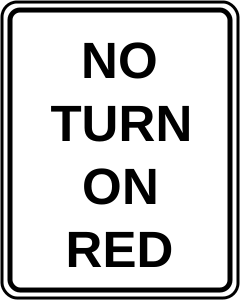
- Yes, after yielding to people and vehicles in your path
- No, this sign bans every right turn here at all times of day
- No, you must wait for a green arrow
- Only after coming to a full stop first
Show answer
Yes, after yielding to people and vehicles in your path. Where this sign is posted, you must wait until the signal turns green before going ahead or making a turn. Once the light is green, the turn is allowed, but a steady green still means proceed with caution: yield to pedestrians and vehicles already in the intersection or crosswalk, and take special care when turning. The sign only removes the usual right turn on red.
Study this in the handbook: Road signs by shape and color
11. Another driver is tailgating and making angry gestures at you. Which response does Delaware law enforcement ask for?
- Brake suddenly to teach the driver a lesson
- Make eye contact so the driver knows you see them
- Speed up to stay ahead of the driver
- Stay calm and avoid eye contact with the driver
Show answer
Stay calm and avoid eye contact with the driver. Delaware law enforcement asks drivers to help by remaining calm, not taking traffic problems personally, avoiding eye contact with aggressive drivers, staying away from erratic drivers, and not challenging them. You can also report aggressive driving by noting the tag number and calling 911. If you are being followed too closely and there is a right lane, move over and let the driver go.
12. The pictured sign warns of a series of curves. When should you do your slowing down?

- Before you enter each curve
- In the middle of each curve
- Only on the last curve
- After each curve, on the straight part
Show answer
Before you enter each curve. A vehicle can travel much faster in a straight line than in a curve, and it is easy to go too fast in one. If you do, the tires cannot grip and the vehicle skids. Always slow down before you enter a curve so you do not have to brake in it. On a winding road, set a safe speed before the first curve and keep it through the series.
Study this in the handbook: Seeing ahead and adjusting to conditions
13. You think you can reach a railroad crossing before an approaching train. What should you do?
- Race the train if your vehicle accelerates well
- Never try to beat a train across the tracks
- Cross if the train appears far away and slow
- Cross while sounding the horn to warn the train
Show answer
Never try to beat a train across the tracks. Trains are large, may move faster than they appear, and cannot stop or swerve for a vehicle on the tracks. Judging distance and speed of a train from a crossing is unreliable, and a stall during a hurried crossing traps the vehicle. A horn cannot move a train or clear the tracks. Wait on the approach side until the train passes and any second train clears, then cross without stopping on the rails. The delay is short compared with the force of a train impact.
Study this in the handbook: Pavement markings, signaling and roundabouts
14. You are driving out of a parking garage, and someone walking along the sidewalk is about to cross the exit in front of you. What must you do?
- Go first, since the exit belongs to drivers
- Honk and pull out slowly
- Yield to the person on the sidewalk
- Pull across, then stop in the street
Show answer
Yield to the person on the sidewalk. Drivers crossing a sidewalk while entering or exiting a driveway, alley, or parking lot must yield to pedestrians. A garage exit crosses the sidewalk, so the person walking there has the right-of-way. Stop before the sidewalk, let the person pass, and then move forward. It is illegal to drive on a sidewalk except to cross it. Pedestrians also have the right-of-way on a sidewalk where it crosses an alley, entrance, or driveway.
Study this in the handbook: Right of way at intersections
15. As you approach any railroad crossing, what should you assume about train traffic?
- A train uses the crossing only at posted times
- No train is coming if none has been seen there before
- Crossing gates will always warn you in time
- Always expect a train
Show answer
Always expect a train. Assuming no train is coming is a leading cause of deaths at railroad crossings. A crossing may seem quiet for years and still carry a train at any time. Gates and signals can fail or may not be present at all. Slowing down and looking up and down the tracks on every approach, and making sure there is room on the far side, keeps the vehicle from being trapped on the tracks.
16. After passing another vehicle, when is it safe to return to the driving lane?
- As soon as your front bumper clears the other vehicle
- When you see both its headlights in your mirror
- When the passed vehicle sounds its horn
- After traveling one full mile beyond the vehicle
Show answer
When you see both its headlights in your mirror. Seeing both headlights of the passed vehicle in the rearview mirror confirms enough space has opened between the vehicles. Returning on bumper clearance alone cuts in too closely and can force the other driver to brake. A horn signal is not a spacing measure. A full mile is far more than needed once both headlights are visible in the mirror.
17. You cannot stop yawning and have trouble keeping your head up on a long drive. What does the manual say about these signs?
- A normal part of long trips that needs no action
- A cue to turn up the radio and keep going
- A reason to speed up and finish the trip sooner
- Signs of a drowsy driver; rest or change drivers
Show answer
Signs of a drowsy driver; rest or change drivers. The manual lists signs of drowsy drivers: your eyes close or go out of focus by themselves, you have trouble keeping your head up, you cannot stop yawning, and you have wandering, disconnected thoughts. Others are not remembering the last few miles, missing your exit, drifting out of your lane, and a variable speed. If you are tired while driving, it is best to rest or change drivers.
Study this in the handbook: Seeing ahead and adjusting to conditions
18. You need to read a road map while you are driving. What does the manual tell you to do?
- Glance at it at stoplights only
- Pull safely off the road before you look at it
- Read it quickly while driving straight
- Ask a passenger to hold it in front of the mirror
Show answer
Pull safely off the road before you look at it. Do not take your eyes off the road for more than a few seconds at any one time. If you need to look at a map, pull safely off the road before you try to look at it. Do not try to read the map while you are driving. Even with hands-free equipment, talking on a phone or radio takes your attention away from driving and makes you less likely to notice a dangerous situation.
19. You are circulating inside a circular intersection and the vehicle ahead slows for its exit. What passing action is allowed inside?
- Pass on the left whenever the central island leaves extra room
- Do not pass other vehicles while traveling inside the circle
- Pass on the right if your exit is the next street ahead
- Pass only when the vehicle ahead signals for its exit turn
Show answer
Do not pass other vehicles while traveling inside the circle. Inside a roundabout the driver keeps to the right of the central island, travels counterclockwise, and maintains a slow speed. Passing other vehicles inside the circle is not part of that pattern, even when a vehicle ahead slows for an exit. Attempting to overtake disrupts the single circulating flow and can block an exit. The driver holds position, leaves space, and exits when the intended street arrives.
Study this in the handbook: Pavement markings, signaling and roundabouts
20. You stop to help at a crash with several injured people. Whom should you help first?
- Anyone who is not already walking and talking
- The person who is talking the loudest
- Whoever is closest to your own car
- The drivers before any passengers
Show answer
Anyone who is not already walking and talking. If someone is injured, first make sure police and emergency medical help have been called. Then help anyone who is not already walking and talking. Check for breathing, then check for bleeding. Apply pressure directly to a bleeding wound with your hand or a cloth. Do not move an injured person unless they are in a burning vehicle or in other immediate danger.
Study this in the handbook: Railroad crossings, vehicle emergencies and crashes
Every question is written from the official Delaware Driver Manual. Need paper? Printable DE practice test with answer key.
Last verified 2026-10-05. How we check every question · Study all 500 as flashcards
Frequently asked questions
How many questions are on this Delaware practice test?
This fixed set has 20 questions. It is test 18 of 25 from the 500 question Delaware bank. The real DE exam asks 32 questions and you need 26 correct.
What is the passing score for the real Delaware test?
26 of 32 correct (approximately 81%) That figure comes from the official Delaware source cited on the DMV facts page.
How does this fixed test relate to the full Delaware bank?
Each numbered test is a fixed set of questions in a fixed order, so you can retake the same test later and compare. Every test mixes road signs and the other topics in about the same proportion as the full bank. Tests 1 to 25 together cover every question in the Delaware bank once. The full practice page mixes the whole bank at random.
Last verified 2026-10-05. See the Delaware DMV facts page for sourced state details.
Return to the full Delaware practice test · Study road signs