
Test 15 of 25 · 20 questions · Free 2026
DE Permit Practice Test 15
Jump to the test ↓A fixed 20 question set from the Delaware bank with answers and plain English explanations. The real DE exam is 32 questions, 81 percent to pass; take the full length version on the main practice page.
Question 1 of 20 · 0 right so far
All 20 questions in test 15
Every question below comes from the Delaware question bank on this page. Open a question to see the correct answer and the explanation. Nothing here is hidden behind a signup.
1. Your vehicle breaks down on a highway outside a business or residence area. Where should it end up?
- On the paved part of the highway with flashers on
- In the nearest travel lane while you seek help
- Blocking part of the shoulder and part of the lane
- Off to the right as far as possible
Show answer
Off to the right as far as possible. You must never park on the paved or traveled part of a highway outside a business or residence district unless the vehicle is disabled and cannot be moved, and then you must pull off to the right as far as possible. Staying in a travel lane or straddling the edge leaves the car in the path of traffic. Turn on your emergency flashers and, if you have them, place flares behind the vehicle.
2. In a work zone you see a large panel of lights flashing in an arrow pattern across the lane ahead. What is it telling you?
- Speed up so you pass the crew before the arrows stop
- Part of the road ahead is closed; move into the open lane
- A detour begins, so every vehicle must leave the highway
- Workers are on break, so the lane is open again for now
Show answer
Part of the road ahead is closed; move into the open lane. Large flashing or sequencing arrow panels can be used in work zones day and night. They guide drivers into certain lanes and tell them that part of the road ahead is closed. Begin your lane change early, follow the arrow, and keep out of the closed area. Brake gradually and avoid weaving so drivers behind you have time to slow down too.
3. Driving at night with high beams on, you see a car coming toward you. Under Delaware law, by what distance must you switch to low beams?
- 100 feet before meeting it
- 300 feet before meeting it
- 500 feet before meeting it
- 1,000 feet before meeting it
Show answer
500 feet before meeting it. Delaware requires headlights to be switched to low beams 500 feet before meeting another vehicle. The manual describes this as about a one-block distance. Waiting until the car is close leaves the other driver blinded by glare at the moment you pass. If an oncoming driver keeps high beams on, look toward the right side of the road rather than answering with your own bright lights.
Study this in the handbook: Headlights, seat belts, phones and insurance
4. Why should you lower your speed on narrow bridges and in tunnels?
- Tunnels and bridges have lower speed limits by law
- Vehicles approaching each other there are closer together
- Brakes work less well while on a bridge
- Oncoming drivers expect you to stop for them
Show answer
Vehicles approaching each other there are closer together. Wherever people or traffic gather, your room to maneuver is limited, and you need to lower your speed to have time to react in a crowded space. Narrow bridges and tunnels are on the manual's list of such places because vehicles approaching each other in these areas are closer together. The list also includes shopping centers, parking lots, rush hours, toll plazas, schools, and railroad crossings.
Study this in the handbook: Seeing ahead and adjusting to conditions
5. An orange diamond sign warns that a lane will be closed ahead. What is the timely action?
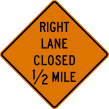
- Wait until the last cone, then steer sharply over
- Speed up to pass as many cars as you can first
- Stay in the closing lane; it often reopens
- Prepare early to move out of the lane that closes
Show answer
Prepare early to move out of the lane that closes. When you see signs indicating lane closures ahead, prepare to move from the closed lane. Signal and change lanes early, while gaps are still available, and avoid sudden moves. In a work zone, observe what other drivers are doing, do not weave from lane to lane, and brake gradually so drivers behind you have time to slow down. Keep up with the flow of traffic.
Study this in the handbook: Road signs by shape and color
6. A person on foot presses the button at a crosswalk, and a HAWK signal begins a series of stages. What is its job?
- To warn drivers of an upcoming railroad crossing ahead
- To let drivers turn without stopping for people on foot
- To stop traffic long enough for pedestrians to cross safely
- To flash on its own all day at a fixed steady rate
Show answer
To stop traffic long enough for pedestrians to cross safely. The HAWK signal, a High Intensity Activated Crosswalk, is activated when a pedestrian presses the crosswalk button. Once it is activated, it goes through a series of stages that stop traffic long enough for pedestrians to cross the roadway safely. Traffic is then allowed to proceed, and the signal resets itself until it is activated again. Drivers must obey it just like any other traffic signal.
7. You overtake a bicyclist on a quiet street and then need to turn right at the next corner. What is the safest way to handle it?
- Pass quickly, then turn right ahead of the rider
- Speed up so you are well clear before you turn
- Move into the left lane and swing wide for the turn
- Do not pass just to turn in front of the rider; wait
Show answer
Do not pass just to turn in front of the rider; wait. Delaware asks drivers to make sure there is enough time before turning left or right near a cyclist. Do not pass a cyclist only to turn directly in front of them, and when in doubt, wait. Many car and bicycle crashes happen because the driver did not see the cyclist, especially when preparing to turn or enter a roadway. Intersections are particularly dangerous for both cars and bicycles, and bicycles can be harder to see at night.
8. To avoid a crash by turning quickly, where should you steer the vehicle?
- In the direction you want the vehicle to go
- Toward the object you are trying to avoid
- With one hand so the other can signal
- Away from the direction you want to travel
Show answer
In the direction you want the vehicle to go. A vehicle follows the steering direction, so aiming where you want to go gives the turn a clear target. Holding the wheel with both hands keeps control during the quick move. After turning away or changing lanes, staying ready to correct keeps one avoided crash from becoming another. Steering toward the object or away from the intended path defeats the purpose of the maneuver.
Study this in the handbook: Railroad crossings, vehicle emergencies and crashes
9. Your car stalls on a railroad crossing. You look both ways and see no train. What should you try first?
- Stay in the car with your belt on until help comes to you
- Leave the car and run along the tracks away from it
- Try to restart it; if it will not start, get out and move away
- Wait for the gates to come down before you act
Show answer
Try to restart it; if it will not start, get out and move away. If your vehicle stalls on railroad tracks, look both ways for trains. If none are coming, try to restart the vehicle. If it does not start, or you are not sure whether a train is coming, get out and move away from your vehicle. When a train is coming, get out and move far from the tracks, running in the general direction the train is coming from so debris from the collision will not hit you.
Study this in the handbook: Railroad crossings, vehicle emergencies and crashes
10. You, a car on your left, and a car on your right all stop at a four-way stop at the same moment, and all want to go straight. In what order should they go?
- You, then the car on your right, then the one on your left
- The car on your left, then you, then the one on your right
- The car on your right, then you, then the one on your left
- All three at once if each driver signals
Show answer
The car on your right, then you, then the one on your left. When vehicles arrive at the same time at a four-way stop, the vehicle on the right goes first. Applying that to three cars means the car on your right goes first because nothing is on its right in this setup. You are next, since the car on your left has you on its right and must wait. Every driver must come to a complete stop before proceeding.
Study this in the handbook: Right of way at intersections
11. Which person on foot must drivers give extra time and room to at a crossing?
- A person jogging in athletic clothing
- A person crossing in a large group
- A person walking while looking at a phone
- A person using a cane, walker, or wheelchair
Show answer
A person using a cane, walker, or wheelchair. Some people on foot may have trouble detecting approaching traffic and may need more time to cross. That group includes people who are hearing impaired and people whose physical disabilities require aids such as canes, crutches, walkers, guide dogs or service animals, wheelchairs, or motorized scooters. Drivers should stay alert for these individuals and yield. Giving added time reduces the chance that a slow crossing becomes a conflict in the lane.
Study this in the handbook: Road signs by shape and color
12. There is no sidewalk where you are walking. How should you position yourself?
- With your back to traffic, close to moving cars
- On the shoulder, facing traffic, far from the road
- In the left wheel track of the travel lane
- Behind parked cars where drivers cannot see you
Show answer
On the shoulder, facing traffic, far from the road. Without a sidewalk, a person on foot should walk on the shoulder facing oncoming traffic and as far from the road as possible. Facing traffic lets the walker see approaching vehicles and react. Distance from the travel lanes adds a buffer if a vehicle drifts or passes closely. Walking with traffic at the back, inside a lane, or hidden behind parked cars removes that view and buffer.
Study this in the handbook: School buses, pedestrians and bicyclists
13. Where must a rear-facing child car seat never be installed?
- In the back seat behind the driver
- In the center of the back seat
- In front of an active frontal air bag
- In a vehicle with lower anchors
Show answer
In front of an active frontal air bag. Never install a rear-facing car seat in front of an active frontal air bag. Children under age 1 should always ride rear-facing, and a child should stay rear-facing until reaching the seat maker's height or weight limit. The back seat is safer for children. Once installed, the seat should not move more than one inch side to side or front to back at the belt path.
14. A yellow diamond sign ahead displays an upside-down triangle. What should you prepare to do?

- Slow down and be ready to stop at the yield sign ahead
- Come to a full stop at this warning sign itself
- Ignore the yield sign ahead if no one is in sight now
- Expect a stop sign and plan to stop twice
Show answer
Slow down and be ready to stop at the yield sign ahead. This sign warns of a yield sign ahead. Slow down and be prepared to stop at the yield sign, or adjust your speed to traffic. At the yield sign you must yield the right-of-way to any vehicle or pedestrian in or approaching the intersection, stopping if necessary, and you may go on only when it is safe. The advance warning gives you time to plan.
15. You plan to proceed straight through a circular intersection with a central island. Which approach lane may you use for that movement?
- Only the left approach lane, because straight traffic must circle longest
- Only the right approach lane, because straight traffic exits earliest
- Neither approach lane until a gap in the circle fully stops
- Either approach lane, since both are acceptable for going straight
Show answer
Either approach lane, since both are acceptable for going straight. Approach lanes at a roundabout are chosen by intended exit movement. The right approach lane serves a right turn, and the left approach lane serves a left turn or U-turn. For proceeding straight, any approach lane is acceptable. Choosing by destination before entry keeps the vehicle in the correct path around the central island. After choosing, the driver still slows, watches for bicyclists and pedestrians, and yields to traffic already circulating.
Study this in the handbook: Pavement markings, signaling and roundabouts
16. You have a cold and plan to take an over-the-counter cold or allergy medicine before driving. What should you do first?
- Check the label for warnings about effects on driving
- Nothing, because medicine sold without a prescription is always safe
- Take double the dose so it works before you leave
- Drink coffee with it so you will not feel drowsy
Show answer
Check the label for warnings about effects on driving. Many prescription drugs and even drugs bought without a prescription can affect driving. Medicines taken for headaches, colds, hay fever or other allergies, or to calm nerves can make a person drowsy. Before you take a drug and drive, check the label for warnings about its effect. If you are not sure it is safe, ask your doctor or pharmacist about side effects.
Study this in the handbook: Alcohol, BAC and implied consent
17. You reach the pictured sign right where rails cross the road. How should you treat it as you approach?

- It works like a yield sign: give way to trains
- It is an advance warning that a crossing is far ahead
- It works like a stop sign: always stop completely
- It means cross without slowing if no gate is down
Show answer
It works like a yield sign: give way to trains. A white X-shaped sign, or crossbuck, with Railroad Crossing on it is located at the railroad crossing itself. It has the same meaning as a yield sign: you must yield to crossing trains. Slow down, look both ways along the tracks, and be ready to stop. The round yellow sign with an X and RR is the advance warning placed before the crossing.
Study this in the handbook: Road signs by shape and color
18. When driving in city traffic, how far ahead should you try to look?
- Only to the end of your own hood
- At least one block ahead
- About half a block in busy areas
- No farther than the nearest parked car
Show answer
At least one block ahead. In city traffic, one block is about ten seconds of travel and gives a useful preview of intersections, signals and people near the road. That preview supports gradual slowing and timely lane choices instead of last second stops. Looking only to the hood or to a nearby parked car misses cross traffic and pedestrians. A full block view helps traffic move at a steadier pace as well.
Study this in the handbook: Seeing ahead and adjusting to conditions
19. It is 94 degrees outside and you plan a quick stop, leaving a child in your parked car with the windows up. Why does the manual warn against this?
- The inside of the car can reach 122 degrees in half an hour
- The inside of the car stays close to the outside temperature
- The car cools down quickly once the engine is off
- Only a long stop of several hours is dangerous
Show answer
The inside of the car can reach 122 degrees in half an hour. When it is hot outside, do not leave children or animals unattended in a vehicle. On a hot summer day the interior of a car can get dangerously hot. One study found that with the windows up and the temperature outside at 94 degrees, the inside of a car could reach 122 degrees in just half an hour, or 132 degrees after an hour. Make sure no one leaves small children or animals in a hot vehicle.
20. You are being followed too closely and a right lane is available. What should you do?
- Slow down quickly to discourage the follower
- Move over to the right lane
- Match the follower speed for speed
- Tap your brakes repeatedly until they back off
Show answer
Move over to the right lane. Moving to the right lane lets a close follower pass without conflict. Where no right lane exists, waiting for a clear road ahead and then reducing speed slowly can encourage the follower to go around. A quick slowdown raises the risk of being hit from behind. Steady speed and early signals for your own slowdowns also help keep the driver behind at a safer distance.
Study this in the handbook: Following distance, trucks and motorcycles
Every question is written from the official Delaware Driver Manual. Need paper? Printable DE practice test with answer key.
Last verified 2026-10-05. How we check every question · Study all 500 as flashcards
Frequently asked questions
How many questions are on this Delaware practice test?
This fixed set has 20 questions. It is test 15 of 25 from the 500 question Delaware bank. The real DE exam asks 32 questions and you need 26 correct.
What is the passing score for the real Delaware test?
26 of 32 correct (approximately 81%) That figure comes from the official Delaware source cited on the DMV facts page.
How does this fixed test relate to the full Delaware bank?
Each numbered test is a fixed set of questions in a fixed order, so you can retake the same test later and compare. Every test mixes road signs and the other topics in about the same proportion as the full bank. Tests 1 to 25 together cover every question in the Delaware bank once. The full practice page mixes the whole bank at random.
Last verified 2026-10-05. See the Delaware DMV facts page for sourced state details.
Return to the full Delaware practice test · Study road signs