
Test 13 of 25 · 20 questions · Free 2026
DE Permit Practice Test 13
Jump to the test ↓A fixed 20 question set from the Delaware bank with answers and plain English explanations. The real DE exam is 32 questions, 81 percent to pass; take the full length version on the main practice page.
Question 1 of 20 · 0 right so far
All 20 questions in test 13
Every question below comes from the Delaware question bank on this page. Open a question to see the correct answer and the explanation. Nothing here is hidden behind a signup.
1. A passenger tucks the shoulder belt under their arm because it rubs their neck. What is the problem?
- Nothing is wrong, as long as the lap part is still fastened
- It is fine for adults but not for teens
- It is only a problem on highways
- It can cause serious injury and is not proper belt use
Show answer
It can cause serious injury and is not proper belt use. Putting the shoulder belt under your arm or behind you can result in serious injury. Because it is not considered proper safety belt use, it can also lead to a ticket. Wearing either the lap or shoulder part alone greatly reduces your protection. Delaware law requires all occupants to wear seatbelts, and an officer may stop a vehicle for an improperly restrained occupant.
2. A police car signals you to pull over. Once you have stopped safely at the side of the road, what should you do?
- Get out of the car and walk back to meet the officer at the cruiser
- Start searching the glove box so your license and papers are ready
- Turn off the engine, stay inside, and keep your hands on the wheel
- Keep the engine running and call someone on your phone
Show answer
Turn off the engine, stay inside, and keep your hands on the wheel. When you see emergency lights behind you, stay calm, signal, and pull to the side of the road as soon as it is safe, moving to the right whenever possible. Turn off the ignition and radio, stay in your vehicle unless the officer tells you to get out, and keep your hands on the steering wheel where they can be seen. Wait for instructions before reaching for documents.
Study this in the handbook: Emergency vehicles and the Move Over law
3. Your car does not have anti-lock brakes. In a quick stop the wheels lock and the car starts to skid. What should you do?
- Hold the pedal down harder until you stop
- Let up quickly, then brake again when the skid stops
- Shift to neutral and let the car coast
- Steer sharply to the side while holding the brake down hard
Show answer
Let up quickly, then brake again when the skid stops. Without ABS you can cause a skid if you brake too hard. Apply the brakes as hard as you can without locking them. If the brakes lock and you feel the vehicle start to skid, quickly let up on the brake pedal. As soon as the skid stops, push down on the pedal again, and keep repeating until the vehicle has stopped. With ABS, you hold firm pressure instead.
Study this in the handbook: Railroad crossings, vehicle emergencies and crashes
4. Unless a sign posts a different speed, what is the limit in a school zone?
- 25 miles per hour, like a residential district
- 20 miles per hour
- 35 miles per hour when no children are visible
- 50 miles per hour on a two-lane road
Show answer
20 miles per hour. Delaware's speed table lists school zones at 20 miles per hour, unless a sign posts a different limit. Business and residential districts are 25, and two-lane roads are 50. The manual tells drivers to be especially watchful for children near schools and not to speed in school zones. The 20 mph value is the lowest listed limit in the table.
Study this in the handbook: Delaware speed limits
5. At tracks with paired flashing lights beside the crossbuck, the lights begin flashing as a train approaches. What must you do?
- Stop and remain stopped while the lights continue flashing
- Slow down and cross quickly before the train gets closer
- Cross if you judge the train is still far down the track
- Follow the vehicle ahead through without a separate check
Show answer
Stop and remain stopped while the lights continue flashing. Paired lights at a crossing flash when a train is approaching, and the required response while they flash is to stop. Judging that the train still looks distant is unreliable because trains can move faster than they appear. Following another vehicle through removes the independent check each driver must make. The vehicle stays stopped until the flashing ends and the crossing can be used safely.
Study this in the handbook: Road signs by shape and color
6. On a frosty morning, only a small patch of your windshield is clear. What should you do before driving?
- Drive slowly and look through the clear patch
- Clear only the windshield; side windows can wait
- Open the side window and lean out to see
- Clear snow, ice, or frost from all windows
Show answer
Clear snow, ice, or frost from all windows. It is important to be able to see clearly through the windows, windshield, and mirrors. Clear snow, ice, or frost from all windows before driving, including the front, sides, and back. A patch on the windshield does not show traffic beside or behind you. Keep the windshield clean inside and out, because bright sun or headlights on a dirty windshield make it hard to see.
7. You are about to turn right at an intersection. What must you check first?
- Only the traffic that is stopped behind you at the corner
- Oncoming traffic that is going straight ahead
- Traffic from the left, oncoming left turners, and pedestrians
- Only the signal color and the stop line ahead
Show answer
Traffic from the left, oncoming left turners, and pedestrians. Before turning right, make sure that no traffic is approaching from your left and no oncoming traffic is turning left into your path. Do not begin your turn without checking for pedestrians crossing where you will be turning. You may turn right on red unless it is prohibited, after a full stop. Do not rely on signals to tell you that no one will cross in front of you.
8. Outside a business or residence area, when may a vehicle be left on the paved or traveled part of a highway?
- Never, unless the vehicle is disabled and cannot be moved
- Whenever flashers are on and a driver stays nearby
- During daylight hours when traffic is light
- When loading or unloading for under ten minutes
Show answer
Never, unless the vehicle is disabled and cannot be moved. The paved and traveled portions stay clear for moving traffic, with a narrow exception for a vehicle that truly cannot be moved. Hazard lights, daylight, light traffic, or a short loading stop do not create permission to occupy the roadway. A driver who can move the vehicle must take it off the highway portion used by traffic. Only genuine disablement that prevents movement excuses remaining there, and even then the vehicle should sit as far right as possible.
9. A wide lane has a motorcycle riding far to one side. May you move alongside it in that lane?
- Yes, if your car fits without touching it
- Yes, only during daylight hours
- Yes, if you sound the horn first
- No, moving alongside in the same lane is prohibited
Show answer
No, moving alongside in the same lane is prohibited. A driver must never move into the same lane alongside a motorcycle, even if the lane is wide and the rider is far to one side. The rider may need to change position within the lane for visibility or road objects, and side by side travel removes escape space. Fitting without contact, daylight, and a horn warning do not make the maneuver safe or lawful. The action is described as both illegal and extremely hazardous.
Study this in the handbook: Following distance, trucks and motorcycles
10. After overtaking a person on a bicycle, when should you move back to the right?
- As soon as your front bumper clears the rider
- After the rider waves you back over
- Immediately if a vehicle approaches behind you
- Only after allowing plenty of clearance for the rider
Show answer
Only after allowing plenty of clearance for the rider. After overtaking a cyclist, a driver should allow plenty of clearance before pulling to the right. The cyclist speed may be greater than the driver realizes, so cutting back early can place the vehicle directly in the rider path. A rider wave is not the measure, and pressure from behind does not shorten the needed space. Waiting for real clearance protects the rider from a sudden rightward move.
11. A lane carries traffic in one direction in the morning and the opposite direction later in the day. How is that lane usually marked on the pavement?
- With double broken yellow lines marking the reversible lane
- With a single solid white line along each side of the lane
- With a row of orange cones placed permanently in the lane
- With green painted arrows that never change during the day
Show answer
With double broken yellow lines marking the reversible lane. Lanes built to reverse direction by time of day are usually marked by double-broken yellow lines. Before entering, a driver checks signs at the roadside or overhead and any special lights showing which direction may use the lane then. Permanent cones and fixed green arrows cannot show a direction that changes. White edge lines mark lane boundaries for ordinary lanes and do not identify a reversing lane.
Study this in the handbook: Pavement markings, signaling and roundabouts
12. You are turning left and an opposing driver is also positioned to turn left in front of you. How should you shape your turn?
- Cut tightly across the corner even if opposing traffic is close
- Turn behind the opposing driver without leaving any extra room
- Stop across the opposing lane and wait for a wave to proceed
- Avoid a sharp corner cut and leave room for the opposing turn
Show answer
Avoid a sharp corner cut and leave room for the opposing turn. Cutting a left turn corner too sharply can run the vehicle into someone approaching from the left. The turn should leave room for oncoming vehicles to turn left in front of the waiting vehicle. That spacing lets the two left-turn paths coexist without either driver swinging into the other. The driver still yields to oncoming traffic going straight before completing the turn when a gap allows.
Study this in the handbook: Right of way at intersections
13. On a two-lane road posted at 50 mph, a police car is stopped on the shoulder with its lights flashing. You cannot change lanes. What should you do?
- Keep 50 mph and stay in your lane
- Slow below the posted limit until you are completely past
- Stop in your lane until the officer waves you on
- Cross the center line to give extra room
Show answer
Slow below the posted limit until you are completely past. On a two-lane roadway, Delaware's Move Over law requires you to slow down below the posted speed limit until you have completely passed the stopped vehicle. On a multi-lane road you would move over a lane instead when it is safe. These laws protect police, fire, and other workers on the roadside. Keep the slower speed until the whole scene is behind you.
Study this in the handbook: Emergency vehicles and the Move Over law
14. What does the pictured yellow diamond sign tell you about the road ahead?

- The divided highway you are on ends ahead
- A divided highway is about to begin up ahead
- The road ahead turns into a one-way street
- Another road crosses the highway ahead of you
Show answer
The divided highway you are on ends ahead. This warning sign means the divided section of highway ends ahead. It is a yellow diamond, and signs of that kind warn you of a special situation or hazard, so slow down and be ready to stop if necessary. A different sign warns that you are approaching a divided highway and tells you to keep to the right. Reading the picture on the sign, along with its shape and color, tells you which of the two applies.
15. You approach a crash on the shoulder where police are working. How should you pass it?
- Slow way down to see what happened
- Stop beside it in case you can help
- Keep your eyes on the road and get past it safely
- Change lanes back and forth to get a better view
Show answer
Keep your eyes on the road and get past it safely. Do not slow down just to look at a crash, someone getting a ticket, or other roadside activity. This is called rubbernecking. If you take your eyes off the road to look, you could run into a vehicle ahead that has slowed or stopped, and it also adds congestion. Keep your eyes on the road and get past the activity as soon and as safely as you can.
Study this in the handbook: Seeing ahead and adjusting to conditions
16. Before a curve you see a yellow sign showing 30 under a curve warning, and earlier you passed the pictured white sign. Which one states the legal speed limit?

- The yellow sign under the curve warning
- Neither, since both are only advice
- The pictured white rectangular sign
- Whichever shows the higher number
Show answer
The pictured white rectangular sign. Speed limit signs have black letters and numerals on a white rectangular background, and they state the legal allowable limit. Advisory speed signs are black on yellow and often appear under a warning sign. An advisory speed is not a specific limit, but if you exceed it and crash, you may be found to have violated the general speed rule. Obey both.
Study this in the handbook: Road signs by shape and color
17. An orange diamond sign shows a person holding a flag out to the side. What should you be ready for?
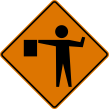
- A worker ahead who may stop, slow, or guide traffic
- A rule to stop at this sign and wait ten minutes
- A parade route with spectators crossing the road
- A railroad worker who will lower crossing gates
Show answer
A worker ahead who may stop, slow, or guide traffic. The flagger ahead sign warns that a flagger is working in the zone. Flaggers are often used in highway and street work zones to stop, slow, or guide traffic safely through the area. They wear yellow-green vests, shirts, or jackets and use red flags or stop and slow paddles. Obey the directions of police and flaggers in work zones. Approach slowly enough to stop.
18. A sudden downpour is so heavy that you cannot see well enough to drive. What should you do?
- Turn on high beams and keep going slowly
- Pull off the road in a safe place and wait
- Stop in your lane with your hazard lights on
- Follow the taillights of the car ahead closely
Show answer
Pull off the road in a safe place and wait. In a very heavy downpour you may not be able to see well enough to drive. If this happens, pull off the road in a safe place and wait until the rain clears. Do not stop in a travel lane, and do not rely on the car ahead to show you the way. In hard rain, low beams work better than high beams, which reflect back as glare.
Study this in the handbook: Seeing ahead and adjusting to conditions
19. Under Delaware's zero tolerance law, what BAC mandates a license revocation for a driver under 21?
- .02 BAC
- .04 BAC
- .08 BAC
- .10 BAC
Show answer
.02 BAC. Delaware's zero tolerance statute mandates a license revocation for an underage driver with a .02 BAC, so .02 is the figure that applies to drivers under 21. The law reaches anyone under 21 who drives or has actual physical control of a vehicle while consuming or after having consumed alcohol, and a first offense brings a two month revocation. The adult .08 figure and the commercial .04 figure do not replace this separate underage rule. A young driver should simply not drink before driving.
Study this in the handbook: Alcohol, BAC and implied consent
20. While the vehicle is still moving, what must you never do with the ignition key position?
- Turn it to the accessory setting at a stop
- Turn it to the lock position while in motion
- Use it to restart after a stall at low speed
- Turn the engine off after pulling off the road
Show answer
Turn it to the lock position while in motion. Turning the ignition to lock while moving can lock the steering when the wheel is turned, removing control of the vehicle. The engine should be turned off only after the vehicle is safely off the road. Accessory use at a stop and restarting after a stall do not create the steering lock risk. Keeping steering free while rolling is essential during any vehicle problem.
Study this in the handbook: Railroad crossings, vehicle emergencies and crashes
Every question is written from the official Delaware Driver Manual. Need paper? Printable DE practice test with answer key.
Last verified 2026-10-05. How we check every question · Study all 500 as flashcards
Frequently asked questions
How many questions are on this Delaware practice test?
This fixed set has 20 questions. It is test 13 of 25 from the 500 question Delaware bank. The real DE exam asks 32 questions and you need 26 correct.
What is the passing score for the real Delaware test?
26 of 32 correct (approximately 81%) That figure comes from the official Delaware source cited on the DMV facts page.
How does this fixed test relate to the full Delaware bank?
Each numbered test is a fixed set of questions in a fixed order, so you can retake the same test later and compare. Every test mixes road signs and the other topics in about the same proportion as the full bank. Tests 1 to 25 together cover every question in the Delaware bank once. The full practice page mixes the whole bank at random.
Last verified 2026-10-05. See the Delaware DMV facts page for sourced state details.
Return to the full Delaware practice test · Study road signs