
Test 6 of 10 · 20 questions · Free 2026
DE Permit Practice Test 6
Jump to the test ↓A fixed 20 question set from the Delaware bank with answers and plain English explanations. The real DE exam is 32 questions, 81 percent to pass; take the full length version on the main practice page.
Question 1 of 20 · 0 right so far
All 20 questions in test 6
Every question below comes from the Delaware question bank on this page. Open a question to see the correct answer and the explanation. Nothing here is hidden behind a signup.
1. How many months of valid driving authority must a Delaware Level One permit holder complete before automatic Class D conversion?
- 12 months
- 6 months
- 3 months
- 24 months
Show answer
12 months. A Delaware Level One Learner's Permit automatically converts to a Class D license after the holder completes a full 12 months of valid driving authority. Six months marks a change in supervision and driving-hour restrictions, but it is not the full program length. Three and 24 months do not match the manual's conversion rule. The word valid matters: time during a suspension, revocation, cancellation, denial, or surrender is excluded and additional experience can be added. Permit holders should track uninterrupted authorized time, not merely calendar time since issuance.
Study this in the handbook: The Level One Learner's Permit and GDL rules
2. What duty does a Delaware driver have when overtaking a vehicle traveling in the same direction?
- Assume the passing vehicle automatically has priority
- Force that vehicle onto the shoulder
- Sound the horn until it stops
- Yield to the vehicle being overtaken
Show answer
Yield to the vehicle being overtaken. Delaware requires a driver overtaking a vehicle in the same direction to yield to that vehicle, even if the vehicle slows or stops. Passing does not create an automatic priority status, and the overtaking driver may not force the other road user onto the shoulder. A horn can warn in some circumstances, but repeated sounding does not replace the yielding duty. The cue is to leave room and be prepared for the vehicle ahead to change speed, rather than treating the pass as permission to continue regardless of its movement.
Study this in the handbook: Right of way at intersections
3. For a first Delaware DUI offense with a BAC between .15 and .19, how long is the DMV license loss?
- 18 months
- 12 months
- 24 months
- 36 months
Show answer
18 months. For a first offense, Delaware's DMV penalty is 18 months when the BAC falls between .15 and .19. The 12-month period applies to a BAC below .15 or drugs, while 24 months applies to .20 or greater or a chemical-test refusal. The 36-month choice belongs to a different offense tier and is not the first-offense figure in this range. Compare both the offense number and BAC band before selecting a penalty.
Study this in the handbook: DUI penalties and underage laws
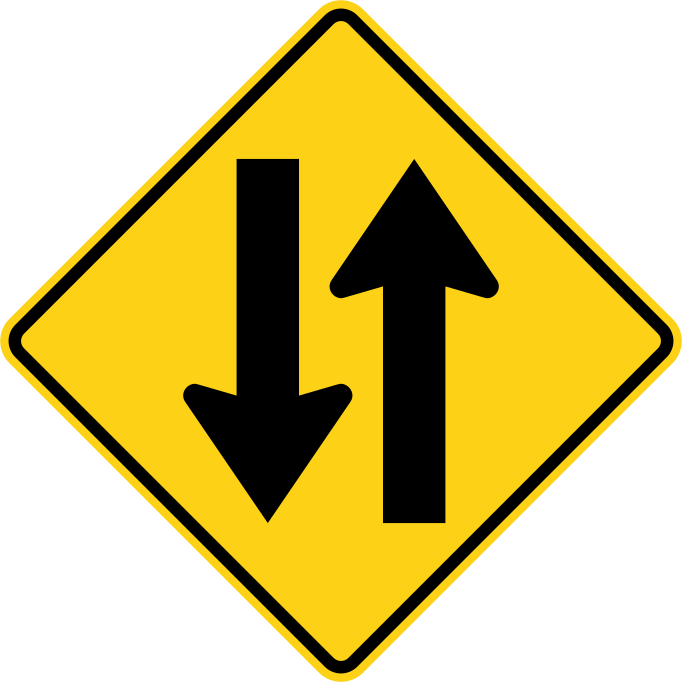
4. When interpreting a highway sign such as this one, which features should you use together?
- Its color alone, without considering the symbol
- Its shape, color, and words, numbers, or figures
- The direction of the nearest vehicle only
- The distance between the sign and the curb only
Show answer
Its shape, color, and words, numbers, or figures. Delaware expects drivers to recognize signs through several features working together. Shape and color help identify the kind of message, while a symbol, number, or wording communicates its specific meaning. Color alone cannot distinguish all the warnings that share a yellow background. As you approach this sign, examine the opposing arrows along with the sign shape and color. Do not substitute the behavior of nearby traffic for reading the actual traffic control.
Study this in the handbook: Road signs by shape and color
5. Why should you reduce speed before entering the curves warned of by this sign?

- Braking in a curve always increases tire grip
- Braking in a curve can cause a skid
- A curve allows a higher speed than a straight road
- The steering wheel automatically limits speed in curves
Show answer
Braking in a curve can cause a skid. Braking while turning can cause the tires to lose grip and the vehicle to skid. Reduce speed on the approach so that the vehicle is already traveling at a controlled pace when the bend begins. Waiting until the middle of a curve to brake does not increase traction. On a winding road, continue scanning for the next bend instead of assuming the first curve is the last. Smooth steering and an appropriate entry speed help keep the vehicle within its lane.
Study this in the handbook: Seeing ahead and adjusting to conditions
6. In Delaware, which child should not ride in the front passenger seat?
- Only a child under 8
- Only a child in a booster seat
- A child under 12 or under 5 feet 5 inches
- Any child under 16
Show answer
A child under 12 or under 5 feet 5 inches. The manual says a child under the age of 12 or under 5 feet 5 inches should not occupy the front passenger seat, with certain exceptions in Delaware code. Children who outgrow a booster seat but are not yet 16 must wear a properly secured seat belt in all seating positions, which is a primary enforcement law. So under 16 is the seat belt rule, not the front seat rule, and under 8 or booster seat only are too narrow.
Study this in the handbook: Headlights, seat belts, phones and insurance
7. How early may a Delaware driver renew a noncommercial license?
- Only in the last week
- One year early
- Only after it expires
- Any time during the 180 day period before expiration
Show answer
Any time during the 180 day period before expiration. You may renew at any time during the 180 day, six month, period prior to the expiration of your license, at any DMV facility. Licenses are issued for eight years except for limited immigration stays, hazmat holders and Driving Privilege Card holders. Renewing after the expiration date brings a $10 late fee, and endorsements add to the base fee, $12 for motorcycle and $10 for taxi. Commercial driver license holders follow a different rule and may renew no earlier than 30 days before expiration.
Study this in the handbook: Exams, renewal and license rules
8. A pedestrian has started crossing while the DON'T WALK signal is flashing. What should that pedestrian do?
- Finish crossing as rapidly as possible
- Turn around and wait in the roadway
- Start a new crossing from the curb
- Stop in the crosswalk until the signal changes
Show answer
Finish crossing as rapidly as possible. A flashing DON'T WALK signal means a pedestrian who has already entered the street should finish crossing as rapidly as possible. It does not direct that person to reverse course or stand still in the travel path. Someone who has not begun crossing should wait instead. Drivers must still watch the crosswalk and yield as required, because the signal does not make a person invisible. The practical cue is simple: flashing means complete an existing crossing, while steady DON'T WALK means do not begin one.
9. A Delaware driver charged with DUI says the drug was legally prescribed. Is that a defense?
- No, being legally entitled to use alcohol or a drug is not a defense
- Only if the driver is under 21
- Yes, a prescription is always a defense
- Yes, if the driver was on private property
Show answer
No, being legally entitled to use alcohol or a drug is not a defense. Delaware's DUI law states that the fact a person is or has been legally entitled to use alcohol or a drug is not a defense. The law also applies on highways and elsewhere throughout the state, so private property does not create an exception. Age does not change this rule. At an administrative hearing, a BAC of .08 or more or the presence of any drug is conclusive evidence of being under the influence.
Study this in the handbook: Alcohol, BAC and implied consent
10. A Delaware driver is convicted of speeding 22 mph over the posted limit. What does the serious speeding rule add?
- A one-month suspension
- No action
- A one-year suspension
- An advisory letter
Show answer
An advisory letter. Under Delaware's serious speeding rules, a driver convicted of speeding 20 to 24 mph over the posted limit is sent an advisory letter. Suspensions start at 25 mph over, with one month at that threshold, and a one-year suspension applies at 50 mph or more over the limit or at 100 mph on a highway. So a one-month or one-year suspension overstates the result for 22 mph over, while no action understates it.
Study this in the handbook: Points, suspensions and serious speeding
11. When is a Delaware driver required to yield the right-of-way to a pedestrian?
- Only when the pedestrian is using a traffic signal
- Only when the pedestrian is walking on the driver's side
- When the pedestrian is within a marked or unmarked crosswalk
- Only after the pedestrian has crossed halfway
Show answer
When the pedestrian is within a marked or unmarked crosswalk. Delaware gives pedestrians the right-of-way when they are within a marked or unmarked crosswalk. A signal is not the only circumstance, and neither side of the roadway nor a halfway point changes the duty. Slow before the crosswalk, scan for people who may be partly hidden, and be ready to stop. A horn can warn someone, but it cannot replace yielding when a pedestrian is crossing.
Study this in the handbook: School buses, pedestrians and bicyclists
12. A Delaware GDL permit holder needs a supervisor for a practice drive. Which adult qualifies (assuming sponsor approval)?
- A 21-year-old with a Class D license for 3 years
- A 22-year-old with a Class D license for 5 years
- A 30-year-old with a Class D license for 2 years
- A 25-year-old with a Class D license for 5 years
Show answer
A 25-year-old with a Class D license for 5 years. For GDL driving, the supervisor must be a properly licensed parent, guardian, or sponsor-approved licensed driver who is at least 25 years old and has held a Class D license for at least 5 years. Only the 25-year-old with 5 years meets both parts. The 21 and 22 year olds are too young, and the 30-year-old lacks the five years of licensed driving. Note that the separate adult Temporary Instruction Permit only needs a licensed companion 21 or older, which is a common mix-up.
Study this in the handbook: The Level One Learner's Permit and GDL rules
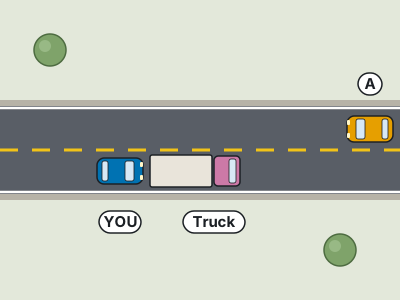
13. What does a broken yellow line between opposing lanes allow?
- Changing into the opposing lane whenever a signal is green
- Passing at any time without checking traffic
- Crossing only to park on the shoulder
- Crossing to pass when it is safe to do so
Show answer
Crossing to pass when it is safe to do so. A broken yellow line separates traffic moving in opposite directions and permits a driver to cross it to pass when the maneuver is safe. The marking does not make passing automatic, so the driver must check sight distance, oncoming traffic, and other hazards. Parking on the shoulder is not the purpose of the line, and a green signal does not override lane safety. The cue is broken yellow plus a clear view and a safe gap, not the paint alone.
Study this in the handbook: Pavement markings, signaling and roundabouts
14. What does a round yellow sign with an X and black RR letters warn about?

- An approaching highway rail intersection
- A school crossing with children
- A divided highway beginning
- A required route for trucks
Show answer
An approaching highway rail intersection. The round yellow sign with an X and black RR letters is the advance warning for a highway rail intersection. A five-sided school sign, divided-highway warning, and truck route sign carry different shapes and messages. The railroad symbol is meant to prompt early caution, not a last-second maneuver. On seeing it, reduce speed, look for the crossing, and be prepared for trains or signals before committing the vehicle to the tracks.
Study this in the handbook: Road signs by shape and color
15. What must a Delaware Driving Privilege Card applicant do before visiting the DMV?
- Nothing, walk in with a passport
- Schedule an appointment with the State Bureau of Identification for fingerprinting and pay a $72 fee
- Pass a road test first
- Pay $20 online
Show answer
Schedule an appointment with the State Bureau of Identification for fingerprinting and pay a $72 fee. Effective September 11, 2023, all eligible Driving Privilege Card applicants must schedule an appointment with the Delaware State Bureau of Identification to begin the process. SBI collects fingerprints, validates identification and collects a $72 fee, and provides a receipt to bring to the DMV along with original or certified required documents and a tax filing compliance certification from the Division of Revenue.
16. On a multi-lane roadway, what is the Delaware response when approaching a stopped vehicle covered by the Move Over law?
- Drive on the shoulder until completely past it
- Change lanes away from the stopped vehicle when safe
- Stop in your lane and wait for a signal
- Accelerate so you spend less time beside it
Show answer
Change lanes away from the stopped vehicle when safe. On a multi-lane roadway, Delaware asks an approaching driver to move over one lane from the stopped vehicle until safely past it. The lane change must be appropriate and safe, so driving onto the shoulder is not the default response. Stopping in the travel lane can create another hazard, and acceleration does not provide the protective separation the rule is designed to create. If a lane change is impossible or unsafe, the manual directs the driver to proceed cautiously and reduce to a safe speed. Think separation first, then controlled speed.
Study this in the handbook: Emergency vehicles and the Move Over law
17. What information do blue motorist service signs usually provide?
- Speed limits and passing rules
- Upcoming curves and hills
- Gas, food, or lodging
- Railroad crossing warnings
Show answer
Gas, food, or lodging. Motorist service signs usually have white letters on a rectangular blue background and identify services such as gas, food, and lodging. They help drivers locate facilities, rather than announce curves, regulate speed, or warn about railroad tracks. Read the service sign early and plan a legal, gradual maneuver to reach the facility. Do not stop abruptly in an active lane or treat the blue background as permission to ignore other controls. The useful cue is blue with service information, while yellow warning signs and regulatory signs serve different purposes.
Study this in the handbook: Road signs by shape and color
18. What must a driver do before entering a railroad crossing if traffic ahead may force a stop?
- Enter the crossing and stop on the tracks if traffic backs up
- Wait until there is room beyond the tracks to cross completely
- Drive around a lowered gate if no train is visible
- Shift gears on the tracks to prepare for the far side
Show answer
Wait until there is room beyond the tracks to cross completely. A driver must not begin crossing railroad tracks unless there is enough space on the far side to clear them without stopping. Entering while traffic is backed up can leave the vehicle stranded on the rails. A lowered gate must never be bypassed, and avoiding a gear shift is safer than shifting on the crossing. The cue is the space beyond the tracks, not merely the absence of a visible train. Stop before the crossing and wait for a clear exit path.
Study this in the handbook: Pavement markings, signaling and roundabouts
19. If a police officer's instruction conflicts with a Delaware traffic signal, which instruction must a driver follow?
- The direction of the nearest other driver
- The traffic signal because it is always controlling
- The police officer's instruction
- The instruction shown on a parked vehicle
Show answer
The police officer's instruction. A police officer may direct traffic differently from a sign, signal, or pavement marking when conditions require it. Delaware tells drivers to obey the officer even when that instruction is contrary to the ordinary traffic control. The signal still operates for other road users, but the officer's hand signal or verbal command governs the driver being directed. Do not assume a green light authorizes movement when the officer is stopping traffic. Slow down, identify the officer's intended path, and follow that direction carefully.
Study this in the handbook: Pavement markings, signaling and roundabouts
20. What following-distance method does the Delaware manual recommend for ordinary driving?
- Following until the lead vehicle's brake lights appear
- The one-car-length rule at every speed
- The three-second rule
- Keeping exactly one second behind on dry roads
Show answer
The three-second rule. The manual calls the three-second rule an easy way to tell whether a driver is following too closely, and says it works at any speed. A fixed car length changes meaning as speed changes, while waiting for brake lights leaves little reaction time. One second is less than the stated ordinary cushion. Choose a stationary point after the vehicle ahead passes it, count three seconds, and stretch the gap to four seconds on slippery roads or when following a motorcycle.
Study this in the handbook: Following distance, trucks and motorcycles
QualitySpace is expanding to Delaware
We are a California-based independent insurance brokerage working on licensing in more states. We cannot help with Delaware insurance yet. Leave your email and we will let you know when we can.
Every question is written from the official Delaware Driver Manual. Need paper? Printable DE practice test with answer key.
Last verified 2026-10-05. How we check every question · Study all 205 as flashcards
Frequently asked questions
How many questions are on this Delaware practice test?
This fixed set has 20 questions. It is test 6 of 10 from the 205 question Delaware bank. The real DE exam asks 32 questions and you need 26 correct.
What is the passing score for the real Delaware test?
26 of 32 correct (approximately 81%) That figure comes from the official Delaware source cited on the DMV facts page.
How does this fixed test relate to the full Delaware bank?
Each numbered test is a fixed set of questions in a fixed order, so you can retake the same test later and compare. Every test mixes road signs and the other topics in about the same proportion as the full bank. Tests 1 to 10 together cover 200 of the 205 questions in the Delaware bank, each once. The full practice page mixes the whole bank at random.
Last verified 2026-10-05. See the Delaware DMV facts page for sourced state details.
Return to the full Delaware practice test · Study road signs