
Test 7 of 10 · 20 questions · Free 2026
DE Permit Practice Test 7
Jump to the test ↓A fixed 20 question set from the Delaware bank with answers and plain English explanations. The real DE exam is 32 questions, 81 percent to pass; take the full length version on the main practice page.
Question 1 of 20 · 0 right so far
All 20 questions in test 7
Every question below comes from the Delaware question bank on this page. Open a question to see the correct answer and the explanation. Nothing here is hidden behind a signup.
1. At what ages may a Delaware applicant (without an IEP) apply for a GDL Level One Learner's Permit?
- At least 16 and less than 18
- At least 15 and less than 17
- At least 17 and less than 21
- Any age from 16 to 25
Show answer
At least 16 and less than 18. Delaware's Level One Learner's Permit is for applicants at least 16 years old and less than 18. The only extension in the eligibility rule is for a student on an active IEP, who may apply from 16 up to less than 22. Fifteen is too young, and an applicant 18 or older is handled as a first time adult applicant with a Temporary Instruction Permit instead. The applicant also needs the Blue/White driver education certificate and a sponsor's signature.
Study this in the handbook: The Level One Learner's Permit and GDL rules
2. A Delaware driver is convicted of driving 100 mph on a highway posted at 65. What suspension applies?
- One year
- Three months
- Six months
- No suspension because it is under 50 mph over
Show answer
One year. Delaware imposes a one-year suspension for driving 50 mph or more over the posted limit or for driving 100 mph on a highway. Even though 100 in a 65 zone is 35 over, the 100 mph highway rule applies on its own, so the one-year suspension controls. Reinstatement also requires a behavior modification/attitudinal driving course completed within the previous two years. The three and six month choices come from the lower, per five mph scale.
Study this in the handbook: Points, suspensions and serious speeding
3. What does a Delaware identification card cost, and when does it expire?
- $20, expiring in 4 years
- $40, expiring eight years from the applicant's next birthday
- $10, expiring in 2 years
- Free, never expiring
Show answer
$40, expiring eight years from the applicant's next birthday. The fee for a Delaware identification card is $40 and it expires eight years from the applicant's next birthday. The applicant must be a Delaware resident and present the same identity documents required for a license. Any applicant under 18 must be accompanied by a sponsor who is the mother, father, or court appointed guardian listed on the birth certificate.
Study this in the handbook: Exams, renewal and license rules
4. How long does a Delaware driver have to report an address change?
- One year
- 10 days
- 30 days, to both the Vehicle Registration and Driver License sections
- At the next renewal
Show answer
30 days, to both the Vehicle Registration and Driver License sections. After changing your Delaware address, you have 30 days to notify both the Vehicle Registration and Driver License Sections of the Division of Motor Vehicles. The change can be submitted online or in person, and you provide your license or ID card, your name as it appears on it, and the new address. To update the card itself, visit a DMV facility, where it is replaced at no cost; a duplicate fee applies only if you cannot present the current card or proof that it was stolen.
Study this in the handbook: Exams, renewal and license rules
5. When may a Delaware driver cross a broken yellow line to pass?
- When the broken line is on the driver's side and it is safe
- Whenever a solid yellow line is on the driver's side
- Only during rain when visibility is reduced
- Only after crossing a double solid yellow line
Show answer
When the broken line is on the driver's side and it is safe. A broken yellow line between opposing lanes permits a pass when it is safe to do so. If the broken line is on the driver's side beside a solid line, the driver may pass after checking visibility and opposing traffic. A solid line on the driver's side prohibits the pass, and rain does not create permission to cross. Double solid yellow lines mean neither side may pass, so crossing them for an overtake is not the rule. The practical cue is to identify which line is next to your vehicle before deciding.
Study this in the handbook: Pavement markings, signaling and roundabouts
6. What does the Delaware manual warn drivers about the turn signals on most motorcycles?
- They always cancel after five seconds
- They may not cancel automatically
- They work only when the motorcycle is stopped
- They should be replaced by hand signals in every turn
Show answer
They may not cancel automatically. Turn signals on most motorcycles are not automatically self-canceling, so a rider may forget to switch one off after completing a maneuver. A blinking signal can mislead another driver about whether the motorcycle will turn or continue straight. The signal does not operate only while stopped, and the manual does not require replacing it with a hand signal for every turn. Before turning in front of a motorcycle, confirm the rider's actual path instead of trusting the indicator alone. The cue is a blinking signal that remains on after the bike has straightened.
Study this in the handbook: Following distance, trucks and motorcycles
7. A Delaware Level One Learner's Permit holder is prohibited from operating a motor vehicle while:
- Using a cellular telephone or similar electronic device
- Driving with an adult supervisor
- Traveling during daylight hours
- Carrying an immediate family member
Show answer
Using a cellular telephone or similar electronic device. A Level One permit holder may not operate a motor vehicle while using a cellular telephone, text messaging device, or similar electronic device. The rule names no exception for navigation or other convenient uses. Having an adult supervisor or carrying an immediate family member is not the prohibited conduct described here. The safe habit is to secure the device before the vehicle moves and handle any needed communication after parking. GDL restrictions are stricter than the general hands-free rule, so a permit holder should not assume hands-free use is allowed.
Study this in the handbook: The Level One Learner's Permit and GDL rules
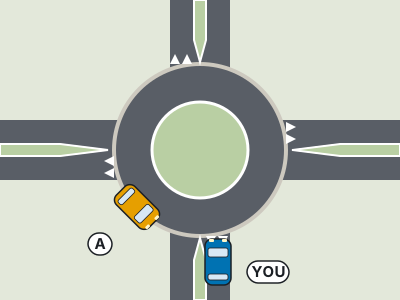
8. When entering a Delaware traffic circle or rotary, to whom must the driver yield?
- Only drivers entering from the right
- Drivers already in the circle
- No one if the entering vehicle is signaling
- Pedestrians only, never circulating vehicles
Show answer
Drivers already in the circle. Delaware requires drivers entering a traffic circle or rotary to yield to drivers already in the circle. The circulating traffic has already established its path, so an entering driver should slow, check for a safe gap, and wait when needed. Signaling does not cancel the yielding rule, and limiting the duty to pedestrians ignores the explicit vehicle instruction. Once inside a roundabout, the manual also says not to stop except to avoid a collision and to maintain a slow counterclockwise path around the central island.
Study this in the handbook: Right of way at intersections
9. A Delaware resident is convicted of DUI while visiting another state. What happens to the Delaware license?
- Nothing, because the offense was out of state
- The driver gets a warning letter
- Only points are added
- It is revoked in Delaware
Show answer
It is revoked in Delaware. The manual states that a person convicted of a DUI in another state will have their driver license revoked in Delaware. More generally, the Division suspends or revokes the license of a resident convicted elsewhere of any violation that would be grounds for suspension or revocation in Delaware, and the driving record includes out of state convictions. So an out of state DUI is not ignored, and it is not reduced to points or a warning.
Study this in the handbook: Alcohol, BAC and implied consent
10. After a DUI arrest, a Delaware officer takes the driver's license. How long does the driver have to request an administrative hearing?
- 30 days
- 5 days
- 15 days
- 60 days
Show answer
15 days. The officer confiscates the Delaware license at arrest (out of state licenses excepted) and issues a 15-day temporary license. The driver has 15 days to request an administrative hearing, in writing, by mail, by fax, online, or in person. If no hearing is requested, the license is revoked at the end of the 15-day period. Five, 30, and 60 days are not the deadlines in the Delaware procedure.
Study this in the handbook: DUI penalties and underage laws
11. What minimum vision acuity must a Delaware license applicant demonstrate, with or without corrective lenses?
- 20/20 in both eyes without lenses
- 20/50 only during daylight hours
- 20/40 with or without glasses or contact lenses
- 20/70 with a signed physician waiver
Show answer
20/40 with or without glasses or contact lenses. Delaware sets minimum acceptable vision at 20/40, and the standard may be met with glasses or contact lenses. Requiring unaided 20/20 vision is stricter than the manual's rule. Vision between 20/40 and 20/50 may lead to daylight-only permission, but that is not the ordinary minimum stated for a license. A physician waiver and 20/70 do not replace the screening standard. The key cue is the phrase with or without corrective lenses.
Study this in the handbook: Exams, renewal and license rules
12. At a Delaware stop sign, where must the driver stop if a stop line is present?
- After entering the crosswalk
- At the stop line
- Past the intersection where visibility improves
- Only when another vehicle is approaching
Show answer
At the stop line. A stop line is the first listed stopping point at a Delaware stop sign. If there is no stop line, the driver stops at the crosswalk, and if neither exists, before entering the intersection. The crosswalk choice skips over a marked stop line and could place the vehicle too far forward. Waiting for another vehicle is also wrong because the sign controls the driver even when the road appears empty. The cue is to look for the nearest required stopping mark before checking whether movement can resume safely.
Study this in the handbook: Road signs by shape and color
13. After stopping for an emergency vehicle, when may the driver move again?
- When the driver reaches the next traffic signal
- As soon as the driver sees its headlights
- After the authorized emergency vehicle has passed
- Immediately after moving onto the shoulder
Show answer
After the authorized emergency vehicle has passed. The duty to yield continues until the authorized emergency vehicle has passed. Moving as soon as its headlights appear or merely reaching the shoulder could put the driver back into the responder's path. A traffic signal does not determine when the emergency vehicle has enough room. Keep the vehicle stopped at the right edge or curb, follow any officer direction, and wait for the vehicle to clear. The concrete cue is the passing vehicle itself, followed by a scan for other responders or traffic before reentering the roadway.
Study this in the handbook: Emergency vehicles and the Move Over law
14. What does it cost to reinstate a revoked Delaware license compared with a suspended one?
- Nothing for either
- $50 for both
- $500 for both
- $200 for a revoked license and $50 for a suspended license
Show answer
$200 for a revoked license and $50 for a suspended license. A fee of $50 must be paid to reinstate a suspended license, and a $200 fee is charged to reinstate a revoked license, and you may be required to complete the knowledge, road and eye screening tests before reinstatement. Revocation is the more serious action and follows offenses such as DUI, and the period varies with the offense. Habitual offenders may lose the license for up to five years.
Study this in the handbook: Points, suspensions and serious speeding
15. What does a flashing Don't Walk pedestrian signal mean for someone who has not started crossing?
- Do not start crossing
- Start crossing quickly before the signal ends
- Cross only if a vehicle stops first
- Ignore the signal if the roadway appears clear
Show answer
Do not start crossing. A flashing Don't Walk indication permits someone already in the street to finish crossing rapidly, but tells a person who has not started not to enter. The choice “Start crossing quickly before the signal ends” confuses the instruction for people already crossing with the instruction for people waiting. A clear-looking roadway does not cancel the signal, and a stopped vehicle is not permission to begin. Drivers should still watch for pedestrians who are completing a crossing.
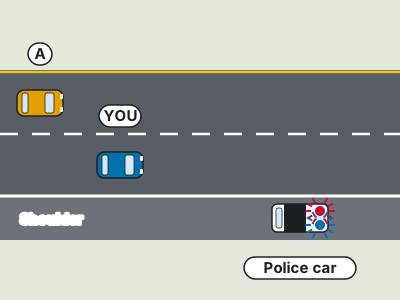
16. On a multilane roadway, how long should you remain moved over while passing a stationary emergency vehicle?
- Until you are directly alongside the stopped vehicle
- Only until your front bumper reaches its rear bumper
- Only until the emergency lights disappear from your mirror
- Until you are safely past the stopped vehicle
Show answer
Until you are safely past the stopped vehicle. Moving over creates room around the roadside activity, and that separation should continue until you are safely past the stopped vehicle. Returning while directly alongside it removes the space where a responder may be standing or moving. The position of your front bumper alone does not show that the entire vehicle has cleared the hazard. Check mirrors and surrounding traffic before moving back, and keep the passage smooth so other drivers can anticipate your position.
Study this in the handbook: Emergency vehicles and the Move Over law
17. Which headlight setting should you use when following another vehicle in Delaware?
- Parking lights instead of headlights
- High beams until the driver ahead complains
- Low beams
- High beams whenever the road is straight
Show answer
Low beams. Delaware's driving tips say to use your low beams when following another vehicle or when in heavy traffic. High beams belong on roads with no oncoming vehicles, so a straight road does not make them acceptable behind another car, and waiting for the other driver to complain is not the rule. Parking lights are for parking only and may never be used alone while driving. Switch to low beams as soon as you settle in behind another vehicle at night.
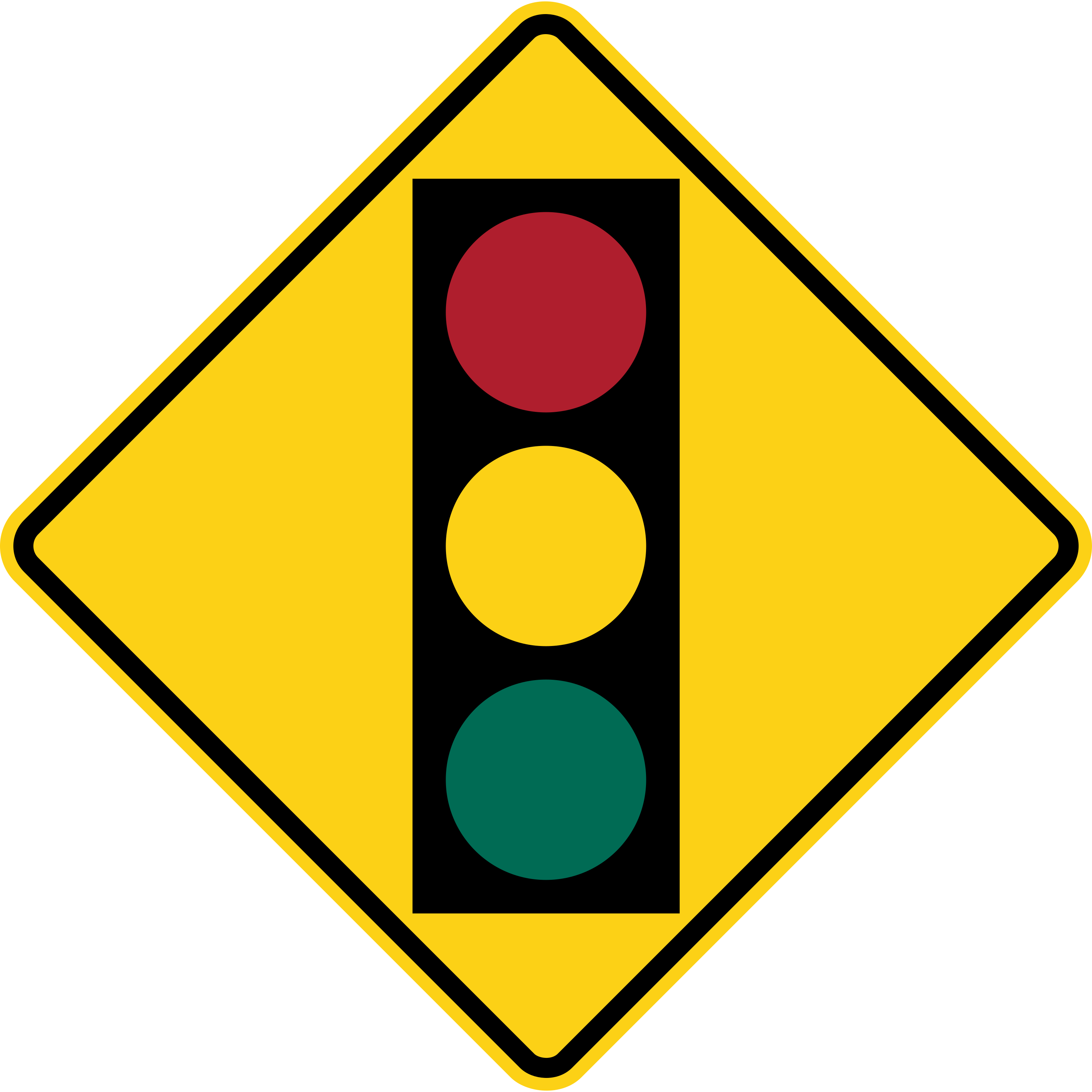
18. How should you respond to the yellow warning sign shown here as you approach the intersection?
- Stop immediately beside the warning sign in every case
- Maintain speed until a driver behind you brakes
- Accelerate to reach the intersection before traffic stops
- Slow down and be prepared to stop if necessary
Show answer
Slow down and be prepared to stop if necessary. Yellow warning signs call for a slower, alert approach and readiness to stop when needed. The signal symbol gives you a reason to scan ahead for the intersection and traffic waiting there. It does not require an automatic stop beside the warning sign, and accelerating could leave too little room for a queue beyond a curve. Ease off early, keep an adequate following gap, and look for the actual traffic signal that will control your movement.
Study this in the handbook: Road signs by shape and color
19. What action is shown with the warning for a curve to the right?

- Accelerate so the vehicle clears the curve quickly
- Adjust speed before entering the curve
- Stop in the travel lane at the curve
- Turn left immediately before the curve
Show answer
Adjust speed before entering the curve. The curve warning calls for adjusting speed before the driver reaches the bend. Accelerating through it reduces the time available to respond and can make the vehicle harder to control. Stopping in the lane creates a new hazard unless an emergency requires it, while turning left does not follow the roadway. The practical cue is to read the road ahead, slow while the vehicle is still straight, and enter the curve at a controlled speed that leaves room for steering corrections.
Study this in the handbook: Seeing ahead and adjusting to conditions
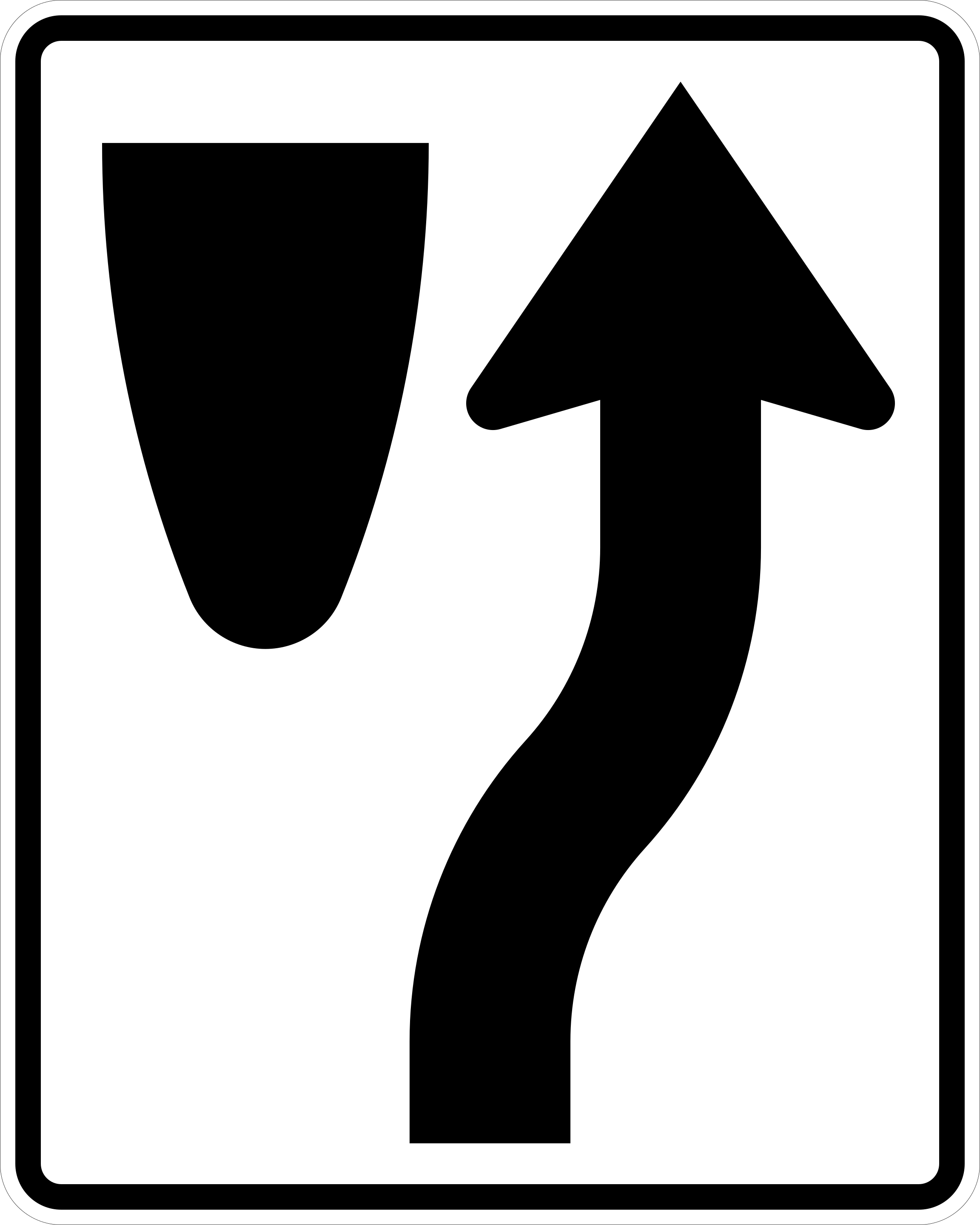
20. What path does the arrow around the obstruction on this sign direct you to take?
- Stop before the obstruction until a green arrow appears
- Use the left shoulder to pass the obstruction
- Remain in the center of the divider
- Keep to the right of the traffic island or divider
Show answer
Keep to the right of the traffic island or divider. The sign directs traffic to keep right of a traffic island or divider. The arrow is a channeling instruction around an obstruction, not an invitation to use the left shoulder or drive through the divider. A green-arrow requirement belongs to a traffic signal, while this sign tells you how to position the vehicle immediately. Reduce speed as needed, check nearby traffic, and follow the indicated side of the island. A useful cue is to trace the arrow around the obstruction before moving, making sure the vehicle remains on the permitted roadway.
Study this in the handbook: Road signs by shape and color
QualitySpace is expanding to Delaware
We are a California-based independent insurance brokerage working on licensing in more states. We cannot help with Delaware insurance yet. Leave your email and we will let you know when we can.
Every question is written from the official Delaware Driver Manual. Need paper? Printable DE practice test with answer key.
Last verified 2026-10-05. How we check every question · Study all 205 as flashcards
Frequently asked questions
How many questions are on this Delaware practice test?
This fixed set has 20 questions. It is test 7 of 10 from the 205 question Delaware bank. The real DE exam asks 32 questions and you need 26 correct.
What is the passing score for the real Delaware test?
26 of 32 correct (approximately 81%) That figure comes from the official Delaware source cited on the DMV facts page.
How does this fixed test relate to the full Delaware bank?
Each numbered test is a fixed set of questions in a fixed order, so you can retake the same test later and compare. Every test mixes road signs and the other topics in about the same proportion as the full bank. Tests 1 to 10 together cover 200 of the 205 questions in the Delaware bank, each once. The full practice page mixes the whole bank at random.
Last verified 2026-10-05. See the Delaware DMV facts page for sourced state details.
Return to the full Delaware practice test · Study road signs