
Test 17 of 25 · 20 questions · Free 2026
DE Permit Practice Test 17
Jump to the test ↓A fixed 20 question set from the Delaware bank with answers and plain English explanations. The real DE exam is 32 questions, 81 percent to pass; take the full length version on the main practice page.
Question 1 of 20 · 0 right so far
All 20 questions in test 17
Every question below comes from the Delaware question bank on this page. Open a question to see the correct answer and the explanation. Nothing here is hidden behind a signup.
1. After driving through deep water, your brakes feel weak. How should you check whether braking action has returned to normal?
- Test them once after a full mile
- Test them only after reaching highway speed
- Test every 200 feet until braking feels normal again
- Wait for the brakes to dry on their own overnight
Show answer
Test every 200 feet until braking feels normal again. Deep water can leave brakes pulling to one side or barely holding at all. Driving slowly in low gear while lightly applying the brakes helps dry them. Testing every 200 feet shows when normal braking has returned before higher speed travel resumes. A single test after a mile or at highway speed risks discovering weak brakes too late, and waiting overnight leaves the problem unchecked for the next trip.
Study this in the handbook: Railroad crossings, vehicle emergencies and crashes
2. On a long trip, how often should you stop for a break to reduce tiredness?
- Only when fuel runs low
- Every three to four hours at most
- Every hour or so, or whenever you need to
- Only after the first signs of falling asleep
Show answer
Every hour or so, or whenever you need to. Regular breaks with a short walk, fresh air and a drink help restore alertness on a long trip. Planning enough travel time makes those stops possible without rushing. Waiting for signs of falling asleep means impairment is already present. A normal night of sleep before departure and avoiding travel at hours when you usually sleep also reduce the risk of a fatigue related crash.
3. You want to make a U-turn at a roundabout. Which approach lane should you use?
- The left approach lane
- The right approach lane
- Either approach lane
- Neither; U-turns are not allowed
Show answer
The left approach lane. Approach lanes at a roundabout are chosen by your intended movement. Use the right approach lane to turn right, the left approach lane to make a left turn or a U-turn, and any approach lane to proceed straight. Stay to the right of the splitter island and slow down to 10 to 15 miles per hour, and yield to pedestrians, bicyclists, and traffic already in the roundabout.
Study this in the handbook: Pavement markings, signaling and roundabouts
4. A driver is waiting to pull out of a driveway ahead, but a tall hedge blocks their view of the road. What should you expect?
- They will wait until they can see you clearly
- They may pull into your path without knowing you are there
- They must yield, so you can keep full speed past them
- They will sound the horn before pulling out
Show answer
They may pull into your path without knowing you are there. Give extra room to anyone who cannot see you, because they may enter your path without knowing you are there. The manual lists drivers at intersections or driveways whose view is blocked by buildings, trees, or other vehicles, drivers backing out of parking spaces, and drivers whose windows are covered with snow or ice. Slow down and be ready to stop near a blocked driveway.
5. A school bus is slowing in front of you as it approaches a railroad crossing. Why does the manual tell you to leave extra room?
- It will speed up to beat the train
- It is required to stop at the crossing
- It cannot see your vehicle in its mirrors
- Its brake lights do not work at crossings
Show answer
It is required to stop at the crossing. When you approach a railroad crossing, leave extra room for vehicles that are required to come to a stop there. The manual names transit buses, school buses, and vehicles carrying hazardous materials. If you follow too closely, a required stop in front of you can leave you with no room to react. Extra space also helps you avoid stopping on the tracks yourself, since you must never start across unless there is room on the far side.
Study this in the handbook: Following distance, trucks and motorcycles
6. The green arrow in your turn lane is replaced by a steady yellow arrow. What does that tell you?
- The green arrow has ended; if too close to stop, continue with care
- You may turn only after yielding to opposing traffic and pedestrians
- You must stop even if you are too close to stop safely
- A longer green arrow is about to begin again soon
Show answer
The green arrow has ended; if too close to stop, continue with care. A steady yellow arrow means the green arrow display has ended. It is the change interval between the green arrow and the next display. If you are too close to the intersection to stop safely, you should continue through it and complete your turn with care. Otherwise, prepare to stop. Do not confuse it with a flashing yellow arrow, which lets you make the movement after yielding to opposing traffic and pedestrians.
Study this in the handbook: Traffic lights and arrows
7. Why should you leave extra space when following a motorcycle?
- Motorcycles always stop faster than cars
- If the rider falls, you need room to avoid the rider
- Motorcycles block less of the road ahead
- Riders can see behind better than car drivers
Show answer
If the rider falls, you need room to avoid the rider. A fallen rider lies in the lane with no vehicle body for protection. Extra following space gives room to stop or steer clear without striking the rider. Falls are most likely on wet or icy roads, gravel, and metal surfaces such as bridges and railroad tracks, so the larger gap matters most there. Braking ability and rearward vision do not remove the need for that space.
Study this in the handbook: Following distance, trucks and motorcycles
8. Your engine dies while you are driving. What should you expect from the brakes as you pull off the road?
- They will not work at all
- They will lock up the wheels
- They work, but you may have to push very hard
- They work only if you pump them quickly
Show answer
They work, but you may have to push very hard. If the engine dies while you are driving, keep a strong grip on the steering wheel and pull off the roadway. The brakes should still work, but you may have to push very hard on the brake pedal. The steering wheel may also be hard to turn, but you can turn it. Expect the extra effort so you are not surprised when you need to stop.
9. Thick fog lets you see only about 200 feet ahead. What is the fastest you can safely drive?
- About 30 mph
- About 40 mph
- About 50 mph
- The posted limit
Show answer
About 30 mph. In very heavy rain, a snowstorm, or thick fog, you may not see much more than 200 feet ahead. When you cannot see any farther than that, you cannot safely drive faster than 30 mph, because that is roughly the distance needed to stop at 30. Speed limits are set for ideal conditions, so in fog you must go below them.
Study this in the handbook: Seeing ahead and adjusting to conditions
10. You finish a small turn and notice your turn signal is still blinking. What should you do?
- Turn it off yourself so no one expects another turn
- Leave it on until the next turn to save a step
- Let it run, since it will always stop by itself
- Tap the brakes so drivers know to ignore it
Show answer
Turn it off yourself so no one expects another turn. After a turn or lane change, make sure the turn signal is off. After small turns the signal may not turn off by itself. If it does not click off, switch it off yourself. A signal left blinking makes other drivers think you plan to turn again, and someone waiting to pull out may move in front of you based on that false message.
11. Some people believe it is better to be thrown across the car, away from a side impact. What actually happens to an unbelted person when a vehicle is hit from the side?
- They slide away from the crash point to safety
- They stay in place because the seat holds them
- They are always thrown out of the vehicle
- They slide toward the point of the crash
Show answer
They slide toward the point of the crash. When a vehicle is struck from the side, it moves sideways. Everything inside that is not fastened down, including passengers, slides toward the point of the crash, not away from it. That is why the idea of being better off thrown across the car is false. Lap and shoulder belts keep you in place and behind the wheel so you can still steer or brake.
12. You turn off a paved highway onto a gravel road. What should you expect?
- The same traction as on asphalt
- Shorter stopping distances than on pavement
- Better grip for turning than on concrete
- Less traction, so you must slow down
Show answer
Less traction, so you must slow down. You do not have as much traction on gravel or dirt roads as on concrete or asphalt. When driving on gravel or dirt you must slow down, because it will take much longer to stop and it is much easier to skid when turning. Your tires are the vehicle's only contact with the road, so the road surface directly limits how quickly you can stop or turn.
Study this in the handbook: Seeing ahead and adjusting to conditions
13. A yellow diamond sign shows the road bending sharply one way and then sharply back the other way. What should you do?
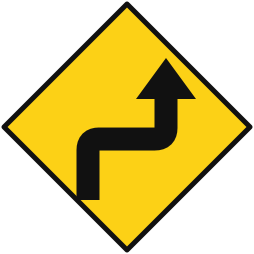
- Take the first turn at normal speed
- Prepare for a sharp right turn and then a turn to the left
- Expect one gentle curve needing no change in speed
- Get ready for the road to end at a T intersection
Show answer
Prepare for a sharp right turn and then a turn to the left. This warning sign means a sharp turn to the right and then to the left. Slow down before the first turn, because a vehicle cannot travel as fast in a curve as in a straight line, and braking in a curve can cause a skid. Set your speed early so you can handle both turns smoothly while staying in your lane.
Study this in the handbook: Road signs by shape and color
14. A yellow warning sign shows a side road joining your highway from the right. What should you expect?
- A lane is added, so no one will need to merge
- Vehicles may enter your road from the right
- The highway ends, and all traffic must turn right
- A bump in the road surface just past the side road
Show answer
Vehicles may enter your road from the right. This warning sign means a side road enters the highway from the right. Expect vehicles to pull onto your road from that side, sometimes slowly. Ease off your speed, watch the side road as you approach, and be prepared to stop if necessary. Drivers entering from a side road must yield to you, but you must still do everything you can to avoid a crash.
15. At a crash scene, when should you move an injured person?
- Right away, so they can lie flat and rest
- Whenever they say they feel able to stand
- After you give them some water to drink
- Only if they face fire or being hit by a car
Show answer
Only if they face fire or being hit by a car. Do not move the injured unless they are in a burning vehicle or in other immediate danger of being hit by another vehicle, because moving a person can make injuries worse. Make sure police and emergency medical help have been called. Apply direct pressure to bleeding wounds, cover the person with a blanket or coat to help prevent shock, and give them nothing to drink.
Study this in the handbook: Railroad crossings, vehicle emergencies and crashes
16. The pictured warning is posted before a bridge. Rain has just begun after a dry week. What timing makes the surface especially risky?

- After three dry and sunny days
- Only during heavy winter snowfall
- During the second full day of rain
- The first half hour of rain
Show answer
The first half hour of rain. The slippery when wet sign warns that the roadway is slippery when wet and that the first half hour of rain is the most hazardous. If rain starts on a hot day, heat brings oil in the asphalt to the surface, and the road stays more slippery until the oil washes off. Slow down at the first sign of rain, about 10 mph on a wet road, and avoid sudden braking.
17. Which direction of travel is prohibited for a person riding a bicycle on a highway?
- Riding facing oncoming traffic
- Riding with the flow of vehicle traffic
- Riding on the right side of a wide lane
- Riding beside a marked crossing
Show answer
Riding facing oncoming traffic. A cyclist must not ride on a highway facing traffic. Riding against the flow shortens closing time for both the rider and drivers and places the bicycle where drivers do not expect a vehicle to approach. Predictable travel with motor vehicle traffic lets drivers judge speed and position more reliably. Right side travel in a wide lane and riding with traffic follow the expected direction pattern.
18. Traffic ahead inside an intersection is stopped and your vehicle would have to halt in the middle of the junction. What must you do?
- Enter and stop in the junction so your place in line is kept
- Enter partway and angle the vehicle to leave a small gap open
- Enter if the light is green even though the exit is blocked
- Wait before entering until you can clear without stopping inside
Show answer
Wait before entering until you can clear without stopping inside. A driver may not enter an intersection unless the vehicle can get through it without having to stop. The driver waits until traffic ahead clears so the intersection is not blocked. A green light does not excuse stopping inside the junction, and entering partway still obstructs cross traffic and emergency access. Holding at the entry line until the far side has room keeps the crossing paths open.
Study this in the handbook: Right of way at intersections
19. You must exit on the street side of a parked vehicle. What extra care is required?
- Open the door halfway and wait for drivers to move over
- Turn and check for oncoming traffic, especially bicyclists
- Rely on mirrors only, since bicyclists use the sidewalk
- Exit quickly so the door is open for the shortest time
Show answer
Turn and check for oncoming traffic, especially bicyclists. A street side exit puts you and the door edge into space used by passing vehicles and bicyclists riding near parked cars. Turning to look directly catches a rider who may be hidden from mirrors by the vehicle frame. Mirrors alone leave blind areas along the side. Opening halfway still intrudes into the lane, and speed of exiting does not remove the hazard. Wait for a clear gap, check again for riders, and close the door promptly after exiting.
20. According to the Delaware manual, when does the higher crash risk from drinking begin?
- Once a driver reaches a BAC of .08
- Only after a driver feels drunk
- Before a driver is impaired or intoxicated
- Only after more than four drinks
Show answer
Before a driver is impaired or intoxicated. As blood alcohol concentration goes up, the chance of being involved in a crash increases, and that increased risk begins before drivers are impaired or intoxicated. Waiting until you feel drunk or reach .08 misses the early rise in risk. Even one drink can affect your driving. The best advice is simple: if you drink alcohol, do not drive. With two or more drinks, you are impaired.
Study this in the handbook: Alcohol, BAC and implied consent
Every question is written from the official Delaware Driver Manual. Need paper? Printable DE practice test with answer key.
Last verified 2026-10-05. How we check every question · Study all 500 as flashcards
Frequently asked questions
How many questions are on this Delaware practice test?
This fixed set has 20 questions. It is test 17 of 25 from the 500 question Delaware bank. The real DE exam asks 32 questions and you need 26 correct.
What is the passing score for the real Delaware test?
26 of 32 correct (approximately 81%) That figure comes from the official Delaware source cited on the DMV facts page.
How does this fixed test relate to the full Delaware bank?
Each numbered test is a fixed set of questions in a fixed order, so you can retake the same test later and compare. Every test mixes road signs and the other topics in about the same proportion as the full bank. Tests 1 to 25 together cover every question in the Delaware bank once. The full practice page mixes the whole bank at random.
Last verified 2026-10-05. See the Delaware DMV facts page for sourced state details.
Return to the full Delaware practice test · Study road signs