
Test 11 of 25 · 20 questions · Free 2026
DE Permit Practice Test 11
Jump to the test ↓A fixed 20 question set from the Delaware bank with answers and plain English explanations. The real DE exam is 32 questions, 81 percent to pass; take the full length version on the main practice page.
Question 1 of 20 · 0 right so far
All 20 questions in test 11
Every question below comes from the Delaware question bank on this page. Open a question to see the correct answer and the explanation. Nothing here is hidden behind a signup.
1. You approach an intersection where people may cross but you see no painted crossing lines. What should you expect?
- People may still cross there, so stay alert for them at the intersection
- No one may cross where painted lines are missing from the roadway
- Only people with a push-button beacon may cross at that corner
- Drivers may treat the corner as having no crossing activity at all
Show answer
People may still cross there, so stay alert for them at the intersection. Painting is not what creates every crossing place. Not all crosswalks are marked, so the absence of painted lines at an intersection does not remove the need to watch for pedestrians. A driver should stay alert for people crossing intersections and yield to pedestrians in a crosswalk when required. Assuming no crossing exists because lines are missing leads a driver to scan only the painted areas and miss people on foot.
Study this in the handbook: Pavement markings, signaling and roundabouts
2. Why is it illegal in Delaware to drive wearing headphones that cover or go in both ears?
- They make it hard to hear emergency horns or sirens
- They block your view of the side mirrors
- They drain power the car needs for its lights
- They are allowed only for drivers over age 21
Show answer
They make it hard to hear emergency horns or sirens. Delaware makes it illegal to drive with head or earphones that cover or go in both ears. The reason given is hearing: with both ears covered it is hard to hear emergency horns or sirens. Sounds such as a siren or screeching tires can warn you of danger before you see it. Keep both ears free so you can respond to those warnings.
Study this in the handbook: Seeing ahead and adjusting to conditions
3. The engine keeps running faster and faster on its own. After keeping your eyes on the road, what should you do?
- Press the brake hard and hold it down
- Quickly shift to neutral
- Turn the ignition to lock at once
- Steer onto the shoulder at full speed
Show answer
Quickly shift to neutral. Shifting to neutral disconnects engine power from the wheels while you keep watching the road. Then you can pull off the road when safe and turn off the engine. Holding the brake alone fights a racing engine without removing drive power. Locking the ignition while moving can lock the steering. Leaving the road at full speed risks loss of control on the shoulder.
4. A curb is painted yellow and no sign is posted. What does Delaware say about stopping or parking there?
- You must not stop or park there, even if someone stays inside
- You may stop there if you leave your flashers on
- You may park there after sunset when traffic is light enough
- You may stop there for up to five minutes at a time
Show answer
You must not stop or park there, even if someone stays inside. Delaware lists places where you must not stop or park, unless otherwise posted, ordered by a police officer, or needed to avoid a crash. One of them is anywhere a curb is painted yellow or a yellow line is placed at the edge of a roadway. The prohibition applies even if someone is left in the car. Other listed places include sidewalks, crosswalks, the area in front of a driveway, and designated fire lanes.
5. Another vehicle is about to hit you from the side or behind, and there is open room ahead of you. What action may avoid the crash?
- Brake hard and stay in place
- Speed up to get out of danger, then slow down
- Close the gap ahead to block the other vehicle
- Turn sharply across the nearest lane
Show answer
Speed up to get out of danger, then slow down. Moving forward into open room can carry your vehicle out of the path of a side or rear strike. Once the danger has passed, slowing down restores a normal pace. Braking in place keeps you in the impact zone when room ahead exists. Closing the gap ahead removes the escape space, and a sharp lane change without a clear path can create a second conflict.
Study this in the handbook: Railroad crossings, vehicle emergencies and crashes
6. A frontal crash cannot be avoided entirely. What type of impact should you try for instead of a head on strike?
- A direct center to center impact
- A glancing blow by turning the vehicle
- A rearward roll into the shoulder
- An impact taken while braking in a straight line only
Show answer
A glancing blow by turning the vehicle. If your vehicle is about to be hit from the front, try to have a glancing blow rather than being struck head on. That means turning the vehicle if a collision is going to happen: at worst you hit with a glancing blow, and you might miss entirely. If the air bag inflates it will then deflate, so be ready to keep the car from hitting something else. Belts keep you behind the wheel.
7. How should a head restraint be adjusted?
- So it touches the back of your head
- So it rests against the back of your neck
- As low as it will go for comfort
- Removed if it blocks the rear window
Show answer
So it touches the back of your head. Head restraints are designed to prevent whiplash if you are hit from behind. Adjust them so the head restraint contacts the back of your head. Check your seat, mirrors, and head restraint before you start to drive, not while moving. In a rear crash, pressing back against the seat with your head on the restraint helps protect your neck. Make all adjustments before you drive off.
8. Why should you watch for large trucks and small underpowered cars on steep grades?
- They always speed up when going downhill
- They can lose speed on long or steep hills
- They are not allowed to use the right lane
- They stop at the top of every hill
Show answer
They can lose speed on long or steep hills. Watch for large trucks and small underpowered cars on steep grades or when they are entering traffic. They can lose speed on long or steep hills, and it takes longer for these vehicles to get up to speed when they enter traffic. If you spot slow vehicles early, you have time to change lanes or slow down safely, whereas slowing suddenly can cause a crash.
Study this in the handbook: Seeing ahead and adjusting to conditions
9. How should a Delaware driver use an advisory speed sign posted before a curve?
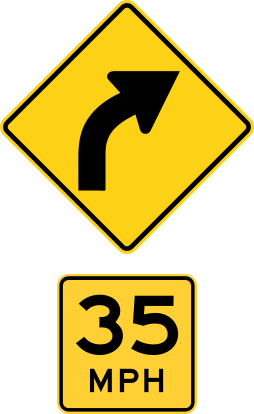
- Use it as permission to exceed the posted limit by that amount
- Treat it as a warning that conditions may make a higher speed unsafe
- Ignore it unless a police officer is visible
- Stop in the travel lane before entering the curve
Show answer
Treat it as a warning that conditions may make a higher speed unsafe. An advisory speed sign warns that conditions on a portion of highway may make it unsafe to drive faster. It is guidance for adjusting speed, not permission to add the advisory number to the legal limit. Ignoring the warning until an officer appears defeats its safety purpose, while stopping in a travel lane creates another hazard. The cue is the yellow advisory sign under a warning sign: read it as an early signal to slow for conditions.
Study this in the handbook: Seeing ahead and adjusting to conditions
10. A driver finds oncoming headlights uncomfortable at night. Should they wear dark glasses or tinted contact lenses?
- Yes, dark lenses are the best fix for glare
- Yes, but only on unlit country roads
- Only when the moon is bright
- No, they cut down light you need to see clearly
Show answer
No, they cut down light you need to see clearly. Avoid using dark glasses or tinted contact lenses at night, even if you think they help with glare. They cut down the light you need to see clearly. Many people who see well in daytime have trouble at night, and everyone sees less in the dark. If you have problems seeing at night, do not drive more than necessary and be very careful when you do.
11. How are most warning signs shaped and colored in Delaware?
- Usually green with white letters and rectangular
- Usually brown with white letters
- Always orange rectangles in work areas
- Usually yellow with black lettering, most diamond shaped
Show answer
Usually yellow with black lettering, most diamond shaped. Most warning signs are yellow with black lettering or symbols, and most are diamond shaped. They warn that a special situation or hazard is ahead and tell you to slow down and be prepared to stop if necessary. Warning signs in work zones are usually orange. School signs are five-sided and may be fluorescent yellow-green, and the railroad advance warning sign is round.
Study this in the handbook: Road signs by shape and color
12. The pictured sign appears before a bend, and you cannot yet see the light around the curve. How should you drive?

- Hold your speed until you can see the light
- Slow down and be ready to stop for the signal
- Speed up so you make it through on green
- Move to the shoulder until you can see it
Show answer
Slow down and be ready to stop for the signal. This sign warns of traffic signals at an intersection ahead. Like other warning signs, it tells you to slow down and be prepared to stop if necessary. When the signal is hidden by a curve, the light may already be red or turning yellow when it comes into view, so reduce speed early. Adjust your speed so you could stop for anything beyond the bend.
Study this in the handbook: Road signs by shape and color
13. You are driving between a row of parked cars on your right and an oncoming tractor-trailer. Where should you position your car?
- Hug the parked cars so the truck gets all of the extra room
- Hug the center line to stay clear of car doors
- Stay exactly in the center no matter which hazard is more dangerous
- Split the space, leaving a little more room on the truck's side
Show answer
Split the space, leaving a little more room on the truck's side. Split the difference between two hazards by steering a middle course, for example between oncoming and parked vehicles. If one hazard is more dangerous than the other, leave a little more space on the dangerous side. When the oncoming vehicle is a tractor-trailer, leave a little more room on the side the truck will pass. A pedestrian or cyclist is the exception and gets extra room.
Study this in the handbook: Following distance, trucks and motorcycles
14. Traffic slows as you enter a Delaware work zone. Which driving habit does the manual recommend?
- Weave between lanes to find the fastest one
- Brake hard at the last moment to keep pace
- Brake gradually and do not weave from lane to lane
- Follow closely so no one can cut in front of you
Show answer
Brake gradually and do not weave from lane to lane. In a work zone, do not weave from lane to lane. Brake gradually to give drivers behind you plenty of time to slow down, and keep up with the flow of traffic. Keep a reasonable speed and space between vehicles, because if you are going too fast or following too closely you may have nowhere to go when the vehicle ahead suddenly stops.
Study this in the handbook: Road signs by shape and color
15. You are about to turn right at an intersection, and a driver is following closely behind you. How should you set up the turn?
- Swing out to the left first to make a wider turn
- Drift toward the center line so the follower slows
- Stay to the right and avoid swinging wide to the left
- Turn into the far lane of the new street, then move over
Show answer
Stay to the right and avoid swinging wide to the left. On right turns, avoid swinging wide to the left before making the turn. If you swing wide, the driver behind you may think you are changing lanes or going to turn left and may try to pass you on the right. If you swing wide as you finish the turn, drivers in the far lane will not expect to see you there. Signal early, stay right, and turn into the nearest lane.
16. A signal with a bicycle-shaped display faces a marked bicycle lane. Who is controlled by that display?
- Every driver, bicyclist, and pedestrian approaching the intersection
- Only pedestrians crossing parallel to the bicycle lane there
- Only drivers turning across the bicycle lane at that corner
- Only bicyclists using the marked lanes or paths the signal serves
Show answer
Only bicyclists using the marked lanes or paths the signal serves. Bicycle-shaped indicators carry the same meaning as circular signal indicators, but their audience is narrower. They apply only to bicyclists in designated bicycle lanes or paths. Drivers and pedestrians at the same intersection follow their own signals instead. A bicyclist riding in a general travel lane likewise follows the regular traffic signals. Recognizing the intended audience prevents a driver from treating the bicycle display as a vehicle instruction.
Study this in the handbook: Road signs by shape and color
17. You need to cross several lanes of traffic. What is the safest way to make that move?
- Cross all lanes in one continuous sweep
- Wait at the center line between lanes
- Cross only when every lane looks empty at once
- Take the lanes one at a time
Show answer
Take the lanes one at a time. Crossing one lane at a time works like moving step by step, with a fresh check for each lane. Judging every lane at once is difficult, and waiting for all lanes to clear together can block traffic and invite a crash. A single sweep gives no chance to confirm each lane. Stopping between lanes leaves the vehicle exposed in moving traffic without a completed move.
Study this in the handbook: Following distance, trucks and motorcycles
18. To avoid getting drowsy on a long trip, when should you try not to drive?
- Late at night, when you are normally asleep
- In the early afternoon on weekdays
- Right after taking a short rest break
- Whenever the radio is turned off
Show answer
Late at night, when you are normally asleep. Try not to drive late at night when you are normally asleep, because your body thinks it is time to sleep and will try to do so. Before a long trip, get a normal night's sleep, avoid medicine that can make you drowsy, eat lightly, and stop every hour or so. If you are sleepy, it is better to stop and sleep for a few hours than to keep driving.
19. What is the closest you may park to a fire hydrant?
- 5 feet, if you stay with the vehicle
- 10 feet, if the hydrant is on the opposite side
- 15 feet
- 30 feet in all cases
Show answer
15 feet. You must not stop or park within 15 feet of a fire hydrant, even if someone is left in the car, unless signs or a police officer direct otherwise. Staying with the vehicle does not make a closer space legal. Thirty feet is the distance from a flashing beacon, stop sign, or traffic signal, and 20 feet the distance from a crosswalk at an intersection.
20. You drive past the house you wanted, and the pictured sign is posted at the next corner. What should you do?

- Make a quick U-turn while the road is empty
- Back up along the curb to the house
- Continue to a place where turning around is allowed
- Make the U-turn from the right lane
Show answer
Continue to a place where turning around is allowed. This is one of the international signs adopted in Delaware and the other states. The U-shaped arrow with a red circle and slash means No U Turn at that location. If you miss a turn or destination, do not back up and do not make the banned U-turn. Go on to a place where you can safely and legally turn around, then come back.
Study this in the handbook: Road signs by shape and color
Every question is written from the official Delaware Driver Manual. Need paper? Printable DE practice test with answer key.
Last verified 2026-10-05. How we check every question · Study all 500 as flashcards
Frequently asked questions
How many questions are on this Delaware practice test?
This fixed set has 20 questions. It is test 11 of 25 from the 500 question Delaware bank. The real DE exam asks 32 questions and you need 26 correct.
What is the passing score for the real Delaware test?
26 of 32 correct (approximately 81%) That figure comes from the official Delaware source cited on the DMV facts page.
How does this fixed test relate to the full Delaware bank?
Each numbered test is a fixed set of questions in a fixed order, so you can retake the same test later and compare. Every test mixes road signs and the other topics in about the same proportion as the full bank. Tests 1 to 25 together cover every question in the Delaware bank once. The full practice page mixes the whole bank at random.
Last verified 2026-10-05. See the Delaware DMV facts page for sourced state details.
Return to the full Delaware practice test · Study road signs