
Test 12 of 25 · 20 questions · Free 2026
DE Permit Practice Test 12
Jump to the test ↓A fixed 20 question set from the Delaware bank with answers and plain English explanations. The real DE exam is 32 questions, 81 percent to pass; take the full length version on the main practice page.
Question 1 of 20 · 0 right so far
All 20 questions in test 12
Every question below comes from the Delaware question bank on this page. Open a question to see the correct answer and the explanation. Nothing here is hidden behind a signup.
1. You stop at a crash where fuel may have spilled from a wrecked car. What should you do about its engine, and what should you avoid?
- Leave its engine running so the lights stay on
- Turn off its ignition and do not smoke near it
- Turn off its ignition and light a flare beside the fuel
- Let the engine idle but keep people away from the tailpipe
Show answer
Turn off its ignition and do not smoke near it. At a crash scene, turn off the ignition of wrecked vehicles and do not smoke around them. Fuel could have spilled, and fire is a real danger. Do not stand or walk in traffic lanes, and stay away from any power lines that are down with wires in the road. Use flares or other warning devices to alert traffic of the crash, placed so other drivers will not be drawn into it.
2. For a seat belt to fit a child in a booster seat properly, where must the lap belt lie?
- Loosely across the stomach for comfort
- Across the neck and shoulder together
- Under both arms so it feels snug against the chest
- Snugly across the upper thighs, not the stomach
Show answer
Snugly across the upper thighs, not the stomach. A proper belt fit places the lap belt snugly across the upper thighs rather than the stomach, while the shoulder belt lies snug across the shoulder and chest without crossing the neck or face. Children ages eight to twelve stay in a booster seat until the adult belt fits that way. Riding in the back seat remains the safer position for a child even after booster use ends.
3. A tractor-trailer stops across the street and begins preparing to back into a loading area. What should you do?
- Pass close behind it quickly while it is still stopped
- Sound your horn and drive around the back of the trailer
- Wait for it to finish; never cross close behind it
- Squeeze between the trailer and the loading area
Show answer
Wait for it to finish; never cross close behind it. When a truck is backing up, it may have to block the street for a moment to place its trailer. Never pass close behind a truck that is backing up. Most trailers are 8.5 feet wide and can hide anything that suddenly comes between them and the loading area, so you enter a blind spot for both you and the truck driver. Waiting the few seconds the maneuver takes is far safer than trying to slip past.
Study this in the handbook: Following distance, trucks and motorcycles
4. At night, your headlights let you see about how far ahead, so speed must allow stopping within that distance?
- About 350 feet ahead
- About 150 feet ahead
- About 600 feet ahead
- About 900 feet ahead
Show answer
About 350 feet ahead. Headlights reveal roughly 350 feet of road ahead at night. Driving at a speed that allows stopping inside that lit distance, around 50 mph in good conditions, keeps unseen hazards from arriving before a stop is possible. In heavy rain, snow or thick fog the visible distance can fall near 200 feet, which calls for still lower speed. Longer assumed distances invite overdriving the lights.
Study this in the handbook: Seeing ahead and adjusting to conditions
5. You plan to turn right at the second driveway ahead, and another driveway lies between you and your turn. When should you turn on your signal?
- Right away, so drivers get the longest possible warning
- Only once you are inside the driveway you want
- After you pass the first driveway, then signal for yours
- Never, since driveways do not require a turn signal
Show answer
After you pass the first driveway, then signal for yours. Signal early, but not too early. If streets, driveways, or entrances lie between you and the place you want to turn, wait until you have passed them before signaling. A driver waiting at the first driveway may think you are turning there and pull out into your path. Once past it, signal for your own turn so others still get warning before you slow down.
6. A sign warns that farm machinery uses the road you are on. What should you do?
- Expect farm vehicles to keep highway speed
- Pass farm vehicles on the shoulder without slowing
- Honk early so farm vehicles leave the road
- Be alert and prepare to slow down for farm vehicles
Show answer
Be alert and prepare to slow down for farm vehicles. The farm machinery sign is used on roads shared by farm vehicles. Be alert and prepare to slow down. Farm tractors and similar vehicles usually go 25 mph or less and should carry an orange slow-moving vehicle emblem. When you see that emblem, slow down immediately and proceed with caution. Their drivers have the same rights and duties as other motor vehicles.
7. You must drive slowly and a line of vehicles has built up behind you on a two-lane road. What should you do?
- Keep going, since the drivers can wait
- Speed up beyond the limit to clear the line
- Tap your brakes so the drivers drop back
- Pull over when safe and let them pass
Show answer
Pull over when safe and let them pass. Going much slower than other vehicles can be just as bad as speeding. It makes vehicles bunch up behind you and pushes other traffic to pass you. If vehicles are piled up behind you, pull over when it is safe and let them pass. If you regularly cannot keep up, consider using roads with slower speeds. Some two-lane roads have turnout areas for this.
Study this in the handbook: Seeing ahead and adjusting to conditions
8. Before driving, you notice a water bottle rolling around on the driver's floor. Why should you secure it?
- It could make the air bag go off
- It is against the law to carry drinks
- It could roll under the brake pedal
- It could scratch the floor mats
Show answer
It could roll under the brake pedal. Before you drive, make sure there are no loose objects in the vehicle that could hit someone in a sudden stop or crash. Also make sure nothing on the floor could roll under the brake pedal and prevent you from stopping. A bottle or can on the driver's floor can slide forward when you brake. Put such items where they cannot move.
9. Two lanes travel the same direction separated by a white line painted in short segments. When may you cross that line?
- No, a white line between same-direction lanes bars crossing
- Only when an officer waves you across during heavy traffic periods
- Only to reach the shoulder when another vehicle blocks your lane
- To change lanes when checking shows the move can be made safely
Show answer
To change lanes when checking shows the move can be made safely. A broken white line between lanes moving the same direction may be crossed to change lanes when the move is safe. That differs from a solid white line, which discourages lane changes, and from double solid white lines, which prohibit them. The permission is conditional on a proper check for traffic in the target lane. An officer direction or a blocked lane is not the general condition attached to the broken marking.
Study this in the handbook: Road signs by shape and color
10. You drive on a road with three lanes going your way, and many vehicles are entering and leaving it. Which lane does Delaware suggest?
- The center travel lane
- The far left lane only
- The far right lane only
- The paved shoulder
Show answer
The center travel lane. On a road with two lanes in your direction, stay in the right lane except to pass. When there are three or more lanes in your direction and a lot of traffic is entering or exiting, use the center travel lane. That keeps you away from the merging and slowing traffic in the right lane while leaving the left lane open for passing.
11. On a two-lane road with no other traffic close by, where in your lane is it generally safest to drive?
- Near the center line to stay clear of the edge
- Along the right edge to leave more room for oncoming cars
- Along the left side, since oncoming cars drive on the right
- In the center of your lane
Show answer
In the center of your lane. Keep as much space as you can between yourself and oncoming vehicles. On a two-lane road, that means not crowding the center line. In general, it is safest to drive in the center of your lane. You also need space on both sides of your vehicle to turn or change lanes, and extra room next to parked cars, because someone could step out or a car could pull out.
Study this in the handbook: Following distance, trucks and motorcycles
12. After a minor crash, no one is hurt, but your damaged car is blocking a traffic lane. What does Delaware expect?
- Leave it right where it stopped until the police come and see it
- Make every reasonable effort to move it out of the traffic flow
- Drive away from the scene to clear the road
- Stand in the lane and direct traffic around it
Show answer
Make every reasonable effort to move it out of the traffic flow. Stop your vehicle at the crash site. If, after reasonably making sure there are no injuries or deaths, the damaged vehicle is blocking traffic, the driver must make every reasonable effort to move it, or have it moved, so it does not block the regular flow of traffic more than necessary. Moving it aside is not leaving the scene. Stay out of traffic lanes yourself.
13. A car crosses into your lane head-on and you cannot stop in time. Which choice does the manual say is generally better?
- Running off the road rather than crashing head-on
- Braking straight ahead and taking the head-on crash
- Swerving into the oncoming lane the car just left
- Closing your eyes and holding the wheel still
Show answer
Running off the road rather than crashing head-on. In most cases you can turn a vehicle more quickly than you can stop it, so consider turning to avoid a collision. Keep both hands on the wheel, steer in the direction you want to go, and be ready to stay in control once you have turned away. The manual adds that it is generally better to run off the road than to crash head-on into another vehicle.
Study this in the handbook: Railroad crossings, vehicle emergencies and crashes
14. On slippery roads, what following distance may be needed to stop safely if the vehicle ahead stops suddenly?
- A two second following distance
- The usual dry road distance with no change
- A four-second following distance
- Half the usual distance to stay close
Show answer
A four-second following distance. Slippery surfaces lengthen stopping distance, so the usual gap may not leave room to stop if the vehicle ahead halts without warning. A four second gap adds the space needed on slick pavement. The same larger gap helps in darkness or bad weather, behind motorcycles, and with heavy loads. Closing to half the usual distance removes the extra room that slippery roads demand.
Study this in the handbook: Following distance, trucks and motorcycles
15. You approach the pictured sign where a busy road crosses yours and people are walking nearby. What must you be ready to do?
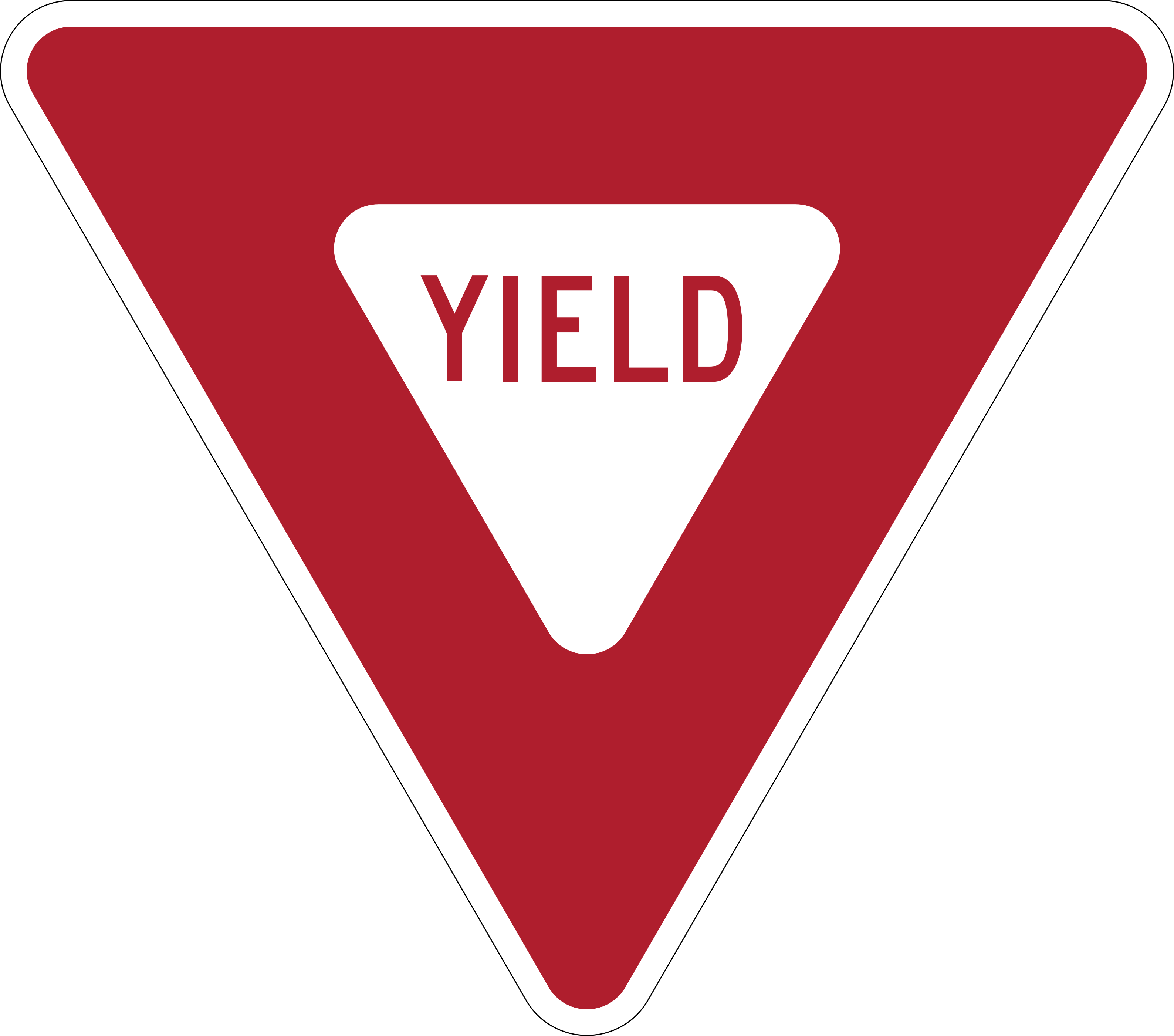
- Accelerate quickly to merge ahead of cross traffic flow
- Give way to traffic and people, halting if needed
- Always stop fully, even with no one coming
- Keep your speed, since cross traffic must yield to you
Show answer
Give way to traffic and people, halting if needed. At a yield sign you must yield the right-of-way to any vehicle or pedestrian in or approaching the intersection, stopping if necessary, and you may go on only when the movement can be made safely. Speeding up to claim a gap reverses that duty. A full stop is not required every time; it depends on what is coming. Slow down, look left and right, and give way to people walking.
Study this in the handbook: Road signs by shape and color
16. You may legally cross a median opening that is not marked for emergency vehicles only. Which side of the opening should you stay on?
- The left side, to stay close to the median
- The right side, treating the median like a roadway
- Whichever side looks clearer at the time
- The center of the opening between the two sides
Show answer
The right side, treating the median like a roadway. Pay attention to signs at median crossings. If a crossing is marked for emergency vehicles only, it is illegal for you to cross there. When crossing is legal and not marked otherwise, the rule keep to the right applies. Drivers should treat the median the same as a roadway and stay to the right of the opening at all times.
Study this in the handbook: Right of way at intersections
17. You have parked on a street and will walk away from the car. Which set of actions is required before leaving it?
- Stop the engine, lock the ignition, remove the key, and set the brakes
- Leave the engine idling, keep the key inside, and release the brakes
- Stop the engine but leave the key in place for the next driver
- Set the brakes only if the street slopes sharply downhill
Show answer
Stop the engine, lock the ignition, remove the key, and set the brakes. When you park and leave your vehicle on a highway or street, you must stop the engine, lock the ignition, remove the key, and set the brakes. Raising the windows and locking the doors is also advisable. It is against the law to leave keys in a running, unattended vehicle. Setting the brakes is required on every street, not only on hills.
18. A yellow diamond sign shows a leaping animal with antlers. What is the safest response?

- Watch only the right shoulder for animals
- Be alert for deer on both sides of the road
- Honk steadily to keep animals away
- Speed up to spend less time in the area
Show answer
Be alert for deer on both sides of the road. The deer crossing sign tells you to be alert to deer on both sides of the road. Animals can step into the road from either shoulder, so scan both edges, slow down, and be ready to brake. Like other warning signs, it means a special situation or hazard is ahead and that you should be prepared to stop if necessary.
19. You see the pictured sign on a quiet street, but no one is in sight yet. How should you approach?

- Keep your speed, since no one is crossing
- Slow down and be ready to stop if someone crosses
- Sound your horn before every driveway
- Change lanes to the far side of the road
Show answer
Slow down and be ready to stop if someone crosses. Yellow warning signs tell you that a special situation or hazard is ahead and warn you to slow down and be prepared to stop if necessary. The walking-person sign means people on foot may cross. A person can step out from behind a parked car or bush, so slow down before you see anyone. If someone is in a crosswalk, you must yield, stopping if necessary.
Study this in the handbook: Road signs by shape and color
20. How much lane width may a motorcycle use while traveling?
- The same full width available to other vehicles
- Only the right third of the lane
- Half the lane if a car wants to share it
- Only a marked motorcycle lane where present
Show answer
The same full width available to other vehicles. Motorcycles are entitled to the same full lane width as all other vehicles. A skilled rider changes position within that lane to improve seeing and being seen and to respond to objects in or near the road. Treating the motorcycle as confined to a third or half of the lane invites unsafe sharing. A marked motorcycle lane is not a condition for the rider full lane entitlement.
Study this in the handbook: Following distance, trucks and motorcycles
Every question is written from the official Delaware Driver Manual. Need paper? Printable DE practice test with answer key.
Last verified 2026-10-05. How we check every question · Study all 500 as flashcards
Frequently asked questions
How many questions are on this Delaware practice test?
This fixed set has 20 questions. It is test 12 of 25 from the 500 question Delaware bank. The real DE exam asks 32 questions and you need 26 correct.
What is the passing score for the real Delaware test?
26 of 32 correct (approximately 81%) That figure comes from the official Delaware source cited on the DMV facts page.
How does this fixed test relate to the full Delaware bank?
Each numbered test is a fixed set of questions in a fixed order, so you can retake the same test later and compare. Every test mixes road signs and the other topics in about the same proportion as the full bank. Tests 1 to 25 together cover every question in the Delaware bank once. The full practice page mixes the whole bank at random.
Last verified 2026-10-05. See the Delaware DMV facts page for sourced state details.
Return to the full Delaware practice test · Study road signs