
Test 4 of 10 · 20 questions · Free 2026
DE Permit Practice Test 4
Jump to the test ↓A fixed 20 question set from the Delaware bank with answers and plain English explanations. The real DE exam is 32 questions, 81 percent to pass; take the full length version on the main practice page.
Question 1 of 20 · 0 right so far
All 20 questions in test 4
Every question below comes from the Delaware question bank on this page. Open a question to see the correct answer and the explanation. Nothing here is hidden behind a signup.
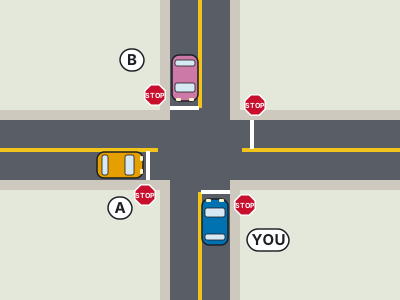
1. At a Delaware four-way stop, which vehicle goes first when vehicles arrive at different times?
- The vehicle with the largest engine
- The vehicle that reached the intersection first after stopping
- The vehicle turning left
- The vehicle arriving last
Show answer
The vehicle that reached the intersection first after stopping. At a four-way stop, Delaware says the driver reaching the intersection first goes first, but only after coming to a complete stop. Vehicle size, engine power, and turning direction do not replace the arrival order in this situation. If vehicles arrive at the same time, the vehicle on the right goes first, which is a separate tie rule. The helpful routine is stop completely, note who arrived first, and remain ready to yield if another road user would otherwise be placed in danger.
Study this in the handbook: Right of way at intersections
2. What must Delaware drivers use when they intend to stop, turn, or change lanes?
- A horn without any signal
- Hazard lights only
- Headlights only
- A hand signal or turn signal
Show answer
A hand signal or turn signal. Delaware requires drivers to communicate an intended stop, turn, or lane change with a hand signal or turn signal. Hazard lights do not replace the directional warning, and headlights do not tell other road users which movement is planned. A horn may alert someone to danger but is not the required method for announcing this maneuver. Activate the signal early, check mirrors and blind spots, and keep the vehicle predictable until the action is complete. The cue is the planned change in movement: signal before braking, turning, or moving sideways.
Study this in the handbook: Headlights, seat belts, phones and insurance
3. What must a driver do when an authorized emergency vehicle approaches using a siren or flashing lights?
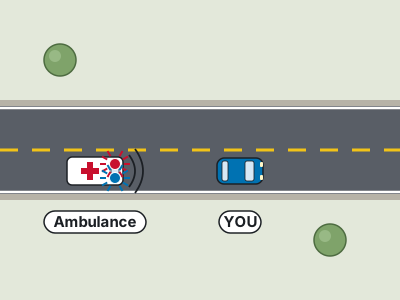
- Yield and immediately drive to the right edge or curb clear of intersections
- Stop in the travel lane wherever the driver first hears the siren
- Turn left at the next intersection to get away from the vehicle
- Maintain speed until the emergency vehicle passes on its own
Show answer
Yield and immediately drive to the right edge or curb clear of intersections. Delaware requires every other vehicle to yield to an approaching authorized emergency vehicle using the listed warning equipment. Move immediately toward the right edge or curb, but clear an intersection first if you are already in one. Stopping in the intersection can obstruct the responder, while turning away or maintaining speed does not provide a predictable path. The practical cue is lights or a siren behind you: continue through the intersection if needed, then pull right and remain there until the emergency vehicle has passed.
Study this in the handbook: Emergency vehicles and the Move Over law
4. What does it cost to add the veteran indicator to a Delaware license?
- $10
- $40
- $20
- Nothing, it is free during renewal or duplicate transactions
Show answer
Nothing, it is free during renewal or duplicate transactions. The veteran indicator may be added to your driver license or identification card free of charge during renewal or duplicate transactions; at other times there is a $10 fee. It is available to Delaware veterans discharged under conditions other than dishonorable who present original proof such as a DD-214 or a Military ID. It lets veterans show their status for local business benefits without carrying a DD-214, which contains sensitive information, but it is not a military ID card.
5. During the first six months after a Delaware Level One Learner's Permit is issued, the permit holder may drive:
- Only between 10:00 p.m. and 6:00 a.m.
- Unsupervised between 6:00 a.m. and 10:00 p.m.
- Unsupervised whenever a parent approves
- Only when supervised
Show answer
Only when supervised. For the first six months after a Level One Learner's Permit is issued, the permit holder must be supervised at all times. The unsupervised six-to-ten window begins only after that initial period of valid driving authority. A parent’s approval does not replace the required supervision during those first months, and the overnight hours are not an exception to the initial rule. The practical cue is the phrase first six months: every drive needs a qualified supervisor beside the learner, regardless of daylight, trip purpose, or completed practice hours.
Study this in the handbook: The Level One Learner's Permit and GDL rules
6. How should a driver use an anti-lock braking system during a quick stop?
- Shift to reverse before touching the brake pedal
- Pump the pedal repeatedly and release it after each pulse
- Press the brake pedal as hard as possible and keep pressing
- Use only the parking brake to avoid the service brakes
Show answer
Press the brake pedal as hard as possible and keep pressing. With ABS, the manual instructs the driver to press the brake pedal as hard as possible and keep pressing it. Letting up on the pedal is the manual's step for a skid without ABS, and pumping is its advice for brake failure; neither is the ABS technique. Selecting reverse does not provide controlled stopping, while the parking brake is not a substitute for the service brakes. If the pedal pushes back, do not let up, because ABS works only with the pedal pushed down; keep steady pressure and steer where the vehicle needs to go.
Study this in the handbook: Railroad crossings, vehicle emergencies and crashes
7. A Delaware driver reaches 12 calculated points. What does the Problem Driver Program require?
- An advisory letter only
- A mandatory 12-month suspension
- Retaking the road test
- Complete a behavior modification course within 90 days after notification
Show answer
Complete a behavior modification course within 90 days after notification. At 12 calculated points the driver must complete a behavior modification/attitudinal driving course within 90 days after notification, unless DMV extends it. Failing to comply, or choosing not to take the course, brings a mandatory 2-month suspension. The advisory letter is the 8 point step, and a 12-month suspension is the 22 point step. A road retest is not part of the 12 point action.
Study this in the handbook: Points, suspensions and serious speeding
8. A Delaware Class D driver gets a first speeding ticket in three years for 12 mph over and pays it by mail. How many points are assessed?
- None
- 2 points
- 4 points
- 6 points
Show answer
None. Delaware's point credit rule says a speeding violation of 1 to 14 mph over the limit is not assessed points if it is the first violation within any 3-year period and the ticket is paid through the Voluntary Assessment Center or Alderman's Court as a guilty mail in or online. This driver meets both conditions, so no points are added. The credit applies only to Class D holders; CDL holders still receive points.
Study this in the handbook: Points, suspensions and serious speeding
9. How many people were killed in U.S. motor vehicle crashes in 2020, according to the Delaware manual?
- 42,060, with over three million injured
- About 5,000
- About 100,000
- About 500
Show answer
42,060, with over three million injured. In 2020, 42,060 people were killed in motor vehicle crashes in the United States and over three million were injured. The manual opens its distracted driving section with this figure, noting that driving is a risky activity and that driving instructors estimate a driver makes 200 decisions for every mile. Anything else done behind the wheel adds to that workload. The smaller and larger choices are far from the reported total, so remember the 42,060 figure along with the three million injuries.
Study this in the handbook: Alcohol, BAC and implied consent
10. A warning sign says the roadway is slippery when wet. What condition is especially hazardous?

- Dry pavement immediately after sunrise
- Only heavy rain after several hours
- The first half hour of rain
- Rain that begins after traffic has stopped
Show answer
The first half hour of rain. Delaware identifies the first half hour of rain as the most hazardous period for a roadway that is slippery when wet. The option limiting the danger to heavy rain after hours adds a condition the manual does not give. Dry pavement is not the stated hazard, and stopped traffic has no bearing on the warning. When rain begins, reduce speed, increase space, and make steering and braking inputs smoothly because, as the manual notes for rain on a hot day, oil in the asphalt rises to the surface and the road stays slicker until it washes off.
11. What does the divided-highway warning sign tell a driver to do?

- Stop before entering the divided highway
- Drive left of the divider until the highway ends
- Keep to the right of the traffic island or divider
- Use the shoulder as an extra travel lane
Show answer
Keep to the right of the traffic island or divider. The manual's caption for this yellow warning sign reads approaching divided highway, keep to right, and the matching regulatory sign tells drivers to keep to the right of the traffic island or divider. Traffic is about to separate around a median, so stay on its right side. Driving left of the divider reverses the instruction, stopping is not the normal response, and the shoulder is not a travel lane. Look for the median as the road splits and adjust speed to traffic.
Study this in the handbook: Road signs by shape and color
12. What action does the yellow warning for a roadway with room for only one lane advise?
- Slow down and prepare to yield to oncoming vehicles
- Accelerate so opposing traffic must wait
- Change lanes into the shoulder without checking
- Maintain speed because the lane is widening
Show answer
Slow down and prepare to yield to oncoming vehicles. This warning means the roadway ahead has room for only one lane of traffic, so vehicles from both directions must share it. Delaware's advice is to slow down and prepare to yield to oncoming vehicles. Speeding up to make opposing traffic wait turns a shared space into a head on conflict, and moving onto the shoulder without checking adds a new hazard. Nothing about the sign suggests the lane is widening. Look well ahead for approaching vehicles, reduce speed early, and be ready to stop and let them clear the narrow section before you continue.
13. Which movement is forbidden by the crossed left-pointing arrow sign shown here?
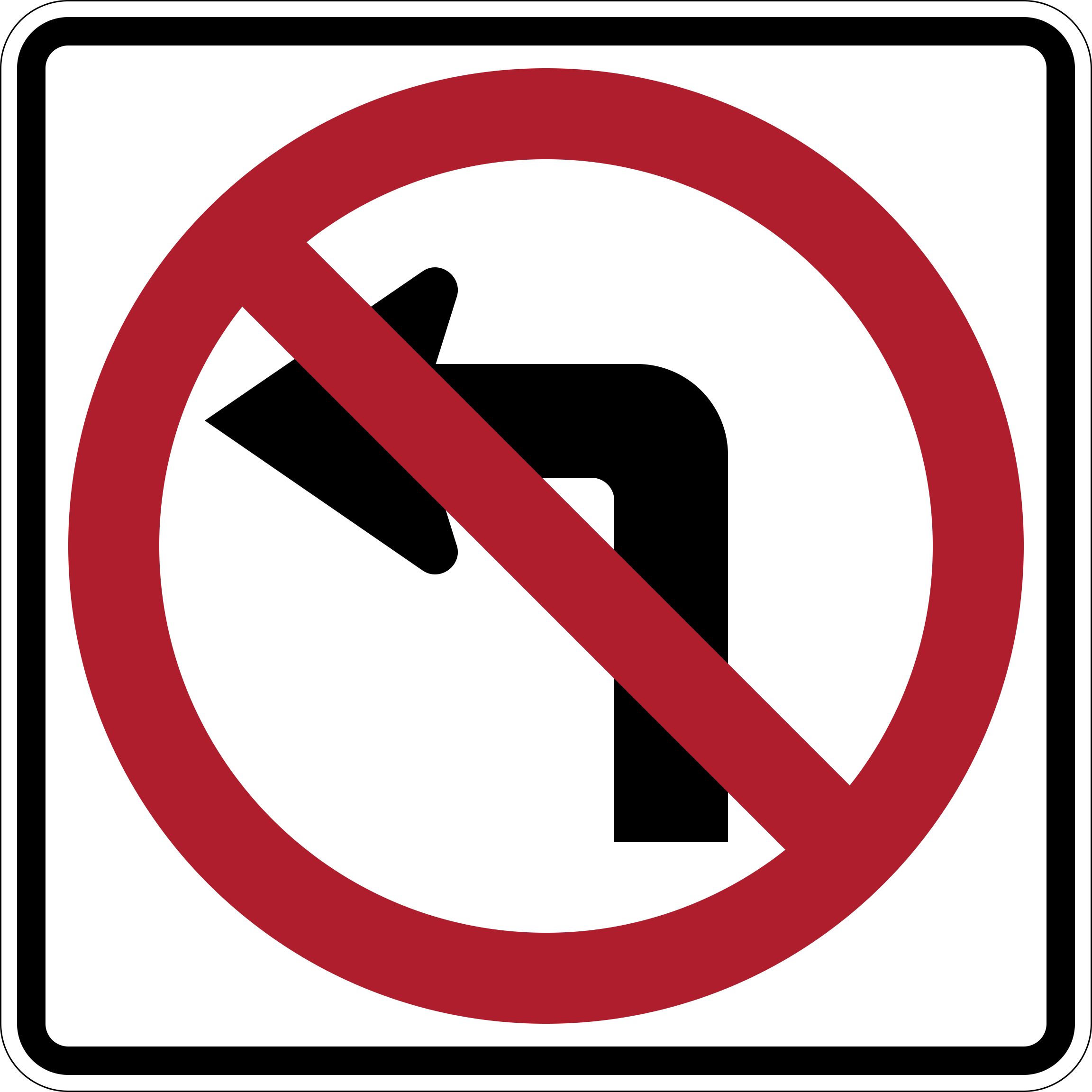
- Proceeding straight
- A U-turn
- A left turn
- Entering a designated parking space
Show answer
A left turn. The symbol pictures a left-turn movement and the slash prohibits that movement. It is therefore different from a no U-turn sign, which uses a U-shaped arrow, and from a straight-ahead restriction, which would show another symbol. The parking option describes a separate curb or parking regulation. Even when a left turn is banned, continue to follow all other traffic controls and choose a permitted route. The recognition cue is movement matching: look at what the arrow would make the vehicle do, then apply the red prohibition to that action.
Study this in the handbook: Road signs by shape and color
14. What court fine range is listed for a first DUI offense in Delaware?
- $100 to $300
- $500 to $1,500
- $750 to $2,500
- $5,000 to $15,000
Show answer
$500 to $1,500. The first-offense court sanction includes a fine from $500 to $1,500, along with possible imprisonment of up to 12 months. The $100 to $300 range is the first offense fine for aggressive driving, and $750 to $2,500 is listed for a second DUI offense. The largest range is not the first-offense court figure. The cue is the word court: this question asks about the fine sanction, separate from DMV license loss.
Study this in the handbook: DUI penalties and underage laws
15. Which countries are named in Delaware's reciprocity agreement for waiving the Class D knowledge and road exams?
- Japan, South Korea, and Vietnam
- Canada, Mexico, and the United Kingdom
- Germany, Taiwan, and France
- Spain, Italy, and Portugal
Show answer
Germany, Taiwan, and France. Delaware names Germany, Taiwan, and France in its reciprocity agreement for a Class D license. The agreement waives the knowledge and road exams for those drivers, but endorsements are not included. The other country groups may sound plausible because they are common licensing jurisdictions, yet the manual does not list them for this agreement. The cue is the exact three-country set and the Class D limitation.
Study this in the handbook: Exams, renewal and license rules
16. How should a driver respond to a flashing yellow light at a Delaware intersection?
- Stop and remain stopped until a green light appears
- Slow down, become more aware, and proceed with caution
- Accelerate because cross traffic must stop
- Treat it as permission to ignore crossing traffic
Show answer
Slow down, become more aware, and proceed with caution. A flashing yellow light is a warning to reduce speed, increase awareness, and continue only after checking the intersection. It is different from a flashing red indication, which requires a complete stop. Accelerating through the junction leaves less time to detect vehicles entering from another direction, and the signal does not erase the duty to watch for crossing traffic. A useful habit is to lift off the accelerator before the intersection, look both ways, and be prepared for another vehicle controlled by a flashing red signal.
Study this in the handbook: Traffic lights and arrows
17. On a two-lane road, what must a driver do when a school bus is stopped with red lights flashing?
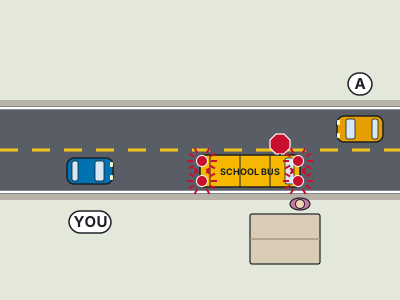
- Stop before reaching the bus and remain stopped until the red lights stop and the stop arm retracts
- Slow down and pass if no child is visible
- Stop only if traveling behind the bus
- Pass on the shoulder after checking mirrors
Show answer
Stop before reaching the bus and remain stopped until the red lights stop and the stop arm retracts. On a road with fewer than four lanes, traffic in both directions must stop for the bus. The driver remains stopped until the red lights have stopped flashing and the stop arm has retracted, then proceeds cautiously. Visibility of children does not create a pass exception, and an oncoming driver is also required to stop. The shoulder is not a substitute for the bus rule. The cue is the overhead red flash and extended stop arm: stop early, wait for both signals to end, and scan before moving.
Study this in the handbook: Right of way at intersections
18. A Delaware officer sees an unbelted adult passenger. Who receives the ticket?
- The passenger only
- The driver
- The vehicle owner, even if not present
- No one, because adult passengers are exempt
Show answer
The driver. Delaware law requires every occupant to be properly restrained in a seat belt or child safety seat, and officers may pull a vehicle over if they see unbuckled occupants. The driver receives a ticket for any unrestrained or improperly restrained occupant. The passenger-only and owner choices shift the responsibility away from the driver, and adult passengers are not exempt from the belt requirement.
Study this in the handbook: Headlights, seat belts, phones and insurance
19. What does a Delaware CDL Class A license cover?
- School buses only
- Any single vehicle over 26,001 pounds
- Passenger cars with trailers under 3,000 pounds
- Any combination of vehicles with a GCWR of 26,001 pounds or more where the towed units exceed 10,000 pounds
Show answer
Any combination of vehicles with a GCWR of 26,001 pounds or more where the towed units exceed 10,000 pounds. A CDL Class A license is required for any combination of vehicles with a gross combined weight rating of 26,001 pounds or more, provided the towed units exceed 10,000 pounds. Class B covers a single vehicle of 26,001 pounds or more, or such a vehicle towing 10,000 pounds or less. Qualifying farm vehicles used within 150 miles of the farm and firefighting or emergency vehicles operate under a CDL waiver with a Non-CDL Class A or B license instead.
20. What court penalties does Delaware list for a second DUI offense?
- A $100 fine
- A fine of $500 and no jail
- A fine of $750 to $2,500 and imprisonment of at least 60 days and up to 18 months
- Community service only
Show answer
A fine of $750 to $2,500 and imprisonment of at least 60 days and up to 18 months. For a second DUI offense the court imposes a fine of $750 to $2,500 and a sentence of imprisonment for a minimum of 60 days and up to 18 months, though the court may suspend the minimum sentence for offenders who complete the Court of Common Pleas DUI Treatment Program. A first offense carries $500 to $1,500 and up to 12 months, and a third is a felony.
Study this in the handbook: DUI penalties and underage laws
QualitySpace is expanding to Delaware
We are a California-based independent insurance brokerage working on licensing in more states. We cannot help with Delaware insurance yet. Leave your email and we will let you know when we can.
Every question is written from the official Delaware Driver Manual. Need paper? Printable DE practice test with answer key.
Last verified 2026-10-05. How we check every question · Study all 205 as flashcards
Frequently asked questions
How many questions are on this Delaware practice test?
This fixed set has 20 questions. It is test 4 of 10 from the 205 question Delaware bank. The real DE exam asks 32 questions and you need 26 correct.
What is the passing score for the real Delaware test?
26 of 32 correct (approximately 81%) That figure comes from the official Delaware source cited on the DMV facts page.
How does this fixed test relate to the full Delaware bank?
Each numbered test is a fixed set of questions in a fixed order, so you can retake the same test later and compare. Every test mixes road signs and the other topics in about the same proportion as the full bank. Tests 1 to 10 together cover 200 of the 205 questions in the Delaware bank, each once. The full practice page mixes the whole bank at random.
Last verified 2026-10-05. See the Delaware DMV facts page for sourced state details.
Return to the full Delaware practice test · Study road signs