
Test 21 of 25 · 20 questions · Free 2026
DE Permit Practice Test 21
Jump to the test ↓A fixed 20 question set from the Delaware bank with answers and plain English explanations. The real DE exam is 32 questions, 81 percent to pass; take the full length version on the main practice page.
Question 1 of 20 · 0 right so far
All 20 questions in test 21
Every question below comes from the Delaware question bank on this page. Open a question to see the correct answer and the explanation. Nothing here is hidden behind a signup.
1. After stopping at a stop sign, which road users deserve an extra careful look?
- Only trucks with more than two axles
- Bicycles, mopeds, and motorcycles
- Parked cars with their engines off
- Drivers who are still several blocks away
Show answer
Bicycles, mopeds, and motorcycles. When you come to a stop sign, make a complete stop, and before starting, yield the right-of-way to any vehicle or pedestrian in or approaching the intersection. The manual adds: be careful to look for less visible vehicles such as bicycles, mopeds, and motorcycles. Their narrow shape is easy to miss in a quick glance, so look twice before you go.
Study this in the handbook: Road signs by shape and color
2. You are angry after an argument and about to drive. What does the manual advise?
- Give yourself time to cool off and stay off the road
- Drive slowly on quiet streets until the anger fades
- Turn the radio up loud and head out
- Start driving at once so the trip is over sooner
Show answer
Give yourself time to cool off and stay off the road. Emotions can have a great effect on safe driving. If you are angry or excited, give yourself time to cool off. If necessary take a short walk, but stay off the road until you have calmed down. If you are impatient, give yourself extra time and leave a few minutes early, and do not be impatient waiting for a train, since driving around lowered gates or trying to beat the train can be fatal.
3. You are about to pass a bicyclist on a two-lane road just as an oncoming car approaches. What should you do?
- Slow down and let the oncoming car pass first
- Pass right away, squeezing between the bike and the car
- Honk so the bicyclist moves onto the shoulder
- Speed up so the pass is over before the car arrives
Show answer
Slow down and let the oncoming car pass first. When possible, take potential hazards one at a time. If you are overtaking a bicycle while an oncoming vehicle approaches, slow down and let the oncoming vehicle pass first so you can give extra room to the bicycle. Motorists must leave at least three feet of clearance at all times when passing a cyclist, and on multi-lane roads move to the adjacent lane whenever possible.
Study this in the handbook: Following distance, trucks and motorcycles
4. Where does Delaware's DUI law apply?
- Only on interstate highways
- Only on public roads with posted limits
- On highways and elsewhere throughout the state
- When the driver is on a public street
Show answer
On highways and elsewhere throughout the state. Delaware's DUI law applies to anyone who drives, operates, or has actual physical control of a vehicle, an off-highway vehicle, or a moped while under the influence. A person is subject to the law both on highways and elsewhere throughout the state, so a parking lot or private road is not a safe place to drive impaired. Being legally entitled to use the alcohol or drug is not a defense.
Study this in the handbook: Alcohol, BAC and implied consent
5. On a wet highway your tires start to ride up on the water and the steering feels light. What should you do?
- Ease off the gas and keep the steering wheel straight
- Brake firmly until the tires grip again
- Turn sharply toward the shoulder to get off the water
- Speed up to push through the water quickly
Show answer
Ease off the gas and keep the steering wheel straight. Riding up on the water like water skis is called hydroplaning. If your tires have lost traction, ease your foot off the gas pedal and keep the steering wheel straight. Only turn if it is an emergency, and then slowly, or the vehicle will skid. Do not try to stop or turn until the tires grip the road again. Slowing down in rain is the best prevention.
Study this in the handbook: Seeing ahead and adjusting to conditions
6. A slow truck is ahead on a two-lane road, the oncoming lane looks clear, and the pictured sign is posted. What should you do?
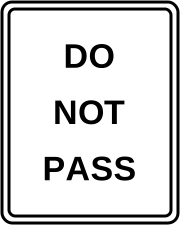
- Pass quickly while the lane is clear
- Pass only if the truck waves you around
- Stay behind the truck and do not pass here
- Pass on the right shoulder instead
Show answer
Stay behind the truck and do not pass here. Watch out for and obey the DO NOT PASS sign, and look for double solid lines on the highway that mark the same zone. The sign means passing is not allowed there even when the oncoming lane seems empty, because traffic or hazards may be hidden ahead. Stay behind the slow vehicle at a safe distance until the sign and markings show passing is allowed.
Study this in the handbook: Road signs by shape and color
7. Which roads may a bicyclist legally use in Delaware?
- Only roads with painted bicycle lanes
- Only residential streets below 25 mph
- All roads except limited access highways
- Only roads with a shared lane marking
Show answer
All roads except limited access highways. Bicyclists retain a legal right to use public roadways, including all Delaware roads except limited access highways. A painted bicycle lane, residential speed, or shared lane marking is not a condition for lawful bicycle use. Drivers should therefore expect bicycles on many kinds of roads and plan passing and turning movements accordingly. Limited access highways are the stated exclusion in this rule about where bicycles may travel.
Study this in the handbook: School buses, pedestrians and bicyclists
8. In Delaware, a large truck is coming toward you on a two-lane road. How should you position your car?
- Move toward the center line to give the truck a clear view of you
- Keep as far to the side as possible
- Speed up so you pass each other quickly
- Stay exactly in the middle of your lane
Show answer
Keep as far to the side as possible. When you meet a truck coming from the opposite direction, keep as far as possible to the side. That helps avoid a sideswipe crash and reduces the wind turbulence between the two vehicles. The manual notes that this turbulence pushes the vehicles apart; it does not suck them together. Hold your steering steady as the truck goes by. Also stay out of a truck's No-Zone blind spots.
Study this in the handbook: Following distance, trucks and motorcycles
9. Your car has a manual transmission. Which gear choices apply when parked facing up a slope and when parked facing down a slope?
- Low gear facing up a slope, reverse facing down a slope
- Reverse facing up a slope, low gear facing down a slope
- Neutral in both directions so the wheels can settle
- Highest gear in both directions for a stronger hold
Show answer
Low gear facing up a slope, reverse facing down a slope. If your car has a manual transmission, leave it in low gear when parked headed uphill and in reverse when parked headed downhill. This helps prevent a crash if the parking brake fails. Neutral gives no help at all. Turn the front wheels correctly for the slope too: toward the curb when facing downhill, away from the curb when facing uphill with a curb.
10. You are in a lane under the pictured overhead sign but meant to go straight. What must you do?
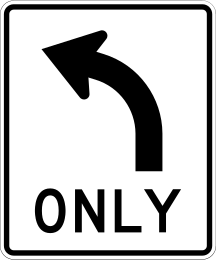
- Go straight, since the sign is only advice
- Turn left as the sign directs
- Stop in the lane and wait for a gap
- Go straight if you signal first
Show answer
Turn left as the sign directs. You must obey the overhead sign in your lane. When the word ONLY is used, you must go in the direction the arrow points; there is no option. If you find yourself in a left-only lane by mistake, make the left turn and find a safe place to turn around later. Next time, watch for lane signs early so you can choose the right lane in time.
Study this in the handbook: Road signs by shape and color
11. Under Delaware law, a child under age 4 and under 40 pounds must ride in what?
- A harnessed car seat
- A belt-positioning booster seat
- An adult lap and shoulder belt
- Any seat, if an adult sits beside them
Show answer
A harnessed car seat. Delaware law requires a harnessed car seat for a child under age 4 and under 40 pounds. Younger children, under age 2 and 30 pounds, must ride rear-facing. After the harnessed seat, a child moves to a belt-positioning booster seat and stays in it until reaching the booster maker's height or weight limit. Officers can stop a vehicle if they see an unrestrained child.
Study this in the handbook: Headlights, seat belts, phones and insurance
12. You are about to pass a tractor-trailer on a level highway. Compared with passing a car, how much more time should you expect the pass to take?
- About half a minute longer
- No extra time, since trucks hold a steady speed
- Only three to five seconds longer
- About a full minute longer
Show answer
Only three to five seconds longer. On a level highway, passing a truck takes only three to five seconds longer than passing a car. Before you move out, check ahead and behind, and use the passing lane only if it is clear and you are in a legal passing zone. Finish the pass as quickly as you can and do not stay alongside the truck. On an upgrade a truck often loses speed, so it is easier to pass than a car.
Study this in the handbook: Following distance, trucks and motorcycles
13. At a minor road stop sign with no stopped vehicle waiting, how may a bicyclist proceed?
- Enter first because bicycles always have priority
- Roll through at full speed without looking
- Stop only if a car honks from behind
- Treat the sign as a yield after slowing and giving way
Show answer
Treat the sign as a yield after slowing and giving way. At stop signs controlling intersections with minor roads, when no vehicle is stopped at the sign being approached, a cyclist may treat the stop sign as a yield sign after slowing and yielding the right of way to any vehicle at or approaching the intersection. The cyclist may then cautiously turn or proceed without stopping. Full speed rolling, horn based decisions, and automatic priority ignore the required slowing and yielding.
Study this in the handbook: School buses, pedestrians and bicyclists
14. Another driver ahead has a turn signal flashing. What should you assume about that vehicle?
- It will turn at the next opening without fail
- It may not turn, so plan for either outcome
- Its signal cancels the need to keep your gap
- It will always complete the turn before you arrive
Show answer
It may not turn, so plan for either outcome. A flashing signal does not promise a turn. The driver may turn later, may have left the signal on, or may change plans. Planning for both outcomes, by holding your gap and waiting until the vehicle actually starts to turn, avoids pulling into its path. This care matters even more with motorcycles, whose signals often do not cancel by themselves after a turn.
Study this in the handbook: Seeing ahead and adjusting to conditions
15. You approach a delivery person carrying boxes close to the road. What does the manual advise?
- Allow extra room, since busy people may not notice you
- Sound your horn so they know that you are coming
- Assume they see you because your headlights are on
- Speed up to pass them before they step out
Show answer
Allow extra room, since busy people may not notice you. Even when other people can see you, allow extra room or be extra cautious if you think they may be distracted. The manual lists delivery persons, construction workers, and children or drivers who are not paying attention. Anyone who cannot see you may also walk or drive into your path without knowing you are there, such as people with umbrellas in front of their faces. Slowing down gives you more time to react.
16. What must a Delaware driver do when a posted speed limit is lower than the usual listed limit?
- Use the usual limit if traffic is light
- Follow the posted limit and never exceed it
- Exceed it briefly to pass another vehicle
- Ignore it unless a police officer is present
Show answer
Follow the posted limit and never exceed it. A posted limit controls the driver's maximum speed, even when the usual category limit would be higher. Delaware also warns that the driver must never exceed the posted limit. Light traffic, passing, or the absence of an officer does not suspend that restriction. Watch for a lower sign in work areas or unusual conditions, adjust before reaching it, and maintain a lawful speed for the road and conditions.
Study this in the handbook: Delaware speed limits
17. No signs or lane markings control turning at an intersection. From which lane should you start and finish a turn?
- Start wide for a better view and finish in any lane with space
- Start in the far lane and finish close to the center line always
- Start from the middle lane so other turners can pass both sides
- Start nearest your direction and finish nearest the lane you left
Show answer
Start nearest your direction and finish nearest the lane you left. Without signs or markings controlling the turn, the pattern is to turn from the lane closest to the direction of travel and into the lane closest to the lane of origin. That path crosses the fewest lanes of traffic. The turn should go from one lane to the other as directly as possible without crossing lane lines unnecessarily or interfering with traffic. Lane changes to a farther lane come after the turn is complete.
18. Another car is about to hit the side of your vehicle. What will your body tend to do, and what keeps you in control?
- Move away from the hit side; air bags hold you
- Stay still; the seat back holds you in place
- Slide forward; the steering wheel stops you
- Move toward the hit side; belts keep you behind the wheel
Show answer
Move toward the hit side; belts keep you behind the wheel. If your vehicle is hit from the side, your body will be thrown toward the side that is hit. Air bags may not help in this situation. Your lap and shoulder belts are needed to help keep you behind the wheel. Get ready to steer or brake so your vehicle does not hit something else after the first impact. Belts must be worn even in cars with air bags.
19. Does driving faster than the traffic around you save much time, according to the manual?
- Yes, it saves about ten minutes of driving every single hour
- Yes, it saves time because you pass fewer cars
- No, speeding does not save more than a few minutes an hour
- No, but only in heavy traffic jams
Show answer
No, speeding does not save more than a few minutes an hour. Vehicles moving in the same direction at the same speed cannot hit one another. If you are going faster than traffic, you will have to keep passing others, and each pass is a chance for a collision. Slow down and keep pace with other traffic, because speeding does not save more than a few minutes an hour. Going much slower than other vehicles is almost as bad, since traffic bunches up behind you.
Study this in the handbook: Seeing ahead and adjusting to conditions
20. A sign says a lane is reserved for "Transit." Who may use the lane?
- Buses and taxis
- Any vehicle with two or more people
- Trucks and buses only
- Buses only
Show answer
Buses only. Reserved lanes are marked by signs stating that the lane is reserved for special use. A lane marked Transit or Bus is for bus use only. A lane marked Bicycle is reserved for bicycles. HOV stands for High Occupancy Vehicles, and those lanes are for vehicles with more than one person, with signs showing the number of people required and the days and hours that apply. For example, HOV 3 means at least three people.
Study this in the handbook: Pavement markings, signaling and roundabouts
Every question is written from the official Delaware Driver Manual. Need paper? Printable DE practice test with answer key.
Last verified 2026-10-05. How we check every question · Study all 500 as flashcards
Frequently asked questions
How many questions are on this Delaware practice test?
This fixed set has 20 questions. It is test 21 of 25 from the 500 question Delaware bank. The real DE exam asks 32 questions and you need 26 correct.
What is the passing score for the real Delaware test?
26 of 32 correct (approximately 81%) That figure comes from the official Delaware source cited on the DMV facts page.
How does this fixed test relate to the full Delaware bank?
Each numbered test is a fixed set of questions in a fixed order, so you can retake the same test later and compare. Every test mixes road signs and the other topics in about the same proportion as the full bank. Tests 1 to 25 together cover every question in the Delaware bank once. The full practice page mixes the whole bank at random.
Last verified 2026-10-05. See the Delaware DMV facts page for sourced state details.
Return to the full Delaware practice test · Study road signs