
Test 2 of 10 · 20 questions · Free 2026
DE Permit Practice Test 2
Jump to the test ↓A fixed 20 question set from the Delaware bank with answers and plain English explanations. The real DE exam is 32 questions, 81 percent to pass; take the full length version on the main practice page.
Question 1 of 20 · 0 right so far
All 20 questions in test 2
Every question below comes from the Delaware question bank on this page. Open a question to see the correct answer and the explanation. Nothing here is hidden behind a signup.
1. A Delaware commercial motor vehicle driver has a BAC of .04. What first-offense disqualification applies?
- Five years from commercial driving
- 30 days from all driving
- One year from driving a commercial vehicle
- Lifetime disqualification on the first offense
Show answer
One year from driving a commercial vehicle. Delaware disqualifies a commercial motor vehicle driver for one year when the BAC is .04 or more, or when the driver refuses the breath or blood test. The rule concerns operating a commercial vehicle, not an automatic ban from every kind of driving. Thirty days and five years are not the listed first-offense periods, and lifetime disqualification may be imposed for a second conviction. The cue is the lower .04 commercial threshold.
Study this in the handbook: Alcohol, BAC and implied consent
2. Your Delaware signal is red and the NO TURN ON RED sign shown here is posted at the corner. What must you do?
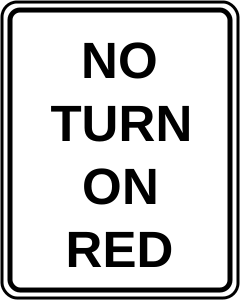
- Wait until the signal turns green before proceeding or turning
- Turn right after a full stop if no traffic is coming
- Turn left onto a one-way street after a full stop
- Go straight once no cross traffic is visible
Show answer
Wait until the signal turns green before proceeding or turning. Where the NO TURN ON RED sign is posted, Delaware requires you to wait until the signal turns green before proceeding or making turns. Without the sign, a right turn on red, or a left turn from one one-way street onto another, is allowed after a full stop. The posted sign takes those options away, so stopping and checking for traffic is not enough. Going straight on a red light is never allowed. Stay stopped at the line and move only on green.
Study this in the handbook: Road signs by shape and color
3. At a Delaware intersection with no stop sign, yield sign, or traffic signal, which vehicle should you yield to?
- A vehicle coming from your left
- A vehicle coming from your right
- Only a vehicle traveling faster than you
- No vehicle, because an uncontrolled intersection has no priority rule
Show answer
A vehicle coming from your right. At an uncontrolled intersection, Delaware directs drivers to yield to vehicles coming from the right. The left-side traffic answer reverses that relationship, while speed does not determine priority. The manual also says it is safest to consider yielding to all vehicles before entering, so scan broadly rather than entering because the roadway appears open. The practical cue is the missing control: with no sign or signal, check right first and be ready to wait for any approaching traffic.
Study this in the handbook: Right of way at intersections
4. What penalties does Delaware list for a fifth DUI offense?
- A $500 fine
- A misdemeanor with 30 days
- A Class E felony with a fine up to $10,000 and three to five years in prison, plus 60 months license loss
- A one year suspension
Show answer
A Class E felony with a fine up to $10,000 and three to five years in prison, plus 60 months license loss. A fifth DUI offense is a Class E felony carrying a fine of up to $10,000 and imprisonment of not less than three years nor more than five years, with loss of license for 60 months. A third offense is a Class G felony with up to $5,000 and one to two years, and fourth and sixth offenses also carry 60 month license losses. The penalties escalate with every conviction.
Study this in the handbook: DUI penalties and underage laws
5. What electronic-device restriction applies to a Delaware Level One Learner's Permit holder?
- The holder may not operate while using a cellular telephone or similar device
- Use is allowed with a supervisor present
- Only texting is prohibited
- Hands-free calls are required but permitted
Show answer
The holder may not operate while using a cellular telephone or similar device. The Level One restriction prohibits the permit holder from operating a motor vehicle while using a cellular telephone, text messaging device, or similar electronic device. A supervisor does not create an exception in the quoted rule, and the wording is broader than a texting-only ban. The hands-free choice also adds permission that the restriction does not provide. The useful cue is to treat the entire listed device category as off limits while the permit holder is operating, rather than trying to classify a call as safer or more convenient.
Study this in the handbook: The Level One Learner's Permit and GDL rules
6. A standard Delaware driver license is generally issued for how long?
- Two years
- Four years
- Six years
- Eight years
Show answer
Eight years. Delaware driver licenses are generally issued for eight years. The manual lists exceptions involving immigration length of stay, hazmat holders, and Driving Privilege Card holders, so the printed expiration date remains important for an individual credential. Two, four, and six years are not the general term stated for a standard license. The eight-year period also appears in the application fee description, which is a useful memory cue. Check the card rather than assuming every applicant receives the standard term when an exception may apply.
Study this in the handbook: Exams, renewal and license rules
7. Which roadway rights and duties apply to someone driving a horse-drawn vehicle on a Delaware highway?
- Only the duties of a pedestrian using a sidewalk
- The rights of a driver but none of the duties
- Those of a motor vehicle driver, except laws that cannot apply by their nature
- No roadway rights unless accompanied by a motor vehicle
Show answer
Those of a motor vehicle driver, except laws that cannot apply by their nature. An animal-drawn vehicle driver shares the rights and duties of a motor vehicle driver where those laws can apply. The exception recognizes that some requirements cannot sensibly apply to an animal or its vehicle. It does not remove every traffic duty or turn the driver into a sidewalk pedestrian. When you encounter a horse-drawn vehicle, recognize its lawful place on the highway and allow room for its movement instead of assuming it must surrender all roadway rights.
Study this in the handbook: School buses, pedestrians and bicyclists
8. What is the meaning of a steady red arrow?
- Proceed if no pedestrian is visible
- Turn in the arrow's direction after yielding
- Continue straight but do not turn
- Stop fully and do not proceed in the arrow's direction
Show answer
Stop fully and do not proceed in the arrow's direction. A steady red arrow controls the direction shown by the arrow and requires a full stop. Delaware does not allow movement in that direction while the steady red arrow is displayed. The choice permitting a turn after yielding describes a flashing red arrow, not a steady one. Looking for pedestrians is always wise, but their absence does not cancel the signal. The cue is the arrow rather than a round red lens: stop and wait for a signal that authorizes movement in that specific direction.
Study this in the handbook: Traffic lights and arrows
9. When are speed limits allowed to be reduced below the usual listed limits?
- Whenever a driver is running late
- Only on weekends and holidays
- Whenever the listed limits are unsafe for conditions
- Only when no speed sign is visible
Show answer
Whenever the listed limits are unsafe for conditions. Delaware allows the listed speed limits to be reduced when they are unsafe for current conditions, with signs placed along the highway to show the lower limit. Personal urgency does not authorize a change, and the rule is not limited to weekends or missing signs. Rain, congestion, work activity, or another hazard can make a lower posted speed appropriate. Watch for the condition-specific sign and obey it.
Study this in the handbook: Road signs by shape and color
10. A first-time Delaware applicant using a Temporary Instruction Permit must be accompanied by a licensed driver who is at least:
- 21 years old
- 19 years old
- 18 years old
- 25 years old
Show answer
21 years old. A first-time applicant using a Temporary Instruction Permit must be accompanied by a licensed driver who is qualified for the class of vehicle and is at least 21 years old. Payment is due when you apply, and every exam must be passed within twelve months. The lower ages of 18 and 19 do not meet the stated minimum, while 25 is higher than necessary. Before each practice drive, confirm the companion's age and license class so the required supervision is in place from the start.
Study this in the handbook: The Level One Learner's Permit and GDL rules
11. A Delaware curve has an advisory speed below the posted limit. What may happen if a driver exceeds it and crashes?
- The advisory number automatically becomes the legal speed limit
- The driver may be considered in violation of the general speed restriction
- The driver is immune from speed enforcement because the sign is advisory
- The posted limit is canceled until the curve ends
Show answer
The driver may be considered in violation of the general speed restriction. An advisory speed is not itself a specific legal speed limit, but Delaware may conclude that a driver violated the general speed restriction if the driver exceeds the advisory number and crashes. The sign does not automatically replace the posted limit, and it does not create immunity from responsibility. The posted limit also remains in force. The concrete cue is the combination of advisory speed, crash, and the separate requirement to drive reasonably for conditions.
Study this in the handbook: Road signs by shape and color
12. What commercial driving disqualification applies to a CDL holder convicted of DUI while driving a non-commercial vehicle for the first time?
- Thirty days
- One year
- Six months
- Lifetime disqualification for the first conviction
Show answer
One year. A DUI conviction in a personal vehicle can cost a CDL holder commercial driving privileges for one year. The consequence is not limited to incidents behind the wheel of a commercial truck or bus. Lifetime disqualification may be imposed for a second conviction, so selecting that penalty for the first conviction confuses the two stages. Remember that the license held by the driver is relevant even when the vehicle used during the offense is non-commercial.
Study this in the handbook: Alcohol, BAC and implied consent
13. What suspension follows a conviction for driving 50 miles per hour or more over the posted limit?
- No suspension if the road is a highway
- A one-month suspension
- A two-month suspension
- A one-year suspension
Show answer
A one-year suspension. Delaware identifies this level of speeding as a one-year suspension offense. The same passage also covers driving 100 miles per hour on a highway, and it requires completion of a behavior modification or attitudinal driving course within the previous two years for reinstatement eligibility. The one-month option describes the starting suspension for 25 miles per hour over the limit, not the 50 mile threshold. A highway does not create an exemption; the manual expressly includes 100 miles per hour on a highway in this serious speeding rule.
Study this in the handbook: Points, suspensions and serious speeding
14. What does the sharp-turn warning advise a driver to do?

- Stop and reverse before the turn
- Maintain the posted speed without adjustment
- Change lanes into oncoming traffic
- Reduce speed
Show answer
Reduce speed. The sharp-turn symbol warns that the roadway changes direction abruptly and specifically pairs that warning with reducing speed. Maintaining speed ignores the sign's safety instruction. Moving into oncoming traffic is never a response to a turn warning, and reversing is not a normal maneuver at the bend. The cue is the tight arrow shape: slow before the turn, stay in the lane, and keep enough control to follow the roadway without braking or steering suddenly at the sharpest point.
Study this in the handbook: Road signs by shape and color
15. Under Delaware law, which child must ride in a rear-facing car seat?
- A child under age 2 and 30 pounds
- A child under age 4 and 40 pounds
- Any child under 8
- A child under age 1 only
Show answer
A child under age 2 and 30 pounds. Delaware law requires children under age 2 and 30 pounds to ride in a rear-facing car seat, and children under age 4 and 40 pounds to ride in a harnessed car seat. The under 4 and 40 pound choice is the harnessed seat rule, not the rear-facing rule. Under 8 describes no Delaware requirement in this list, and limiting rear-facing seats to children under 1 is too narrow.
Study this in the handbook: Headlights, seat belts, phones and insurance
16. As you enter a Delaware roundabout, what does the manual say to do about bicyclists?
- Watch for them and allow them to merge into the entry lane
- Pass them inside the circle
- Sound the horn so they pull onto the sidewalk
- Stop in the circle until they leave
Show answer
Watch for them and allow them to merge into the entry lane. Bicyclists approaching a roundabout may need to move into the entry lane alongside other traffic. The manual tells drivers to watch for bicyclists on the approach and allow them to merge into the entry lane ahead of you rather than squeezing past. Passing inside the circle, honking a rider onto the sidewalk, or stopping inside the roundabout all create the conflicts the design is meant to remove. Slow to 10 to 15 mph on the approach, yield to pedestrians in the crosswalk and to traffic already circulating, and do not pass inside the circle, since the manual says not to pass other vehicles there.
Study this in the handbook: Pavement markings, signaling and roundabouts
17. How far before an intended stop, turn, or lane change must a Delaware driver signal?
- 30 feet
- 300 feet
- 100 feet
- 1,000 feet
Show answer
300 feet. Delaware requires a hand signal or turn signal 300 feet before the intended stop, turn, or lane change. The 30-foot and 100-foot figures are shorter distances and do not meet this state rule. One thousand feet substantially overstates the required advance notice and could mislead other road users about an earlier maneuver. The cue is to signal well before the action, keep the signal visible while preparing, and still check mirrors and blind spots before moving.
Study this in the handbook: Headlights, seat belts, phones and insurance
18. How does Delaware count points from a violation that happened 18 months ago when deciding administrative action?
- At full value
- At half value
- At zero, because points expire after one year
- At double value
Show answer
At half value. For administrative action, points count at full value for the first 12 months from the date of the violation and at half value for the second 12 months. A violation 18 months old falls in the second year, so it counts at half value. Points do not drop to zero after one year, and they are never doubled. The points displayed on the driving record itself still show full value; the half value rule is only for calculating DMV action.
Study this in the handbook: Points, suspensions and serious speeding
19. During a supervised Delaware GDL drive, who may sit in the front seat?
- Any belted passenger
- The supervisor or any passenger over 18
- Only the supervising driver, next to the permit holder
- A sibling under 16 if the supervisor sits behind
Show answer
Only the supervising driver, next to the permit holder. The supervising driver must be seated beside the permit holder in the front seat while the vehicle is moving, and no one other than the supervising driver can be in the front seat. A passenger over 18 or any other belted passenger therefore may not take the front seat. The supervisor cannot move to the back to make room for a sibling. Other occupants ride in the back, and every occupant must be belted or in a child safety seat or booster seat.
Study this in the handbook: The Level One Learner's Permit and GDL rules
20. Where should a driver expect the X-shaped railroad sign shown here, and how should it be treated?
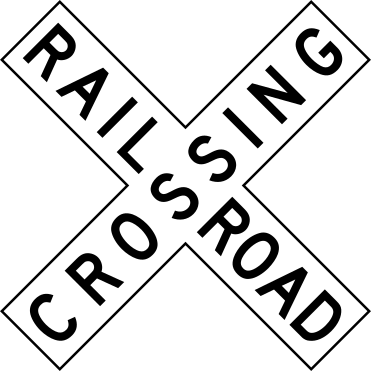
- In a work zone, as an instruction to merge left
- At a hospital, as a prohibition on using the horn
- At the tracks, as a yield sign requiring caution for trains
- At a school, as a command to stop for children
Show answer
At the tracks, as a yield sign requiring caution for trains. The white X-shaped crossbuck identifies the railroad crossing itself and carries the same meaning as a yield sign. A driver must yield to crossing trains, so the track area deserves a deliberate check before entering. The hospital, work-zone, and school choices attach the sign to unrelated locations and actions. Do not treat the crossbuck as permission to continue without looking. Scan for trains and obey any additional lights, gates, or bells at the crossing. The shape is the cue that this is the crossing point, not merely an advance warning.
Study this in the handbook: Road signs by shape and color
QualitySpace is expanding to Delaware
We are a California-based independent insurance brokerage working on licensing in more states. We cannot help with Delaware insurance yet. Leave your email and we will let you know when we can.
Every question is written from the official Delaware Driver Manual. Need paper? Printable DE practice test with answer key.
Last verified 2026-10-05. How we check every question · Study all 205 as flashcards
Frequently asked questions
How many questions are on this Delaware practice test?
This fixed set has 20 questions. It is test 2 of 10 from the 205 question Delaware bank. The real DE exam asks 32 questions and you need 26 correct.
What is the passing score for the real Delaware test?
26 of 32 correct (approximately 81%) That figure comes from the official Delaware source cited on the DMV facts page.
How does this fixed test relate to the full Delaware bank?
Each numbered test is a fixed set of questions in a fixed order, so you can retake the same test later and compare. Every test mixes road signs and the other topics in about the same proportion as the full bank. Tests 1 to 10 together cover 200 of the 205 questions in the Delaware bank, each once. The full practice page mixes the whole bank at random.
Last verified 2026-10-05. See the Delaware DMV facts page for sourced state details.
Return to the full Delaware practice test · Study road signs