
36 question exam format · Real sign images · Producer reviewed

California Permit Practice Test

Real test: 36 questions, 30 correct to pass. Practice 20 at a time below. Free, no signup.

Free California DMV practice test with 506 questions written from the official California Driver's Handbook, each with an explanation and a handbook page citation. No signup and no ads. The real California exam has 36 questions and requires 83% (30 of 36) to pass. Last reviewed 2026-10-12.

Also here: exam simulator in the real test format, flashcards for the whole bank, a one-page cheat sheet, handbook lessons, chapter by chapter, and audio read-aloud for questions.

Question 1 of 20 · 0 right so far

0 correct · 0 missed
A 35-year-old California driver is on probation for a prior DUI. At what BAC is it illegal for this driver to drive?
More ways to practice: exam simulator, topic drills, missed questions

506-question bank · Sign images & explanations · Free

California practice test has 506 questions. Every question comes with a plain-English explanation the moment you answer.

Get a day by day study plan

Optional. Three quick answers; the tests below work without it.

Age on test day

No date yet? You get a 7 day plan.

Real exam format: 36 questions, 30 correct to pass.

Your age on test day

Start here

Run 20 questions to warm up.

Find your gaps

Diagnose weak topics and retry what you've missed.

Simulate the real thing

Practice under graded exam conditions or run the whole bank.

Practice one topic

Drill a single topic, up to 20 questions with explanations.

Random draw and answer order every attempt. Scored against the real test's pass mark: 30 of 36 correct.

Free means actually free: no subscription, no auto-renew, no card required, no locked features. This site is funded by our insurance work, not by test-prep charges.

Show a parent how you are doing

A read-only link with your California readiness, topic scores and test results. No account, no name or email.

California permit practice test at a glance

506 free practice questions, with 25 numbered 20 question tests and the full bank to practice, plus a free real-exam simulator that follows the California test format, a road sign test, and an explanation for every answer. No signup, no paywall, nothing locked. Questions are written from the California Driver's Handbook and were last checked against it on October 12, 2026.

Key facts: California permit test

Knowledge test fee

No separate fee; covered by the original driver license/permit application fee of $46 for a Class C license

Official source · verified 2026-10-05

Road signsRight of waySpeed limitsParkingAlcohol & DUISafe drivingSignals & markingsLaws & paperworkEmergencies

Parent of a new California driver? Adding a teen to the family policy changes the price. Get a free quote or call 714-666-6669. English and Vietnamese.

New California driver? Insurance is the next step

Once the permit or license is in hand, the family policy changes. QualitySpace is an independent California broker (Kevin Vu, CDI #4037122): teen-driver additions, first-time policies, and multi-car bundles quoted across many carriers in one call.

Get a free quote or call 714-666-6669. English and Vietnamese.

All 36 questions, CA exam length

Every question below comes from the California question bank on this page. Open a question to see the correct answer and the explanation. Nothing here is hidden behind a signup.

  1. 1. A 35-year-old California driver is on probation for a prior DUI. At what BAC is it illegal for this driver to drive?

    1. 0.08% or higher, like any adult
    2. 0.01% or higher
    3. 0.10% or higher
    4. 0.04% or higher
    Show answer

    0.01% or higher. A driver on DUI probation is held to a 0.01% BAC limit at any age, so a 35-year-old on probation cannot use the ordinary adult 0.08% limit. Full explanation in Test 1

    Study this in the handbook: Alcohol, drugs and DUI

  2. 2. Your car is disabled on the freeway shoulder. Where should you wait?

    1. Get out and stand behind the car
    2. Stay inside belted until help arrives
    3. Push the car to the next exit
    4. Stand in the travel lane to flag help
    Show answer

    Stay inside belted until help arrives. The belted cabin is the safest place on a high-speed shoulder: it shields occupants from passing traffic and debris while keeping everyone t Full explanation in Test 2

    Study this in the handbook: Blowouts, breakdowns and brake failure

  3. 3. Unless otherwise posted, what is the ideal maximum speed on most California highways?

    1. 55 mph
    2. 65 mph
    3. 70 mph
    4. 60 mph
    Show answer

    65 mph. Most California highways post 65 mph as the standard maximum where conditions allow, balancing travel speed against stopping distances and t Full explanation in Test 3

    Study this in the handbook: Speed limits and the Basic Speed Law

  4. 4. May you drink alcohol or take drugs while operating a boat?

    1. Only on weekends
    2. Never, on boats, jet skis, water skis, and similar vessels
    3. Only after sunset
    4. Only without a life jacket aboard
    Show answer

    Never, on boats, jet skis, water skis, and similar vessels. Waterways punish impairment as harshly as highways: sun, wind, and motion intensify alcohol's effects while drowning replaces the guardrail Full explanation in Test 4

    Study this in the handbook: Alcohol, drugs and DUI

  5. 5. What does a solid yellow traffic signal light mean?

    1. Speed up to clear the intersection
    2. Stop immediately even in the intersection
    3. Prepare to turn; through traffic must stop
    4. Caution: the light is about to turn red; stop if you can do so safely
    Show answer

    Caution: the light is about to turn red; stop if you can do so safely. Yellow is the transition warning between green and red, giving drivers already close a moment to clear while telling everyone farther back t Full explanation in Test 5

    Study this in the handbook: Traffic lights and pedestrian signals

  6. 6. If oncoming headlights are too bright at night, where should you look?

    1. Directly into the headlights until your eyes adjust
    2. At your rearview mirror to avoid the glare
    3. Toward the right edge of your lane
    4. At the centerline between the vehicles
    Show answer

    Toward the right edge of your lane. When oncoming lights are too bright, avoid staring into them and guide your path by looking toward the right edge of your lane. Full explanation in Test 6

    Study this in the handbook: Scanning, following distance and skids

  7. 7. This round yellow sign warns of a railroad crossing ahead. If the crossing has several tracks, what should you expect?

    Round yellow RXR sign
    1. Trains only on the track nearest you
    2. Trains only during posted hours
    3. A train on any track, at any time, traveling in either direction
    4. No train once one has just passed
    Show answer

    A train on any track, at any time, traveling in either direction. The handbook tells drivers to expect a train on any track, at any time, traveling in either direction. Full explanation in Test 7

    Study this in the handbook: School buses and railroad crossings

  8. 8. Where may a California driver attach a sticker no larger than a 7-inch square?

    1. In the center of the windshield behind the rearview mirror
    2. The lower corner of the passenger's side windshield
    3. Anywhere along the top edge of the windshield
    4. The lower corner of the driver's side of the windshield
    Show answer

    The lower corner of the passenger's side windshield. California limits what you may stick on your glass so that your view stays clear. Full explanation in Test 8

    Study this in the handbook: Tickets, points and suspensions

  9. 9. Which road surfaces tend to freeze before the rest of the road?

    1. Bridges and overpasses
    2. Freshly painted lane markings only
    3. Flat city blocks with heavy traffic
    4. Downhill shoulders after sunrise only
    Show answer

    Bridges and overpasses. Bridges and overpasses can freeze before other pavement, so slow before reaching them on cold wet days and expect hidden icy spots. Full explanation in Test 9

    Study this in the handbook: Speed limits and the Basic Speed Law

  10. 10. What must you do before driving on any medication?

    1. Assume all medications are safe for driving
    2. Ask passengers whether you seem impaired
    3. Drive first and judge the effects later
    4. Read labels and know the effects of every drug you take
    Show answer

    Read labels and know the effects of every drug you take. Many prescriptions and over-the-counter remedies warn against driving precisely because drowsiness, dizziness, and slowed reactions sneak up Full explanation in Test 10

    Study this in the handbook: Alcohol, drugs and DUI

  11. 11. A California school bus ahead of you in your lane is flashing its red lights, and you drive past without stopping. What penalty can follow?

    1. A fine of up to $1,000 and a possible one year suspension
    2. A $35 fine with no effect on the license
    3. A warning for a first offense
    4. A fine of up to $100
    Show answer

    A fine of up to $1,000 and a possible one year suspension. Failing to stop for a school bus with flashing red lights can bring a fine of up to $1,000, and the driving privilege could be suspended for Full explanation in Test 11

    Study this in the handbook: School buses and railroad crossings

  12. 12. For a California driver age 21 or older operating a noncommercial vehicle, what is the lowest general per-se DUI BAC threshold?

    1. 0.04% or higher only when not towing
    2. 0.08% or higher
    3. 0.10% or higher after midnight
    4. Any reading only if a crash occurs
    Show answer

    0.08% or higher. For a noncommercial driver over 21, California sets the illegal BAC threshold at 0.08% or higher. The 0. Full explanation in Test 12

    Study this in the handbook: Alcohol, drugs and DUI

  13. 13. Your vehicle begins to skid on a slippery surface. What should you do with the brake pedal?

    1. Press it hard until the vehicle stops
    2. Tap it rapidly while turning away from the skid
    3. Avoid using it while you ease off the accelerator
    4. Hold it halfway down to keep the wheels straight
    Show answer

    Avoid using it while you ease off the accelerator. For a slippery-surface skid, ease off the accelerator and do not use the brakes. Full explanation in Test 13

    Study this in the handbook: Scanning, following distance and skids

  14. 14. In extreme heat, which step does the handbook list for overheating conditions?

    1. Drive faster so air cools the engine
    2. Open the radiator cap immediately
    3. Watch the temperature gauge and turn off the air conditioner
    4. Idle the engine in park for ten minutes
    Show answer

    Watch the temperature gauge and turn off the air conditioner. Extreme heat pushes cooling systems toward their limits, so the handbook advises watching the temperature gauge for early warning and switch Full explanation in Test 14

    Study this in the handbook: Blowouts, breakdowns and brake failure

  15. 15. What is allowed at a white painted curb?

    1. Loading freight while the driver leaves
    2. Parking all day if no sign gives a time limit
    3. Stopping briefly to pick up or drop off passengers
    4. Parking only with a disabled placard
    Show answer

    Stopping briefly to pick up or drop off passengers. A white curb permits only a short stop for passenger pickup or dropoff. Full explanation in Test 15

    Study this in the handbook: Parallel parking, hills and colored curbs

  16. 16. What does a flashing red traffic signal require at an intersection?

    1. Stop first, then continue only when it is safe
    2. Slow to a crawl without stopping if cross traffic is clear
    3. Wait for a green light before moving again
    4. Treat the signal as a warning that cross traffic must stop
    Show answer

    Stop first, then continue only when it is safe. A flashing red signal is handled like a stop control. Full explanation in Test 16

    Study this in the handbook: Traffic lights and pedestrian signals

  17. 17. What minimum liability insurance must California drivers carry for property damage?

    1. $5,000 for property damage
    2. $15,000 for property damage
    3. $10,000 for property damage
    4. $30,000 for property damage
    Show answer

    $15,000 for property damage. California minimum liability coverage includes at least $15,000 for property damage. Full explanation in Test 17

    Study this in the handbook: Insurance, collisions and paperwork deadlines

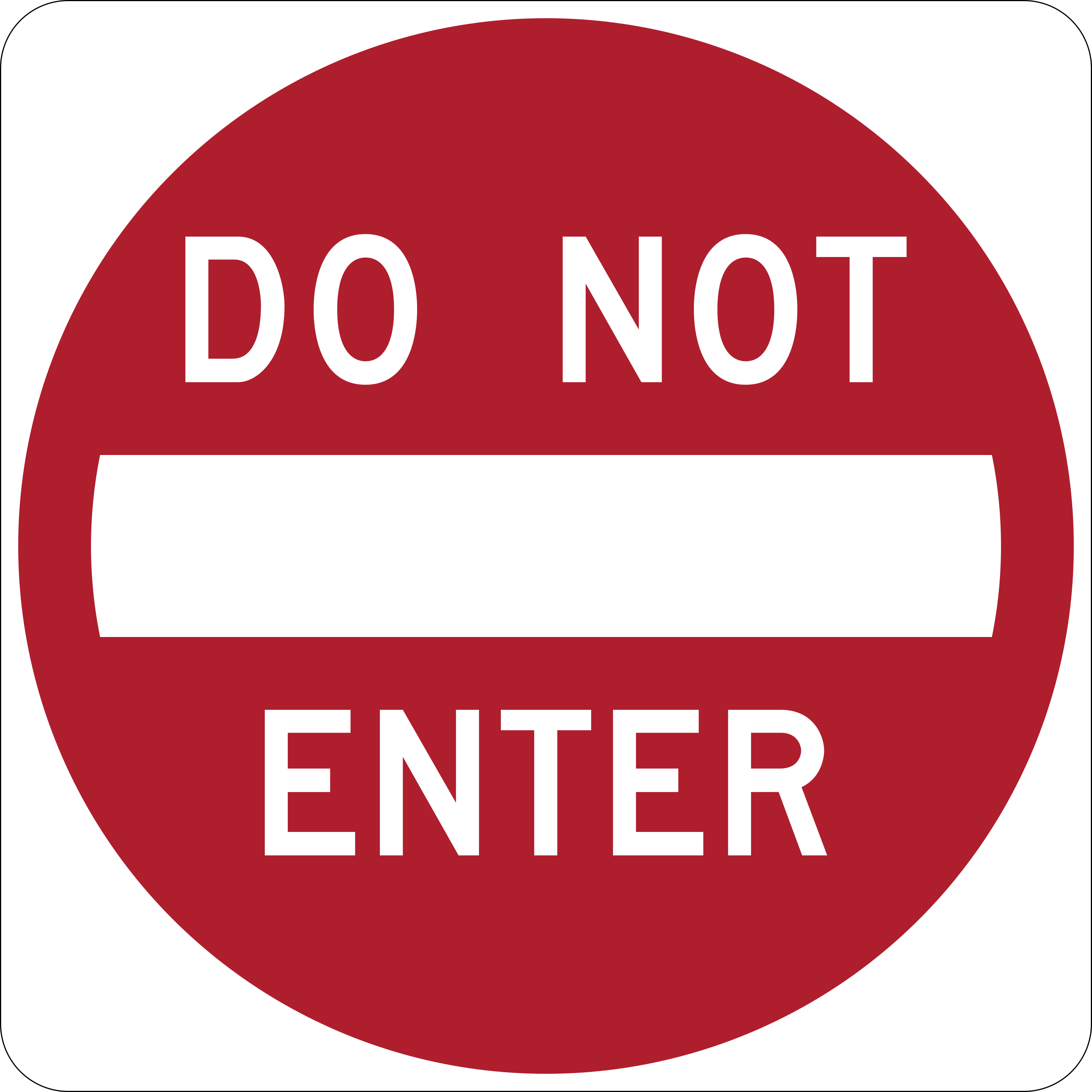
  18. 18. What does this DO NOT ENTER sign tell you?

    Square sign with red circle reading DO NOT ENTER
    1. The road may be entered after stopping
    2. Only trucks are barred from the ramp
    3. Do not enter the road or ramp where it is posted
    4. The lane is closed only during rush hour
    Show answer

    Do not enter the road or ramp where it is posted. A DO NOT ENTER sign is a regulatory sign that bars entry to the road or ramp where it stands. Stopping first does not make entry legal. Full explanation in Test 18

    Study this in the handbook: Road sign shapes, colors and meanings

  19. 19. A preliminary alcohol screening shows a 20-year-old California driver at 0.05% BAC. What may the officer do?

    1. Nothing, because 0.05% is under the adult limit
    2. Require a breath or blood test
    3. Issue a parking citation
    4. Only call the driver's parents
    Show answer

    Require a breath or blood test. If a preliminary alcohol screening shows 0.05% or higher for a driver under 21, the officer may require a breath or blood test. Full explanation in Test 19

    Study this in the handbook: Alcohol, drugs and DUI

  20. 20. A California applicant under 18 wants an instruction permit. What is the youngest age at which they can apply?

    1. 15
    2. 15 and a half
    3. 16
    4. 14 and a half
    Show answer

    15 and a half. California lets a minor apply for an instruction permit at 15 and a half, provided they also complete a driver education program and a paren Full explanation in Test 20

    Study this in the handbook: Instruction permit and provisional license rules

  21. 21. A pedestrian using a wheelchair is crossing. How should a driver treat that person?

    1. As a pedestrian or vulnerable road user
    2. As a slow vehicle that must yield
    3. As a bicyclist only in a marked lane
    4. As traffic only when using a motor
    Show answer

    As a pedestrian or vulnerable road user. California includes a person with a disability using a wheelchair for transportation among pedestrians or vulnerable road users. Full explanation in Test 21

    Study this in the handbook: Right of way: who goes first

  22. 22. What should you carry if you drive in snowy areas?

    1. A bag of sand but no chains
    2. Snow chains of the correct number and type for your vehicle
    3. Spare windshield wipers only
    4. A second spare tire
    Show answer

    Snow chains of the correct number and type for your vehicle. Chains give tires the extra bite that snow and ice take away, and California chain-control areas can require them with no exceptions for unp Full explanation in Test 22

    Study this in the handbook: Speed limits and the Basic Speed Law

  23. 23. A judge offers traffic violator school for your one-point ticket. What does it do?

    1. Pay double the fine instead
    2. Lose the license automatically
    3. Attend traffic violator school to keep it off the insurance record
    4. Ignore the ticket safely
    Show answer

    Attend traffic violator school to keep it off the insurance record. Judges may offer school for eligible one-point violations, letting drivers trade classroom hours for insurance protection. Full explanation in Test 23

    Study this in the handbook: Tickets, points and suspensions

  24. 24. When may you make a U-turn in a residential district?

    1. Whenever your turn signal has flashed for 100 feet
    2. If no vehicle is approaching within 200 feet
    3. Only at a traffic light showing a green arrow
    4. Only when the street has two lanes in each direction
    Show answer

    If no vehicle is approaching within 200 feet. A residential U-turn is allowed only when no vehicles are approaching within 200 feet and no other listed ban applies. Full explanation in Test 24

    Study this in the handbook: Turns, U-turns, merging and passing

  25. 25. At night, red road reflectors shining in your headlights usually warn that you are:

    1. Approaching a carpool lane entrance
    2. Driving the wrong way
    3. Near a railroad crossing
    4. Entering a construction detour
    Show answer

    Driving the wrong way. Red reflectors shining back at night are California's warning that you have entered a roadway against traffic. Full explanation in Test 25

    Study this in the handbook: Road sign shapes, colors and meanings

  26. 26. What does a green arrow mean at a traffic signal?

    1. Go in the direction of the arrow for a protected turn.
    2. Proceed straight only after yielding to all traffic.
    3. Turn only after stopping at the limit line.
    4. The protected turn has ended and the light will change.
    Show answer

    Go in the direction of the arrow for a protected turn.. A green arrow means go in the direction the arrow points, and California describes that movement as a protected turn because oncoming vehicl Full explanation in Test 1

    Study this in the handbook: Traffic lights and pedestrian signals

  27. 27. When may a child graduate to a regular safety belt?

    1. They must use a rear-facing seat
    2. They must sit in the front seat
    3. They may use a properly secured safety belt meeting federal standards
    4. They need no restraint at all
    Show answer

    They may use a properly secured safety belt meeting federal standards. Eight years or 4-foot-9 marks the graduation from child restraints to adult belts, provided the belt fits properly across the hips and shoul Full explanation in Test 2

    Study this in the handbook: Seat belts, child seats and cell phones

  28. 28. Which headset or earplug use is illegal while driving in California?

    1. Wearing a headset or earplugs in both ears.
    2. Using a single hands-free earpiece.
    3. Listening through the vehicle's built-in speakers.
    4. Wearing hearing aids prescribed by a doctor.
    Show answer

    Wearing a headset or earplugs in both ears.. California says hearing helps drivers notice horns, sirens, motorcycles, and screeching tires, and it bars wearing a headset or earplugs in Full explanation in Test 3

    Study this in the handbook: Turn signals, horn and headlights

  29. 29. A limit line stands before a crosswalk where pedestrians are crossing. Where do you stop?

    1. Stop at the limit line and let pedestrians cross
    2. Stop past the line inside the crosswalk
    3. Slow down but keep rolling through
    4. Stop only if pedestrians wave at you
    Show answer

    Stop at the limit line and let pedestrians cross. The limit line holds cars back so the full crosswalk stays open and pedestrians remain visible to all lanes. Full explanation in Test 4

    Study this in the handbook: Right of way: who goes first

  30. 30. What is the speed limit in California business or residential districts, unless otherwise posted?

    1. 25 mph
    2. 15 mph
    3. 35 mph
    4. 30 mph
    Show answer

    25 mph. Streets lined with shops, homes, driveways, and parked cars hide pedestrians, cyclists, and pulling-out vehicles behind every obstacle, so C Full explanation in Test 5

    Study this in the handbook: School buses and railroad crossings

  31. 31. An average passenger vehicle at 55 mph can stop within about 300 feet. How far can a large truck take at the same speed?

    1. About 150 feet
    2. The same 300 feet
    3. About 200 feet
    4. Up to 400 feet
    Show answer

    Up to 400 feet. California's handbook compares the two directly: at 55 mph an average passenger vehicle can stop within 300 feet, while a large vehicle can Full explanation in Test 6

    Study this in the handbook: Right of way: who goes first

  32. 32. A California driver under 21 is caught with alcohol in the vehicle. How long can law enforcement impound the vehicle?

    1. Up to 30 days
    2. Up to 7 days
    3. Up to 6 months
    4. It cannot be impounded
    Show answer

    Up to 30 days. When a driver under 21 is caught with alcohol in the vehicle, law enforcement can impound the vehicle for up to 30 days. Full explanation in Test 7

    Study this in the handbook: Alcohol, drugs and DUI

  33. 33. DMV mails you notice of a proposed action against your California driving privilege. How long do you have to request a hearing?

    1. 30 days from the date of the notice
    2. 10 days after being served, or 14 days from the date the notice is mailed
    3. Until your license expires
    4. 48 hours
    Show answer

    10 days after being served, or 14 days from the date the notice is mailed. An administrative hearing must be requested within 10 days of being served, or within 14 days of the date the notice was mailed. Full explanation in Test 8

    Study this in the handbook: Tickets, points and suspensions

  34. 34. What is a bike route, and how is it marked?

    1. A freeway lane closed to bicycles
    2. A sidewalk shared with pedestrians
    3. A signed preferred route for bikes on streets shared with cars
    4. A racing course closed to traffic
    Show answer

    A signed preferred route for bikes on streets shared with cars. Bike routes steer cyclists onto calmer streets using route signs and shared-lane markings, but cars still use the same lanes, so drivers mus Full explanation in Test 9

    Study this in the handbook: Lane markings and special lanes

  35. 35. Where must an opened alcohol container be kept in the car?

    1. In the trunk or where passengers do not sit
    2. In the glove box
    3. On the passenger seat
    4. In the driver's cup holder
    Show answer

    In the trunk or where passengers do not sit. Once a seal breaks, the container must leave everyone's reach so nobody can sip during the trip. Full explanation in Test 10

    Study this in the handbook: Alcohol, drugs and DUI

  36. 36. How long must a California minor hold an instruction permit before scheduling the behind-the-wheel drive test?

    1. At least 30 days
    2. At least 1 year
    3. At least 3 months
    4. At least 6 months, or until turning 18
    Show answer

    At least 6 months, or until turning 18. An applicant under 18 must have an instruction permit from California or another state for at least 6 months, or turn 18, before scheduling Full explanation in Test 11

    Study this in the handbook: Instruction permit and provisional license rules

Study rewards · Earned as you practice

Level 1Answer questions to earn XP
0 XP

Achievements

    Rewards are saved on your device only. They never affect your score or the real DMV test.

    Evidence-based study plan · Personalized to your exam date

    When is your driving test?

    Tell us the date and we will build a review schedule (based on learning-science research: spreading study out always beats cramming).

    How this test works

    Written for new Americans, scored like the real thing

    Every question here was written from the current California Driver's Handbook and independently fact-checked against the Vehicle Code, never copied from the DMV's sample tests. The explanations are the point: most practice sites tell you what the answer is; this one tells you why, in plain English, so the rule sticks on exam day.

    The real California knowledge test depends on your age: first-time applicants 18 and older get 36 questions and need 30 correct, and applicants under 18 get 46 questions and need 38 correct. Pick your age group above the simulator and it deals and grades the matching test. Wrong answers are remembered on your device, and the retry mode re-serves them until you have mastered every one.

    The DMV itself says "a passing score is 80%". The counts above clear that bar, so passing here means passing with room to spare.

    Fixed test set

    25 numbered tests from the bank

    Prefer studying test by test? Each numbered test is a fixed set of 20 questions from our verified bank, each with a plain-English explanation. Together the 25 tests cover 500 of the 506 questions; the practice test above draws from all 506.

    Printable CA practice test with answer key

    Study all 506 California questions as flashcards

    Cheat sheet

    Want the key numbers on one page? Keep our free California DMV cheat sheet open while you study the most-missed rules.

    Test day

    Booked your test? See what to bring and where to go: a printable document checklist with the official DMV office and appointment links.

    Exam day

    Knowledge is half the battle. See what the science says actually helps you pass on exam day itself.

    After you pass

    The first policy is where new drivers overpay

    A brand-new license means carriers rate you as a new driver even if you have driven for years abroad. Before accepting the first number you see, ask about good student discounts, driver assignment on multi-car households, and carriers that are friendlier to newly licensed adults. That conversation is free: request a quote or explore our other California insurance tools, including the AB60 eligibility checker for drivers without federal documents.

    How we write and check these questions