
Test 9 of 10 · 20 questions · Free 2026
AL Permit Practice Test 9
Jump to the test ↓A fixed 20 question set from the Alabama bank with answers and plain English explanations.
Question 1 of 20 · 0 right so far
All 20 questions in test 9
Every question below comes from the Alabama question bank on this page. Open a question to see the correct answer and the explanation. Nothing here is hidden behind a signup.
1. Except when backing into a parking place, how does the Alabama manual characterize backing on a public street or road?
- It is preferred whenever a turn is inconvenient
- It is never advisable
- It is required before entering any driveway
- It is allowed only during daylight
Show answer
It is never advisable. The manual describes backing on a public street or road as never advisable, except for backing into a parking place. That is a safety judgment broader than a time-of-day restriction, so daylight does not make the maneuver acceptable. The manual does not prefer reverse movement for convenience and does not require it before every driveway entry. If backing out of a driveway is necessary, back into the nearest lane and proceed from there, never across other traffic lanes. Think of minimizing reverse travel and checking all around the vehicle before moving.
Study this in the handbook: Passing, backing, lane changes and loads
2. What fee does the Alabama manual list for each knowledge test?
- $5.00, with no checks accepted
- $10.00, payable only by check
- $15.00, waived for learner applicants
- No fee is listed for a knowledge test
Show answer
$5.00, with no checks accepted. The knowledge-test section lists a fee of $5.00 for each test and adds that checks are not accepted. The $10 and $15 amounts do not appear in this statement, and the manual does not describe the test as free for learner applicants. The wording each knowledge test matters because it ties the fee to every test attempt or category rather than presenting one general licensing charge. When preparing from this page, remember both pieces together: five dollars per knowledge test and no checks accepted.
Study this in the handbook: Who needs a license, and the knowledge and road tests
3. How long is an Alabama learner license valid?
- Until the holder turns 18
- Six months
- Four years
- One year
Show answer
Four years. An Alabama learner license is valid for four years. The six month period is a separate requirement for some applicants who are 16 but under 18 and want to present for the road test. Turning 18 does not automatically end the license’s stated validity, and the manual does not give one year as the term. Keep the validity period separate from the supervised learning and road test conditions so an age milestone is not mistaken for an expiration date.
Study this in the handbook: The learner license and graduated license rules
4. What happens when a driver under arrest for DUI refuses a directed chemical breath test in Alabama?
- The license is renewed automatically
- The vehicle registration is canceled
- The driver receives only a parking citation
- The driver license is suspended
Show answer
The driver license is suspended. A driver under arrest for Driving Under the Influence who refuses to submit to chemical breath tests when directed by an officer will have the driver license suspended. The rule concerns the license, not cancellation of vehicle registration or a routine parking citation. Automatic renewal is the opposite of the stated consequence. The same implied consent passage explains that anyone who drives on Alabama public highways has already given consent to a chemical test of blood, breath, or urine for blood alcohol content.
Study this in the handbook: Alcohol and the DUI law
5. How should an Alabama driver handle hydroplaning?
- Press the accelerator to regain traction
- Take the foot off the accelerator and let the car slow down
- Turn sharply toward the nearest lane
- Apply the parking brake immediately
Show answer
Take the foot off the accelerator and let the car slow down. When hydroplaning begins, the manual recommends taking your foot off the accelerator and allowing the car to slow down. Pressing the accelerator can maintain the speed that lifted the tires onto water, while a sharp turn or parking-brake application can create an unpredictable skid. Keep steering controlled and avoid abrupt inputs until tire contact returns. Good tread helps prevent complete hydroplaning, but it cannot make excessive speed safe when water is deep or rain is severe.
Study this in the handbook: Skids, hydroplaning, fog and hills
6. How long is Alabama's grace period after a driver license expires?
- 60 days, during which the license remains valid for renewal
- One year
- There is no grace period
- 10 days
Show answer
60 days, during which the license remains valid for renewal. Alabama law provides a grace period of 60 days after the expiration date of a driver license for the purpose of renewal, and the license remains valid during that period. Renewal can also be done up to 180 days before expiration. A license may be renewed without examination within a three year period after expiration; beyond that, testing is required.
Study this in the handbook: Renewal, address changes and license classes
7. What must an Alabama driver do when approaching a blind pedestrian carrying a qualifying cane or using a guide dog?
- Sound the horn and continue without stopping
- Stop and give the pedestrian the right of way
- Pass behind the pedestrian before yielding
- Yield only if a traffic signal is present
Show answer
Stop and give the pedestrian the right of way. Alabama requires a driver to stop and give the right of way at any intersection to a blind person carrying a white cane tipped with red and holding it extended, or using a guide dog. The rule is not limited to signalized intersections, and a horn does not substitute for stopping. Passing behind the pedestrian could still put the person in danger and ignores the required priority. Reduce speed as soon as the person is visible, stop before the crossing path, and wait until the pedestrian has safely cleared the roadway.
Study this in the handbook: Right of way and yielding
8. An Alabama driver accumulates 12 to 14 points in a 2-year period. How long is the suspension?
- 90 days
- 120 days
- 60 days
- 365 days
Show answer
60 days. Alabama's point suspension schedule starts at 12 to 14 points in a 2-year period, which brings a 60 day suspension. It then climbs to 90 days for 15 to 17 points, 120 days for 18 to 20, 180 days for 21 to 23, and 365 days for 24 or more. So 90, 120 and 365 days belong to higher point totals. The driver may request a pre-suspension or administrative hearing.
Study this in the handbook: Losing your license, points and phone laws
9. When is physically holding a phone a violation of Alabama's Hands-Free Law, as the manual describes it?
- Any time the car is parked
- When the driver is seen crossing lanes without signaling, swerving or otherwise driving improperly
- Only on interstates
- Only for drivers over 21
Show answer
When the driver is seen crossing lanes without signaling, swerving or otherwise driving improperly. The manual describes the Hands-Free Law this way: physically holding a wireless device is a violation when the driver is observed crossing in and out of a traffic lane without using a turn signal, swerving, or otherwise operating the vehicle in an improper manner. A parked car, an interstate-only rule, and an age limit are not part of this description. Penalties start at a $50 fine and 1 point.
Study this in the handbook: Renewal, address changes and license classes
10. According to the Alabama manual, what is a driver's No. 1 responsibility when using a cellular phone while driving?
- Driving
- Finding the fastest route
- Keeping the phone conversation going
- Reading every incoming message
Show answer
Driving. The manual places driving first when a person uses a cellular phone. The other choices make the device or conversation the priority, which can divert attention from traffic, pedestrians, and changing road conditions. If a call is necessary, assess conditions first, use hands-free equipment when possible, and place the call while stopped or have a passenger handle it. Pull off the road to dial or finish a conversation. The practical cue is to treat phone use as secondary to vehicle control, not as a task that can compete with watching the roadway.
Study this in the handbook: Phones, fatigue, following distance and crashes
11. How far do high beam headlights normally illuminate the road, according to the Alabama manual?
- About 100 feet
- About 1,000 feet
- About one mile
- About 350 feet under normal conditions
Show answer
About 350 feet under normal conditions. Headlights on high beam normally illuminate the roadway about 350 feet under normal conditions, and you should never drive so fast that you cannot stop within the distance you can see ahead with your lights. Dimming is required by law within 500 feet of an oncoming vehicle and within 200 feet when following another vehicle. The equipment rules also require the high beam to illuminate objects at a minimum of 350 feet.
Study this in the handbook: Night and winter driving
12. How should a driver enter a roundabout when there is no safe gap in traffic?
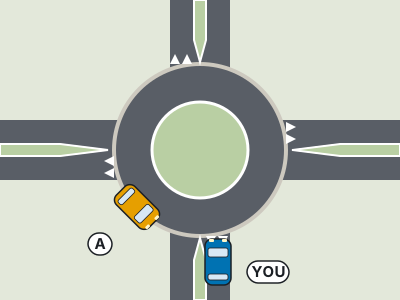
- Enter immediately and force circulating traffic to brake
- Stop inside the roundabout to create a gap
- Wait until a safe gap appears
- Drive the wrong way around the circle
Show answer
Wait until a safe gap appears. A driver should wait for a safe gap before entering a roundabout. Circulating traffic has priority, so entering immediately would force other drivers to brake or swerve. Stopping inside the circle disrupts the flow and creates a new conflict, while driving the wrong way is inherently dangerous. Use the approach to reduce speed, yield to pedestrians and bicyclists, watch the traffic on the left, and choose an opening large enough to enter without making another road user react abruptly. If the gap disappears, remain outside and reassess rather than rushing the entry.
Study this in the handbook: Roundabouts
13. What is the usual purpose of a yellow diamond-shaped warning sign?
- To mark a parking area
- To identify a public recreational or cultural destination
- To warn of a hazardous condition ahead requiring extra caution
- To give directions to a hospital or fuel station
Show answer
To warn of a hazardous condition ahead requiring extra caution. Yellow diamond-shaped signs are generally warning signs. They alert drivers to hazardous conditions ahead and call for extra caution, while fluorescent yellow is used for pedestrian crossings and school zones. Green, blue, and brown sign colors serve informational, service, or recreational guidance purposes instead. Slow your pace when a yellow diamond appears, look for the condition it identifies, and be ready to adjust before reaching the hazard. Shape and color together provide the early warning.
Study this in the handbook: Sign types, regulatory signs and four way stops
14. Which group lists the three types of traffic signs by their function?
- Stop, yield, and speed-limit signs
- Construction, school, and railroad signs
- Interstate, county, and recreational signs
- Regulatory, warning, and information or guide signs
Show answer
Regulatory, warning, and information or guide signs. Alabama groups traffic signs by function into regulatory, warning, and information or guide signs. The construction, school, and railroad choices name particular subjects or locations, not the full functional classification. Interstate, county, and recreational labels describe route or destination markers, while stop, yield, and speed-limit signs are examples within the regulatory group. A useful study cue is to ask what job the sign performs: it may control traffic, warn about a hazard, or inform and direct motorists. That cue helps separate the three broad families from individual signs shown in the manual.
Study this in the handbook: Sign types, regulatory signs and four way stops
15. What must you do at this sign?

- Slow down; proceed if clear
- Turn around before reaching the intersection
- Stop only if other cars are present
- Come to a COMPLETE stop at the line, yield, then go
Show answer
Come to a COMPLETE stop at the line, yield, then go. A STOP sign requires a complete stop before entering the intersection. Alabama's stopping rule places the stop at the marked stop line; if none exists, stop before the near crosswalk, or before entering the crossing street where the driver has a clear view. Slowing and proceeding without stopping misses the sign's command, and waiting for another car is unnecessary. After stopping, proceed cautiously and yield as needed. Use the line or crosswalk as the visual cue, then check for traffic before moving.
Study this in the handbook: Speed limits
16. Which circumstance makes an Alabama speed limit violation prima facie evidence that the speed is unlawful?
- Driving faster than a posted limit established for normal conditions
- Driving below the limit during heavy rain
- Driving at the limit on a clear road
- Driving on a road with no official regulatory sign
Show answer
Driving faster than a posted limit established for normal conditions. Alabama's manual explains that statutory speed limits apply for normal driving conditions, unless another zone has been established and posted on an official regulatory sign. Speed in excess of those limits is prima facie evidence that it is unlawful and may lead to arrest. The below-limit choice is not an excess-speed violation, and traveling exactly at the limit is not above it. A road lacking an official sign does not create the stated posted-limit condition. Check both the normal-conditions qualifier and the fact that the speed exceeds the applicable limit.
Study this in the handbook: Speed limits
17. What does a solid yellow line on your side of the centerline indicate?
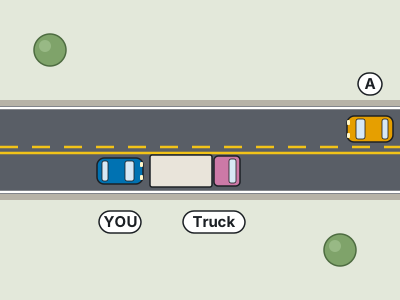
- Passing is required before the next intersection
- Passing is permitted only at night
- Only trucks may cross the line
- You may not pass
Show answer
You may not pass. A solid yellow line on your side of the centerline means you may not pass. The manual explains that two-lane highways are marked with solid yellow center stripes in areas where passing would be hazardous, so crossing it to overtake would ignore the intended protection. By contrast, broken lines mark areas with no passing restriction when it is safe to pass. Time of day does not change the restriction, and vehicle type does not create an exception for trucks. Read the line nearest your lane before considering any passing maneuver.
Study this in the handbook: Pavement markings
18. What traffic pattern is indicated by a MERGE sign?

- The roadway ends and every vehicle must turn around
- Opposing traffic will begin using the driver's lane
- The driver will join other traffic traveling in the same direction
- A divided highway is changing into a railroad crossing
Show answer
The driver will join other traffic traveling in the same direction. A merge warning means traffic will join the driver’s flow in the same direction. Drivers entering from the right must yield to traffic on the main route, while the speed-change lane helps everyone blend smoothly. This is not an opposing-lane warning or a dead-end instruction. Check mirrors, maintain space, and adjust speed predictably so entering vehicles can merge without abrupt braking.
Study this in the handbook: Warning, construction and guide signs
19. If the accelerator pedal sticks, what should you try first?
- Press the pedal harder until it releases
- Hook your toe under the pedal and try to raise it
- Shift into reverse while moving forward
- Turn sharply toward the nearest curb
Show answer
Hook your toe under the pedal and try to raise it. A stuck accelerator requires a controlled attempt to free the pedal before choosing a more serious response. The manual advises hooking your toe under the pedal and attempting to raise it. Pressing harder could keep the vehicle accelerating, while shifting into reverse or steering abruptly could create a separate loss of control. If the pedal will not come free, the engine can be turned off to slow the vehicle, though power steering and power brakes will then be lost. Keep the vehicle pointed safely while reducing speed.
Study this in the handbook: Driving emergencies
20. A steady GREEN ARROW over a lane means you may:
- Use the lane only to park temporarily
- Drive in the lane beneath the arrow while obeying other controls
- Ignore all other traffic controls in that lane
- Enter the lane only after the arrow changes to yellow
Show answer
Drive in the lane beneath the arrow while obeying other controls. A steady green arrow over an individual lane permits travel in that lane, but it does not cancel ordinary traffic rules. You still need to obey signs, signals, and safe driving practices that apply at the same time. The choice claiming every other control can be ignored goes too far, because the manual expressly keeps those controls in force. Match the arrow with the lane directly below it, then scan for a speed limit, merge instruction, or other restriction before proceeding.
Study this in the handbook: Traffic signals, arrows and lane use signals
QualitySpace is expanding to Alabama
We are a California-based independent insurance brokerage working on licensing in more states. We cannot help with Alabama insurance yet. Leave your email and we will let you know when we can.
Every question is written from the official Alabama Driver Manual. Need paper? Printable AL practice test with answer key.
Last verified 2026-10-05. How we check every question · Study all 200 as flashcards
Frequently asked questions
How many questions are on this Alabama practice test?
This fixed set has 20 questions. It is test 9 of 10 from the 200 question Alabama bank.
How does this fixed test relate to the full Alabama bank?
Each numbered test is a fixed set of questions in a fixed order, so you can retake the same test later and compare. Every test mixes road signs and the other topics in about the same proportion as the full bank. Tests 1 to 10 together cover every question in the Alabama bank once. The full practice page mixes the whole bank at random.
Last verified 2026-10-05. See the Alabama DMV facts page for sourced state details.