
Test 1 of 10 · 20 questions · Free 2026
AL Permit Practice Test 1
Jump to the test ↓A fixed 20 question set from the Alabama bank with answers and plain English explanations.
Question 1 of 20 · 0 right so far
All 20 questions in test 1
Every question below comes from the Alabama question bank on this page. Open a question to see the correct answer and the explanation. Nothing here is hidden behind a signup.
1. After moving within Alabama, how long does a driver have to notify the Driver License Division of the new address?
- 30 days
- 10 days
- 90 days
- One year
Show answer
30 days. After changing your address within Alabama, you have 30 days under Alabama Code 760-X-1-.07(7) to notify the Driver License Division of the new address. An Alabama citizen with a license or identification card may update the address on the state driver record without charge, although a new card is not reissued through that update. The change can also be made in person at a driver license, probate judge, or license commissioner office, or online if eligible. Keep in mind that Alabama licenses and identification cards are not forwarded by mail.
Study this in the handbook: Renewal, address changes and license classes
2. In Alabama, how must a driver respond to a flashing red traffic signal?
- Treat it as a stop sign and proceed only when safe
- Treat it as a yield and continue if the lane looks open
- Treat it as a green signal for the direction of travel
- Stop only if a train or emergency vehicle is visible
Show answer
Treat it as a stop sign and proceed only when safe. A flashing red signal carries the same stopping duty as a stop sign. Bring the vehicle to a complete stop, check for conflicting traffic and pedestrians, and proceed only when the route is safe. The yield choice would let a driver roll through without stopping, which is not permitted by this signal. A flashing red is also different from a green indication, so the choice “Treat it as a green signal for the direction of travel” reverses the required response. Remember the color and pattern together: red that flashes still means stop, even when the intersection appears empty.
Study this in the handbook: Stopping rules, school buses and emergency vehicles
3. When may an Alabama driver cross a double solid white line?
- Whenever traffic is slow
- Only to pass a motorcycle
- Whenever a turn signal is active
- It is prohibited
Show answer
It is prohibited. A double solid white line separates lanes moving in the same direction, and crossing it is prohibited. Activating a turn signal does not override that pavement marking, and slow traffic does not create an automatic exception. The motorcycle option is also too broad because the marking controls lane movement regardless of the vehicle type. Plan lane changes before reaching the double lines, obey arrows and signs, and remain in the permitted lane until a lawful opening appears.
Study this in the handbook: Pavement markings
4. Why are motorcycles hard to identify in traffic, according to the Alabama manual?
- They are always painted dark colors
- They ride only on the shoulder
- They travel faster than cars
- They are only about two feet wide compared with the five to six foot width of a car
Show answer
They are only about two feet wide compared with the five to six foot width of a car. Motorcycles are not easily identified in traffic because they are only about two feet wide compared with the five to six foot width of an automobile. Even when seen, drivers may misjudge how far away a motorcyclist is and how fast it is closing. Look twice for motorcycles at intersections and before lane changes, and remember a rider may forget to cancel a turn signal.
Study this in the handbook: Curves, bicycles, motorcycles and large vehicles
5. Where must you stop at an Alabama STOP sign when a marked stop line is present?
- In the center of the crossing street
- Past the crosswalk near the intersection
- At the marked stop line
- Only where the driver can see traffic
Show answer
At the marked stop line. At an Alabama STOP sign, the marked stop line is the first required stopping location when one is present. If there is no line, the driver uses the near-side crosswalk, or the nearest point before the crossing street when no crosswalk exists. The choice placing the vehicle beyond the crosswalk moves the stop too far forward and can endanger pedestrians. Visibility may require a cautious second stop, but it does not replace the marked line. Stop fully at the line, then proceed only after checking the intersection and yielding as required.
Study this in the handbook: Speed limits
6. What is the penalty for a first Alabama Hands-Free Law conviction?
- A $100 fine and 2 points
- A $50 fine and 1 point
- A $150 fine and 3 points
- A warning with no points
Show answer
A $50 fine and 1 point. A first conviction under Alabama’s Hands-Free Law carries a $50 fine and 1 point on the driver’s record. The $100 and 2 point penalty belongs to a second conviction, while $150 and 3 points applies to a third conviction within the stated period. A warning with no points is not the listed first offense consequence. Keep the sequence tied to the conviction count: first, second, and third have increasing fines and points over a 24-month period.
Study this in the handbook: Losing your license, points and phone laws
7. After an Alabama crash with $500 or more in damage, when must Form SR-31 be sent if the at-fault driver was uninsured?
- Within 24 hours
- Within 10 days
- Within 30 days
- Within one year
Show answer
Within 30 days. If a crash involves injury, a death, or $500 or more in damage to any vehicle or property, a written Form SR-31 must be sent within 30 days by the driver involved when the at-fault party was not insured. If both parties were insured, neither has to file the SR-31. Twenty-four hours and ten days are not the stated deadline, and one year is far too long. Injury and fatal crashes must also be reported to police right away.
Study this in the handbook: Phones, fatigue, following distance and crashes
8. What minimum liability coverage does Alabama require for death or bodily injury to two or more persons?
- $50,000
- $25,000
- $100,000
- $10,000
Show answer
$50,000. Alabama liability policies must provide at least $25,000 for death or bodily injury to one person, $50,000 for death or bodily injury to two or more persons, and $25,000 for damage or destruction of property. So $25,000 is the per person and property figure, not the two-person total. One hundred thousand and ten thousand dollars are not the state minimums. A mandatory liability violation can bring a fine up to $500 for a first offense.
Study this in the handbook: Traffic stops, insurance and window tint
9. What penalty applies to a second conviction within a 24-month period under Alabama's Hands-Free Law?
- $50 fine and 1 point
- $150 fine and 3 points
- $25 fine and no points
- $100 fine and 2 points
Show answer
$100 fine and 2 points. Alabama's Hands-Free Law, which the manual lists as effective June 2024, sets rising penalties within a 24-month period: a first conviction brings a $50 fine and 1 point, a second a $100 fine and 2 points, and a third a $150 fine and 3 points. So the $50 and $150 choices describe the first and third convictions. A $25 fine with no points is not part of this schedule. Each step adds both money and points, so repeat offenses within 24 months build up quickly on the driving record.
Study this in the handbook: Renewal, address changes and license classes
10. At what location must an Alabama driver stop and yield for a blind person using a red-tipped cane or guide dog?
- Only at a signalized intersection
- At any intersection
- Only in a marked crosswalk
- Only when another vehicle has already stopped
Show answer
At any intersection. The manual places the duty at any intersection when a blind person is carrying a white cane tipped with red and holding it extended, or is using a guide dog. A marked crosswalk is not stated as a prerequisite, so limiting the duty to marked crossings is too narrow. A traffic signal and another vehicle’s decision to stop are also not conditions in the passage. The safest cue is the person’s recognized cane or guide dog, followed by a complete stop and yield at the intersection. Give the pedestrian the right of way before continuing.
Study this in the handbook: Right of way and yielding
11. What roadway feature is warned by a sharp-turn arrow sign?

- A sharp turn or curve in the direction of the arrow
- A straight road with a normal lane change
- A one-way street beginning at the next block
- A crosswalk controlled by a pedestrian signal
Show answer
A sharp turn or curve in the direction of the arrow. Alabama's warning signs with an arrow warn of a sharp turn or curve in the direction the arrow points. A right-angle arrow shows the road turns sharply rather than bending gradually. The sign does not describe an ordinary lane change, a one-way designation, or a pedestrian signal. Reduce speed before reaching the turn and keep the vehicle positioned for the path shown by the roadway rather than cutting across it. Where an advisory speed plate is posted with the arrow, it gives the top safe speed for making the turn.
12. What is the main function of a regulatory traffic sign?
- It regulates the movement of traffic
- It identifies only recreational destinations
- It announces weather conditions
- It marks the beginning of every passing lane
Show answer
It regulates the movement of traffic. Regulatory signs control or restrict how traffic moves, so drivers must obey their instructions. They are different from warning signs, which alert drivers to hazards, and guide signs, which provide directions or destination information. The recreational and passing-lane choices describe narrower or unrelated purposes, while weather information is not the defining function of this sign class. When a regulatory sign appears, read it immediately and follow the instruction before continuing. Examples include signs governing stopping, turning, speed, lane use, and right of way.
Study this in the handbook: Sign types, regulatory signs and four way stops
13. Under Alabama's Mandatory Liability Insurance law, what offense does a person commit by operating a motor vehicle without liability insurance?
- A Class C felony
- A Class C misdemeanor
- No offense unless a crash occurs
- A parking infraction handled by the county
Show answer
A Class C misdemeanor. Section 32-7A-16, as amended by Act 2023-479, makes it a Class C misdemeanor to operate a motor vehicle without a liability insurance policy, bond, or cash deposit. The offense does not depend on a crash, so driving uninsured is itself the violation, and it is not a felony or a parking matter. The same section lets an officer move or impound a vehicle when the operator cannot show insurance and registration after a stop or a crash. Alabama's minimum policy is $25,000 per person, $50,000 per accident for injury, and $25,000 for property damage.
14. What does a steady circular red traffic signal require in Alabama?
- Accelerate to clear the intersection before cross traffic
- Slow down but continue through the intersection
- Stop and remain stopped until the signal turns green
- Turn left without stopping from any lane
Show answer
Stop and remain stopped until the signal turns green. A steady circular red signal requires a stop, and the vehicle must remain stopped until the signal changes to green. Alabama allows some turns after stopping when the turn is otherwise lawful, the path is clear, and no sign prohibits it. That limited exception does not turn red into permission to continue straight or to turn from any lane. The acceleration choice is especially unsafe because cross traffic may receive the right of way. Stop at the proper location, check for posted restrictions, and wait for a lawful movement.
Study this in the handbook: Traffic signals, arrows and lane use signals
15. Where does Alabama rank nationally for highway railroad crossing fatalities, according to the manual?
- Number 1
- Number 13
- Number 50
- Number 30
Show answer
Number 13. Alabama ranks number 13 in the nation for highway railroad crossing fatalities, a motorist is 40 times more likely to die in a crash involving a train, and more people die each year in crossing crashes than in all aviation crashes. Be prepared to stop when following buses and trucks that must stop at crossings, and always expect a train, since a train may be on any track at any time and cannot stop quickly.
Study this in the handbook: Phones, fatigue, following distance and crashes
16. How far from a vehicle you are following must you dim your high beams?
- Within 100 feet
- Within 500 feet
- Within 300 feet
- Within 200 feet
Show answer
Within 200 feet. Alabama requires low beams when following another vehicle within 200 feet. The separate 500-foot distance applies to an oncoming vehicle, so swapping those figures is the tempting mistake. A 100-foot or 300-foot threshold does not match the manual’s rule. Dim before the gap closes to 200 feet so the vehicle ahead is not exposed to glare in its mirrors. Keep the two distances paired in memory: 500 feet for meeting oncoming traffic, 200 feet for following traffic.
Study this in the handbook: Night and winter driving
17. What does a fourth or subsequent Alabama DUI conviction bring?
- A $600 fine and 90 day suspension
- A misdemeanor with community service
- A Class C felony with fines of $4,100 to $10,100, a five year revocation, and one year and one day to 10 years in prison
- A one year revocation
Show answer
A Class C felony with fines of $4,100 to $10,100, a five year revocation, and one year and one day to 10 years in prison. A fourth or subsequent DUI conviction is a Class C felony. Fines range from $4,100 to $10,100 with a five year revocation of the driver license, and the offender may be imprisoned for not less than one year and one day and up to 10 years. A third conviction carries a three year revocation and a mandatory minimum of 60 days in jail that cannot be probated.
Study this in the handbook: DUI penalties and implied consent
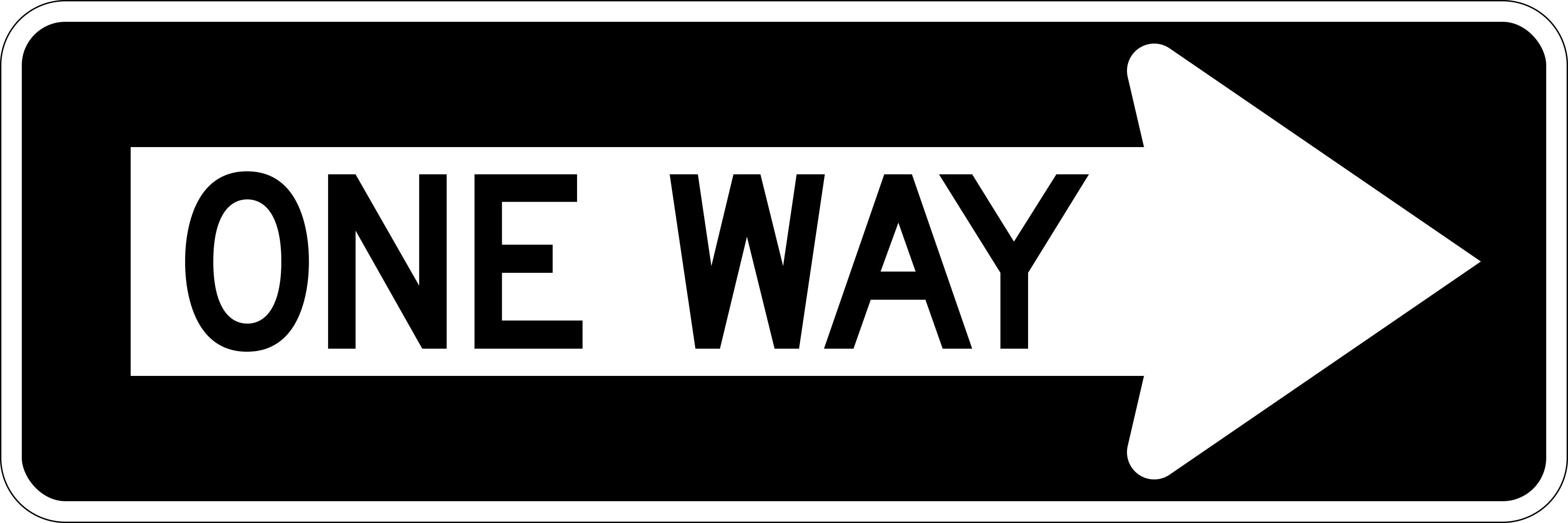
18. What does a ONE WAY sign require a driver to do?
- Turn around at the next intersection
- Travel only in the direction shown by the arrow
- Use the lane only when passing another vehicle
- Yield to traffic approaching from both directions
Show answer
Travel only in the direction shown by the arrow. A one-way sign assigns the permitted direction of travel, shown by its arrow. It does not tell a driver to reverse direction, reserve a lane for passing, or expect opposing traffic on the same roadway. Watch for the arrow before turning or entering. Once on the one-way road, keep the vehicle moving with the indicated flow and obey any lane-use sign that follows.
Study this in the handbook: Sign types, regulatory signs and four way stops
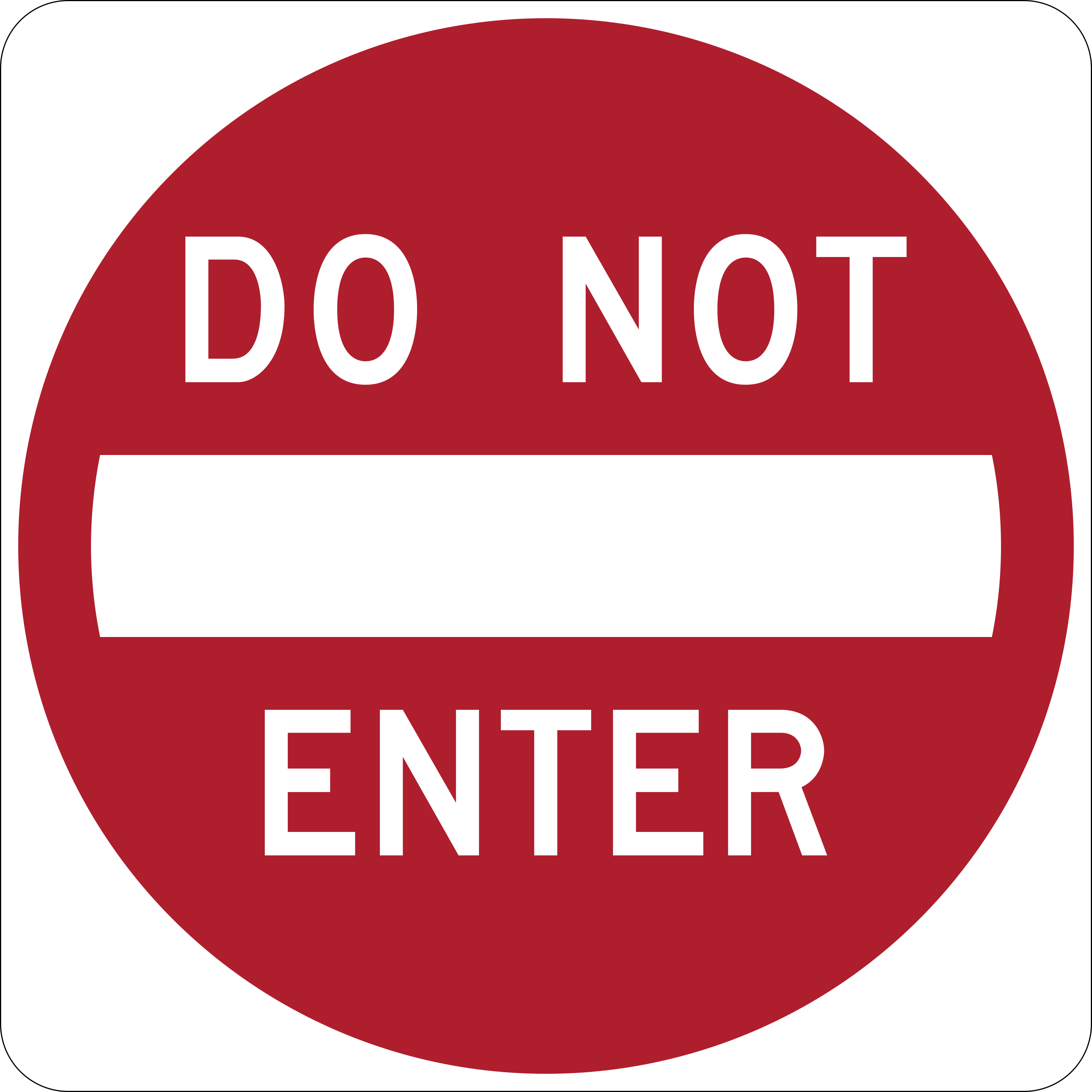
19. A red and white sign says DO NOT ENTER. What roadway condition does it identify?
- A road that ends after the next intersection
- A parking space reserved for emergency vehicles
- A two-way road where passing is prohibited
- A one-way roadway with traffic coming against you that you must not enter
Show answer
A one-way roadway with traffic coming against you that you must not enter. The Alabama manual pairs the DO NOT ENTER sign with this description: it marks a one-way roadway with traffic coming against you, and you must not enter the one-way at that point. It is a prohibition on entry, not a warning about a dead end, parking, or a no-passing zone. If the sign faces you, do not turn in; continue on a lawful route instead. Treat the entrance itself as closed from your direction, even if the pavement looks open and no traffic is in sight.
Study this in the handbook: Sign types, regulatory signs and four way stops
20. What minimum blood alcohol concentration makes driving unlawful for a person under 21 in Alabama?
- 0.06 percent or more
- 0.04 percent or more
- 0.02 percent or more
- 0.08 percent or more
Show answer
0.02 percent or more. For a person under 21, Alabama identifies 0.02 percent or more as an unlawful blood alcohol concentration for operating or being in actual physical control of a vehicle. The 0.04 percent threshold applies to commercial vehicle operators, while 0.08 percent is the general adult threshold listed elsewhere. Choosing 0.06 invents a middle limit that the manual does not use. The safest plan is no alcohol before driving, because impairment can occur before a driver reaches any legal threshold and the consequences can include license action and criminal penalties.
Study this in the handbook: Alcohol and the DUI law
QualitySpace is expanding to Alabama
We are a California-based independent insurance brokerage working on licensing in more states. We cannot help with Alabama insurance yet. Leave your email and we will let you know when we can.
Every question is written from the official Alabama Driver Manual. Need paper? Printable AL practice test with answer key.
Last verified 2026-10-05. How we check every question · Study all 200 as flashcards
Frequently asked questions
How many questions are on this Alabama practice test?
This fixed set has 20 questions. It is test 1 of 10 from the 200 question Alabama bank.
How does this fixed test relate to the full Alabama bank?
Each numbered test is a fixed set of questions in a fixed order, so you can retake the same test later and compare. Every test mixes road signs and the other topics in about the same proportion as the full bank. Tests 1 to 10 together cover every question in the Alabama bank once. The full practice page mixes the whole bank at random.
Last verified 2026-10-05. See the Alabama DMV facts page for sourced state details.