
Test 11 of 25 · 20 questions · Free 2026
AL Permit Practice Test 11
Jump to the test ↓A fixed 20 question set from the Alabama bank with answers and plain English explanations.
Question 1 of 20 · 0 right so far
All 20 questions in test 11
Every question below comes from the Alabama question bank on this page. Open a question to see the correct answer and the explanation. Nothing here is hidden behind a signup.
1. Your car breaks down at night on an Alabama highway and you carry flares. Where should those flares be placed to warn traffic?
- Ahead of the vehicle, facing approaching traffic
- Only beside the driver door while you wait inside
- 100 to 500 feet behind your vehicle, on the right edge
- Ten feet behind the rear bumper, in the middle of the lane
Show answer
100 to 500 feet behind your vehicle, on the right edge. Night breakdown guidance in Alabama places flares or reflectors from 100 to 500 feet to the rear of the vehicle, along the right hand edge of the highway. That long warning lets approaching drivers slow and change lanes before reaching a dark car. Ten feet gives almost no reaction room, and flares ahead of the car warn traffic traveling the wrong way. Pull fully off the traveled portion first, set the warning behind you, and stay with the vehicle when possible.
2. Following another car at night in Alabama on high beams, you close to about 150 feet behind it. What must you do?
- Dim only on curves where mirrors reflect light
- Alternate high and low beams to signal your presence
- Keep high beams until 50 feet behind the car
- Dim within 200 feet of the vehicle you follow
Show answer
Dim within 200 feet of the vehicle you follow. When following another vehicle at night in Alabama, headlights must be dimmed within 200 feet of that vehicle. At 150 feet, the high beams already strike the mirrors of the car ahead and can blind its driver from behind. Waiting until 50 feet prolongs that glare, and flashing between beams repeats it. Curves are not the only place mirrors carry light backward. Dip to low beams as you close inside 200 feet and stay dipped while following.
Study this in the handbook: Night and winter driving
3. Your brake pedal sinks straight to the floor at an Alabama stop sign approach. What should you try first to slow the car?
- Open the door and drag a foot outside
- Pump the pedal to build up brake pressure
- Turn the wheel side to side to scrub speed
- Shift into reverse while still rolling forward
Show answer
Pump the pedal to build up brake pressure. When a brake pedal suddenly sinks to the floor in Alabama, pumping the pedal can build pressure back up and restore some braking. Weaving the wheel scrubs little speed and risks a spin, while reverse gear at forward speed can destroy the transmission and lock wheels. A foot outside the door invites severe injury without stopping power. Pump steadily first. If pressure stays absent, apply the parking brake gently and use a lower gear to let the engine help.
Study this in the handbook: Driving emergencies
4. You turn toward a street entrance in Alabama and face a red and white DO NOT ENTER sign, with headlights visible coming toward you beyond it. What should you understand and do?

- Stay out, because that opening serves traffic coming against you
- Enter if your destination is on that block
- Wait for the oncoming cars to pass, then enter
- Enter carefully, because traffic beyond is traveling slowly
Show answer
Stay out, because that opening serves traffic coming against you. That sign marks a one way roadway with traffic coming against you, and it tells you not to enter at that point in Alabama. Headlights approaching through the opening confirm the danger rather than create a gap to use after they pass. A nearby destination does not open a wrong way entrance either. Stop before the opening, turn toward a lawful entry farther along, and never treat an empty moment as permission to go against the flow.
Study this in the handbook: Sign types, regulatory signs and four way stops
5. An Alabama school bus ahead of you extends its stop arm and switches on flashing red lights while children gather at its door. What is the bus doing?
- Marking a parking stop where traffic may pass
- Warning that it will turn at the next corner
- Stopping to load or unload school children
- Signaling a mechanical failure to following cars
Show answer
Stopping to load or unload school children. Flashing red lights together with the extended stop area in Alabama mean the bus is stopped to load or unload school children. That combination is not a turn warning, a breakdown flag, or permission to pass while parked. Children may cross in front of the bus where a passing car cannot see them in time. Stop at the required distance from either direction and remain stopped until the arm retracts and the red lights go off.
Study this in the handbook: Right of way and yielding
6. A storm has knocked out the traffic light at a busy Alabama corner, leaving every face dark. How should you treat that intersection?
- As a green light for the street with more lanes
- As a yield crossing where faster streets go first
- As a four-way stop for traffic from every direction
- As an uncontrolled crossing with no duties
Show answer
As a four-way stop for traffic from every direction. When an Alabama traffic light is inoperative, drivers treat the intersection as a four way stop. Every approach stops, which replaces guessing about which street deserves priority. Lane counts and street speed give no claim when the control is dark, and treating the corner as duty free invites simultaneous entry. Stop fully, note the order of arrival, yield to the driver entitled to go, and enter only when your turn and a clear path arrive together.
Study this in the handbook: Stopping rules, school buses and emergency vehicles
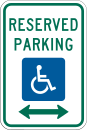
7. In Alabama, a car uses a space signed for handicapped plates or permits only. Along with being operated by or for a handicapped person, what must the car show?
- A note on the dashboard naming the driver
- A visibly displayed handicapped sticker
- A hospital receipt dated that same week
- Flashing hazard lights during the stay
Show answer
A visibly displayed handicapped sticker. A space signed for handicapped plates or permits only may be used only when both stated conditions are met. The vehicle must be operated by a physically handicapped person, or under the direction of a physically handicapped person, and it must visibly display the handicapped sticker. A dashboard note, a hospital receipt, and flashing hazard lights are not the displayed sticker the rule requires, so none of them can replace that visible display.
Study this in the handbook: Sign types, regulatory signs and four way stops
8. An Alabama driver uses the two-second rule to check following distance. How does the count begin?
- When the driver taps the brake pedal twice
- As soon as the speedometer passes twenty
- After glancing at the rearview mirror once
- When the vehicle ahead passes a fixed roadside object
Show answer
When the vehicle ahead passes a fixed roadside object. Picking a sign post, tree, or bridge edge turns an abstract gap into something measurable at any speed. Counting starts as the leading vehicle reaches that marker, and reaching the same marker too early exposes a short cushion. Brake taps and mirror glances measure nothing about space ahead. Speed alone cannot define safety either, since weather and vehicle length alter stopping needs. Extending the count on slick pavement adds margin where tires grip poorly. Practicing the routine on ordinary drives builds an instinct for space that holds up under pressure.
Study this in the handbook: Phones, fatigue, following distance and crashes
9. In Alabama, when may a driver drive over an unprotected fire hose?
- Whenever the hose looks flat and empty
- Only when authorized by a police officer or fire department official
- After honking twice to warn firefighters
- Only while following an emergency vehicle closely
Show answer
Only when authorized by a police officer or fire department official. A hose stretched across pavement stays off limits unless police or fire officials authorize crossing it. Looks can mislead, because a charged line may be hard to judge from the driver seat and damage can cut water supply during a fire. A horn blast does not grant permission, and tailing an emergency vehicle creates separate hazards. Stop short of the hose, wait for direction from officials at the scene, and use another route when they wave traffic elsewhere.
Study this in the handbook: Stopping rules, school buses and emergency vehicles
10. A bicycle lane is marked on an Alabama roadway and a person is riding a bicycle beside it in the travel lane. What does the bicycle lane rule require of that rider?
- Use the bicycle lane, because where one is available, riders must use it
- Ride on the sidewalk instead, since it keeps the bicycle clear of traffic
- Stay in the travel lane, because bicycle lanes are only a suggestion
- Use the lane only at night, when lights and reflectors are required
Show answer
Use the bicycle lane, because where one is available, riders must use it. Where a bicycle lane is available, people on bicycles must use it. A bicycle lane is a portion of a roadway designated by striping, signing, and pavement markings for preferential or exclusive use by people on bicycles. Sidewalks do not qualify as bicycle lanes, and riding on the sidewalk is illegal in Alabama. The lane is a requirement where available, not a preference or a night only rule.
Study this in the handbook: Curves, bicycles, motorcycles and large vehicles
11. A slow vehicle ahead uses the travel lane in Alabama and the paved shoulder looks wide and open. When may you use that shoulder to pass it?
- Only in an emergency or when traffic authorities direct it
- Whenever the vehicle ahead is traveling below the posted limit
- At any time the shoulder is paved and wide enough
- To pass on the right at intersections blocked by turning cars
Show answer
Only in an emergency or when traffic authorities direct it. Driving on shoulders is unlawful unless required by emergency conditions, and it is never lawful, except under emergency conditions, to drive on the shoulder to pass another vehicle. The manual adds an emergency or a direction from traffic authorities as the pass exception. A wide paved shoulder, a slow vehicle ahead, and a blocked intersection lane do not by themselves make a shoulder pass lawful.
Study this in the handbook: Stopping rules, school buses and emergency vehicles
12. Inside an Alabama roundabout you realize you just passed the street where you meant to exit, and no traffic is close behind you. What should you do?
- Stop in the circle and wait for a gap backward to the street
- Continue around and take it next time
- Cut across the center island directly to the missed street
- Back up a short distance to the missed street behind you
Show answer
Continue around and take it next time. Missing an exit inside an Alabama roundabout calls for another full trip around the circle to reach that street again. Backing up or stopping inside the circle puts your car across the path of drivers who expect continuous one way movement. Crossing the island is not a shortcut the design allows for cars. Keep rolling at low speed, signal as your exit approaches the second time, and leave the circle smoothly without a sudden stop.
Study this in the handbook: Roundabouts
13. You wait to turn left at an Alabama intersection while a car approaches from the opposite direction, already inside the intersection area and closing fast. What must you do?
- Yield until that oncoming car has passed
- Turn if your signal has been on the longest
- Enter halfway and wait inside its path
- Turn quickly before that car arrives
Show answer
Yield until that oncoming car has passed. A left turning driver in Alabama must yield to an oncoming vehicle that is within the intersection or close enough to be an immediate hazard. A car already in that space and closing fast fits the hazard description, so darting ahead or pausing in its path keeps you exposed to a head-on angle crash. Signal time gives no priority over oncoming traffic. Hold your position, let the car pass, and turn only when the opposite lane is clear.
Study this in the handbook: Right of way and yielding
14. What colors and markings appear on Alabama's round railroad advance warning sign?
- Red with a white X and the word STOP
- Orange with black letters spelling TRAIN
- Yellow with a black X and the letters RR
- White with a red border and a black train
Show answer
Yellow with a black X and the letters RR. A round outline already separates this advance device from diamond warnings. Yellow fill plus a black cross and the two letters announce tracks far enough ahead for a driver to scan both directions. Red regulatory coloring, orange work coloring, and a locomotive picture each point toward different roadside messages. When distance makes lettering small, color contrast plus silhouette should trigger a search for rails, crossbucks, and any moving train before the crossing itself arrives.
Study this in the handbook: Phones, fatigue, following distance and crashes
15. You approach a STOP sign in Alabama where no stop line and no crosswalk are marked. Where must you stop?
- On the crossing street after entering it slowly
- At the far side after crossing through traffic
- Beside the stop sign post wherever it stands
- Before entering, where you can clearly see traffic
Show answer
Before entering, where you can clearly see traffic. With no painted line and no crosswalk, stop before entering the crossing street. Pick the nearest spot to the intersection that gives you a clear look at approaching traffic in both directions. Stopping beside the sign post can leave you blind behind buildings or parked cars. Rolling onto the far side puts your car in the path of drivers who expect the crossing to stay clear. Creep forward only after the first stop if your view remains blocked, then check again before moving.
Study this in the handbook: Speed limits
16. At any Alabama railroad track, what should a driver expect, day or night?
- A train may come at any time, in either direction, day or night
- Trains run only during daylight hours on secondary tracks
- A train will always be announced by flashing lights first
- Trains must stop before every crossing to let road traffic pass
Show answer
A train may come at any time, in either direction, day or night. Railroad tracks do not keep a schedule that road drivers can rely on. Expect a train on any track at anytime, and be cautious both day and night. Some crossings have no flashing lights to announce a train, trains do not stop for highway traffic, and daylight only operation is not the rule. Treating every track as live keeps a driver from being trapped or surprised on a crossing.
Study this in the handbook: Phones, fatigue, following distance and crashes
17. An Alabama railroad crossing has no warning device of any kind. What should a driver do before proceeding across?
- Cross quickly before a train can arrive
- Stop only if the crossing looks rough
- Depend on other drivers to warn of a train
- Slow down, look and listen for trains
Show answer
Slow down, look and listen for trains. Unmarked crossings place full detection duty on the driver. Alabama directs a slowdown combined with looking and listening before proceeding where no warning device exists. Quiet rural settings can hide trains behind vegetation, curves, or buildings, and sound may arrive late on windy days. Racing across or waiting for another motorist to react surrenders that check. Open a window when safe, reduce radio volume, and scan far along the tracks in both directions before committing.
Study this in the handbook: Railroad crossings
18. Why do many safety experts hesitate to recommend shifting into neutral to fight a skid, according to the Alabama manual?
- Neutral makes the brakes stop working, so the car can never slow during a skid
- Automatic transmissions are damaged whenever they are shifted while the wheels slide
- In a panic, a driver may look away from the road or shift past neutral into reverse
- Shifting out of gear locks the steering wheel until the car comes to a full stop
Show answer
In a panic, a driver may look away from the road or shift past neutral into reverse. The manual says that to stop a skid, a driver who lacks room to step on the gas can disengage the transmission and steer in the direction the rear of the vehicle is skidding. It adds a caution: many safety experts hesitate to recommend shifting into neutral because, in a panic, drivers may take their attention off the road or accidentally shift past neutral into reverse, and either reaction is potentially disastrous.
Study this in the handbook: Skids, hydroplaning, fog and hills
19. At an Alabama railroad crossing with gates, when may a stopped driver proceed after the gates begin lowering?
- As soon as the nearest gate starts rising, even while lights flash
- When the train clears the closest track only
- Only after the gates are raised and the lights stop flashing
- After honking once and creeping around the gate
Show answer
Only after the gates are raised and the lights stop flashing. Gates and flashing lights work as one system. Alabama instructs drivers to stop as lights begin flashing before gates lower, then remain stopped until gates rise fully and flashing ends. A train clearing the nearest track can hide a second movement, and a gate beginning to lift can pause or reverse. Horn use never creates permission to bypass the barrier. Wait for both signals of safety together, then look along every track before rolling forward.
Study this in the handbook: Traffic signals, arrows and lane use signals
20. Barbiturates are sedatives used mainly for sleep. Why is a person heavily affected by them unfit to drive in Alabama?
- Excessive use causes symptoms similar to alcohol intoxication
- They sharpen reflexes, so the driver reacts to hazards sooner
- They affect only sleep at night, not daytime driving ability
- They are unfit only when mixed with coffee, which reverses them
Show answer
Excessive use causes symptoms similar to alcohol intoxication. Sedative drugs can impair driving in familiar ways. Excessive use of barbiturates can produce symptoms similar to alcoholic intoxication, including drowsiness, confusion, and lack of coordination, and a person so affected is unfit to drive. That is the opposite of sharpened reflexes, the effect is not limited to nighttime, and coffee does not cancel the impairment that makes driving unsafe.
Every question is written from the official Alabama Driver Manual. Need paper? Printable AL practice test with answer key.
Last verified 2026-10-05. How we check every question · Study all 500 as flashcards
Frequently asked questions
How many questions are on this Alabama practice test?
This fixed set has 20 questions. It is test 11 of 25 from the 500 question Alabama bank.
How does this fixed test relate to the full Alabama bank?
Each numbered test is a fixed set of questions in a fixed order, so you can retake the same test later and compare. Every test mixes road signs and the other topics in about the same proportion as the full bank. Tests 1 to 25 together cover every question in the Alabama bank once. The full practice page mixes the whole bank at random.
Last verified 2026-10-05. See the Alabama DMV facts page for sourced state details.