
Test 20 of 25 · 20 questions · Free 2026
AL Permit Practice Test 20
Jump to the test ↓A fixed 20 question set from the Alabama bank with answers and plain English explanations.
Question 1 of 20 · 0 right so far
All 20 questions in test 20
Every question below comes from the Alabama question bank on this page. Open a question to see the correct answer and the explanation. Nothing here is hidden behind a signup.
1. You have just passed a large vehicle on an Alabama road. When is it safe to pull back in front of it?
- As soon as your front bumper is just ahead of the large vehicle
- After you slow down enough to leave a wide gap between the two vehicles
- After you can see the entire front of the vehicle in your rear-view mirror
- Right after you hear its horn or see the driver flash the headlights
Show answer
After you can see the entire front of the vehicle in your rear-view mirror. A loaded large vehicle needs far more room to stop than a car. After passing, do not cut in too quickly. The manual says to look for the entire front of the vehicle in your rear-view mirror before pulling in front, and not to slow down once you are there. Pulling in as soon as your bumper clears, or braking in front of the truck, leaves the driver behind too little stopping room.
Study this in the handbook: Curves, bicycles, motorcycles and large vehicles
2. Must an Alabama driver stop for a school or church bus stopped on a four to six lane undivided highway?
- Yes, when meeting or following the bus on that undivided highway
- No, because wide roads never require a bus stop
- Only when following, never when meeting the bus
- Only if the bus is on the opposite side of a median
Show answer
Yes, when meeting or following the bus on that undivided highway. Lane count alone does not create separation on an undivided highway. Painted lines can be crossed by a child, so traffic meeting and following a stopped school or church bus must stop across four to six lanes. Saying wide roads never require stopping ignores the missing physical divider. Meeting traffic carries the same duty as following traffic here. A median changes the analysis because it forms the divided highway exception. Until red lamps go out and the stop arm retracts, hold position and scan for children near both sides of the bus.
Study this in the handbook: Stopping rules, school buses and emergency vehicles
3. In Alabama, a steady yellow arrow appears together with a circular green light. What does the yellow arrow mean?
- The protected turn has just begun and opposing traffic must yield
- The previous protected green arrow movement is ending
- Drivers may enter on the yellow arrow until it turns red
- The circular green cancels every turn restriction at the corner
Show answer
The previous protected green arrow movement is ending. A yellow arrow shown beside circular green signals the end of an earlier protected turn. Through traffic may continue on green, yet turning drivers lose the protected phase and must prepare to yield or stop as the indication changes. The arrow does not launch a new protected movement. Entering until red ignores the warning role of yellow. Circular green also leaves posted turn prohibitions in force. Treat the pairing as a transition cue: finish a turn already lawfully started, otherwise hold back and reassess opposing traffic before moving.
Study this in the handbook: Traffic signals, arrows and lane use signals
4. In slow-moving Alabama traffic, what can help prevent your vehicle from overheating?
- Shift into neutral and race the engine briefly during stops
- Open the radiator cap briefly during every stop
- Turn the engine off and coast between stops
- Shift into low gear and hold the brake hard
Show answer
Shift into neutral and race the engine briefly during stops. Briefly racing the engine while shifted into neutral during stops can help an overheating vehicle. The faster spin speeds up the fan and water pump, moving more air and coolant while traffic is barely moving. Opening a hot radiator cap risks a violent steam burn. Coasting with the engine off removes powered circulation. Holding low gear against the brake adds strain without improving airflow. Watch the temperature gauge as traffic crawls. If steam appears, pull aside, shut the engine down, and keep the cap closed.
Study this in the handbook: Driving emergencies
5. Your car starts to skid in Alabama and steering feels ineffective. What should you do with the brake?
- Press the brake firmly until the car runs straight again
- Pump the brake quickly while the car is still sliding sideways
- Stay off the brake until you regain your forward direction
- Hold the brake down while steering hard against the slide
Show answer
Stay off the brake until you regain your forward direction. Hard braking during a skid makes the slide worse. Braking increases the speed of the skid and can lock the front wheels, which removes steering control when it is needed most. Keep pressure off the brake until you regain control of your forward direction. Only then should you apply the brakes carefully if they are still needed. Firm pressure, rapid pumping, and steering against a held brake all act before control returns.
Study this in the handbook: Night and winter driving
6. Loose gravel and a pavement seam cross the lane just ahead of a motorcyclist you are following in Alabama. What should you be prepared for from that rider?
- No change, since surface flaws affect motorcycles like cars
- A full stop in the lane each time the front tire meets a seam or loose gravel
- A quick change in speed or direction as the rider avoids the gravel
- A move into the oncoming lane to find smoother pavement without checking traffic
Show answer
A quick change in speed or direction as the rider avoids the gravel. Small surface flaws that a car rolls over with little notice can unsettle a motorcycle, which has only two tires and must balance as it travels. The manual notes that gravel, debris, pavement seams, small animals, and manhole covers may cause a motorcyclist to change speed or direction. A following driver should leave room and be ready for that quick adjustment. Expecting no change, or crowding the rider, leaves no space when the motorcycle moves to regain stability.
Study this in the handbook: Curves, bicycles, motorcycles and large vehicles
7. A fire truck races ahead of you on an Alabama emergency run with lights flashing. You are late for work and consider following 300 feet behind it. Who may follow that closely?
- Only vehicles on necessary official business
- Drivers who keep hazard lights flashing
- Residents who live along the same street
- Any driver traveling in the same direction
Show answer
Only vehicles on necessary official business. Only vehicles on necessary official business in Alabama may follow within 500 feet of an emergency vehicle on an emergency run. Three hundred feet sits well inside that protected space, where sudden stops, hose lines, and turning apparatus can fill the road without warning. Hazard lights and a shared destination or street give a private driver no entry into that space. Drop back beyond 500 feet, expect abrupt moves ahead, and let the crew work without a follower crowding the scene.
Study this in the handbook: Stopping rules, school buses and emergency vehicles
8. On the left side of a two-lane Alabama road, a NO PASSING ZONE sign stands where your view ahead is still open. What does its placement mark?
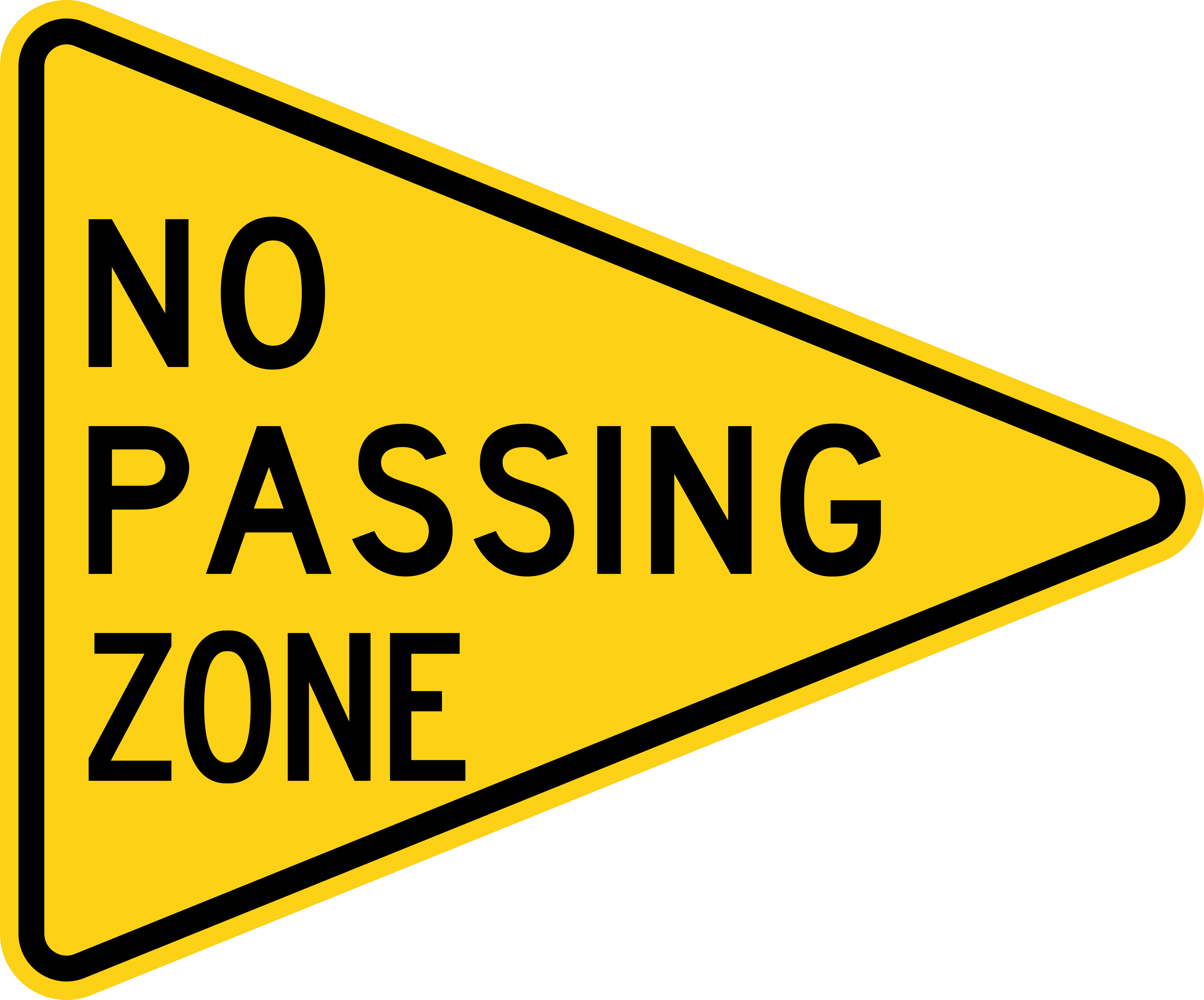
- The end of a passing zone for trucks only
- The beginning of a no-passing section ahead
- A suggested point where lawful passes should begin
- The last legal point to return after passing
Show answer
The beginning of a no-passing section ahead. That sign in Alabama marks the beginning of a no passing zone. Open view at the sign itself does not keep passing lawful beyond it, because the restriction looks ahead to sight limits, intersections, or other hazards that justify the ban. It neither ends a truck section nor invites a pass to start or finish there. Complete any lawful pass before the sign, settle into your lane, and stay behind until passing becomes lawful again past the zone.
Study this in the handbook: Sign types, regulatory signs and four way stops
9. In bright Alabama daylight, why may hand and arm signals be useful in addition to signal lights?
- Hand signals are required instead of electric lights on every sunny day
- Signal lights turn off automatically whenever bright weather occurs
- A hand signal gives you priority over other traffic at intersections
- Bright sunlight reflection can make a flashing signal light hard for others to see
Show answer
Bright sunlight reflection can make a flashing signal light hard for others to see. Glare can wash out a small blinking lamp, while an extended arm stays readable to drivers behind and beside you. The hand method supplements working lamps rather than replacing them. Vehicle lights do not shut down merely because the sun is strong. Showing an intention never grants priority; you still wait until the move is safe. Use both signals when sunlight, angle, or a doubtful lamp could hide your plan.
Study this in the handbook: Good driving habits, turns and three point turns
10. In Alabama, when may a driver take one hand off the steering wheel?
- Whenever the car is traveling straight on an open stretch of highway
- When it is needed to signal or for another purpose needed to operate the vehicle
- Whenever a passenger asks for help with something inside the car
- When the car is moving slowly enough that the other hand can hold it steady
Show answer
When it is needed to signal or for another purpose needed to operate the vehicle. The manual tells drivers to always keep both hands on the wheel. The only exception is when it is necessary to remove one hand for signaling or for another purpose necessary to the operation of the vehicle. Good posture and a firm but not rigid grip give better vision, control, and ability to maneuver in an emergency, so a straight road, a slow speed, or a passenger request does not make a one hand grip acceptable.
Study this in the handbook: Good driving habits, turns and three point turns
11. In Alabama, your wheels spin when starting on snow or ice. What starting technique should you try?
- Race the engine in first gear until the tires grip
- Rock the car by shifting rapidly between drive and reverse
- Start in second or high gear for smoother acceleration
- Turn the front wheels fully to one side for traction
Show answer
Start in second or high gear for smoother acceleration. Too much torque at a low gear can break loose tires free on packed snow or ice. A higher gear softens the force delivered at the wheels, making a smoother launch and reducing sideways slide. Racing in first gear produces more spin, and rapid rocking can damage the driveline or dig the tires deeper. Ease the clutch out slowly where equipped, or apply the accelerator gently with an automatic, and stop to clear snow if spinning continues.
Study this in the handbook: Night and winter driving
12. You park on a hill in Alabama where the road has no curb. Which way should you turn your front wheels?
- Away from the edge, toward the road center
- Toward the edge of the road, away from traffic
- Straight ahead, in line with the road
- In whichever direction the hill slope is gentler
Show answer
Toward the edge of the road, away from traffic. With no curb, the handbook gives one wheel direction for both slopes: toward the edge of the road, whether the car faces uphill or downhill. Always set the hand brake as well, and shift to PARK, or to reverse or low gear without a PARK position. Toward the center would let a rolling car enter the travel lane. Straight wheels give a rolling car no turned tire to slow its path off the roadway edge.
Study this in the handbook: Curves, bicycles, motorcycles and large vehicles
13. Your car sinks before you can escape in Alabama. Where is the usual air pocket, and what should you do there?
- In the front footwells; hold your breath there
- Under the dashboard; kick out the windshield
- No air remains anywhere inside a sinking car
- In the back, then out a window
Show answer
In the back, then out a window. A heavy engine pulls the nose downward first, leaving trapped air toward the rear as the vehicle goes under. Moving into that pocket lets you breathe while pressure equalizes and motion stops. Trying to force an exit too early can be difficult, and the front of the car submerges sooner. Once the car settles, opening or breaking a window and leaving quickly offers the best route upward. Push clear of the vehicle and swim toward the surface without delay.
Study this in the handbook: Driving emergencies
14. In Alabama, at a pedestrian crosswalk, what does the pedestrian crossing warning require a driver to do?
- Sound the horn and keep a steady speed through
- Wave pedestrians across only when traffic is light
- Stop only when a school patrol is present there
- Yield to pedestrians in the crosswalk
Show answer
Yield to pedestrians in the crosswalk. People on foot inside a marked crossing need space and time from approaching traffic. Slowing early and giving way lets them finish without hurrying between lanes. A horn blast or a hand wave can confuse a walker and nearby drivers, while a school patrol belongs to a different setting. Scan both curbs before reaching the lines, because a person may enter from behind parked vehicles. Keep the crossing clear when traffic queues, then proceed once everyone has reached safety on the far side.
Study this in the handbook: Warning, construction and guide signs
15. On a monotonous Alabama expressway, which eye habit helps a driver resist highway hypnosis?
- Shifting gaze among near and far objects on both sides
- Fixating on the taillights directly ahead
- Staring at the center line without moving the eyes
- Reading every billboard along the roadside
Show answer
Shifting gaze among near and far objects on both sides. Monotony from wind noise, tire hum, and unchanging pavement lulls the brain toward unawareness. Deliberately sampling distance and direction keeps perception active, because fresh visual targets force the mind to process changing information. Locking onto taillights or a stripe narrows that input to a single point. Billboards pull attention away from traffic tasks instead of refreshing it. Reading lawful highway signs can also support alertness during long stretches. Combined with breaks, movement of the eyes turns passive endurance into active supervision across miles that otherwise blur together.
Study this in the handbook: Losing your license, points and phone laws
16. After pulling over for an Alabama officer, where should the driver stay unless instructed otherwise?
- Standing beside the rear bumper
- Inside the vehicle with hands visible
- On the shoulder away from traffic
- Standing just outside the open driver door where the officer can see both hands clearly
Show answer
Inside the vehicle with hands visible. Remaining seated gives an officer a predictable scene and keeps the driver out of passing traffic. Hands visible on the wheel reduce uncertainty during the approach, while passengers staying calm serves the same goal. Stepping out uninvited can be misread and creates exposure beside moving lanes. Documents should wait until instructions arrive, avoiding sudden reaching that alarms an observer. Night stops benefit from interior lighting once parked safely. Following directions calmly shortens the encounter and lets questions or concerns be handled later through proper channels if disagreement remains.
Study this in the handbook: Passing, backing, lane changes and loads
17. You enter an uncontrolled Alabama intersection at an unlawful speed and another car is crossing. What happens to any right of way you might have had?
- You lose any right of way you might otherwise have had there
- You keep it, since the first vehicle in goes first
- Right of way transfers to the faster vehicle through the crossing
- Nothing changes, because speed is judged only after both clear
Show answer
You lose any right of way you might otherwise have had there. Right of way at an uncontrolled intersection is tied to lawful driving. If you enter an uncontrolled intersection at an unlawful speed, you lose any right of way which you might otherwise have had. Being first inside, traveling faster, and postponing the speed question all reward the unlawful entry. Slow to a lawful approach so the normal yield to the vehicle on the right can operate.
Study this in the handbook: Right of way and yielding
18. A sign on an Alabama interstate posts the statutory interstate figure. What speed does that posting allow where it applies?
- 45 miles per hour on county roads
- 55 miles per hour where no sign is posted
- 65 miles per hour on other posted highways
- 70 miles per hour on the interstate
Show answer
70 miles per hour on the interstate. Where the interstate figure is posted in Alabama, it allows 70 miles per hour on that interstate stretch. The 65 mile per hour figure appears in the same list for other posted zones, while 55 miles per hour covers other locations without that posting. Neither figure follows you onto every highway, because each speed in the list stays tied to its setting or posting. Read the sign in front of you and match your speed to the road you are actually on.
Study this in the handbook: Speed limits
19. Your route enters a built-up urban district in Alabama and you see no posted speed sign. What statutory top speed should you observe?
- 45 miles per hour, as on a county paved road
- 30 miles per hour in the urban district
- 55 miles per hour, as in other locations
- 35 miles per hour, as on an unpaved road
Show answer
30 miles per hour in the urban district. An urban district without a posted zone keeps the 30 mile per hour statutory limit in Alabama. Denser streets bring more driveways, cross traffic, and people on foot, so the default sits well below open road figures. The 45 mile per hour choice belongs to county paved roads, while 55 miles per hour covers other locations and 35 miles per hour covers unpaved roads. Lacking a sign, let the built-up setting remind you to settle at the urban default.
Study this in the handbook: Speed limits
20. A 19-year-old driver in Alabama has a blood alcohol content of 0.03 percent after one drink at dinner. May that driver legally drive home?
- Yes, because any driver may drive below 0.08 percent on any road
- Yes, if the trip home is short and mostly on side streets near home
- No, because drivers under 21 break the law at 0.02 percent or more
- No, only because all alcohol use under 21 is treated as a parking offense
Show answer
No, because drivers under 21 break the law at 0.02 percent or more. Drivers under 21 face a much lower line in Alabama. At 0.02 percent or more, driving is already unlawful, so a 0.03 percent reading leaves no room to drive, even for a short trip. The familiar 0.08 percent figure belongs to the general adult rule and gives a younger driver no protection here. Road type does not soften the limit either. A young driver who has had any drink should hand the keys to a sober adult or wait for a ride.
Study this in the handbook: Alcohol and the DUI law
Every question is written from the official Alabama Driver Manual. Need paper? Printable AL practice test with answer key.
Last verified 2026-10-05. How we check every question · Study all 500 as flashcards
Frequently asked questions
How many questions are on this Alabama practice test?
This fixed set has 20 questions. It is test 20 of 25 from the 500 question Alabama bank.
How does this fixed test relate to the full Alabama bank?
Each numbered test is a fixed set of questions in a fixed order, so you can retake the same test later and compare. Every test mixes road signs and the other topics in about the same proportion as the full bank. Tests 1 to 25 together cover every question in the Alabama bank once. The full practice page mixes the whole bank at random.
Last verified 2026-10-05. See the Alabama DMV facts page for sourced state details.