
Test 14 of 25 · 20 questions · Free 2026
AL Permit Practice Test 14
Jump to the test ↓A fixed 20 question set from the Alabama bank with answers and plain English explanations.
Question 1 of 20 · 0 right so far
All 20 questions in test 14
Every question below comes from the Alabama question bank on this page. Open a question to see the correct answer and the explanation. Nothing here is hidden behind a signup.
1. You park facing downhill on an Alabama street with a curb on your right. How should you set the front wheels and gears?
- Wheels toward the road edge, in PARK only
- Wheels away from the curb, in low gear
- Wheels toward the curb, in reverse gear or PARK
- Wheels straight ahead, in neutral with brake off
Show answer
Wheels toward the curb, in reverse gear or PARK. Facing downhill where a curb exists in Alabama, turn the front wheels toward the curb and shift into reverse gear or PARK, with the hand brake set for hill parking. A forward roll then meets the curb at the front tire instead of entering traffic. Wheels away from the curb with low gear belong to uphill parking, while neutral without a brake discards every safeguard. The road edge direction serves hills without curbs. Set all three protections before leaving a downhill car.
Study this in the handbook: Curves, bicycles, motorcycles and large vehicles
2. While stopping on packed snow or ice in Alabama, what should you not do with the clutch pedal?
- Do not depress the clutch to take the vehicle out of gear
- Depress the clutch fully at the start so the car coasts to a stop
- Hold the clutch halfway down through the stop to soften braking
- Push the clutch in each time the wheels begin to slip
Show answer
Do not depress the clutch to take the vehicle out of gear. A slippery stop is managed with the brakes while the car stays in gear. Apply the brakes gently, release pressure at the first hint the wheels are starting to slip, and do not depress the clutch to take the vehicle out of gear. Coasting freely on the clutch, holding it halfway, and pushing it in at each slip all disconnect the engine during a stop that needs controlled braking.
Study this in the handbook: Night and winter driving
3. A passing driver in Alabama clearly cannot finish a pass and must drop back behind you. What should you do?
- Brake firmly so the driver can slide in behind
- Move onto the right shoulder at full speed
- Hold a steady speed and ignore the other vehicle
- Increase speed, leaving room for the vehicle to move in behind you
Show answer
Increase speed, leaving room for the vehicle to move in behind you. When a passing driver must abandon the maneuver and drop back, increase your speed enough to open room behind you. That space lets the other vehicle return without braking into your rear quarter. Firm braking from you shrinks the very gap the driver needs. Moving to the shoulder at speed adds a second emergency. Steady speed may sound calm, yet it can trap the passer beside oncoming traffic. Judge the situation early. Helping the failed pass end safely protects all three vehicles that could otherwise meet in one lane.
Study this in the handbook: Driving emergencies
4. Why is excessive speed especially risky at night in Alabama?
- Headlights make the road as bright as daylight
- Night driving always requires the daytime limit
- Posted limits stop applying after dark
- Limited visibility makes the danger greater
Show answer
Limited visibility makes the danger greater. Darkness shrinks the distance a driver can read clearly, while speed shrinks the time left to react. Those two pressures work against each other. A hazard that would be easy to spot at noon may appear late at night, yet the car covers ground just as fast. Headlights help, but they do not turn night into day, and posted limits still apply after dark. Slowing down restores a margin between what you can see and the space needed to stop.
5. An Alabama YIELD sign faces you as a pedestrian steps into the crossing street and a car approaches on that street. What must you do?
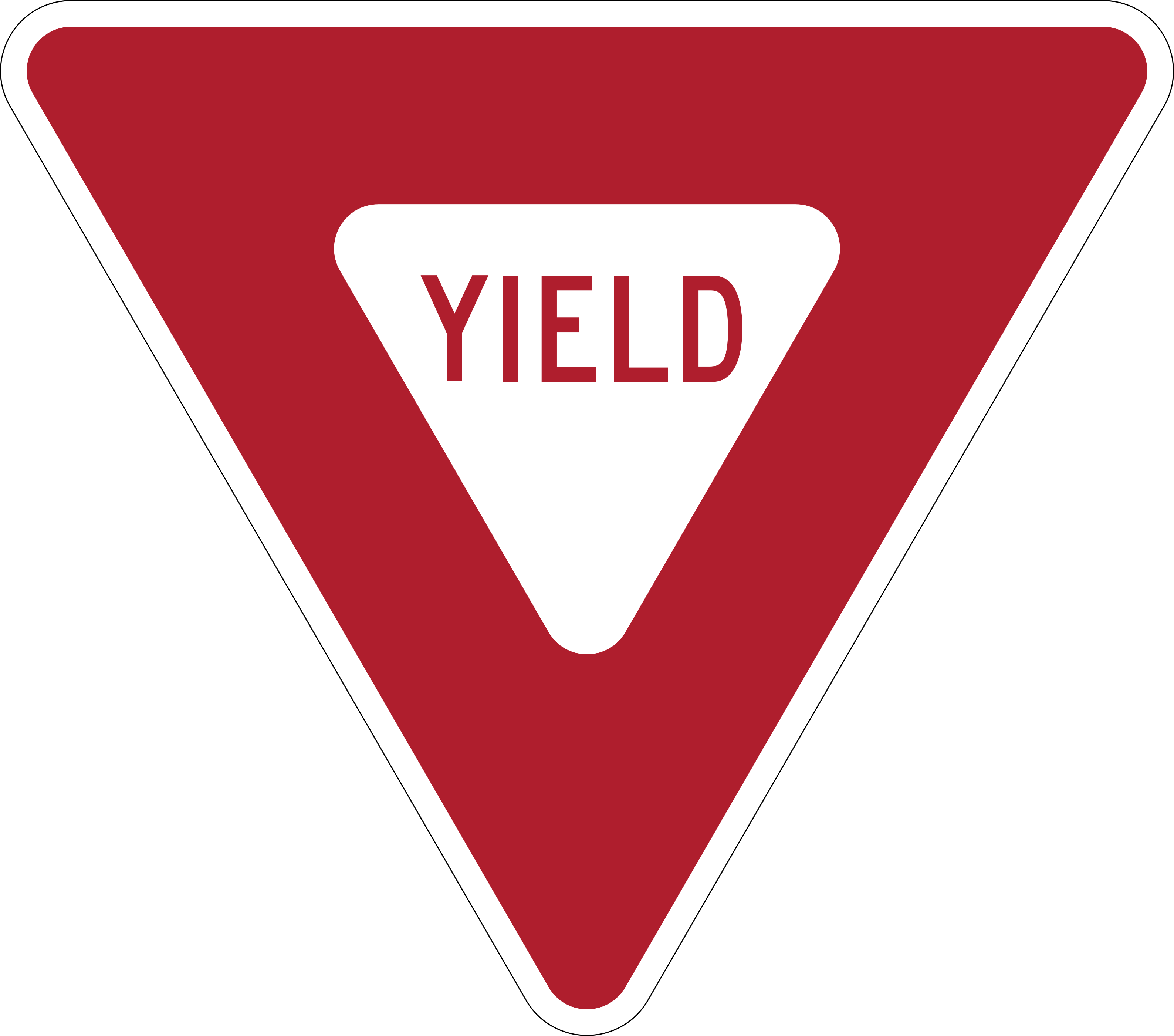
- Stop in all cases and wait for a green light
- Keep speed and pass behind the pedestrian
- Slow down and stop if needed to let them cross
- Enter quickly before the car reaches the corner
Show answer
Slow down and stop if needed to let them cross. A YIELD sign in Alabama tells you to slow down and, if necessary, stop to let vehicles and pedestrians legally crossing your path go first. A pedestrian in the crossing and a car on the intersecting street both claim that priority, so holding speed or darting ahead reverses the duty. A full stop in every case overshoots the rule, because yielding can sometimes be done by slowing alone. Judge the crossing early, slow smoothly, and stop whenever either traveler needs your space.
Study this in the handbook: Right of way and yielding
6. You walk near traffic in Alabama on a slippery road with poor visibility. What should you remember about approaching drivers?
- They may not be able to stop quickly on a slippery road
- They can always stop in the same distance as on dry pavement
- They must yield to you at every point along the road
- Poor visibility helps drivers see pedestrians sooner
Show answer
They may not be able to stop quickly on a slippery road. Pedestrians share the risk when surfaces and visibility turn poor. Slippery roads and poor visibility may hinder a driver ability to stop quickly, so a person on foot should not assume an approaching car can halt in its usual distance. Dry pavement stopping distances do not apply, drivers do not yield at every unmarked point, and limited visibility makes pedestrians harder, not easier, to see in time.
Study this in the handbook: Stopping rules, school buses and emergency vehicles
7. A large truck in Alabama signals a right turn and swings wide to the left. What should you do?
- Wait until the truck completes the turn before proceeding
- Pass quickly on the right before the truck turns
- Move into the gap on the truck's right side
- Follow closely through the wide swing
Show answer
Wait until the truck completes the turn before proceeding. Wide swings by trucks and buses create a closing space on the inside of a right turn that traps cars attempting to squeeze through. Passing on the right during the swing puts a vehicle exactly where the trailer will travel. Sliding into the right side gap looks inviting for a moment, then disappears as the rig rotates. Tailgating through the maneuver leaves no escape if the truck slows mid-turn. Hold back, watch the signal, and roll forward only after the whole vehicle straightens out.
Study this in the handbook: Curves, bicycles, motorcycles and large vehicles
8. Another car is trying to pass you in Alabama, a crash looks almost certain, and the right shoulder is wide enough. What should you do?
- Hold your lane and brake hard in front of the passing car
- Speed up at once so the passing car must stay beside you
- Steer into the left lane to block oncoming traffic
- Move quickly onto the shoulder so the passing car can use your lane
Show answer
Move quickly onto the shoulder so the passing car can use your lane. When a passing driver is trapped beside you and a head on crash is nearly unavoidable, giving up your lane can create the only open path. Moving promptly onto an adequate right shoulder lets the passing vehicle slide into the space you left instead of meeting oncoming traffic. Braking hard ahead of that vehicle or speeding up keeps it exposed longer, and swinging left puts you in the opposing lane. Check that the shoulder is firm and clear, then move without a sudden swerve.
Study this in the handbook: Driving emergencies
9. What does this sign tell an Alabama driver to expect ahead?

- A yield sign is the next control ahead
- Your lane ends and traffic merges left
- A stop sign is ahead
- A railroad crossing lies directly ahead
Show answer
A stop sign is ahead. Advance notice gives you time to prepare for a required halt rather than braking late at the control itself. A yield has its own advance sign and a different duty, while a lane ending asks for a merge. Railroad advance warnings use a round yellow sign with a cross and letters. Start easing off speed, scan the junction beyond the coming stop sign, and be ready to halt at its stop line.
10. You drive out of an alley in an Alabama business district toward the street. Where must you stop first?
- Only after entering the street and checking for cars
- At the midpoint of the sidewalk if it looks empty
- Before crossing the sidewalk or crosswalk area
- No stop is needed unless a car is approaching
Show answer
Before crossing the sidewalk or crosswalk area. People on foot use the sidewalk across your exit, so the halt belongs before your bumper reaches that path. Rolling into the street first puts you past the very conflict the stop protects. Halfway across still blocks walkers and leaves you exposed. An apparently empty approach can change as someone steps from behind a building corner. Stop, look both ways along the walk, then creep forward for a street view.
Study this in the handbook: Speed limits
11. Why does the Alabama manual stress good posture at the steering wheel, sitting erect with both hands gripping the outside rim?
- It gives better vision, control, and emergency maneuver ability
- It lets the driver rest one hand on the lap during long straight stretches of road
- It is required mainly so the driver can reach the radio without leaning forward
- It replaces the need to adjust the seat before starting a trip in the car
Show answer
It gives better vision, control, and emergency maneuver ability. Good posture is a control habit, not a comfort tip. Sitting erect and gripping the outside rim of the wheel with both hands gives better vision, better control, and a better ability to maneuver in an emergency. A loose one hand grip restricts the response when a quick steer is needed, and comfort features do not replace seat adjustment or a firm hold ready for sudden movement.
Study this in the handbook: Good driving habits, turns and three point turns
12. At night in Alabama, bright lights from a vehicle behind you reflect in your rear view mirror. How can you reduce that glare from the rear?
- Use a day-night mirror or adjust your mirror to cut out the light
- Turn the mirror fully toward the roof so no reflection reaches your eyes
- Close your eyes briefly each time the reflection brightens
- Speed up until the following vehicle is far behind you
Show answer
Use a day-night mirror or adjust your mirror to cut out the light. Glare can seriously impair vision, at times to the point of temporary blindness. Glare from behind usually arrives as the reflection of following lights in your rear view mirror. For that rear glare, the manual advises using a day-night mirror or adjusting your mirror to cut out most of the strong light from the rear. Reducing that reflection protects your view ahead without turning your attention away from traffic in front of you for long.
13. A vehicle breaks down at night on an Alabama highway. After pulling well off the road, what should the driver do?
- Walk in the travel lane to find help faster
- Use four-way flashers, raise the hood, and stay with the car if possible
- Sit in the car with all lights turned off
- Leave the hood closed so the car looks parked normally
Show answer
Use four-way flashers, raise the hood, and stay with the car if possible. Flashers and a raised hood convert a dark roadside vehicle into a recognized distress scene for patrol officers and passing motorists. Staying with the car keeps a person away from high speed traffic and preserves shelter while help is summoned. Walking in a travel lane is the most dangerous option available. Darkness with lights off hides both vehicle and occupant from approaching drivers. A closed hood gives no distress cue. If walking becomes unavoidable, carry a light and face traffic from the left edge.
14. Using the two-second rule in Alabama, what does reaching a fixed object before you finish counting show?
- You are following too closely and should gradually slow down
- Your speedometer is reading lower than your true speed
- You have exactly the right gap for wet pavement
- You should speed up until the count matches
Show answer
You are following too closely and should gradually slow down. Pick a sign post, tree, or bridge edge ahead. When the vehicle in front passes it, count one thousand one, one thousand two. Arriving at that same marker early means the gap is too short, so ease off gradually until the count fits. A wet surface needs an even longer count, not the basic one. Speeding up would shrink the space further. This roadside timing check works at many speeds without guessing car lengths.
Study this in the handbook: Phones, fatigue, following distance and crashes
15. A person walks along an Alabama roadway on foot. How should that person walk in relation to traffic and other walkers?
- As far right as possible, walking two abreast
- In the center of the lane, side by side with others
- On either side, spread across the full roadway width
- As far left as possible, in single file
Show answer
As far left as possible, in single file. Walking on the left edge puts a pedestrian facing traffic that approaches from the front, making eye contact and last second moves easier. Staying in single file keeps the group narrow and leaves room for vehicles to pass without crowding the lane. Walking on the right places traffic at the back, while spreading across the road blocks lanes. Light clothing or a carried light helps at night, yet position on the left remains the starting point whenever someone must walk in the roadway itself.
Study this in the handbook: Stopping rules, school buses and emergency vehicles
16. A person in Alabama feels stimulated after drinking alcohol. What best explains that feeling?
- Alcohol speeds up reflexes and sharpens careful judgment
- Lowered inhibitions cause a loss of caution and self-control
- Coffee and food have removed alcohol from the bloodstream
- A small drink always raises alertness without impairing vision
Show answer
Lowered inhibitions cause a loss of caution and self-control. Feeling lively after a drink can mislead a person into thinking driving skill has improved. Alcohol lowers inhibitions first, so caution fades and self control weakens while reflexes, vision, and judgment are actually getting worse. That mix explains bold choices made by someone who feels confident. Coffee or food may make a drinker feel more awake, yet neither clears alcohol from the blood. Only time lowers the amount in the body, so a stimulated feeling should be treated as a warning sign.
Study this in the handbook: Alcohol and the DUI law
17. In Alabama, a steady yellow X glows above your lane on a freeway. What does that signal allow?
- Nothing, since the lane is closed to all travel
- Parking briefly while hazard lights flash
- Travel only for buses and emergency crews
- Driving in that lane with caution amid possible hazards
Show answer
Driving in that lane with caution amid possible hazards. Lane signals sort traffic before congestion or an incident blocks the way farther ahead. A red X closes a lane outright, while yellow keeps the lane usable under a warning. Extra caution fits conditions that may soon force a merge or slowdown. Scanning mirrors, easing speed, and preparing an escape path all suit the message. Buses receive no special claim here, and parking on a freeway lane invites disaster. Treat the yellow indication as advance notice to sharpen attention, not as permission to relax or to stop where traffic flows.
Study this in the handbook: Traffic signals, arrows and lane use signals
18. You are signaling for a turn on an Alabama roadway. How long should you keep the signal on?
- Only until the first car notices you
- Until you are ready to make the actual turn
- Until halfway through the turn itself
- For exactly two seconds before turning
Show answer
Until you are ready to make the actual turn. Keep your turn signal running from the moment you declare the move until you are ready to swing. Canceling when one driver notices leaves walkers and other drivers guessing. Shutting it off halfway through the turn is also too late, since nearby traffic still needs the warning. No fixed two second rule replaces steady signaling paired with mirror checks. Start the signal at least 100 feet ahead, confirm the gap over your shoulder, then turn and let the signal cancel.
Study this in the handbook: Passing, backing, lane changes and loads
19. In Alabama, what does a clearance sign showing a height above the road tell a driver of a tall vehicle or load?
- Only trucks taller than that number must slow down and creep under slowly
- Vehicles or loads higher than that clearance cannot go under the structure ahead
- The height shown is really the width limit for the next bridge or tunnel
- Drivers may pass under the structure if they move into the center lane
Show answer
Vehicles or loads higher than that clearance cannot go under the structure ahead. That posted height marks the vertical space available under a bridge or similar structure ahead. Anything taller than the shown clearance cannot fit through, regardless of lane position. Width is a separate measurement, and slowing down does not add inches overhead. Compare your vehicle or load height before reaching the structure, then choose another route early if the numbers do not fit, rather than stopping beneath the span.
Study this in the handbook: Warning, construction and guide signs
20. Snow has begun to cover an Alabama road and you are unsure how much grip your tires have. While still moving slowly with no traffic close behind, what is the best way to judge the surface?
- Try the brakes gently while driving slowly to find how slippery it is
- Brake as hard as possible at normal speed to measure how far the car slides
- Speed up briefly, then steer sharply from side to side to test grip
- Hold normal speed until the car begins to slide, then judge the surface
Show answer
Try the brakes gently while driving slowly to find how slippery it is. Early in snow or ice, grip can change from one stretch of road to the next and may be much lower than it looks. The manual advises getting the feel of the road by trying the brakes while driving slowly, then adjusting speed to what that test shows. A gentle low speed test gives information without demanding a hard stop. Hard braking, fast steering, or holding normal speed can use up grip before the driver learns how little is available.
Every question is written from the official Alabama Driver Manual. Need paper? Printable AL practice test with answer key.
Last verified 2026-10-05. How we check every question · Study all 500 as flashcards
Frequently asked questions
How many questions are on this Alabama practice test?
This fixed set has 20 questions. It is test 14 of 25 from the 500 question Alabama bank.
How does this fixed test relate to the full Alabama bank?
Each numbered test is a fixed set of questions in a fixed order, so you can retake the same test later and compare. Every test mixes road signs and the other topics in about the same proportion as the full bank. Tests 1 to 25 together cover every question in the Alabama bank once. The full practice page mixes the whole bank at random.
Last verified 2026-10-05. See the Alabama DMV facts page for sourced state details.