
Test 3 of 10 · 20 questions · Free 2026
AL Permit Practice Test 3
Jump to the test ↓A fixed 20 question set from the Alabama bank with answers and plain English explanations.
Question 1 of 20 · 0 right so far
All 20 questions in test 3
Every question below comes from the Alabama question bank on this page. Open a question to see the correct answer and the explanation. Nothing here is hidden behind a signup.
1. What does an Alabama 16 year old need before driving without supervision?
- A letter from the school principal
- A second road test
- Parental or legal guardian permission
- Proof of 100 practice hours
Show answer
Parental or legal guardian permission. The GDL summary says 16 year olds must have parental or legal guardian permission to receive a license and to drive without supervision. A principal's letter and a second road test are not part of the rule. A 100 hour practice log is not the requirement this passage states. Even with permission, the teen's first months of licensing come with passenger, nighttime and handheld device restrictions.
Study this in the handbook: The learner license and graduated license rules
2. After an Alabama license revocation period ends, what must the driver do to be licensed again?
- Pay a fee only
- Wait one more year
- Nothing, the license restores itself
- Apply for a new license and pass the complete examinations
Show answer
Apply for a new license and pass the complete examinations. After the revocation period has expired, the driver may apply for a new driver license and will be required to take and pass the complete examinations. A fee alone does not restore a revoked license, though reinstatement fees also apply. There is no extra year of waiting in the rule, and a revoked license never restores itself. Revocation is required for offenses like a second DUI conviction or three reckless driving convictions in 12 months.
Study this in the handbook: Losing your license, points and phone laws
3. Under Alabama's basic speed law, what must a driver consider when deciding whether a speed is reasonable?
- Whether the driver has traveled the road before
- Only the posted speed limit and the vehicle's age
- The number of passengers, regardless of road conditions
- Road, weather, vehicle, and personal physical conditions
Show answer
Road, weather, vehicle, and personal physical conditions. Alabama's basic speed law requires a driver to judge speed against existing conditions. That judgment includes the road, weather, condition of the vehicle, and the driver's physical condition. A posted limit is important, but it does not make every speed safe in rain, poor pavement, a mechanical problem, or fatigue. The choice about passengers leaves out the manual's listed factors, while familiarity with a route does not cancel changing hazards. Use the practical cue that a speed acceptable on a clear, dry road may be unreasonable when visibility, traction, vehicle condition, or alertness changes.
Study this in the handbook: Speed limits
4. What action does the triangular YIELD sign call for?
- Slow down and give the right of way as needed
- Stop at the sign even when the road is empty
- Accelerate to enter before cross traffic arrives
- Ignore pedestrians because the sign applies only to cars
Show answer
Slow down and give the right of way as needed. The triangular YIELD sign is a regulatory instruction to reduce speed and give the right of way to the people and traffic using the roadway you are entering. A complete stop may be necessary, but it is not automatic in every empty-road situation. Accelerating defeats the purpose of the sign, and pedestrians are explicitly part of the protected traffic. The key cue is the downward-pointing triangle paired with the yield message: approach under control, look for crossing users, and stop if the available gap is not sufficient.
Study this in the handbook: Right of way and yielding
5. What should an Alabama driver do before leaving a parallel parking space?
- Look over the shoulder and in the mirrors, then wait for a clear way
- Pull out immediately if the front mirror is clear
- Sound the horn and enter the far lane
- Back into traffic without signaling
Show answer
Look over the shoulder and in the mirrors, then wait for a clear way. Before leaving a parallel parking space, check the mirrors and look over your shoulder, then wait until the way is clear. A mirror alone cannot show every area beside or behind the vehicle. The far-lane choice also skips the manual’s instruction to enter the nearest lane and remain there until a later change is safe. Signal the intention to leave, scan for approaching traffic and cyclists, and move smoothly only after the full entry path is open.
Study this in the handbook: Good driving habits, turns and three point turns
6. What does Alabama’s child restraint law require for children through age 15?
- They may ride unrestrained in the back seat
- They must be restrained while riding in Alabama motor vehicles
- They need a restraint only on interstate highways
- They are exempt when traveling with a parent
Show answer
They must be restrained while riding in Alabama motor vehicles. Alabama’s child restraint law requires children through age 15 to be restrained when riding in motor vehicles in Alabama. The rule applies to occupants in both front and back seats and covers the vehicle types named in the manual. A back-seat exemption is not provided, and the requirement is not limited to interstate travel. A parent’s presence does not remove the duty. Match the child’s age and size to the appropriate restraint, secure it before moving, and remember that the safety-belt rule protects every occupant regardless of age.
Study this in the handbook: Parking, safety belts and child restraints
7. If an emergency vehicle approaches while you are already in an intersection, what should you do?
- Clear the intersection before pulling over and stopping
- Stop in the intersection so the emergency vehicle can go around
- Reverse to the prior stop line
- Continue driving behind the emergency vehicle
Show answer
Clear the intersection before pulling over and stopping. When an emergency vehicle is using its warning lights and siren, traffic must yield, but a driver already in the intersection should first clear that intersection. Stopping in the middle can block the emergency vehicle and create a second conflict. Reversing is unpredictable and following the responding vehicle is not a yielding maneuver. Once clear, pull to the side and stop, then remain stopped until the emergency vehicle has passed. A good visual cue is to finish the crossing safely, open the route, and only then take the roadside position.
Study this in the handbook: Stopping rules, school buses and emergency vehicles
8. What penalty does Alabama list for a first DUI conviction?
- A $100 fine
- A warning and a class
- A five year revocation
- A fine of $600 to $2,100, up to one year in jail or both, plus a 90 day license suspension
Show answer
A fine of $600 to $2,100, up to one year in jail or both, plus a 90 day license suspension. The penalty for a first DUI conviction is a fine of $600 to $2,100, up to one year in jail, or both, and the driver license is suspended for 90 days. Under Section 32-5A-191, that suspension can be stayed if the offender elects to use an approved ignition interlock device for 90 days. Later convictions bring larger fines and license revocation rather than a short suspension, so a five year revocation belongs to a much later offense level. A $100 fine or a simple warning badly understates the first offense.
Study this in the handbook: DUI penalties and implied consent
9. What roadway transition is shown by a two-way traffic warning sign?
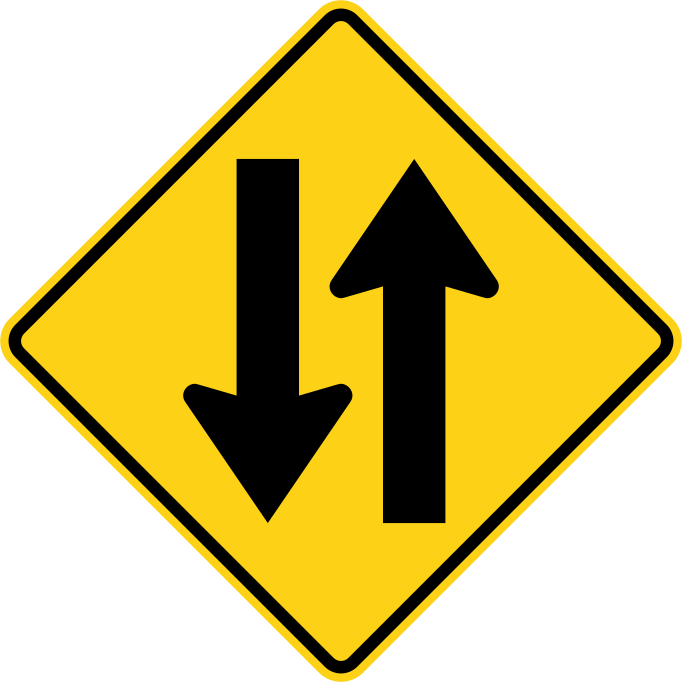
- The driver is entering a divided highway with a permanent median
- The driver is leaving a separated one-way roadway and entering a two-way roadway
- Passing is permitted in both directions without checking traffic
- All traffic must turn right at the next intersection
Show answer
The driver is leaving a separated one-way roadway and entering a two-way roadway. The two-way warning marks a change from separated one-way travel to a roadway where traffic moves in both directions. The driver should keep right and watch for oncoming vehicles. It does not promise unrestricted passing, indicate a divided highway, or require a right turn. Expect the opposing stream before crossing the centerline or choosing a passing maneuver. Check the lane ahead before moving left.
Study this in the handbook: Warning, construction and guide signs
10. Through what age must children generally be restrained under Alabama’s child restraint law?
- Through age 5
- Through age 8
- Through age 15
- Through age 12
Show answer
Through age 15. Alabama’s child restraint law requires children through age 15 to be restrained while riding in motor vehicles in Alabama. The younger ages in the choices may sound familiar because the manual assigns different equipment stages to infants, young children, and booster-seat users, but the broad law statement extends through age 15. The rule is not limited to children who still need a booster seat. Look for the phrase through age 15 when the question asks about the overall age coverage, then distinguish it from the separate size-appropriate restraint requirements.
Study this in the handbook: Parking, safety belts and child restraints
11. On snow or ice, how does stopping distance compare with stopping on dry pavement?

- It is shorter because tires grip the surface better
- It is always exactly twice as long
- It can take three to twelve times as much distance
- It is unchanged if the headlights are on
Show answer
It can take three to twelve times as much distance. The manual warns that snow or ice can require three to twelve times as much distance to stop as dry pavement. The wide range reflects changing surface and vehicle conditions, so following distance must increase substantially before a stop is needed. An exact two-times rule is too narrow, and slippery surfaces reduce tire grip rather than improve it. Headlights help visibility but do not restore traction or shorten the braking distance. Ease off the accelerator early, leave a large gap, and brake gently when the roadway is slick.
Study this in the handbook: Night and winter driving
12. How can an Alabama driver reach the State Troopers from a cell phone to report a crash or drunk driver?
- Dial 311
- Dial 0 for the operator
- Text the plate number to 511
- Dial *HP, which is *47, toll free
Show answer
Dial *HP, which is *47, toll free. For highway emergencies, to report accidents and drunk drivers, dial *HP, which is *47, toll free on your cell phone to contact Alabama State Troopers. The same section reminds drivers that parking is not permitted on the freeway except in an emergency. When reporting a crash and requesting aid, give the exact location, whether the road is blocked, and the probable damage and injuries so police can respond quickly.
Study this in the handbook: The Move Over Law
13. A car is leaving a private driveway for a public street. What must the driver do?
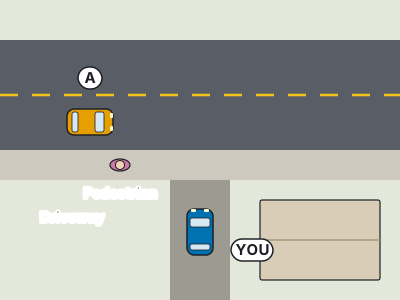
- Yield only to pedestrians, not vehicles
- Enter first because driveway traffic has priority
- Stop and yield to cars on the public street
- Proceed without stopping if the turn signal is on
Show answer
Stop and yield to cars on the public street. Cars entering from a private road or driveway must stop and yield to cars already on a public street or highway. The rule protects through traffic from vehicles emerging from a location that does not carry ordinary roadway priority. A turn signal does not replace the required stop, and the duty is not limited to pedestrians. The driveway vehicle also does not gain priority by being first to move. The roadside cue is the change from private access to public roadway: stop before entering, scan for traffic, and yield before proceeding.
Study this in the handbook: Right of way and yielding
14. How much following distance should a driver use when road or weather conditions are poor?
- One car length for every five miles per hour
- A two-second count in every condition without adjustment
- A four or five second count
- No following distance is needed below 35 mph
Show answer
A four or five second count. The manual says to increase following distance to a four or five second count when road or weather conditions are not good. The two-second rule is the basic reference for ordinary conditions, not a fixed ceiling for rain, snow, poor pavement, or other hazards. One car length per five miles per hour is not the stated adjustment, and low speed never removes the need for space to stop. Pick a fixed object, count after the vehicle ahead passes it, and enlarge the interval until your vehicle has enough room to respond smoothly.
Study this in the handbook: Phones, fatigue, following distance and crashes
15. What do two solid yellow center lines mean?
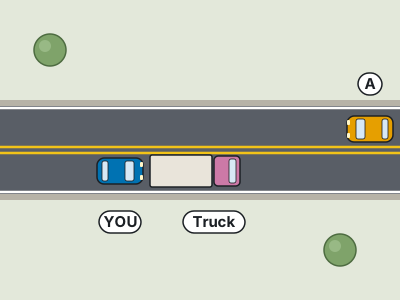
- Passing is allowed for both directions when visibility is good
- Passing is prohibited for traffic in both directions
- Only vehicles traveling in your direction may cross to pass
- The roadway is one-way until the next intersection
Show answer
Passing is prohibited for traffic in both directions. Two solid yellow lines indicate that passing is prohibited for traffic moving in both directions. The paired lines replace the broken line used where passing may be allowed, so a clear-looking roadway does not authorize crossing the center. The one-direction choice would apply only when the solid restriction is on the other side. Stay in your lane and wait for a lawful maneuver, such as a permitted left turn, rather than treating the center stripes as a passing invitation.
Study this in the handbook: Pavement markings
16. According to the Alabama manual, what causes most fatal injuries in a crash that safety belts can prevent?
- Steering assemblies cause 30 percent, and striking the windshield, frame or instrument panel causes another 40 percent
- Ejection causes 90 percent
- Fire causes most deaths
- Side impacts cause nearly all deaths
Show answer
Steering assemblies cause 30 percent, and striking the windshield, frame or instrument panel causes another 40 percent. Statistics show that in a crash, steering assemblies cause 30 percent of fatal injuries and another 40 percent of deaths are caused by striking the windshield, windshield frame or instrument panel. Safety belts can prevent these second collisions. Children under six need special child and infant restraints, because traffic accidents are the number one killer of children. Ejection, fire, and side impacts are not the causes the manual cites.
17. What response is required when a school crossing sign is visible?

- Maintain the posted speed without scanning for pedestrians
- Slow down and watch for children crossing
- Stop in the crosswalk to block children from entering
- Sound the horn continuously until the sign is passed
Show answer
Slow down and watch for children crossing. A school crossing warning calls for slower, more attentive driving because children may enter the roadway. It does not authorize blocking the crosswalk, ignoring pedestrians, or using the horn as a substitute for caution. Ease off the accelerator before the crossing and scan both sides for a child who may be hidden by a vehicle. Be prepared to stop when a pedestrian is entering or already in the crosswalk.
Study this in the handbook: Warning, construction and guide signs
18. What is the purpose of a truck apron in an Alabama roundabout?
- It marks a pedestrian-only crossing
- It provides a parking area for passenger cars
- It creates a passing lane for motorcycles
- It gives the rear wheels of large trucks extra turning space
Show answer
It gives the rear wheels of large trucks extra turning space. A truck apron is the paved inside area of a roundabout that large vehicles can use when their rear wheels track outside the standard roadway during a turn. It accommodates the longer turning path of trucks without making the whole circle wider for ordinary traffic. Passenger cars, pickup trucks, and SUVs are not intended to use it, so the parking choice misunderstands both its function and its users. Stay on the normal travel lane unless the vehicle's size and the roundabout design require the larger vehicle to mount the apron.
Study this in the handbook: Roundabouts
19. What must a driver do when approaching an Alabama regulatory sign?
- Follow it only if other traffic agrees
- Obey the sign without hesitation
- Treat it as optional route advice
- Ignore it when traveling below the speed limit
Show answer
Obey the sign without hesitation. Alabama describes regulatory signs as controls on traffic movement, and drivers must obey them without hesitation. A stop, yield, speed limit, or turn restriction therefore carries an instruction that governs the maneuver, not a suggestion that may be accepted when convenient. The choice that makes compliance depend on what nearby drivers do removes the legal force of the sign. A driver should identify the sign early, adjust speed and position, and complete the required action before continuing through the controlled area.
Study this in the handbook: Sign types, regulatory signs and four way stops
20. At a railroad crossing, what should you do when the red lights begin flashing?
- Stop and wait until crossing is safe
- Drive around the gates before they lower
- Continue if you cannot yet see a train
- Stop only when another vehicle stops first
Show answer
Stop and wait until crossing is safe. Flashing red lights at a railroad crossing mean a train is near, so the driver must stop and wait. The manual also says to make sure every track is clear when more than one track exists before proceeding. Driving around a gate is dangerous and defeats the crossing warning. Waiting for another vehicle to stop is not a condition of the rule, and the absence of a visible train is not proof that the tracks are safe. Stop before the crossing, observe all tracks, and move only after the signals no longer require a stop and the route is clear.
Study this in the handbook: Traffic signals, arrows and lane use signals
QualitySpace is expanding to Alabama
We are a California-based independent insurance brokerage working on licensing in more states. We cannot help with Alabama insurance yet. Leave your email and we will let you know when we can.
Every question is written from the official Alabama Driver Manual. Need paper? Printable AL practice test with answer key.
Last verified 2026-10-05. How we check every question · Study all 200 as flashcards
Frequently asked questions
How many questions are on this Alabama practice test?
This fixed set has 20 questions. It is test 3 of 10 from the 200 question Alabama bank.
How does this fixed test relate to the full Alabama bank?
Each numbered test is a fixed set of questions in a fixed order, so you can retake the same test later and compare. Every test mixes road signs and the other topics in about the same proportion as the full bank. Tests 1 to 10 together cover every question in the Alabama bank once. The full practice page mixes the whole bank at random.
Last verified 2026-10-05. See the Alabama DMV facts page for sourced state details.