
Test 19 of 25 · 20 questions · Free 2026
AL Permit Practice Test 19
Jump to the test ↓A fixed 20 question set from the Alabama bank with answers and plain English explanations.
Question 1 of 20 · 0 right so far
All 20 questions in test 19
Every question below comes from the Alabama question bank on this page. Open a question to see the correct answer and the explanation. Nothing here is hidden behind a signup.
1. At an Alabama traffic stop, the officer asks for documents that are in a glove box or bag out of your easy reach. What should you do first?
- Tell the officer first, then reach for the documents
- Reach for them quickly so the stop is not delayed
- Ask a passenger to hand them over without telling the officer
- Wait until the officer returns to the patrol car, then search
Show answer
Tell the officer first, then reach for the documents. Documents at a stop should change hands without sudden movement. If the requested documents are out of your reach, inform the officer prior to reaching for them, and do not search for a license or other papers until instructed. Reaching quickly, having a passenger hand things over silently, and searching after the officer walks away all create the unexplained movement the instruction is meant to prevent.
Study this in the handbook: Passing, backing, lane changes and loads
2. An Alabama driver feels angry and depressed after a heated argument. What should the driver do before traveling?
- Let someone else drive
- Drive slowly until the feelings pass
- Take a familiar route to relax
- Turn on music and keep driving
Show answer
Let someone else drive. Strong feelings narrow attention and invite rushed choices at exactly the wrong moments. Slowing down still leaves an upset person steering, judging gaps, and reacting to surprises while preoccupied. Familiar pavement and music do not restore calm judgment either. Handing the keys over removes the risk entirely until balance returns. Cooling off first, talking the problem down, or riding with another person all protect everyone nearby. Pride often pushes people to drive anyway, yet stepping aside shows maturity rather than weakness on the road.
Study this in the handbook: Phones, fatigue, following distance and crashes
3. On which Alabama roadways is passing on the right permissible?
- Only on gravel roads with no centerline and very light traffic present
- Only beside a vehicle that is waiting to turn right at an intersection
- Only when the paved shoulder is wide enough for a full vehicle width
- On one-way roads and highways with two or more same-direction lanes
Show answer
On one-way roads and highways with two or more same-direction lanes. Right side passing belongs on roads built for same direction flow, where the passed vehicle will not turn across that path from an opposing lane. One way streets and multilane same direction highways provide that structure. Gravel surfaces and wide shoulders do not create permission, because shoulders sit outside the travel lanes. Passing beside a right turning vehicle is the opposite pattern and can conflict with its turn. Before moving right, confirm lane markings allow the movement, check mirrors and the blind area, signal, and leave the passed driver room to react.
Study this in the handbook: Passing, backing, lane changes and loads
4. Your car stalls on railroad tracks in Alabama and has an automatic transmission. No train is approaching yet. How should you try to move the car clear?
- Run the starter while in low or second gear
- Keep trying the ignition while seated on the tracks
- Get out and push the car off the tracks
- Rock the car free by shifting between drive and reverse
Show answer
Get out and push the car off the tracks. A starter motor trick can roll a manual gearbox car clear because the starter turns the engine with a low gear engaged. An automatic gearbox gives no such path, so muscle power becomes the way to clear the rails when conditions allow people to push safely. Hands on the bodywork and steady pressure move the car beyond the steel rails. If a train appears while the car stays stuck, everyone needs to leave at once and move along the tracks toward it.
Study this in the handbook: Driving emergencies
5. Your friends are waiting outside a house in Alabama and you want them to come out. How may you use the car horn?
- Use short honks until they hear you, if the street is quiet
- Tap it twice to call passengers to the car
- Honk for passengers after dark if you also flash the headlights
- Never use it to announce arrival or call passengers
Show answer
Never use it to announce arrival or call passengers. The horn is a warning device, not a doorbell. It is unlawful to use a motor vehicle horn for any purpose except giving warning when reasonably necessary to insure safe operation, and the manual adds: never use the horn to announce arrival or call your passengers. A quiet street, a double tap, and flashing lights do not create an exception for summoning people from a house.
6. In Alabama, you are stopped behind a school bus with its red lights flashing and stop arm out. When may you proceed?
- As soon as children have crossed to the far curb
- After ten seconds if no child is visible
- Only after the arm is retracted and the red lights are off
- Once the driver waves traffic past the bus
Show answer
Only after the arm is retracted and the red lights are off. Stay stopped while the bus displays flashing red lights with its arm extended. Movement resumes only after the arm has been pulled back and those red lights go dark. Children finishing one crossing do not end the loading period, since another child may still leave the bus or cross back. A hand wave cannot override the bus signals either. Hold position, scan both sides of the roadway, then move only after the equipment itself shows loading has ended and the path ahead looks clear for everyone nearby.
Study this in the handbook: Stopping rules, school buses and emergency vehicles
7. In Alabama, what do white solid lines used at intersections and sometimes between intersections denote?
- Bicycle lanes reserved for riders only
- Truck aprons for large vehicle rear wheels
- Pedestrian crosswalks
- Railroad stop bars for trains only
Show answer
Pedestrian crosswalks. White solid lines across the roadway outline pedestrian crosswalks. They appear at intersections and sometimes at mid block crossing points. Drivers must respect people inside those boundaries, especially where no signal controls the crossing. Bicycle lane markings run along the roadway rather than across it. Truck aprons belong inside roundabouts. Railroad stop placement uses its own lines near tracks. When parallel white bars come into view, scan both curbs early. A person may already be between parked vehicles and the marked crossing space.
Study this in the handbook: Pavement markings
8. In Alabama, parking is prohibited within what distance of a fire hydrant?
- Within 15 feet of the hydrant
- Within 50 feet of the hydrant
- Within 30 feet of the hydrant
- Parking beside a hydrant is allowed if the driver stays in the car
Show answer
Within 15 feet of the hydrant. Parking is barred within fifteen feet of a fire hydrant in Alabama. That clear space lets firefighters connect hoses and work around the hydrant without a parked vehicle blocking access. Thirty and fifty feet describe other no parking clearances in the same list, covering traffic control devices and railroad rails. Staying seated inside the car does not turn prohibited parking into a legal stop. Measure from the hydrant itself before leaving the vehicle. When the distance looks doubtful, choose a space farther along the block instead of guessing.
Study this in the handbook: Parking, safety belts and child restraints
9. You are 34 years old and driving your own car home in Alabama after drinking. A test shows 0.09 percent alcohol in your blood. Which statement fits Alabama law for a driver in your situation?
- Driving is unlawful at 0.08 percent or more
- Driving is unlawful only above 0.12 percent
- The level matters only for truck drivers
- Driving is allowed until the level reaches 0.10 percent
Show answer
Driving is unlawful at 0.08 percent or more. Alabama treats 0.08 percent or more as unlawful for a driver age 21 or older in a noncommercial vehicle, apart from the separate ban on driving while under the influence. A reading of 0.09 percent is already past that line, so waiting for 0.10 percent misreads the threshold. Commercial limits and higher figures borrowed from other rules do not raise the general line. If you have been drinking, arrange another ride well before any test becomes part of the trip.
Study this in the handbook: Alcohol and the DUI law
10. At night in Alabama you follow closely behind a large truck. What should you do with your headlights?
- Keep high beams on so the truck driver can see you better
- Dim them so the glare does not reach the truck driver
- Flash high beams to signal you want to pass
- Turn headlights off and follow by the truck's tail lights
Show answer
Dim them so the glare does not reach the truck driver. Large trucks and buses have a large blind area directly behind them, so the driver may not see a following car at all. At night, bright following lights add another problem because they reflect from the large side mirrors and can blind that driver. Dim your headlights when following a large vehicle at night. Keeping distance also matters, because a sudden stop by the truck leaves a close follower with nowhere to go.
Study this in the handbook: Curves, bicycles, motorcycles and large vehicles
11. You are driving on a paved county road in Alabama. No speed sign is posted along this stretch. What top speed does the statutory limit allow?
- 30 miles per hour
- 35 miles per hour
- 55 miles per hour
- 45 miles per hour
Show answer
45 miles per hour. County paved roads carry a 45 mile per hour statutory limit in Alabama when no other limit is posted. The lower figures belong to different settings, with 30 miles per hour for an urban district and 35 miles per hour for an unpaved road. The 55 mile per hour figure covers other locations outside those listed settings, not a county paved road. When no sign appears, picture the road surface and county setting, then use the limit tied to that setting.
Study this in the handbook: Speed limits
12. What does an Alabama NO PARKING sign mean if the driver stays seated in the car?
- Parking is allowed while the driver remains inside
- Parking is allowed for five minutes with flashers on
- The car may not be parked in that area even though the driver stays in it
- Only commercial vehicles are barred from parking there
Show answer
The car may not be parked in that area even though the driver stays in it. Staying behind the wheel does not turn a prohibited parking spot into a legal one under that sign. Flashers and a short time limit do not create an exception in the wording given. Commercial status is not the dividing line either. Keep moving to a lawful space instead of waiting in the barred area, even for a quick pickup, because a stopped car still blocks sight lines and traffic flow there.
Study this in the handbook: Sign types, regulatory signs and four way stops
13. In Alabama during winter driving, which group of symptoms points to carbon monoxide poisoning?
- Hunger, thirst, sneezing, and itchy eyes
- Sudden weariness, yawning, dizziness, and nausea
- Sharp back pain and a rapid heartbeat only
- Loss of hearing and numb fingers only
Show answer
Sudden weariness, yawning, dizziness, and nausea. Carbon monoxide has no odor, so early body signals may be the only warning before judgment and consciousness fail. Weariness that arrives suddenly, repeated yawning, dizziness, or nausea inside a closed car should prompt an immediate move into fresh air. Eating or turning up heat does not remove the gas. Stop in a safe place, shut off the engine if exposure may continue, get everyone outside, and seek medical help when symptoms persist or worsen.
Study this in the handbook: Skids, hydroplaning, fog and hills
14. A passing car can complete its pass with your help in Alabama. What should you do?
- Slow your speed to allow the passing driver to move ahead quickly
- Speed up so the passing car must stay beside you
- Move left to block the passing lane
- Maintain speed and flash your lights repeatedly
Show answer
Slow your speed to allow the passing driver to move ahead quickly. Helping a driver finish a pass shortens the time spent beside opposing traffic. Easing off creates space ahead so that vehicle can return to the right lane sooner. Accelerating or blocking extends the dangerous overlap and can force a head-on conflict. Judge early whether the pass can finish; if it clearly cannot, the passing driver needs room behind you instead. Cooperation and predictable speed changes give everyone more margin when traffic approaches.
Study this in the handbook: Driving emergencies
15. You are in an Alabama freeway acceleration lane and traffic is moving. When may you come to a full stop in that lane?
- At the end of every ramp before merging
- Whenever the first gap looks small
- To let a passenger check directions
- Only if absolutely necessary
Show answer
Only if absolutely necessary. Stopping on an acceleration lane defeats its purpose and leaves a driver trying to join fast traffic from zero speed. Routine hesitation at the ramp end produces exactly that danger, even when the nearest gap looks tight. A better response is adjusting pace early so a usable opening develops. Checking directions belongs off the freeway entirely, never in a live merge area. Keep rolling and match traffic speed; reserve a complete halt for moments when continuing would cause an immediate collision.
Study this in the handbook: The Move Over Law
16. Red lights begin flashing at an Alabama railroad crossing as you approach, though no train has entered the crossing yet. What must you do?
- Cross quickly before the train arrives
- Stop and wait until the crossing is safe
- Proceed if the crossing has no gates
- Stop only after a train becomes visible
Show answer
Stop and wait until the crossing is safe. Flashing red lights at an Alabama railroad crossing mean a train is near, so you must stop and avoid proceeding until you can do so safely. The absence of a train inside the crossing and the lack of gates do not shorten that duty, because the lights warn of approach rather than arrival. Waiting for a visible train wastes the warning the lights provide. Stop before the tracks, check every track in both directions, and cross only when all are clearly safe.
Study this in the handbook: Traffic signals, arrows and lane use signals
17. You need to dial a number while traveling in Alabama. What should you do?
- Dial while coasting slowly
- Pull off the road before dialing the number
- Hold the phone low and dial with only brief glances
- Finish dialing quickly before the next intersection
Show answer
Pull off the road before dialing the number. Dialing takes eyes and attention from traffic at the moment road conditions can change. Your first responsibility while using a phone is driving itself, so pull off the road to dial or to complete a conversation. Coasting slowly while dialing, hiding the phone low, and rushing to finish before an intersection all keep the dialing task inside moving traffic. Stopping clear of travel lets the call happen without steering through it.
Study this in the handbook: Losing your license, points and phone laws
18. You back out of a private driveway toward an Alabama public street as cars travel past on that street. What must you do before entering their lane?
- Sound the horn and continue without stopping
- Yield only to cars approaching from your left
- Enter slowly and let street traffic move around you
- Stop and yield to cars on the public street
Show answer
Stop and yield to cars on the public street. Cars entering from a private road or driveway in Alabama must stop and yield to cars already traveling on the public street or highway. Street traffic holds the through movement, so easing in and expecting others to swing around you reverses the duty. A horn blast does not replace the stop, and yielding to one side only leaves half the street unchecked. Stop at the edge, look both ways, and enter when both directions leave a safe opening.
Study this in the handbook: Right of way and yielding
19. Rain has cleared and traffic is moving normally past an Alabama SPEED LIMIT sign. What does the number on that sign give you?
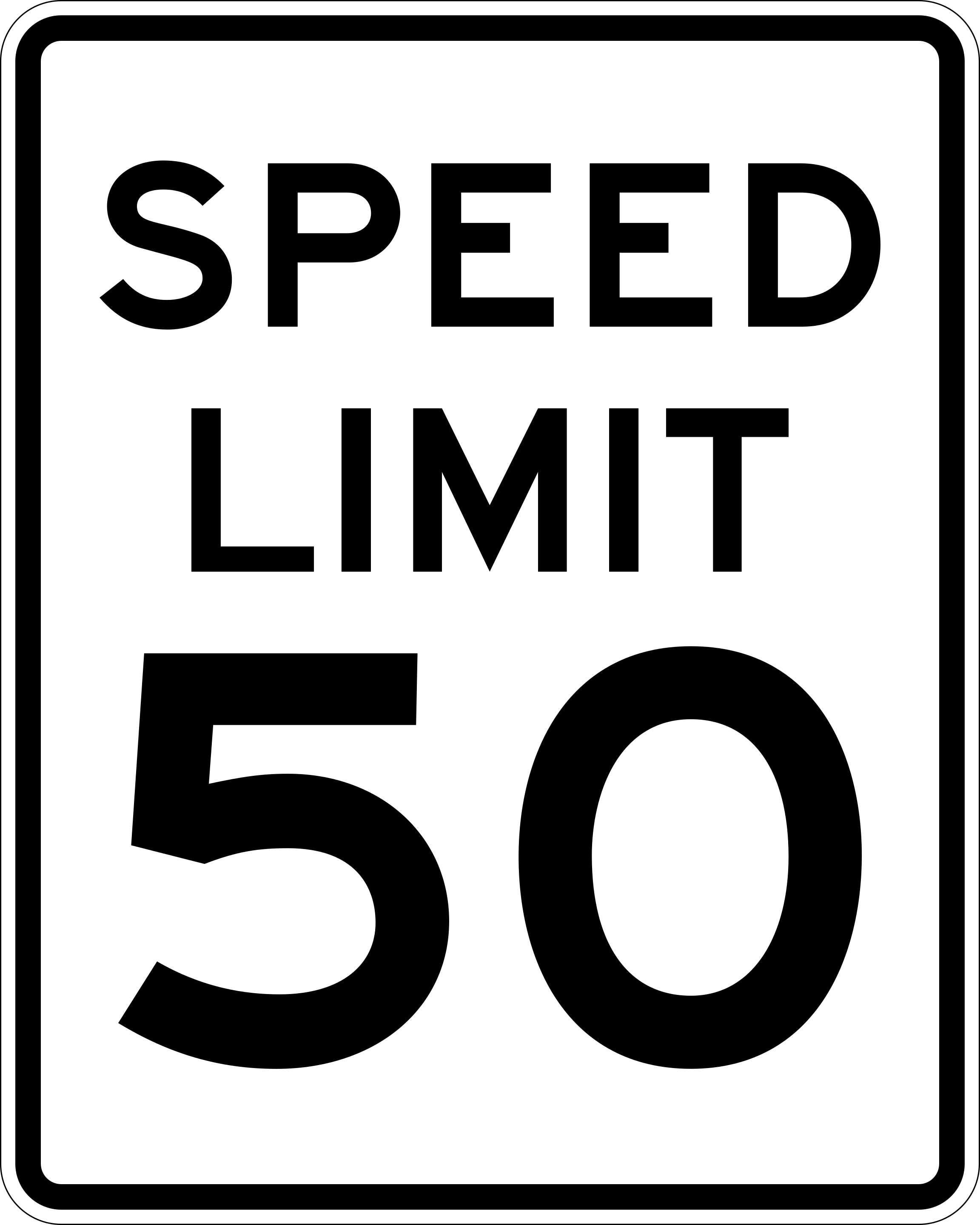
- A limit that applies only to trucks and buses
- A suggested pace that faster drivers may exceed
- The posted speed under normal conditions
- The slowest speed allowed in any weather
Show answer
The posted speed under normal conditions. The number on a speed limit sign states the posted speed for normal conditions on that stretch of highway, within the broader maximum and minimum framework for the section. Normal, cleared weather is the setting the figure assumes, so treating it as a loose suggestion invites unlawful speed. It also does not convert into a floor for foul weather, when slower travel may be needed. Take the figure as the ceiling for ordinary conditions and lower your speed when conditions worsen.
Study this in the handbook: Sign types, regulatory signs and four way stops
20. Your car stalls on Alabama railroad tracks and a train is approaching. You get everyone out and the car cannot be moved. Which way should you walk?
- Alongside the tracks toward the approaching train
- Behind the car, in line with the tracks
- Away from the train, alongside the tracks
- Across the field at a right angle for a mile
Show answer
Alongside the tracks toward the approaching train. After abandoning a stalled car on Alabama tracks with a train approaching, walk quickly alongside the tracks in the direction of the approaching train. That direction moves you away from where wreckage will be thrown when the train strikes the car, which tends to scatter debris forward and backward along the line. Walking away from the train keeps you near the impact scatter, and standing behind the car is worst of all. Angle away from the rails as you move toward the train side.
Study this in the handbook: Driving emergencies
Every question is written from the official Alabama Driver Manual. Need paper? Printable AL practice test with answer key.
Last verified 2026-10-05. How we check every question · Study all 500 as flashcards
Frequently asked questions
How many questions are on this Alabama practice test?
This fixed set has 20 questions. It is test 19 of 25 from the 500 question Alabama bank.
How does this fixed test relate to the full Alabama bank?
Each numbered test is a fixed set of questions in a fixed order, so you can retake the same test later and compare. Every test mixes road signs and the other topics in about the same proportion as the full bank. Tests 1 to 25 together cover every question in the Alabama bank once. The full practice page mixes the whole bank at random.
Last verified 2026-10-05. See the Alabama DMV facts page for sourced state details.