
Test 4 of 10 · 20 questions · Free 2026
AL Permit Practice Test 4
Jump to the test ↓A fixed 20 question set from the Alabama bank with answers and plain English explanations.
Question 1 of 20 · 0 right so far
All 20 questions in test 4
Every question below comes from the Alabama question bank on this page. Open a question to see the correct answer and the explanation. Nothing here is hidden behind a signup.
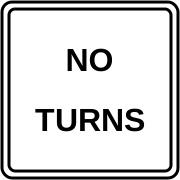
1. At an intersection, which movement is prohibited by a NO TURNS sign?
- Only a U-turn, while right and left turns remain open
- Both right and left turns
- Only a left turn from the inside lane
- Only a turn made after a complete stop
Show answer
Both right and left turns. The no-turns sign closes both turning choices at that intersection. It is broader than a sign that bans only a U-turn or only a left turn, and stopping first does not create an exception. Drivers should continue straight only if that movement is permitted, or choose another route. Read the words and symbol together before entering the intersection so a last-second turn is not attempted.
Study this in the handbook: Sign types, regulatory signs and four way stops
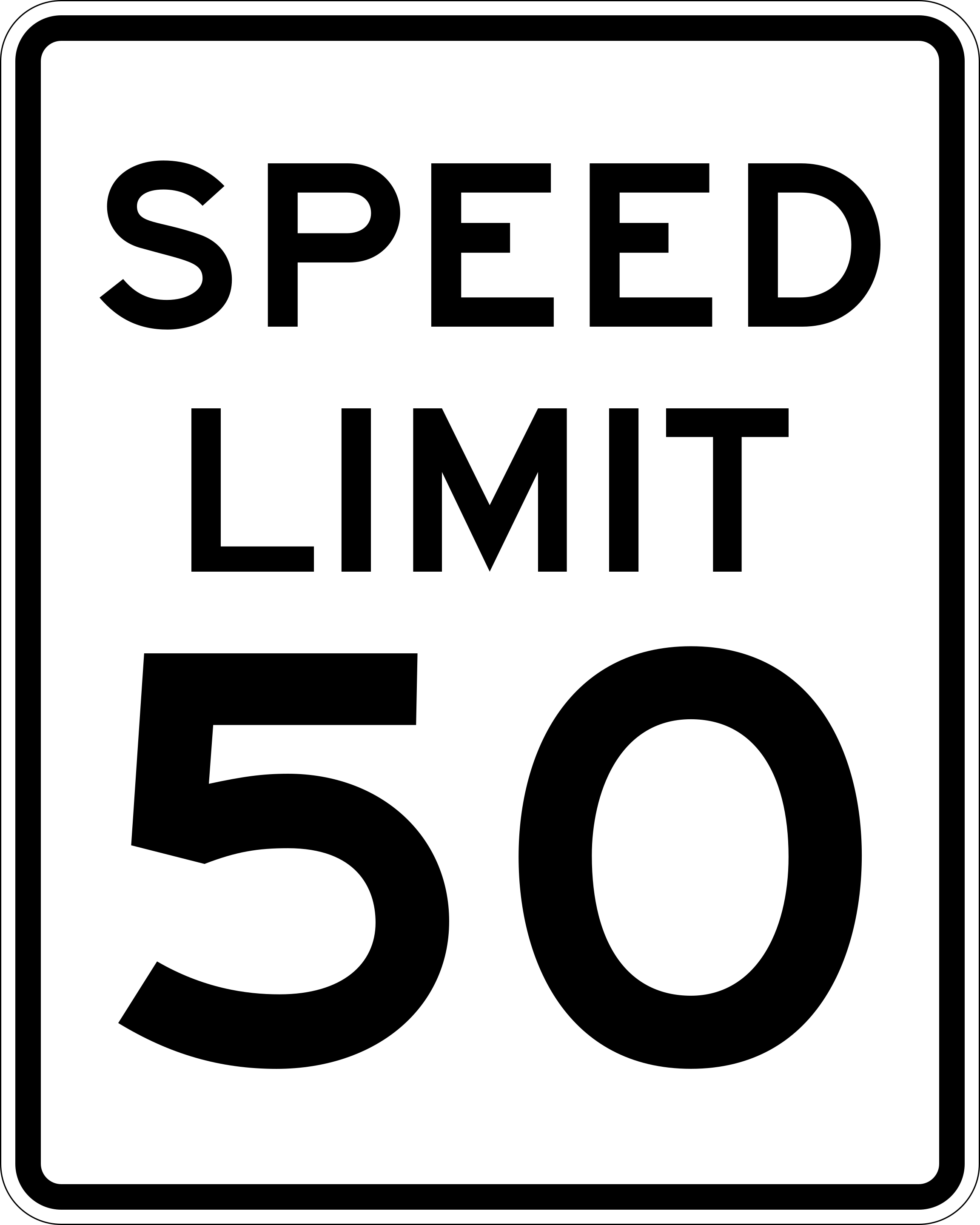
2. What does the SPEED LIMIT number on a regulatory sign represent?
- The minimum speed required on every road
- A suggested speed that may be exceeded whenever traffic is light
- The posted speed under normal conditions
- The speed allowed only while passing
Show answer
The posted speed under normal conditions. The posted number is the speed limit under normal conditions. It is not merely a suggestion, a universal minimum, or a special passing speed. Weather, traffic, visibility, and road conditions can require a driver to go slower. Use the regulatory sign as the ceiling for ordinary conditions, then reduce speed whenever the roadway or surroundings make that limit unsafe. Where a minimum limit is also posted, usually on freeways and other controlled access highways, the sign shows both the maximum and minimum speeds permitted.
Study this in the handbook: Sign types, regulatory signs and four way stops
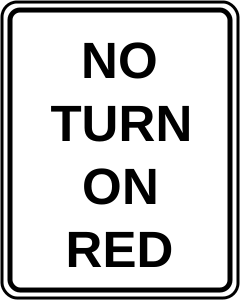
3. What does a NO TURN ON RED sign change at a signalized intersection?
- It prohibits a right or left turn on red at that intersection
- It permits a turn without stopping if the road is clear
- It requires every vehicle to remain stopped after green appears
- It applies only to U-turns made from a red arrow
Show answer
It prohibits a right or left turn on red at that intersection. This sign removes the usual red-light turning permission at the marked intersection. A driver must wait for a permissive signal before making the prohibited right or left turn. Clear pavement does not override the posted instruction, and the sign is not limited to U-turns. Look for it beside the signal or at the corner, then remain behind the stop line until the allowed movement appears.
Study this in the handbook: Sign types, regulatory signs and four way stops
4. What does Alabama establish through the uniform point system described in the manual?
- A system that automatically cancels every driver's license after one violation
- A system for suspending driver licenses based on listed grounds
- A system that applies only to commercial vehicle operators
- A system for setting county property tax rates
Show answer
A system for suspending driver licenses based on listed grounds. The manual presents Alabama's point system as a uniform system used to suspend driver licenses on one or both of the grounds listed in Section 32-5A-195. It then assigns point values to enumerated offenses for each driver, whether the offense occurred in Alabama or elsewhere. The cancellation choice overstates the effect by making every violation automatic, while the commercial-only option narrows a rule that applies to each driver. Property taxes have no connection to the driver-license system. The useful cue is that listed offenses receive points, and accumulated grounds can lead to suspension.
5. If you miss your exit in an Alabama roundabout, what should you do?
- Stop in the circle and reverse to the exit
- Drive around again to reach the exit
- Turn left across the center island
- Leave through the nearest entry point
Show answer
Drive around again to reach the exit. Missing an exit in a roundabout is handled by continuing around the circle and taking that exit on the next pass. The design allows a driver to correct the missed choice without backing into circulating traffic or crossing the center island. Stopping inside the roundabout creates a conflict, and reversing is specifically unsafe. The nearest-entry choice may send the vehicle against the one-way circulation pattern. Keep moving at a low speed, maintain the proper lane, and complete another circuit until the intended exit is reached.
Study this in the handbook: Roundabouts
6. What is the statutory speed limit in an Alabama urban district unless another zone is posted?
- 55 miles per hour
- 35 miles per hour
- 45 miles per hour
- 30 miles per hour
Show answer
30 miles per hour. The manual lists 30 miles per hour as the statutory limit in an urban district, unless an officially posted speed zone establishes another limit. The 35 mph figure applies to an unpaved road, 45 mph applies to a county paved road unless posted, and 55 mph covers other locations in the listed statutory limits. Treat the road classification and signs as part of the question. A driver should not borrow the county-road number simply because the street is paved, nor assume the general rural figure applies inside a municipality.
Study this in the handbook: Speed limits
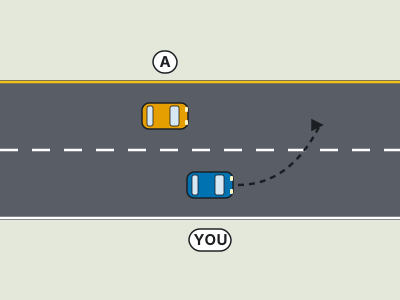
7. What should an Alabama driver do when changing lanes?
- Rely only on the inside mirror
- Check clearance and the blind spot before moving
- Signal after entering the new lane
- Move first if the other lane looks faster
Show answer
Check clearance and the blind spot before moving. Before changing lanes, check safe clearance beside, ahead, and behind the vehicle, then glance over the shoulder to inspect the blind spot. Mirrors do not cover every area, so relying only on one is incomplete. A signal announces intent but does not grant permission to move, which makes signaling after entry especially unsafe. Wait for a real gap, keep the signal active through the maneuver, and move smoothly without forcing another road user to brake.
Study this in the handbook: Passing, backing, lane changes and loads
8. Before entering an Alabama roundabout, whom must you yield to?
- No one if you signal a left turn
- Only vehicles approaching from the right
- Vehicles behind you but not people crossing
- Pedestrians, bicyclists, and traffic already in the roundabout
Show answer
Pedestrians, bicyclists, and traffic already in the roundabout. Before entering a roundabout, the driver must yield to pedestrians and bicyclists, then yield to traffic already circulating on the driver's left. Entry is allowed when a safe gap appears. The right-side choice imports a different intersection habit and overlooks the traffic already moving around the circle. A turn signal cannot create priority, so the signaling choice is also wrong. Slow down, read the yield signs, check the crosswalk, and watch the circulating lane before choosing an opening that does not force another road user to brake.
Study this in the handbook: Roundabouts
9. How long is an Alabama license suspended for 18 to 20 points in a 2-year period?
- 120 days
- 60 days
- 180 days
- 90 days
Show answer
120 days. The schedule lists 18 to 20 points in a 2-year period as a 120 day suspension. Sixty days is for 12 to 14 points, 90 days for 15 to 17, and 180 days for 21 to 23. Knowing the ladder matters because each step is only three points apart. The most serious point offenses, such as alcohol related convictions without mandatory revocation, count 6 points each.
Study this in the handbook: Losing your license, points and phone laws
10. How many reckless driving convictions within 12 months require the Alabama Director to revoke a license?
- Three
- Two
- Four
- One
Show answer
Three. The Director must revoke a license on receiving a record of three reckless driving convictions within 12 months. Other mandatory revocations include vehicular manslaughter or homicide, a second or later DUI conviction, using a vehicle in a felony, and failing to stop and render aid after an injury crash. One or two reckless convictions do not trigger this rule, and four is more than the rule requires.
Study this in the handbook: Losing your license, points and phone laws
11. What is the minimum reinstatement fee after an Alabama license is suspended, revoked, canceled or disqualified?
- $25
- $50
- $10
- Not less than $100
Show answer
Not less than $100. Anyone whose Alabama license has been canceled, suspended, revoked or disqualified must pay a reinstatement fee of not less than $100, plus meet other legal requirements, before being relicensed. The $50 figure is an added fee for failing to surrender the license on time, not the base fee. Twenty-five and ten dollars both fall below the stated minimum, so neither can be the reinstatement fee.
Study this in the handbook: Losing your license, points and phone laws
12. What does Alabama state law prohibit placing on a vehicle window?
- A clean window with no attached material
- A transparent inspection sticker in the permitted location
- A rearview mirror mounted inside the vehicle
- A sign, poster, or other material that obstructs the driver's view
Show answer
A sign, poster, or other material that obstructs the driver's view. Alabama prohibits a sign, poster, or other material on a vehicle window when it obstructs the driver's view. The focus is the obstruction, not a blanket ban on every item associated with a window. A properly placed inspection sticker is not described by this sentence as the prohibited conduct, and an interior rearview mirror serves the driver's view rather than obstructing it. A clear window has no obstructing material at all. Before driving, check that decorations, papers, and other additions do not block the sightline needed for safe observation.
Study this in the handbook: Passing, backing, lane changes and loads
13. What colors identify warning signs in Alabama, except for signs used in construction areas?
- Black and yellow, while construction signs are black and orange
- White and red, while construction signs are blue and white
- Green and white, while construction signs are black and yellow
- Orange and blue, while construction signs are white and red
Show answer
Black and yellow, while construction signs are black and orange. Warning signs normally use a black symbol or message on a yellow background. Construction areas are the important color exception, using black and orange instead. A green and white sign generally guides drivers, while white and red combinations are associated with regulatory messages. Do not choose a color pairing simply because orange suggests danger. On a practice question, first decide whether the sign warns about an ordinary roadway hazard or a temporary work area, then apply the matching color scheme. That quick classification helps distinguish a construction warning from a standard curve, crossing, or lane warning.
Study this in the handbook: Warning, construction and guide signs
14. Where is backing prohibited except for emergency vehicles performing their duties?
- At a private business entrance
- In a marked parking space
- On a residential driveway
- On controlled access highways
Show answer
On controlled access highways. Backing is prohibited on controlled access highways, including freeways and expressways, except when an emergency vehicle is performing its duties. Those roads are designed for travel without stops or cross traffic, so a reversing vehicle creates an especially severe conflict. The parking-space option describes a maneuver the manual allows when backing into a parking place, and ordinary driveways or business entrances are not the named prohibition. If you miss a freeway exit, do not stop, back up, or turn around; proceed to the next exit and come back.
Study this in the handbook: Passing, backing, lane changes and loads
15. By how much do roundabouts reduce fatal crashes, according to statistics in the Alabama manual?
- About 10 percent
- About 90 percent, with injury crashes down about 75 percent and all crashes about 35 percent
- They increase fatal crashes
- About 50 percent
Show answer
About 90 percent, with injury crashes down about 75 percent and all crashes about 35 percent. Crash statistics show that roundabouts reduce fatal crashes about 90 percent, reduce injury crashes about 75 percent, and reduce overall crashes about 35 percent compared with other types of intersection control. Keeping traffic moving one way in a counterclockwise direction leaves fewer conflict points. Yield to traffic already in the circle and to pedestrians before entering, and avoid stopping inside the circle.
Study this in the handbook: Roundabouts
16. What does a steady circular yellow traffic signal require a driver to do?
- Clear the intersection and do not enter when the red signal comes on
- Enter quickly before the red signal
- Stop only if another vehicle is present
- Turn in any direction without yielding
Show answer
Clear the intersection and do not enter when the red signal comes on. A steady circular yellow means the driver should clear the intersection, and must not enter it when the red signal comes on. It is not an invitation to accelerate through the junction. The option “Enter quickly before the red signal” encourages a late entry, while the stop-only-if-busy option overlooks the signal change itself. If you are already lawfully in the intersection, proceed out safely. If you have not entered, prepare to stop when safe and obey the red indication that follows.
Study this in the handbook: Traffic signals, arrows and lane use signals
17. On a two-lane road with traffic moving in both directions, passing on the left is permitted when you can:
- Use the shoulder for the entire maneuver
- See only the rear of the vehicle you are passing
- Complete the pass safely without exceeding the speed limit
- Pass whenever the vehicle ahead is below the speed limit
Show answer
Complete the pass safely without exceeding the speed limit. On a two-lane, two-way road, passing on the left is allowed only when the maneuver can be completed safely and without exceeding the speed limit. A slow vehicle by itself is not enough. You also need adequate sight distance, space, and a clear opposing lane. The rear-view-only choice is especially dangerous because it says nothing about traffic ahead. Check ahead and behind, signal, pass promptly, and return only when the maneuver is safely complete.
Study this in the handbook: Passing, backing, lane changes and loads
18. Before entering a roundabout, you must yield to:
- Vehicles behind you in the entry lane
- Only traffic approaching from your right
- Traffic on your left already in the roundabout
- No traffic because entering vehicles have priority
Show answer
Traffic on your left already in the roundabout. The Alabama roundabout procedure requires a driver to yield to traffic already circulating on the left before entering. Enter only when a safe gap is available, then keep speed low and follow the circular roadway toward the intended exit. The right-side-only choice conflicts with the direction of circulating traffic, while the choice “No traffic because entering vehicles have priority” reverses the priority rule. Slow before the entrance, look left, and wait rather than forcing a gap that requires another driver to brake.
Study this in the handbook: Roundabouts
19. Which listed vehicles are covered by Alabama’s child restraint law?
- Only passenger cars with rear seats
- Passenger cars, pickup trucks, small vans, minivans, and sport utility vehicles
- Only school buses and commercial vans
- Only vehicles registered to a child’s parent
Show answer
Passenger cars, pickup trucks, small vans, minivans, and sport utility vehicles. The manual names passenger cars, pickup trucks, vans with seating capacity of 10 or fewer, minivans, and sport utility vehicles as covered vehicle types. The rule is therefore wider than passenger cars alone and is not limited to school or commercial transportation. Registration ownership is irrelevant to the vehicle list. The phrase small vans in the correct answer reflects the manual's qualifier that a covered van seats 10 or fewer people. When reviewing a vehicle, match both the type and, for a van, the seating capacity described by the manual.
Study this in the handbook: Parking, safety belts and child restraints
20. On a two-lane road posted at 25 mph or more, what must a driver do if moving away from a stopped emergency vehicle is unsafe?
- Stop directly beside the emergency vehicle
- Maintain the posted speed and sound the horn continuously
- Move as far away as possible within the lane and slow to 15 mph below the posted speed limit
- Slow only 5 mph below the posted speed limit
Show answer
Move as far away as possible within the lane and slow to 15 mph below the posted speed limit. When a lane change is unsafe or impossible on a two lane road, the driver must move as far from the emergency vehicle or wrecker as possible within the lane. If the posted speed is 25 mph or greater, the driver must also travel 15 mph below that posted limit. Maintaining the limit ignores the reduced speed requirement, while stopping beside the emergency vehicle creates another hazard. A five mph reduction is not enough. Look for the two linked actions: maximize lateral space within the lane and make the required speed reduction.
Study this in the handbook: The Move Over Law
QualitySpace is expanding to Alabama
We are a California-based independent insurance brokerage working on licensing in more states. We cannot help with Alabama insurance yet. Leave your email and we will let you know when we can.
Every question is written from the official Alabama Driver Manual. Need paper? Printable AL practice test with answer key.
Last verified 2026-10-05. How we check every question · Study all 200 as flashcards
Frequently asked questions
How many questions are on this Alabama practice test?
This fixed set has 20 questions. It is test 4 of 10 from the 200 question Alabama bank.
How does this fixed test relate to the full Alabama bank?
Each numbered test is a fixed set of questions in a fixed order, so you can retake the same test later and compare. Every test mixes road signs and the other topics in about the same proportion as the full bank. Tests 1 to 10 together cover every question in the Alabama bank once. The full practice page mixes the whole bank at random.
Last verified 2026-10-05. See the Alabama DMV facts page for sourced state details.