
Test 10 of 10 · 20 questions · Free 2026
AL Permit Practice Test 10
Jump to the test ↓A fixed 20 question set from the Alabama bank with answers and plain English explanations.
Question 1 of 20 · 0 right so far
All 20 questions in test 10
Every question below comes from the Alabama question bank on this page. Open a question to see the correct answer and the explanation. Nothing here is hidden behind a signup.
1. How long is an Alabama 15-year-old learner license valid, and how many times may it be renewed?
- Four years, with one renewal permitted
- Two years, with unlimited renewals
- Six months, with no renewal permitted
- Until age 18, with two renewals permitted
Show answer
Four years, with one renewal permitted. The restricted learner license described for a 15-year-old remains valid for four years and may be renewed once. The two-year option shortens the period and adds renewals the manual does not authorize. A six-month period confuses the learner license with another licensing milestone, and an age-based expiration is not the stated validity rule. For a test question, separate the duration from the renewal count: four years is the license period, and one is the permitted renewal total.
Study this in the handbook: The learner license and graduated license rules
2. What color family and purpose apply to this traffic-signal warning sign?
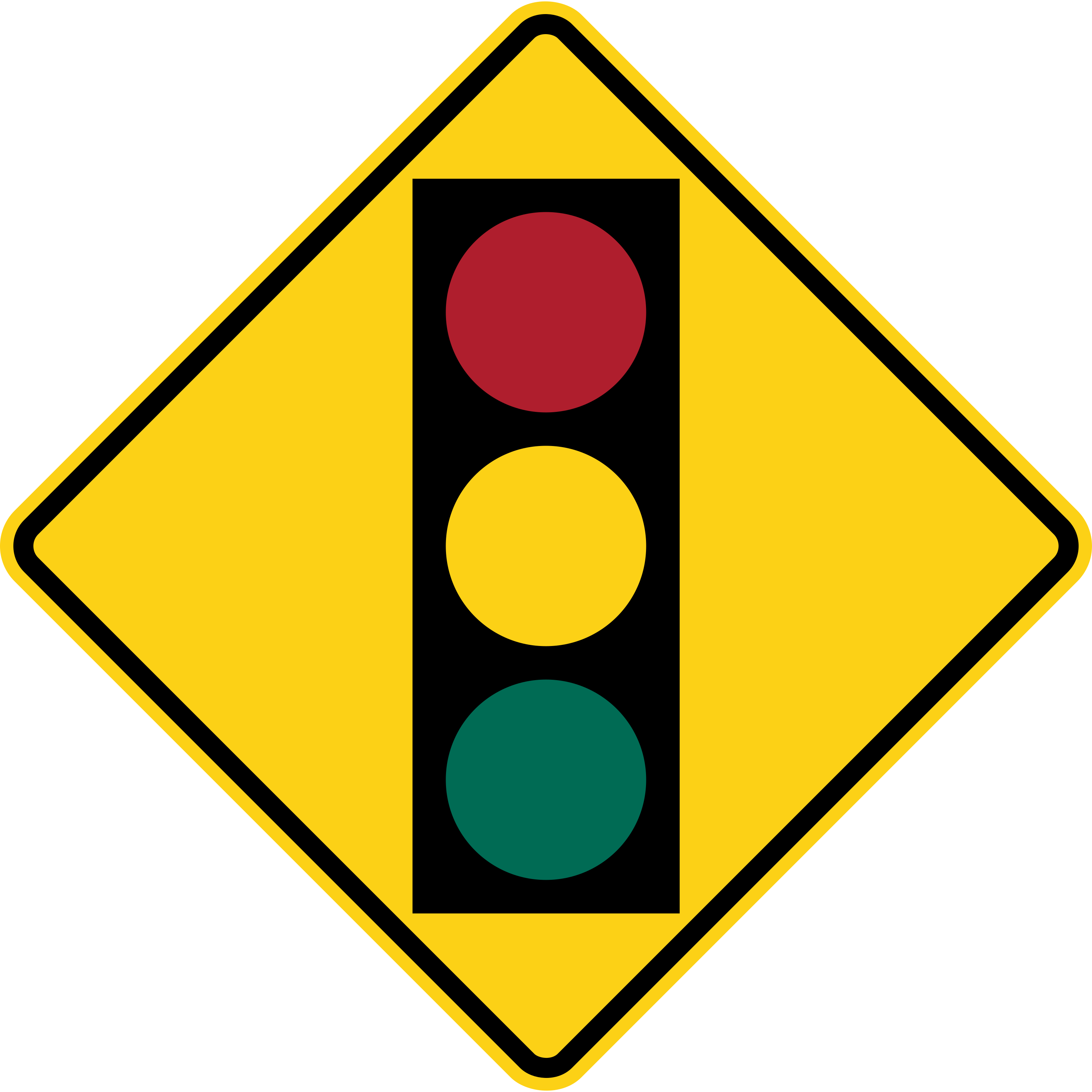
- It is a white and black regulatory sign imposing a speed limit
- It is a black and yellow warning of a hazardous condition ahead
- It is a green and white guide sign for a destination
- It is an orange and black construction sign only
Show answer
It is a black and yellow warning of a hazardous condition ahead. This traffic-signal symbol belongs to the warning-sign family. Alabama describes warning signs as black and yellow and uses them to alert drivers to hazardous conditions ahead. The other color combinations identify different sign functions, so they would not describe this warning. Use the color as an early classification cue, then read the symbol itself to learn that a traffic signal is coming and prepare to obey it.
Study this in the handbook: Sign types, regulatory signs and four way stops
3. At night, what should a driver watch carefully for?
- Nothing if the road is dry
- Only vehicles traveling in the same lane
- Only signs with flashing lights
- Highway signs, pedestrians, bicycles, slow-moving vehicles, and animals on the road
Show answer
Highway signs, pedestrians, bicycles, slow-moving vehicles, and animals on the road. The manual warns that night visibility is reduced and lists several roadway users and objects that deserve careful attention: highway signs, pedestrians, bicycles, slow-moving vehicles, and animals on the road. The list is broader than vehicles in the same lane or signs with flashing lights, and dry pavement does not remove the visibility problem. Use the entire list as a night driving scan. Reduce speed when visibility is limited and keep looking beyond the area immediately illuminated by the headlights.
Study this in the handbook: Night and winter driving
4. On an Alabama two-lane road, when may a driver pass traffic on the left?
- Whenever the driver signals first
- Only when the vehicle ahead is stopped
- When the pass can be completed safely without exceeding the speed limit
- Whenever the centerline is white
Show answer
When the pass can be completed safely without exceeding the speed limit. Passing on the left is allowed on a two-lane road when the driver can complete the maneuver safely and remain within the speed limit. Signaling communicates intent, but it cannot make an unsafe pass legal. The stopped-vehicle option ignores the need to check traffic and distance, and a yellow centerline is normal for opposing traffic. Before moving out, inspect the road ahead and behind, then return only after seeing the entire front of the passed vehicle in the inside mirror.
Study this in the handbook: Passing, backing, lane changes and loads
5. What should a driver do if the vehicle runs off the pavement onto the shoulder?
- Swerve sharply back immediately
- Accelerate until the tires climb onto pavement
- Stay on the shoulder and reduce speed
- Turn across the opposite lane
Show answer
Stay on the shoulder and reduce speed. If wheels drift onto the shoulder, stay there and reduce speed instead of swerving immediately back onto the pavement. A sharp return can throw the vehicle off balance, especially when the shoulder edge is uneven. Once speed is lower and the roadway is clear, turn gently back onto the pavement. The acceleration choice adds instability and the opposite-lane option introduces opposing traffic. Keep both hands steady, avoid panic steering, and use a gradual reentry angle.
Study this in the handbook: Driving emergencies
6. Which statement is correct about following an emergency vehicle on an emergency run?
- Ordinary vehicles may follow within 500 feet if headlights are on
- Only vehicles on necessary official business may follow within 500 feet
- Ordinary vehicles may follow within 250 feet
- Any vehicle may follow closely if it does not pass
Show answer
Only vehicles on necessary official business may follow within 500 feet. The manual permits following within 500 feet only when the vehicle is on necessary official business. An ordinary vehicle remains outside that protected distance even if its headlights are on, it stays behind rather than passing, or it chooses a shorter distance such as 250 feet. The restriction is tied to the emergency run and the vehicle’s official purpose. Give a responding vehicle a broad buffer, avoid using it to move through traffic, and let it create the space needed to reach the emergency safely.
Study this in the handbook: Stopping rules, school buses and emergency vehicles
7. What subjects are included on Alabama’s driver license knowledge test?
- Only road signs
- Vehicle repair procedures and engine design
- Traffic laws, road signs, and rules of safe driving
- Only the applicant’s personal driving history
Show answer
Traffic laws, road signs, and rules of safe driving. The knowledge test covers three subject groups named in the manual: Alabama traffic laws, road signs, and rules of safe driving. Focusing on signs alone omits two substantial parts of the test. Vehicle repair and engine design are not identified as test subjects in this section, and an applicant’s personal history is not a listed study category. The practical study cue is to divide preparation into law, signs, and safe-driving rules. The manual also says the test is taken from material found in the booklet, so those three areas point back to the full manual rather than a single chapter.
Study this in the handbook: Who needs a license, and the knowledge and road tests
8. What does Alabama prohibit on controlled access highways, except for emergency vehicles performing their duties?
- Backing
- Using a turn signal before changing lanes
- Driving in the right lane
- Looking over the right shoulder
Show answer
Backing. Backing is prohibited on Alabama controlled access highways, including freeways and expressways, except when an emergency vehicle is performing its duties. The other choices describe ordinary safe-driving actions or lane use and are not the maneuver singled out by this restriction. The freeway chapter adds that a driver who misses an exit must not stop, back up, or try to turn around, and should instead proceed to the next exit and come back. The key cue is the highway type: controlled access roads give ordinary drivers no permission to back up.
Study this in the handbook: Passing, backing, lane changes and loads
9. How many nonfamily passengers may an Alabama 16 year old driver carry, not counting a parent, guardian or supervising driver 21 or older?
- No more than 4
- No more than 2
- None at all
- No more than 1
Show answer
No more than 1. A driver who is 16, or 17 with a license held less than 6 months, may not have more than 1 nonfamily passenger other than the parent, guardian or supervising licensed driver at least 21. The manual notes the limit was reduced from four in 2010, so four is the old number. Two is not the rule, and a total ban is stricter than the law. Family members are not counted toward the limit.
Study this in the handbook: The learner license and graduated license rules
10. What should a driver do when entering an intersection where a yield sign faces the driver?
- Slow down and stop if necessary to yield to legally crossing vehicles and pedestrians
- Accelerate so other traffic must yield to the entering vehicle
- Stop every time, even when no one is crossing
- Ignore the sign if the driver has already signaled a turn
Show answer
Slow down and stop if necessary to yield to legally crossing vehicles and pedestrians. A yield sign requires the driver to slow down and, if necessary, stop so vehicles and pedestrians legally crossing the roadway receive the right of way. It is not an automatic full-stop command in every empty intersection, so the always-stop option adds a condition the rule does not state. Acceleration cannot transfer priority to the entering vehicle, and a turn signal communicates intent without canceling the sign. Approach with reduced speed, check the crossing path, and be ready to stop whenever traffic or a pedestrian has priority.
Study this in the handbook: Right of way and yielding
11. What happens to a driver’s otherwise available right of way when entering an uncontrolled intersection at an unlawful speed?
- It remains unchanged
- It transfers to the vehicle behind
- It is forfeited
- It applies only if the driver sounds the horn
Show answer
It is forfeited. Alabama’s intersection rule says that a driver entering an uncontrolled intersection at an unlawful speed loses any right of way the driver might otherwise have. The rule therefore removes the protection a driver might expect from the ordinary priority arrangement. The unchanged choice ignores the speed condition, while the horn choice invents a way to restore priority. The vehicle-behind option has no role in the stated rule. A good memory cue is that right of way is not a shield for illegal speed: unlawful entry means the driver gives up the otherwise available priority.
Study this in the handbook: Right of way and yielding
12. When may an Alabama driver use the shoulder to pass?
- Whenever the shoulder is paved
- Only during an emergency or when directed by traffic authorities
- When traffic is stopped
- When passing a slow truck
Show answer
Only during an emergency or when directed by traffic authorities. It is unlawful to drive on the shoulder to pass except during an emergency or when so directed by traffic authorities. Passing on the right is permitted on one-way roadways and on roads marked for two or more lanes moving in the same direction, and even then you check traffic ahead and behind and signal. A signal alone does not give you the right to pass, and the manual urges extreme caution with any pass on the right.
Study this in the handbook: Stopping rules, school buses and emergency vehicles
13. Where does the Alabama manual say a three-point turn is not permitted?
- On interstate freeways
- On residential streets
- At intersections with no traffic
- In a private driveway
Show answer
On interstate freeways. A three-point turn is not permitted on interstate freeways. The manual gives the same restriction for curves and for places near the top of hills where drivers approaching from either direction within 500 feet cannot see you. Otherwise the maneuver is normally permitted where your vehicle can be seen for a great distance and traffic makes it safe. Residential streets, an empty intersection, and a private driveway are not the locations named in this rule, though local ordinances also govern three-point turns and there may be no sign. Pick a turnaround spot with a long, clear view both ways.
Study this in the handbook: Good driving habits, turns and three point turns
14. What does a broken centerline generally indicate on an Alabama roadway?
- The roadway is reserved for emergency vehicles
- Traffic must stop before crossing the line
- Only buses may cross the line
- Passing is unrestricted when it can be done safely
Show answer
Passing is unrestricted when it can be done safely. The manual uses broken lines in areas where passing has no line-based restriction, but safety conditions still control the maneuver. A driver must have enough distance, visibility, and time to pass without exceeding the speed limit or creating a conflict. The stop choice treats a broken marking like a stop control, while the bus and emergency-vehicle choices invent special lane privileges. Read the broken line as permission to consider passing, not a guarantee that passing is safe. Check traffic, road conditions, and the full maneuver before moving left.
Study this in the handbook: Pavement markings
15. How early may an Alabama driver license be renewed?
- Only in the last week
- Only after expiration
- Up to two years early
- Any time within 180 days before expiration
Show answer
Any time within 180 days before expiration. An Alabama driver license expires four years after issue, and it may be renewed at any time within 180 days prior to expiration at a probate judge's office, license commissioner's office, examining office, or online if eligible. Alabama also provides a 60 day grace period after expiration during which the license remains valid for renewal purposes. Military and students out of state have mail options.
Study this in the handbook: Renewal, address changes and license classes
16. How far from a stopped school bus should Alabama drivers stop when its red lights and stop arm are displayed?
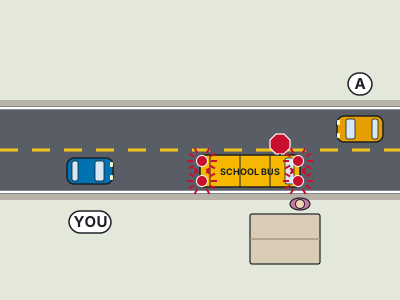
- At least 5 feet
- At least 20 feet
- At least 50 feet
- At least 100 feet
Show answer
At least 20 feet. When a school bus displays flashing red lights and its extended stop area, Alabama directs traffic coming from either direction to stop at least 20 feet from the bus. The 5-foot choice leaves too little space for children moving around the vehicle. Fifty and 100 feet are not the distance stated for this bus stop requirement. Remain stopped until the stop signal is retracted and the red lights are turned off. The practical cue is to stop well before the bus, preserve the children’s safety zone, and watch for the driver’s signal before moving.
Study this in the handbook: Right of way and yielding
17. What colors are used for warning signs in construction areas?
- Black and white
- Black and orange
- Green and white
- Blue and white
Show answer
Black and orange. Warning signs in construction areas use black and orange. The black-and-white choice describes the usual appearance of regulatory signs, while green-and-white is used for motorist directions and blue-and-white identifies services. The orange color is the quick visual cue that a warning belongs to road work rather than ordinary hazards. Drivers should treat that color combination as a reason to slow down, look for workers or changing lanes, and follow any instructions in the work zone. The manual distinguishes construction warnings from the usual black-and-yellow warning signs.
Study this in the handbook: Warning, construction and guide signs
18. At a 4-way stop intersection, what should a driver look for before proceeding?

- Only vehicles approaching from the left
- A gap long enough to roll through without stopping
- Other vehicles approaching at the same time
- Only vehicles larger than your own
Show answer
Other vehicles approaching at the same time. As you approach a 4-way stop intersection, the Alabama manual says to look for other vehicles approaching at the same time. Vehicles leave the stop signs in the order in which they arrived, and when more than one arrives at the same time, the vehicle furthest to the right leaves first. Checking only one side or only larger vehicles misses traffic, and no gap lets you skip the stop. Even when it is your turn, allow a few seconds because many people do not follow the rule.
Study this in the handbook: Sign types, regulatory signs and four way stops
19. Under Alabama's child restraint law, how long must an infant ride in a rear-facing seat?
- Until at least 1 year of age or 20 pounds
- Until 2 years of age
- Until 40 pounds
- Until 6 months of age
Show answer
Until at least 1 year of age or 20 pounds. Alabama's size appropriate schedule requires an infant-only or convertible seat in the rear-facing position until the infant is at least 1 year of age or 20 pounds. The child then moves to a forward-facing seat until at least 5 years or 40 pounds, a booster seat until 6, and a seat belt through age 15. Two years and six months are not Alabama's rear-facing rule, and 40 pounds is the forward-facing seat threshold.
Study this in the handbook: Parking, safety belts and child restraints
20. What license action and minimum jail term does Alabama list for a third DUI conviction?
- Suspension for 90 days and no jail
- Revocation for one year and 48 hours in jail
- Revocation for five years and one year and a day in prison
- Revocation for three years and a mandatory minimum of 60 days in jail
Show answer
Revocation for three years and a mandatory minimum of 60 days in jail. For a third conviction, the fine ranges from $2,100 to $10,100, the license is revoked for three years, and the sentence can be up to one year with a mandatory minimum of 60 days in jail that may not be probated or suspended. A 90 day suspension goes with a first conviction. A one year revocation goes with a second conviction, and 48 hours is not the third conviction minimum. Five years and a prison term of a year and a day or more are the fourth offense felony penalties.
Study this in the handbook: Alcohol and the DUI law
QualitySpace is expanding to Alabama
We are a California-based independent insurance brokerage working on licensing in more states. We cannot help with Alabama insurance yet. Leave your email and we will let you know when we can.
Every question is written from the official Alabama Driver Manual. Need paper? Printable AL practice test with answer key.
Last verified 2026-10-05. How we check every question · Study all 200 as flashcards
Frequently asked questions
How many questions are on this Alabama practice test?
This fixed set has 20 questions. It is test 10 of 10 from the 200 question Alabama bank.
How does this fixed test relate to the full Alabama bank?
Each numbered test is a fixed set of questions in a fixed order, so you can retake the same test later and compare. Every test mixes road signs and the other topics in about the same proportion as the full bank. Tests 1 to 10 together cover every question in the Alabama bank once. The full practice page mixes the whole bank at random.
Last verified 2026-10-05. See the Alabama DMV facts page for sourced state details.