
Test 5 of 10 · 20 questions · Free 2026
AL Permit Practice Test 5
Jump to the test ↓A fixed 20 question set from the Alabama bank with answers and plain English explanations.
Question 1 of 20 · 0 right so far
All 20 questions in test 5
Every question below comes from the Alabama question bank on this page. Open a question to see the correct answer and the explanation. Nothing here is hidden behind a signup.
1. How does Alabama describe speed limits in municipalities?
- They are maximum speeds
- They are advisory speeds only
- They apply only to commercial vehicles
- They are minimum speeds during daylight
Show answer
They are maximum speeds. The manual states that all speed limits in municipalities are maximum speeds. That means a posted or statutory number is not a required cruising speed, and a driver must still choose a lower safe speed when conditions demand it. Calling the limit advisory understates its legal force. The commercial-vehicle choice narrows a rule that applies broadly, while a minimum speed is the opposite of what this passage says. When driving in a municipality, treat the limit as the upper boundary and adjust downward for congestion, rain, curves, pedestrians, or limited visibility.
Study this in the handbook: Speed limits
2. At an Alabama YIELD sign, what is the driver required to do?
- Enter first because the yield sign grants priority
- Stop for three seconds even when the way is empty
- Accelerate before vehicles on the cross street arrive
- Slow down and yield to pedestrians and intersecting traffic
Show answer
Slow down and yield to pedestrians and intersecting traffic. A YIELD sign requires the driver to slow down and give the right of way to pedestrians crossing and vehicles on the intersecting street or highway. A complete stop may be needed when traffic or people make it necessary, but the sign does not impose a three-second stop in every empty approach. The priority choice is backwards because the entering driver must wait for users already crossing the path. Use the sign as a cue to reduce speed, scan both directions, and proceed only after the crossing movement is clear.
Study this in the handbook: Sign types, regulatory signs and four way stops
3. What is the minimum driving age stated for Alabama?
- Fourteen years of age
- Fifteen years of age
- Sixteen years of age
- Eighteen years of age
Show answer
Sixteen years of age. Alabama states that the minimum driving age is 16. The nearby learner-license rules explain why 15 can appear in study material, but a restricted learner license is not the same as the minimum age for driving under the regular licensing framework. Fourteen belongs to the restricted motor driven cycle category, while 18 is later than the stated minimum. Keep the categories separate when reviewing ages: the manual distinguishes learner licenses, regular driver licenses, and motor driven cycle licenses. The exact age in this item is sixteen, not a rounded age of majority.
Study this in the handbook: The learner license and graduated license rules
4. What does a steady red X over a lane mean?
- The lane has a recommended minimum speed
- Use the lane only to pass stopped traffic
- Do not drive in that lane
- Drive there if the vehicle behind is close
Show answer
Do not drive in that lane. A steady red X over a lane means a driver facing the indication shall not drive in that lane. The restriction applies even though other traffic controls remain in force, so a nearby green light or an impatient following vehicle cannot cancel it. The passing choice treats the lane as temporarily available, which is precisely what the red X denies. Move into an allowed lane only after checking clearance and obeying the other signs and signals. The overhead display is a lane-specific command, not a suggestion about speed.
Study this in the handbook: Traffic signals, arrows and lane use signals
5. If a brake pedal sinks to the floor, what should you try first?
- Pump the pedal to build pressure
- Turn off the engine and coast in neutral immediately
- Pull the emergency brake as hard as possible
- Accelerate to test whether the brakes recover
Show answer
Pump the pedal to build pressure. A pedal that suddenly reaches the floor may respond to repeated pumping, which can rebuild braking pressure. If pumping fails, the manual directs the driver to use the emergency or parking brake gently, and it also mentions a lower gear or turning off the engine while leaving the car in gear. The hard pull choice risks locking the brakes and causing a skid. Diagnose the pedal movement first, then add slowing methods progressively while keeping the vehicle under control.
Study this in the handbook: Driving emergencies
6. When making a left turn, when must a driver yield to an approaching vehicle from the opposite direction?
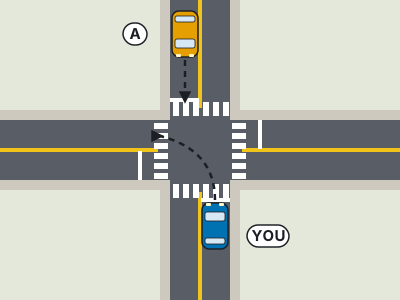
- Only after the turning vehicle enters the opposing lane
- Only when it is traveling above the speed limit
- When it is within the intersection or so close as to constitute an immediate hazard
- Never, because a turn signal gives priority
Show answer
When it is within the intersection or so close as to constitute an immediate hazard. A driver turning left must yield to an opposing vehicle already within the intersection or close enough to create an immediate hazard. The rule does not depend on the other vehicle exceeding the speed limit, and a turn signal announces an intention rather than granting priority. Waiting until the turner is already in the opposing lane is too late to make the required safety judgment. Before moving, look for both an occupied intersection and a vehicle whose closeness leaves no safe opening. If either condition exists, remain stopped until the opposing path is clear.
Study this in the handbook: Right of way and yielding
7. What should an Alabama driver do if a car approaches in the driver’s lane?
- Stop with the wheels pointed left
- Turn into the left lane immediately
- Accelerate toward the approaching car
- Pull right, slow down, and sound the horn
Show answer
Pull right, slow down, and sound the horn. If another car is coming toward you in your lane, pull to the right, slow down, and sound the horn. At night, flashing the lights may also wake an inattentive driver. Turning into the left lane can place both vehicles on the same escape path if the other driver corrects course, so that response is specifically unsafe. Keep control, create separation toward the right, and use the warning signal while avoiding a panicked steering movement.
Study this in the handbook: Driving emergencies
8. What share of fatal accidents involve drinking drivers, according to studies cited in the Alabama manual?
- About 5 percent
- As high as 50 percent
- Less than 1 percent
- About 95 percent
Show answer
As high as 50 percent. Special studies show that fatal accident involvement of drinking drivers is as high as 50 percent, a fact not recognized by people who drink and drive. The alcohol in one bottle of beer is about equal to that in a shot of whiskey or a glass of wine, and the effect on the average driver is the same. Alcohol must be broken down by the liver over time.
Study this in the handbook: Alcohol and the DUI law
9. When do Alabama statutory speed limits apply unless another zone is established?
- Only during daylight hours
- Only when a driver is outside a municipality
- Always, unless a different speed zone has been established and posted on official regulatory signs
- Whenever a driver prefers the statutory number
Show answer
Always, unless a different speed zone has been established and posted on official regulatory signs. Alabama says statutory limits apply unless another speed zone has been established and its limits are posted on official regulatory signs. The statutory limits are the default and need no sign; only a separately established zone, posted on official regulatory signs, replaces them. This does not limit the rule to rural roads or daylight, and a driver cannot choose the statutory number simply because it feels convenient. Check the posted regulatory sign first, then apply the lower safe speed required by weather, traffic, visibility, and roadway conditions.
Study this in the handbook: Speed limits
10. What school related requirement applies to Alabama license applicants under 19?
- They must have a college acceptance letter
- They must complete driver education in school
- There is no school requirement
- They must show secondary school graduation or current attendance under Act 93-368, with limited exclusions
Show answer
They must show secondary school graduation or current attendance under Act 93-368, with limited exclusions. Alabama will not license any person under the age of 19 who is not in compliance with Alabama Act 93-368, which requires secondary school graduation or current attendance, with limited exclusions. All applicants under 19 present a current Student Enrollment/Exclusion Form. The same list of ineligible persons includes habitual drunkards, narcotic addicts, and anyone who fails a required examination. The enrollment form must be current at the time of application.
Study this in the handbook: Who needs a license, and the knowledge and road tests
11. An Alabama GDL driver is convicted of an offense for which four or more points are assessed. What happens to the license?
- The restricted period is extended by 30 days
- The license is automatically suspended for 60 days
- A warning letter is sent
- The license is revoked until 21
Show answer
The license is automatically suspended for 60 days. If a GDL licensee is convicted of a second moving traffic violation, or of offenses like failing to render aid, racing, fleeing police, reckless driving, illegal passing, driving on the wrong side, or any offense worth four or more points, the license is automatically suspended for 60 days. Thirty days is not the extension period, which is 6 months. The manual does not describe a warning letter or revocation until 21 for this rule.
Study this in the handbook: The learner license and graduated license rules
12. When a stopped school bus displays flashing red lights and its stop signal, how far away must you stop?
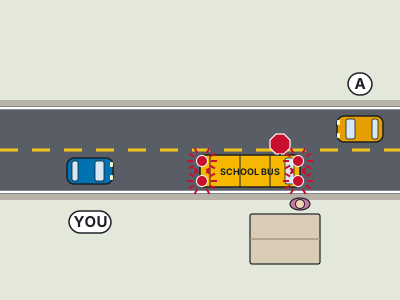
- At least 20 feet from the bus
- At least 15 feet from the bus
- At least 10 feet from the bus
- At least 50 feet from the bus
Show answer
At least 20 feet from the bus. Alabama requires traffic approaching a school bus with the described warning display to stop at least 20 feet from the bus. That space gives children and the bus operator a safer buffer while loading or unloading. The 10-foot and 15-foot options shorten the required distance, while 50 feet adds a larger number that is not the manual’s stated rule. Watch for the extended stop signal and flashing red lights, then make the 20-foot distance your immediate stopping target before waiting for the bus signal to be withdrawn.
Study this in the handbook: Right of way and yielding
13. An Alabama 16 year old wants to drive alone at 1 a.m. For which trip is that allowed?
- Going home from a friend's party
- Going to or from the teen's regular workplace
- Driving to a late movie
- Picking up food with friends
Show answer
Going to or from the teen's regular workplace. A 16 year old, or a 17 year old licensed less than 6 months, may not drive between 12 midnight and 6 a.m. unless accompanied by a parent or legal guardian, or unless accompanied by a licensee 21 or older with parental consent, going to or from a regular workplace, a school sponsored event or a religious sponsored event, or driving because of a medical, fire or law enforcement emergency. A party, a movie and a food run are not listed exceptions.
Study this in the handbook: The learner license and graduated license rules
14. What does a steady red X over a lane tell an Alabama driver?
- The lane is open for passing
- The driver must not drive in that lane
- The driver may use the lane with extra speed
- The lane is reserved for emergency vehicles only
Show answer
The driver must not drive in that lane. A steady red X means a driver must not drive in the lane beneath that signal. It controls the use of that particular lane and supplements the other traffic controls, so a driver must still follow signs and safe-driving rules elsewhere. The passing option treats a closed lane as available, and the emergency-only option invents a restriction not stated by the signal. Look overhead before entering a lane, especially where lane directions change during congestion, construction, or reversible traffic operations.
Study this in the handbook: Traffic signals, arrows and lane use signals
15. What does a yellow warning sign with a curved arrow bending right tell a driver?

- A curve to the right ahead
- A mandatory right turn at the next signal
- A detour around a work zone
- A lane reserved for vehicles turning left
Show answer
A curve to the right ahead. The Alabama manual shows this curved-arrow warning sign with the description curve to the right. It is a roadway alignment warning that the road bends ahead, not a command to turn at a signal, a work-zone detour, or a lane-use instruction. The manual uses separate signs for a sharp turn, a gradual curve to the right then to the left, and a winding road, so read the arrow shape. Slow before reaching the bend and keep the vehicle under control in your lane through it.
16. What does a yellow warning sign with a winding arrow tell a driver?

- A single straight section followed by a mandatory U-turn
- A winding road ahead
- A high wind area requiring hazard lights
- A rough bridge allowing traffic in one direction only
Show answer
A winding road ahead. The Alabama manual describes the sign with a winding arrow as a winding road ahead. It is a different sign from the single curve and from the gradual curve to the right then curve to the left, which shows only two bends. It does not announce a mandatory U-turn, a high wind area, or one-way traffic across a rough bridge. Reduce speed before the first bend, stay within your lane, and keep looking ahead because the road will continue to change direction rather than straighten immediately.
17. A normal solid white line along a travel lane means crossing it is generally:
- Discouraged, even though travel in the same direction is allowed on both sides
- Required before every intersection
- Required to enter opposing traffic
- Freely permitted for passing at any speed
Show answer
Discouraged, even though travel in the same direction is allowed on both sides. A normal solid white line separates travel that is moving in the same direction, but crossing that line is discouraged. It is not a command to change lanes, and it does not separate opposing traffic. The free-passing choice overlooks the caution attached to the solid marking. Treat the stripe as a boundary that should remain intact unless a necessary, careful maneuver is justified. Before moving across it, check mirrors, signal, and make sure the adjacent lane is clear.
Study this in the handbook: Pavement markings
18. In the Alabama Parent/Teen Driving Agreement, what does the teen promise about electronic devices while driving?
- Use a device whenever traffic is moving slowly
- Use a handheld phone only for messages to a parent
- Avoid all cell-phone and electronic-device use while driving and pull over to use one
- Ask a passenger to hold the device while the teen drives
Show answer
Avoid all cell-phone and electronic-device use while driving and pull over to use one. The Parent/Teen Driving Agreement contains a broad promise: the teen will not use a cell phone or other electronic device while driving and will pull over to make calls, receive calls, text, or use an electronic device. This agreement language is broader than identifying one particular message type. Slow traffic and parental messages do not create exceptions in the quoted promise. Having a passenger hold the device also misses the point, because the teen agrees to pull over before using it. Treat the agreement as a planned safe-driving commitment, not a permission to multitask.
19. Until what age does Alabama's child restraint schedule require a booster seat?
- Until the child is 15 years of age
- Until the child is 4 years of age
- Until the child is 8 years of age
- Until the child is 6 years of age
Show answer
Until the child is 6 years of age. Alabama's size-appropriate restraint schedule calls for a booster seat until a child is six years of age. The schedule uses different thresholds for other equipment: a rear-facing infant seat continues until at least age one or 20 pounds, a forward-facing seat until at least age five or 40 pounds, and a seat belt until age 15. That is why age four and age eight do not match the booster entry, while age 15 belongs to the seat-belt stage. Identify the restraint type before selecting the age.
Study this in the handbook: Parking, safety belts and child restraints
20. What danger is indicated when a WRONG WAY sign faces a driver?
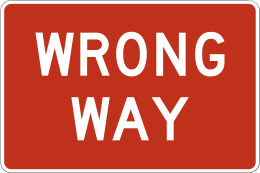
- The driver is leaving a divided highway at its normal exit
- The driver is entering a zone where trucks must use the shoulder
- The driver is approaching a rough section of pavement
- The driver is approaching a one-way highway or ramp from the wrong direction
Show answer
The driver is approaching a one-way highway or ramp from the wrong direction. The Alabama manual describes the WRONG WAY sign as white on a red background and says it means the motorist is approaching a one-way highway or ramp from the wrong direction. Continuing would put the driver against the flow of traffic on that highway or ramp. A rough road, a truck restriction, or an ordinary exit does not explain this sign. If you see it facing you, do not continue; turn around only when a safe and legal opportunity is available.
Study this in the handbook: Sign types, regulatory signs and four way stops
QualitySpace is expanding to Alabama
We are a California-based independent insurance brokerage working on licensing in more states. We cannot help with Alabama insurance yet. Leave your email and we will let you know when we can.
Every question is written from the official Alabama Driver Manual. Need paper? Printable AL practice test with answer key.
Last verified 2026-10-05. How we check every question · Study all 200 as flashcards
Frequently asked questions
How many questions are on this Alabama practice test?
This fixed set has 20 questions. It is test 5 of 10 from the 200 question Alabama bank.
How does this fixed test relate to the full Alabama bank?
Each numbered test is a fixed set of questions in a fixed order, so you can retake the same test later and compare. Every test mixes road signs and the other topics in about the same proportion as the full bank. Tests 1 to 10 together cover every question in the Alabama bank once. The full practice page mixes the whole bank at random.
Last verified 2026-10-05. See the Alabama DMV facts page for sourced state details.