
Test 21 of 25 · 20 questions · Free 2026
AL Permit Practice Test 21
Jump to the test ↓A fixed 20 question set from the Alabama bank with answers and plain English explanations.
Question 1 of 20 · 0 right so far
All 20 questions in test 21
Every question below comes from the Alabama question bank on this page. Open a question to see the correct answer and the explanation. Nothing here is hidden behind a signup.
1. You stop fully at a red light in Alabama, in the right lane, and the crossing looks completely clear. When may you turn right?
- Before stopping, while still rolling at a walking speed
- Stop first, in the right lane, when clear
- Only after the light turns green in every single case
- From any lane at all, as long as you stop completely first
Show answer
Stop first, in the right lane, when clear. Alabama allows a right turn after stopping for a red light when you are in the proper lane for that turn, and the movement still requires the way to be clear for traffic and pedestrians. Rolling through without the stop skips the first condition, while turning from a through lane cuts across drivers who expect lane discipline. Green is not required in every case, because the stopped right turn has its own allowance. Stop fully in the right lane, scan fully, and turn when clear.
Study this in the handbook: Speed limits
2. Your light is red at an Alabama signal, the way looks clear, and a NO TURN ON RED sign is posted beside the signal. May you turn after stopping?
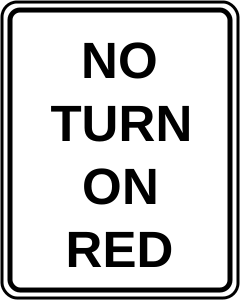
- Yes, in either direction when no traffic is approaching
- No, that posting bars turning on red there
- No, unless you wait through one full green cycle first
- Yes, to the right only after coming to a full stop first
Show answer
No, that posting bars turning on red there. Where NO TURN ON RED is posted at a signal controlled intersection in Alabama, a driver may not make a right or left turn on red at that intersection. A clear view and a complete stop do not restore a movement the posting removes. Waiting through a green cycle adds a condition the sign does not state; the bar lasts while the red shows and the sign applies. Stay stopped, watch the signal, and turn only when a green indication permits that movement.
Study this in the handbook: Sign types, regulatory signs and four way stops
3. You are halfway across an Alabama intersection when your green changes to a steady yellow, and red is about to follow. What should you do?
- Clear the intersection and avoid entering on red
- Back up to the stop line before red appears
- Speed up sharply to beat the red by a wider margin
- Stop at once in the middle of the crossing
Show answer
Clear the intersection and avoid entering on red. A steady circular yellow in Alabama means clear the intersection. It follows green, and you must not enter once the red signal comes on. A driver already halfway across should continue clearing rather than halt in cross traffic or reverse toward the stop line. Sharply speeding adds risk without changing the duty. If you are still approaching and can stop safely before entry, do so. Once inside, move out steadily and let cross traffic wait for its green.
Study this in the handbook: Traffic signals, arrows and lane use signals
4. Traffic inside an Alabama roundabout slows briefly ahead of you, but no crash or danger forces a stop. What should you do?
- Stop in the circle until the driver ahead waves you on
- Keep rolling without stopping, since no danger requires it
- Pull onto the truck apron and wait there
- Back up to use an earlier exit instead
Show answer
Keep rolling without stopping, since no danger requires it. Once inside an Alabama roundabout, a driver should not stop unless stopping is the only way to avoid a crash or other danger. A brief slowdown without danger calls for patience at low speed, not a full halt that stalls the circle. The truck apron serves large vehicle rear wheels, not waiting cars, and reversing toward an earlier exit opposes the flow. Match the slow pace, keep space ahead, and resume normal circle speed when traffic opens.
Study this in the handbook: Roundabouts
5. You leave town on an Alabama road that is not in an urban district, is paved, and is not a county paved road. No limit is posted. What statutory limit applies?
- 55 miles per hour in other locations
- 45 miles per hour on county paved roads
- 70 miles per hour on posted interstates
- 35 miles per hour on unpaved roads
Show answer
55 miles per hour in other locations. Roads that fall outside the urban, unpaved, and county paved settings use 55 miles per hour as the statutory limit in Alabama when nothing is posted. Each lower or higher figure in the list is tied to a named setting, so matching the setting matters more than picking a familiar number. A posted interstate can carry 70 miles per hour, but that allowance does not transfer to an ordinary unposted road. Name the setting first, then take the speed paired with it.
Study this in the handbook: Speed limits
6. When should an Alabama driver adjust the seat and mirrors?
- Before starting to drive
- After reaching highway speed
- At the first red light
- Only when a passenger complains
Show answer
Before starting to drive. Setting seating and mirrors while parked lets a driver confirm pedal reach, wheel clearance, and rearward vision without taking attention from traffic. Waiting until highway speed means adjusting controls during the fastest and least forgiving part of a trip. A red light pause is short and unpredictable, and mirrors set there can remain wrong when the light changes. Passenger complaints are a poor trigger because the driver may have been missing blind traffic for miles. Finish every adjustment before the vehicle moves.
7. On an Alabama road with four or more lanes, changing lanes away from a stopped emergency vehicle is unsafe. What must the driver do instead?
- Maintain the posted speed in the same lane
- Stop in the lane beside the emergency vehicle
- Pass on the shoulder at the posted speed
- Slow to at least 15 mph below the posted speed limit
Show answer
Slow to at least 15 mph below the posted speed limit. When a lane change cannot be made safely beside stopped emergency lights, reduced speed becomes the required protection. Dropping at least 15 mph below the posted limit shortens stopping distance and gives workers more margin if someone steps toward traffic. Holding the posted speed in the close lane leaves that margin unchanged. Stopping beside the scene can trap traffic and create a new hazard. The shoulder is not a passing lane for this situation. Ease off early, stay predictable, and move over later only when a safe gap opens.
Study this in the handbook: Traffic stops, insurance and window tint
8. In Alabama, how may people on bicycles ride in relation to each other on a roadway?
- They must ride single file on every roadway
- They may ride two abreast only inside a bicycle lane
- They may ride two abreast at all times
- They may ride two abreast only when no cars are near
Show answer
They may ride two abreast at all times. Paired riding is allowed, so a driver should expect two riders side by side rather than a single narrow line. Single file everywhere contradicts the allowance. A marked bicycle lane is not the only place pairing may occur. Nearby motor traffic does not cancel the permission, though riders still owe all traffic duties. Give the pair full room when passing and wait rather than squeezing between them and opposing traffic.
Study this in the handbook: Good driving habits, turns and three point turns
9. An Alabama traffic stop happens at night. What should the driver do to help the officer during the stop?
- Turn on the vehicle interior lights so the officer can see inside
- Turn off all vehicle lights so the officer faces no glare
- Leave the car and stand where the officer can see you under a street light
- Keep the interior dark so the officer can use a flashlight on each document
Show answer
Turn on the vehicle interior lights so the officer can see inside. A night stop adds visibility problems for both sides. If a stop occurs at night, turn on the vehicle interior lights to assist the officer, while staying inside the vehicle unless instructed to exit and keeping hands where they can be seen. Turning everything off hides the occupants, leaving the car without instruction adds risk, and keeping the cabin dark works against the stated help.
Study this in the handbook: Passing, backing, lane changes and loads
10. Why should a driver learn the shapes and colors of road signs, according to the Alabama manual?
- Signs that carry words are the only ones a driver must obey
- Both the shape and the color are coded to the sign’s type of message
- Colors alone decide whether a sign can be enforced by police
- Only shapes matter, since colors fade in bad weather
Show answer
Both the shape and the color are coded to the sign’s type of message. A thorough knowledge of traffic signs is a must for all drivers, and the manual says that besides knowing individual signs, a driver should recognize their shapes and colors because both are coded to the sign’s type of message. A driver who knows the code can tell at a glance whether a sign regulates, warns, or guides, even at a distance or at speed, and obey regulatory signs without hesitation. Words, color alone, or shape alone give only part of the message.
Study this in the handbook: Sign types, regulatory signs and four way stops
11. In Alabama, what happens to a driver's impairment as the blood alcohol concentration in the body increases?
- Impairment stays flat until a legal limit is reached
- Impairment becomes greater as the concentration rises
- Impairment fades once the driver eats a full meal
- Impairment depends only on the type of drink chosen
Show answer
Impairment becomes greater as the concentration rises. Alcohol builds its effects in stages as more of it reaches the blood. Small amounts may first loosen caution, then vision, reaction time, and coordination keep worsening with each additional drink. No sharp line separates a safe level from a harmful one, since harm grows along a slope rather than switching on at a single point. Food may slow absorption for a while, yet it cannot pull alcohol back out of circulation. Drink choice matters far less than total intake. Anyone whose concentration is climbing should hand the keys to a sober driver early.
Study this in the handbook: Alcohol and the DUI law
12. Brake trouble is slowing an Alabama car and pumping has not restored pressure. How can the engine help slow the vehicle?
- Shift to a lower gear so the engine slows the vehicle down
- Shift to neutral so the car coasts farther
- Turn off the engine while staying in a high gear
- Press the accelerator briefly to build brake pressure
Show answer
Shift to a lower gear so the engine slows the vehicle down. Engine braking adds drag through the drivetrain when a lower gear engages, buying distance while the parking brake is applied gently. Neutral removes that drag and lets speed carry farther on a failing stop. Killing the engine in a high gear sacrifices smooth control and can also cut power assistance. Extra accelerator input does the opposite of what a frightened driver needs. Work downward through gears if conditions allow, steer toward space, and keep pressure steady rather than stabbing controls.
Study this in the handbook: Driving emergencies
13. Rain covers an Alabama road as your standard passenger car reaches 40 miles per hour and the front end begins to feel loose. What hydroplaning stage fits that speed?
- Partial hydroplaning, which starts at about 35 miles per hour
- Complete hydroplaning, which always begins at 30 miles per hour
- Hydroplaning only affects trucks with wide tires
- No hydroplaning is possible below 55 miles per hour
Show answer
Partial hydroplaning, which starts at about 35 miles per hour. In a standard passenger car, partial hydroplaning starts at about 35 miles per hour and grows with speed toward roughly 55 miles per hour, where tires may ride fully on water in severe rain. Forty miles per hour therefore sits inside the partial stage, not below any risk. Complete float does not begin at 30 miles per hour, and smaller cars face the problem directly. Loose steering in rain means slow down gently until tread contact feels solid again.
Study this in the handbook: Skids, hydroplaning, fog and hills
14. You plan to turn at the next Alabama intersection, now 80 feet ahead. When should your turn signal already be showing?
- After you have slowed fully to turning speed at the corner
- Within the last 25 feet before the corner of the street
- Only as the front wheels begin to turn at the corner
- At least 100 feet before the turn
Show answer
At least 100 feet before the turn. Alabama calls for signaling at least 100 feet before a turn, which means a driver 80 feet from the corner should already have the signal showing. Waiting until the wheels turn or the car slows gives drivers and pedestrians behind you almost no time to adjust. A last moment flash in the final few feet carries the same problem. Start the signal early, keep it going until you are ready to make the turn itself, and cancel it once the maneuver ends.
Study this in the handbook: Good driving habits, turns and three point turns
15. A driver is involved in a traffic crash in Alabama and someone may be hurt. What must the driver do at once?
- Leave to find a phone before helping anyone
- Move every injured person into a passing car
- Stop, aid injured persons, and call medical help if needed
- Drive home and report the crash the next day
Show answer
Stop, aid injured persons, and call medical help if needed. Stopping is mandatory after involvement, and care for injured people comes before paperwork, vehicle photography, or arguments about fault. Call for medical assistance when injuries are possible, warn approaching traffic, and keep hurt people still unless fire or another immediate danger forces movement. Leaving to search for a phone abandons both the scene and the people needing help. Transporting injured people in a random car can worsen harm. Stay, summon aid, and make the area visible to approaching drivers.
Study this in the handbook: Phones, fatigue, following distance and crashes
16. What must a driver never do behind a truck or bus that is backing up in Alabama?
- Cross behind the truck or bus while it is backing
- Sound the horn once and then wait
- Wait until the large vehicle finishes backing
- Look for the driver's signal before proceeding
Show answer
Cross behind the truck or bus while it is backing. A large vehicle backing toward you leaves its driver unable to see directly behind the rig. Crossing in that blind area risks being struck before the driver knows you are there. Honking and darting across does not create a safe gap. Waiting until the maneuver ends is the sound choice, while watching a signal helps mainly with turning plans. Hold your position, give the truck or bus room, and pass behind only after backing has stopped.
Study this in the handbook: Curves, bicycles, motorcycles and large vehicles
17. In Alabama, what most helps prevent complete hydroplaning at normal highway speeds?
- Using wide tires with shallow tread grooves
- Good tires with deep treads that let water escape underneath
- Driving near 55 mph so tires ride over standing water
- Braking lightly and often on wet pavement
Show answer
Good tires with deep treads that let water escape underneath. Deep tread channels give surface water a path away from the contact patch, preserving grip on wet roads. When water becomes deeper than those channels can clear, the tire can lift and lose contact, especially as speed rises. Wider shallow tread does not provide the same escape route, and riding on top of water removes steering and braking friction. Slow down for standing water and keep tread depth healthy before storms arrive.
Study this in the handbook: Skids, hydroplaning, fog and hills
18. If you cannot see a truck or bus driver's face in the side-view mirror while driving beside the large vehicle in Alabama, what does that mean?
- The large vehicle is about to turn right
- You are in a safe passing position
- The driver cannot see you
- The mirror is reserved only for night use
Show answer
The driver cannot see you. Lingering beside a rig places your car inside a broad blind area. A simple mirror check tells the story: no face visible there means the truck or bus driver lacks a view of you. That spot becomes dangerous if the larger vehicle drifts or changes lanes for a hazard ahead. Either complete a left side pass promptly when lawful or drop back into view. Do not cruise alongside hoping the driver senses your presence.
Study this in the handbook: Curves, bicycles, motorcycles and large vehicles
19. In Alabama, parking is NOT allowed in which of these places?
- In a marked space facing a store entrance
- On a residential street beside an unpainted curb
- On a crosswalk or a sidewalk
- Within sight of a mailbox on a rural route
Show answer
On a crosswalk or a sidewalk. Crosswalks and sidewalks belong to people on foot, so a parked vehicle there pushes walkers into the street and blocks wheelchairs, strollers, and children walking to school. A marked space near a store is provided for parking unless another sign restricts it. An unpainted curb on a residential street carries no ban by color alone. Being within sight of a rural mailbox does not place the vehicle on a pedestrian path. Choose pavement intended for vehicles, keep every part of the car clear of the crossing and walkway, and check for signs before leaving.
Study this in the handbook: Parking, safety belts and child restraints
20. When making a left turn from an Alabama four-lane highway, where should the driver enter the cross street?
- In the far right lane of the cross street
- In the far right shoulder area
- Just to the left of the centerline
- Just to the right of the cross street centerline
Show answer
Just to the right of the cross street centerline. Position beside the center line or divider, turn from that inside lane, and avoid swinging wide. Entry belongs slightly right of the cross street centerline, which keeps the car out of opposing lanes. Drifting toward a shoulder leaves the proper travel path, while aiming for the far right lane stretches the arc across extra space. A wide path also confuses drivers waiting nearby. Hold a compact line from the inside lane into the lane right of center.
Study this in the handbook: Good driving habits, turns and three point turns
Every question is written from the official Alabama Driver Manual. Need paper? Printable AL practice test with answer key.
Last verified 2026-10-05. How we check every question · Study all 500 as flashcards
Frequently asked questions
How many questions are on this Alabama practice test?
This fixed set has 20 questions. It is test 21 of 25 from the 500 question Alabama bank.
How does this fixed test relate to the full Alabama bank?
Each numbered test is a fixed set of questions in a fixed order, so you can retake the same test later and compare. Every test mixes road signs and the other topics in about the same proportion as the full bank. Tests 1 to 25 together cover every question in the Alabama bank once. The full practice page mixes the whole bank at random.
Last verified 2026-10-05. See the Alabama DMV facts page for sourced state details.