
Test 12 of 25 · 20 questions · Free 2026
AL Permit Practice Test 12
Jump to the test ↓A fixed 20 question set from the Alabama bank with answers and plain English explanations.
Question 1 of 20 · 0 right so far
All 20 questions in test 12
Every question below comes from the Alabama question bank on this page. Open a question to see the correct answer and the explanation. Nothing here is hidden behind a signup.
1. After an Alabama crash, an injured person is conscious but clearly hurt and no fire threatens the scene. How should bystanders position that person?
- Keep the person lying or sitting down until medical aid arrives
- Walk the person around to prevent stiffness
- Seat the person upright in a passing car
- Lay the person flat on the roadway center line
Show answer
Keep the person lying or sitting down until medical aid arrives. Stillness protects injuries that eyes cannot assess, particularly damage involving the neck, spine, or internal bleeding. Walking for stiffness and rides in passing cars both demand movement before professionals clear it. The center line adds exposure to traffic on top of needless repositioning. Shade, calm reassurance, and a coat for warmth can all help without lifting the body. Someone should guide arriving responders to the exact location. When breathing trouble or bleeding demands attention, give only familiar first aid and avoid elaborate handling beyond your training.
Study this in the handbook: Phones, fatigue, following distance and crashes
2. In addition to checking that all lights work at night in Alabama, what should you keep clean and free of defects?
- All the glass on the vehicle, kept clean and free of frost and steam
- Only the headlight lenses, because the wipers clean the windshield
- The rear license plate, while frost on the side glass melts on its own
- The mirrors only, since steam inside the windshield clears once moving
Show answer
All the glass on the vehicle, kept clean and free of frost and steam. Night vision depends on every piece of glass, not only the lamps. Keep all glass on your vehicle free of defects and clean, including free of frost and steam, and keep lighting equipment clean and in good operating condition. Wipers cannot substitute for clean side and rear glass, frost left to melt blocks early views, and steam on the windshield is exactly what must be cleared.
Study this in the handbook: Night and winter driving
3. What does an Alabama ROAD CONSTRUCTION 1500 FT warning sign tell a driver to do?
- Expect a closed road ahead with no workers or equipment present
- Drive around any barriers when no flagger is visible in the area
- Speed up through the area to clear the work zone as quickly as possible
- Proceed with caution and obey signs and instructions there
Show answer
Proceed with caution and obey signs and instructions there. Advance wording about road construction calls for caution plus obedience to signs and directions inside the work area. Barriers and flagger guidance shape which lane stays open, so driving around them breaks the instruction. Workers, one way flow, or obstructions may appear even when the first view looks empty. Faster travel shortens reaction time near loose gravel and shifted lanes. Slow early, follow the posted path, and watch for people near the roadway.
Study this in the handbook: Warning, construction and guide signs
4. How does the alcohol in one bottle of beer compare with an average shot of whiskey or a glass of wine in Alabama's manual?
- Beer has about half the alcohol of the other drinks
- A whiskey shot holds about twice the alcohol of one beer
- Wine holds about half the alcohol of one bottle of beer
- About the same alcohol in each of these three drinks
Show answer
About the same alcohol in each of these three drinks. Drink names change, yet alcohol amount drives the effect. One bottle of beer carries roughly the same alcohol as an average shot of whiskey or a glass of wine, so the average driver feels a similar impact. Treating beer as a lighter choice before driving is a common error. Food may change how a person feels in the moment, but it does not erase alcohol already absorbed into the blood.
Study this in the handbook: Alcohol and the DUI law
5. Your steady green arrow invites you into an Alabama intersection, but a delivery truck is still clearing that intersection lawfully from the cross street. What must you do?
- Enter beside the truck, because your arrow gives full priority
- Yield to traffic lawfully using the intersection
- Honk and enter slowly behind the truck
- Turn around and leave the intersection approach
Show answer
Yield to traffic lawfully using the intersection. Even on a steady green arrow in Alabama, vehicles entering an intersection must yield to other traffic lawfully using that intersection. A truck still clearing from the cross street holds that lawful space, so the arrow does not grant sole possession. Entering beside it or pressing in behind a horn blast squeezes a large vehicle that needs room to finish. Wait at the entry until the truck clears completely, then make your arrow movement through an open intersection.
Study this in the handbook: Right of way and yielding
6. While exiting a parking area in Alabama, a WRONG WAY sign with white letters on red faces your car. What danger is it warning you about?
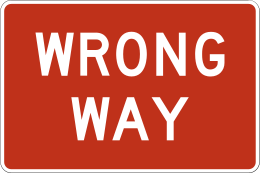
- A school zone begins beyond the parking area exit ahead
- A detour ahead will add extra travel distance to your trip
- You are heading the wrong way onto a one-way road
- Parking in the next aisle beyond the exit is prohibited
Show answer
You are heading the wrong way onto a one-way road. White wording on a red background for this sign warns that a motorist is approaching a one way highway or ramp from the wrong direction in Alabama. Continuing would place your car head on with lawful traffic that expects no opposing vehicle on that roadway. The warning has nothing to do with detours, parking aisles, or school zones. Stop before joining that roadway, turn back into the parking area, and find an exit that joins traffic flowing your way.
Study this in the handbook: Sign types, regulatory signs and four way stops
7. You reach an Alabama railroad crossing marked with a crossbuck. No train is visible in either direction at first glance. What should you do before crossing?
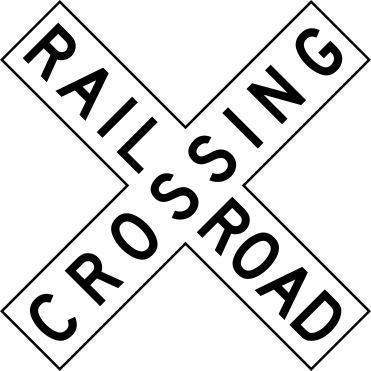
- Stop only when flashing lights also operate
- Follow the car ahead without a separate track check
- Cross quickly before any train can arrive
- Be sure every track is clear before you cross
Show answer
Be sure every track is clear before you cross. At a crossbuck in Alabama, approach with caution and be sure that all tracks are clear before you cross. A first glance can miss a train hidden by vegetation, structures, or another train, so hurrying across gambles on an incomplete view. Flashing lights add warnings at some crossings, but their absence never cancels careful looking, and the car ahead cannot see for you. Slow early, look both ways along each track, listen, and cross only when every track is clearly empty.
Study this in the handbook: Sign types, regulatory signs and four way stops
8. Why should an Alabama driver give a motorcyclist extra room on a windy day, especially on bridges or open highway stretches?
- Crosswinds can move a motorcycle out of its travel lane
- Wind affects only motorcycles stopped at intersections
- A motorcycle becomes wider whenever gusts increase
- Truck windblast always pushes a rider toward the shoulder
Show answer
Crosswinds can move a motorcycle out of its travel lane. A gust strikes a light two wheel machine harder than a car, and open spans offer little shelter. The risk exists while moving, not just at a halt. The motorcycle width stays the same; its path is what may shift. Passing trucks add their own blast, yet direction varies with traffic and terrain. Leave lateral space, avoid lingering beside the rider, and expect a quick drift or correction.
Study this in the handbook: Curves, bicycles, motorcycles and large vehicles
9. On an Alabama freeway, when is parking permitted?
- Whenever the shoulder looks wide enough
- Only in a case of emergency
- For a short rest if flashers are on
- At any time beyond the fog line
Show answer
Only in a case of emergency. Freeway travel breaks down when parked vehicles sit beside high speed lanes, so stopping there is reserved for genuine emergencies. Width of the shoulder does not create a parking privilege, and hazard flashers cannot turn a rest break into an emergency. The fog line marks the lane edge; crossing it does not authorize parking either. A driver who feels drowsy should leave at an exit and stop in a proper area. Reserve the freeway shoulder for breakdowns or urgent trouble that cannot wait.
Study this in the handbook: The Move Over Law
10. On the pavement in front of an Alabama railroad crossing, what does a yellow line in advance of the crossing mean?
- Stop only for passenger trains
- No passing in advance of the tracks
- Parking is allowed before the tracks
- Trains must yield to highway traffic
Show answer
No passing in advance of the tracks. Paint before the rails carries an early passing ban. Alabama describes a large X with two letters on the pavement, then adds that a yellow line in advance means no passing. That placement stops a driver from sitting beside another vehicle when a train arrives. It grants no parking privilege and shifts no duty onto train crews. Finish any lawful pass well before the painted advance area, then settle into line with room to stop short of the tracks.
Study this in the handbook: Phones, fatigue, following distance and crashes
11. Alabama’s manual says brakes, exhaust systems, cooling systems, lights, wipers, and tires wear and become defective. What does it advise as a safety measure?
- Drive more slowly and avoid highways until a part visibly fails
- Have your car checked so that defective equipment will be repaired
- Replace all of these parts on a fixed schedule whether or not they are worn
- Check only the tires, because they cause most serious accidents
Show answer
Have your car checked so that defective equipment will be repaired. Brakes, exhaust systems, cooling systems, lights, windshield wipers, and tires become worn and defective and need maintenance from time to time. If not properly maintained, any one of them could cause a serious accident. As a safety measure, the manual advises having your car checked, because in this way defective equipment will be repaired. Waiting for a part to fail, or checking only one system, leaves other defects hidden.
12. Shared lane markings, called sharrows, appear in an Alabama travel lane. What do they tell road users?
- Bicycles must ride on the sidewalk beside the lane
- Cars must leave the marked lane completely empty
- People on bicycles might occupy the travel lane
- The lane becomes a parking lane for bicycles
Show answer
People on bicycles might occupy the travel lane. A sharrow warns motorists that the lane is shared space rather than car-only territory. Alabama explains that people on bicycles might occupy the travel lane where these markings appear. Drivers should expect a rider centered for visibility, especially where the lane narrows. Leaving the lane entirely or treating it as bicycle parking misreads the symbol. Pass only with ample clearance, change lanes when possible, and avoid squeezing a rider toward parked cars or the curb.
Study this in the handbook: Warning, construction and guide signs
13. How should an Alabama driver enter a curve so the car stays in its lane?
- Enter fast, then brake hard midway through
- Enter on the centerline to see farther ahead
- Enter slow enough to accelerate slightly while rounding it
- Enter without slowing when the curve looks gentle
Show answer
Enter slow enough to accelerate slightly while rounding it. A curve should be approached slowly enough that gentle acceleration is possible while the car rounds it. That pace helps tires keep grip and keeps the vehicle from drifting over the center line or off the edge. Hard braking midway upsets balance, and riding the centerline invites a head on conflict. Even a gentle looking bend can tighten or hide debris. Brake in the straight portion, look through the bend, then apply light power as the road curves.
Study this in the handbook: Good driving habits, turns and three point turns
14. During service on your Alabama car, the tires show uneven wear across the tread. What should be inspected?
- Have the wheels and alignment inspected for the cause of uneven wear
- Only the tire pressure, because uneven wear never points to alignment faults
- The spare tire, since uneven wear is caused by the spare in the trunk
- Nothing, because uneven tread wear is normal until the tread is gone
Show answer
Have the wheels and alignment inspected for the cause of uneven wear. Tire condition is part of keeping the car safe at speed. Check tires for cuts, bruises, foreign objects, or other faults when the car is serviced, and if wear is uneven, have the wheels and alignment inspected. Pressure checks alone miss the mechanical cause the manual names, the spare does not wear the road tires, and waiting for the legal tread depth ignores an early warning of misalignment.
15. When stopping at an Alabama railroad crossing, within what distance from the crossing must the vehicle stop?
- Within 15 to 50 feet
- Within 5 to 10 feet
- Within 60 to 90 feet
- Directly on the nearest rail
Show answer
Within 15 to 50 feet. Stopping position balances clearance from the train against visibility along the tracks. Alabama sets the window at fifteen to fifty feet when a stop is required at a crossing. Closer placement risks overhang near the rail, while stopping much farther back can hide approaching trains behind roadside obstructions. Choose a point inside the range with the clearest view both ways. Keep the vehicle fully out of the track area while waiting for signals or a train to pass.
Study this in the handbook: Railroad crossings
16. A school bus ahead in Alabama flashes amber lights. What is the bus preparing to do?
- Turn at the next intersection
- Continue without stopping ahead
- Stop to load or unload children
- Park for the rest of the day
Show answer
Stop to load or unload children. Amber flashers on a school bus give early notice that a stop for children is coming. Start slowing, widen your gap, and get ready for the red lights and stop arm that follow. The bus is not merely turning or parking for the day. Children may step toward the road before the doors open, so avoid rushing past. Rural buses flash amber farther ahead, while city buses use a shorter warning distance, yet the meaning stays the same everywhere.
Study this in the handbook: Right of way and yielding
17. You approach a two-lane Alabama roundabout and have chosen your entry lane. Before entering, to what traffic must you yield?
- Only traffic in the lane nearest your entry
- Only vehicles that sound their horn while circulating
- Traffic on the cross street beyond the roundabout
- Traffic in both lanes of the roundabout
Show answer
Traffic in both lanes of the roundabout. A two lane circle can send a vehicle across your entry from either circulating lane. Checking only the near lane misses a driver changing position for an exit. Horn use does not assign priority. Vehicles beyond the circle matter later, after you have entered safely. Scan left across both lanes, include walkers and riders at the crosswalk, and enter only when the whole path is open.
Study this in the handbook: Roundabouts
18. You are already stopped inside an Alabama intersection when a fire truck with lights and siren approaches behind you. What should you do?
- Clear the intersection, then pull over and stop
- Back up to the stop line to open a lane
- Turn against the light to leave its path
- Stay stopped and block the intersection until it passes
Show answer
Clear the intersection, then pull over and stop. A driver already inside an Alabama intersection when an emergency vehicle approaches should clear the intersection before stopping, then avoid proceeding until the emergency vehicle has passed. Freezing inside the box traps cross traffic and the fire truck together, while reversing or turning against the light creates fresh conflicts. Rolling forward out of the intersection uses the space you already hold lawfully. Clear the far side, pull to the edge, stop, and wait for the truck to pass completely.
Study this in the handbook: Right of way and yielding
19. You approach an Alabama roundabout and see a short opening between cars already circling. How should you enter?
- Enter whenever your lane reaches the circle before other cars
- Turn left directly toward your exit road across the circle
- Yield, then turn right into a safe gap in circling traffic
- Stop inside the entry until circling cars wave you in
Show answer
Yield, then turn right into a safe gap in circling traffic. Roundabout entry in Alabama works by turning right into the circle when a safe gap appears in traffic already moving there. A leftward shortcut cuts against the one way flow and meets circling cars head on. Stopping inside the entry blocks following drivers, while reaching the circle first gives no claim over traffic inside. Slow on approach, scan left for circling vehicles and people crossing, and roll in to the right when the opening is truly safe.
Study this in the handbook: Roundabouts
20. You drive at night on an Alabama road with high beams on. A car approaches from the opposite direction, now about 400 feet away. What must you do with your lights?
- Keep high beams until the car is 100 feet away
- Dim them, because dimming is required within 500 feet
- Dim them only if the other driver dims first
- Switch to parking lights until the car passes
Show answer
Dim them, because dimming is required within 500 feet. Alabama law requires dimming headlights within 500 feet of an oncoming vehicle, so 400 feet already sits inside the distance where low beams are due. Waiting until 100 feet blinds the other driver through the closest and fastest part of the meeting, and matching the other drivers courtesy keeps both beams high if that driver errs. Parking lights alone are not headlights for night travel. Dip your beams early, keep them dipped, and look toward the right edge if glare persists.
Study this in the handbook: Night and winter driving
Every question is written from the official Alabama Driver Manual. Need paper? Printable AL practice test with answer key.
Last verified 2026-10-05. How we check every question · Study all 500 as flashcards
Frequently asked questions
How many questions are on this Alabama practice test?
This fixed set has 20 questions. It is test 12 of 25 from the 500 question Alabama bank.
How does this fixed test relate to the full Alabama bank?
Each numbered test is a fixed set of questions in a fixed order, so you can retake the same test later and compare. Every test mixes road signs and the other topics in about the same proportion as the full bank. Tests 1 to 25 together cover every question in the Alabama bank once. The full practice page mixes the whole bank at random.
Last verified 2026-10-05. See the Alabama DMV facts page for sourced state details.