
Test 6 of 10 · 20 questions · Free 2026
AL Permit Practice Test 6
Jump to the test ↓A fixed 20 question set from the Alabama bank with answers and plain English explanations.
Question 1 of 20 · 0 right so far
All 20 questions in test 6
Every question below comes from the Alabama question bank on this page. Open a question to see the correct answer and the explanation. Nothing here is hidden behind a signup.
1. Why must a driver never make a left turn to enter an Alabama roundabout?
- A roundabout may be entered only after a police officer signals
- Left turns are reserved for emergency vehicles
- The center island is always open to crossing traffic
- The maneuver would enter against the roundabout’s traffic flow
Show answer
The maneuver would enter against the roundabout’s traffic flow. Roundabouts move traffic in a counterclockwise, one-way pattern, so the manual specifically says never to make a left turn to enter. The required entry is a right turn made when a safe gap is available. The restriction is not a special privilege for emergency vehicles, and the center island is not an ordinary crossing path. Police direction is not required for routine entry. Think of the circle as an established flow: yield to traffic already inside, wait for a safe opening, and turn right into that flow rather than cutting across it.
Study this in the handbook: Roundabouts
2. For a driver age 21 or older operating a noncommercial vehicle in Alabama, what is the lowest BAC covered by the general alcohol per se threshold?
- .04 percent or more
- .08 percent or more
- .05 percent or more
- .10 percent or more
Show answer
.08 percent or more. Alabama treats a blood alcohol concentration of .08 percent or more as unlawful for ordinary drivers, even apart from proof that alcohol affected driving. The .05 choice is important as a warning level because the manual says it impairs most people to some degree, but it is not the stated statutory threshold in this passage. The .04 figure applies to commercial vehicle operators, while .10 is higher than the listed limit. Remember the distinction: impairment can begin below .08, but .08 or more is the listed unlawful concentration for the general driver category.
Study this in the handbook: Alcohol and the DUI law
3. What testing consent does a person give by operating a motor vehicle on Alabama public highways?
- No consent unless the driver volunteers it after arrest
- Consent only to a breath test after signing a separate form
- Consent only when a crash causes property damage
- Consent to a chemical blood, breath, or urine test for blood alcohol content
Show answer
Consent to a chemical blood, breath, or urine test for blood alcohol content. Alabama’s implied-consent rule treats operation on public highways as consent to chemical testing of blood, breath, or urine for blood alcohol content. The rule is broader than a breath-only requirement and does not depend on a separate form signed at the roadside. It also is not limited to crashes or to a driver’s later willingness to volunteer. The practical cue is the phrase public highways: driving there creates the consent described by the manual. A separate passage warns that refusing a directed chemical breath test while under arrest can result in license suspension.
Study this in the handbook: Alcohol and the DUI law
4. What is the driver expected to do near a pedestrian crossing warning sign?

- Use caution, slow down, and watch both sides for pedestrians
- Assume pedestrians will wait because the crossing is not at an intersection
- Drive faster to clear the crossing before anyone reaches it
- Stop in the travel lane whenever the sign is present, even with no pedestrian
Show answer
Use caution, slow down, and watch both sides for pedestrians. The warning identifies a place where people on foot often cross, and the crossing may be between intersections. Drivers should approach more slowly and carefully while watching both sides of the street. The sign alone does not require an unnecessary stop in an empty roadway, but a pedestrian in the crosswalk must be yielded to. Keep sight lines open and cover the brake near the crossing.
Study this in the handbook: Warning, construction and guide signs
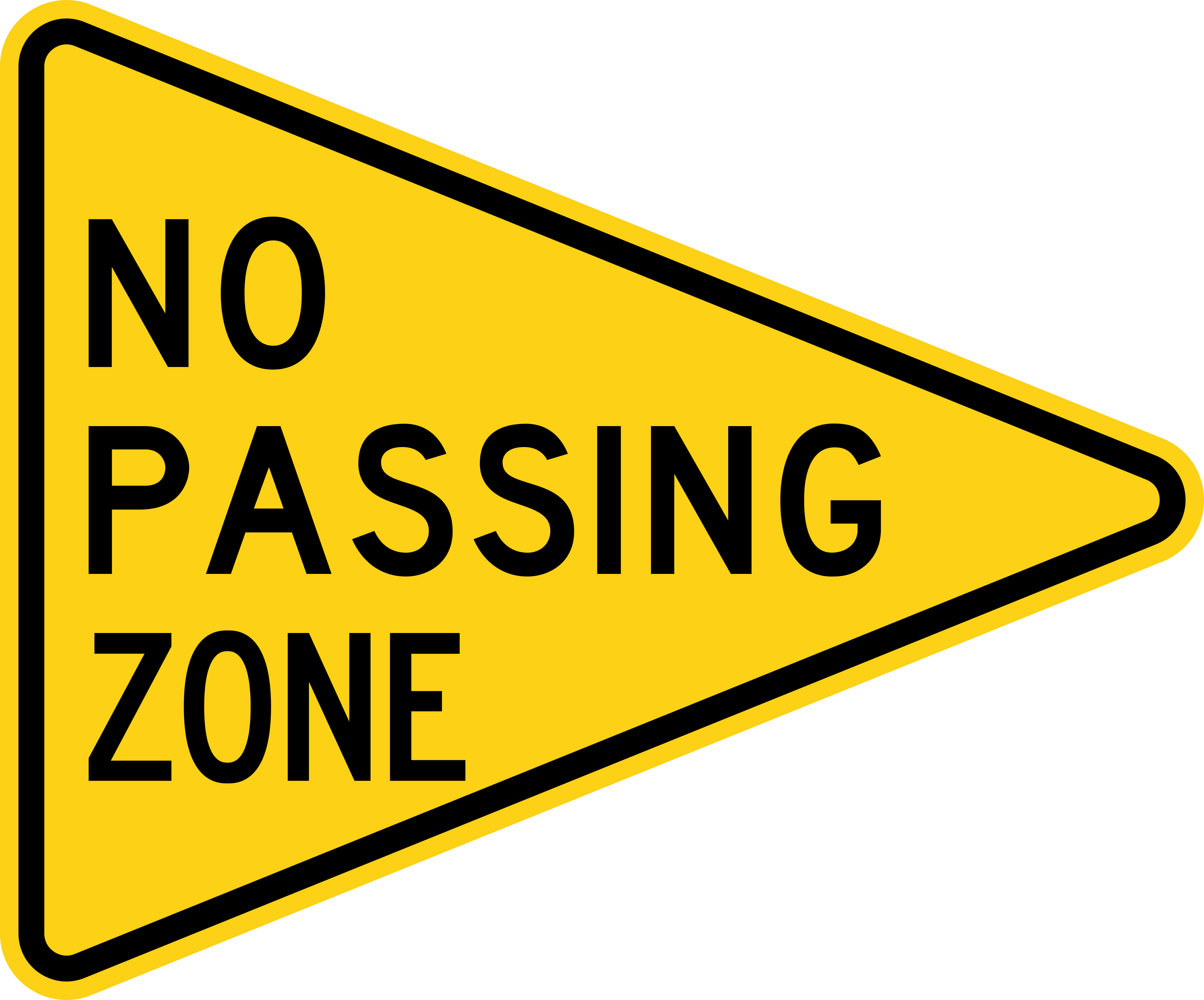
5. What does a NO PASSING ZONE sign on the left side of a two-lane road warn you about?
- A required turn onto the next road
- A lane reserved for passing on the shoulder
- The end of a divided highway
- The beginning of a no passing zone
Show answer
The beginning of a no passing zone. This sign marks the start of a section where passing is prohibited. Its placement on the left side of a two-lane road is an important clue because it faces drivers who might otherwise consider moving into the opposing lane. The shoulder choice is unsafe and invents a passing permission that the sign removes. Treat the sign as an advance warning to remain behind slower traffic, watch the centerline, and wait until a lawful passing area appears. An open view does not create a passing zone.
Study this in the handbook: Warning, construction and guide signs
6. An emergency vehicle approaches while you are already inside a roundabout. What should you do?
- Stop immediately in the roundabout
- Continue to your exit, then pull over
- Reverse toward the entrance
- Circle faster until the emergency vehicle leaves
Show answer
Continue to your exit, then pull over. When an emergency vehicle appears after you have entered a roundabout, Alabama instructs you to continue to your exit and then pull over so the emergency vehicle can pass. Stopping in the circle can block the circulating path and create a collision risk. Reversing is incompatible with the one-way design, and increasing speed adds confusion rather than clearing a route. Keep the vehicle moving calmly, exit when safe, stop outside the roundabout, and remain there until the emergency vehicle has passed and the roadway can be reentered safely.
Study this in the handbook: Roundabouts
7. Under Alabama's Hands-Free Law, which activity is a violation when a driver is also seen swerving or crossing lanes without signaling?
- Writing, sending, or reading a text message, e-mail, or Internet data on a wireless device
- Dictating a message that the device automatically converts into written text
- Following turn directions from a device used for GPS navigation
- Talking through a speaker phone or earpiece without holding the device
Show answer
Writing, sending, or reading a text message, e-mail, or Internet data on a wireless device. Section 32-5A-350.1 applies when a driver is observed crossing in and out of a traffic lane without a turn signal, swerving, or otherwise operating the vehicle in an impaired manner. In that situation, writing, sending, or reading any text-based communication, such as a text message, e-mail, or Internet data, on a wireless device is a violation. The section carves out a voice message the device converts automatically into writing and use of the device for navigation. It also exempts substantially hands-free voice calls through a speaker phone or earpiece. A first conviction carries a fine of not more than $50.
8. What do fluorescent yellow signs indicate in Alabama?

- Railroad crossings and no-passing zones
- Pedestrian crossings and school zones
- Construction detours and hospital entrances
- Speed limits and lane assignments
Show answer
Pedestrian crossings and school zones. The Alabama manual uses fluorescent yellow to identify pedestrian crossings and school zones. That color is a warning cue, so drivers should reduce speed and watch for people entering the roadway or children near a school. Railroad crossings and no-passing zones use different sign treatments, while construction detours and hospital entrances are not the meanings given here. Speed limits and lane assignments are communicated by regulatory or guide signs rather than this fluorescent warning color.
Study this in the handbook: Sign types, regulatory signs and four way stops
9. An Alabama teen breaks a graduated license restriction. How is the restricted period affected?
- It is extended by 30 days
- It is shortened
- It is extended by 6 months or until the driver reaches 18
- It is not affected
Show answer
It is extended by 6 months or until the driver reaches 18. Violating any GDL restriction results in the restrictive period being extended by 6 months or until the driver reaches 18 years of age. Thirty days is not the stated extension, and the period is never shortened or left unchanged. The extension keeps the teen under the passenger, nighttime and handheld device limits for longer. A second moving violation or a four point offense brings a separate 60 day suspension.
Study this in the handbook: The learner license and graduated license rules
10. For a second DUI conviction within 10 years in Alabama, what license consequence is required?
- A 30-day warning with no license action
- A one-year revocation
- A six-month suspension only
- A five-year revocation
Show answer
A one-year revocation. A second DUI conviction within ten years requires a one-year revocation of the driver's license, along with the other penalties described in the manual. The six-month suspension choice uses the wrong type and duration of license action. A warning does not reflect the mandatory consequence, while five years belongs to a later conviction category rather than the second conviction. When reviewing this item, pair the trigger, second conviction within ten years, with the exact result, one-year revocation, instead of borrowing a period from another offense level.
Study this in the handbook: DUI penalties and implied consent
11. What does the 'Y' restriction on an Alabama learner license issued to a 15-year-old require?
- A driving examiner following in another vehicle
- Any passenger who has held a license for at least one year
- A parent seated anywhere in the vehicle
- A licensed driver age 21 or older or a certified instructor beside the operator
Show answer
A licensed driver age 21 or older or a certified instructor beside the operator. For a 15-year-old with Alabama's restricted learner license, the Y restriction requires accompaniment by a person who is at least 21 and duly licensed in Alabama, or by a licensed or certified driving instructor. That supervising person must occupy the seat beside the operator. A parent is not enough merely because of the family relationship, and a passenger with one year of experience does not meet the stated age and licensing rule. Remember the seat beside the learner and the two permitted supervisor categories when applying this restriction.
Study this in the handbook: The learner license and graduated license rules
12. What does Alabama say about speeds above a statutory limit?
- They are prima facie evidence that the speeds are unlawful
- They are lawful whenever the driver is on an interstate
- They are allowed if the driver signals before accelerating
- They are required on roads with posted minimums
Show answer
They are prima facie evidence that the speeds are unlawful. Alabama treats a speed above a statutory limit as prima facie evidence that the speed is unlawful, and the manual notes that the driver may be arrested. A posted limit is a ceiling, not a target that becomes optional when traffic is light. The interstate choice confuses a road category with permission to exceed the sign. Signaling has no effect on the speed rule, and a posted minimum concerns driving too slowly, not speeding above the maximum. Read the regulatory sign, then reduce speed for weather, traffic, visibility, and roadway conditions even when the posted maximum is higher.
Study this in the handbook: Speed limits
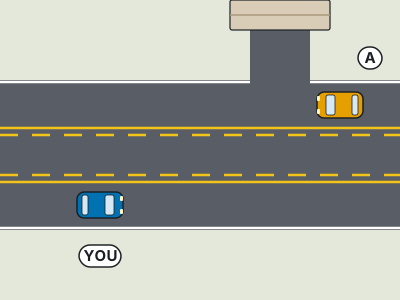
13. A two-way left-turn lane in the center of a roadway is reserved for:
- Parking while waiting for a signal
- Passing through traffic in both directions
- Left-turning vehicles in either direction
- Traveling straight when the outside lanes are crowded
Show answer
Left-turning vehicles in either direction. Alabama describes a center lane with two-way left-turn markings as reserved exclusively for vehicles turning left from either direction. It is not a general travel lane, passing lane, or parking strip. Driving straight through it would expose the vehicle to opposing turning movements and defeats the lane's purpose. Use it briefly to prepare for a left turn, watch for vehicles approaching from the other direction, and leave the center lane as soon as the turn can be completed safely.
Study this in the handbook: Traffic signals, arrows and lane use signals
14. After passing another vehicle on a two-lane road, when should you return to the right lane?
- As soon as your front bumper clears the other vehicle
- Immediately after the passing vehicle sounds its horn
- After you can see the entire front of the passed vehicle in your interior mirror
- Only at the next intersection
Show answer
After you can see the entire front of the passed vehicle in your interior mirror. The manual says not to return to the right lane too soon. The driver should wait until the entire front of the vehicle just passed is visible in the interior rear view mirror. That visual check confirms a useful following gap rather than merely showing that the front bumper has moved ahead. The horn does not establish clearance, and an intersection is not the required landmark. Use the mirror image as the cue: if the whole front is not visible, remain in the passing lane only while the maneuver is still safe and legal.
Study this in the handbook: Passing, backing, lane changes and loads
15. According to a study cited in the Alabama manual, how far do a car and a loaded truck need to stop from 55 mph?
- 193 feet for a passenger car and 430 feet for a loaded truck
- 50 feet and 100 feet
- 193 feet for both
- 1,000 feet for both
Show answer
193 feet for a passenger car and 430 feet for a loaded truck. A National Safety Council study of reaction time and braking distance found that at 55 miles per hour a passenger car needs 193 feet to stop safely and a loaded truck needs 430 feet. That gap is why cutting in front of a truck is so dangerous. Never cross behind a truck or bus that is backing up, because the driver cannot see you.
Study this in the handbook: Curves, bicycles, motorcycles and large vehicles
16. When rain, sleet, or snow requires windshield wipers, what does Alabama law require regarding headlights?
- Turn on high beams whenever precipitation begins
- Use parking lights only while the wipers are running
- Turn on headlights, unless the wipers are used intermittently
- Headlights are required only after sunset
Show answer
Turn on headlights, unless the wipers are used intermittently. Alabama ties headlight use to windshield wipers when the wipers are operating because of rain, sleet, or snow. The rule improves visibility to other road users during weather that can obscure a vehicle. Intermittent wiper use is specifically excluded, so the choice “Turn on headlights, unless the wipers are used intermittently” includes the important qualification. Parking lights alone do not satisfy the rule, high beams can create glare, and waiting for darkness ignores the weather trigger. When steady precipitation makes you run the wipers, turn on the headlights as part of the same habit.
Study this in the handbook: Skids, hydroplaning, fog and hills
17. When an official regulatory sign posts a speed zone different from the statutory limit, which limit applies?
- The statutory limit remains in force in every situation
- The limit changes only when a police officer is present
- The driver may use the higher of the two limits
- The posted regulatory limit applies
Show answer
The posted regulatory limit applies. Alabama’s statutory speed limits are the default for normal driving conditions, but they apply only unless another speed zone has been established and posted on an official regulatory sign. A posted limit therefore controls that roadway segment. The choice “The statutory limit remains in force in every situation” ignores the exception built into the rule, and choosing the higher number would defeat the purpose of a reduced speed zone. A police officer does not need to stand beside the sign for it to be enforceable. Read the sign and treat its posted number as the operating maximum for that zone.
Study this in the handbook: Speed limits
18. When must Alabama drivers turn on headlights under the nighttime visibility rule?
- Only when rain is falling
- Only from midnight until dawn
- From a half-hour after sunset to a half-hour before sunrise, and during limited visibility
- From sunset until midnight regardless of visibility
Show answer
From a half-hour after sunset to a half-hour before sunrise, and during limited visibility. Alabama requires headlights, not parking lights alone, from 30 minutes after sunset until 30 minutes before sunrise. The rule also applies during other limited-visibility periods when the driver cannot clearly see at least 500 feet. Midnight is not the trigger, and rain is only one possible cause of reduced visibility. The choice “From sunset until midnight regardless of visibility” ends the required period too early. Keep the timing cue in two parts: the half-hour nighttime window, plus any condition that prevents a clear 500-foot view.
Study this in the handbook: Night and winter driving
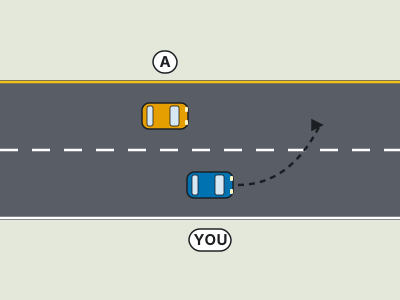
19. What is the safest way to check clearance before changing lanes?
- Rely only on the inside mirror
- Check mirrors and glance over your shoulder for the blind spot
- Turn on hazard lights and move immediately
- Look only at the vehicle directly ahead
Show answer
Check mirrors and glance over your shoulder for the blind spot. Before changing lanes, watch for safe clearance to the side, ahead, and behind, and glance over your shoulder to check the blind spot that mirrors cannot cover. Mirror-only checking can miss a vehicle beside the rear quarter of your car. Hazard lights do not replace a deliberate clearance check or grant permission to move. Looking only forward ignores traffic approaching from behind. Use a turn signal to communicate the plan, but remember that a signal does not make the lane available. Move only after the entire path is clear.
Study this in the handbook: Passing, backing, lane changes and loads
20. When a school bus displays flashing red lights and its extended stop area, what does that signal mean?
- The bus is stopped to load or unload school children
- The bus is leaving the roadway permanently
- The bus is warning that a railroad crossing is ahead
- The bus is allowing traffic to pass without slowing
Show answer
The bus is stopped to load or unload school children. Flashing red lights and the extended stop area indicate that the school bus is stopped to load or unload school children. The warning is not permission to pass and does not describe a railroad hazard or a permanent roadside stop. Treat the bus as an active protected loading zone: reduce the chance of a child entering the roadway, obey the required stop, and wait until the bus signals no longer require traffic to remain stopped. The amber lights have a different role, warning in advance that the bus is preparing to stop.
Study this in the handbook: Stopping rules, school buses and emergency vehicles
QualitySpace is expanding to Alabama
We are a California-based independent insurance brokerage working on licensing in more states. We cannot help with Alabama insurance yet. Leave your email and we will let you know when we can.
Every question is written from the official Alabama Driver Manual. Need paper? Printable AL practice test with answer key.
Last verified 2026-10-05. How we check every question · Study all 200 as flashcards
Frequently asked questions
How many questions are on this Alabama practice test?
This fixed set has 20 questions. It is test 6 of 10 from the 200 question Alabama bank.
How does this fixed test relate to the full Alabama bank?
Each numbered test is a fixed set of questions in a fixed order, so you can retake the same test later and compare. Every test mixes road signs and the other topics in about the same proportion as the full bank. Tests 1 to 10 together cover every question in the Alabama bank once. The full practice page mixes the whole bank at random.
Last verified 2026-10-05. See the Alabama DMV facts page for sourced state details.