
Test 8 of 10 · 20 questions · Free 2026
AL Permit Practice Test 8
Jump to the test ↓A fixed 20 question set from the Alabama bank with answers and plain English explanations.
Question 1 of 20 · 0 right so far
All 20 questions in test 8
Every question below comes from the Alabama question bank on this page. Open a question to see the correct answer and the explanation. Nothing here is hidden behind a signup.
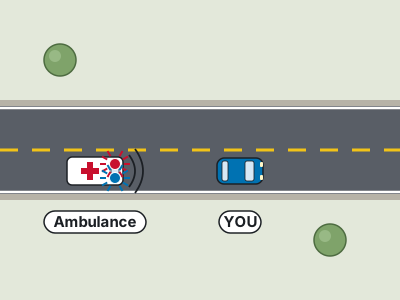
1. When an emergency vehicle approaches with flashing red or blue lights and a siren, what must a driver do?
- Follow the emergency vehicle closely through traffic
- Pull to the side of the roadway and stop
- Stop in the center of the intersection immediately
- Continue driving until reaching the next service station
Show answer
Pull to the side of the roadway and stop. Alabama requires drivers to yield to an approaching or overtaking emergency vehicle displaying flashing red or blue lights and sounding a siren or bell. The driver should pull to the side of the roadway and stop, but if already in an intersection, clear it before stopping. Stopping in the intersection can obstruct the emergency response, and following closely is restricted to vehicles on necessary official business. Continuing to a service station ignores the required response. The practical sequence is clear the intersection if needed, move aside, stop, and wait until the emergency vehicle passes.
Study this in the handbook: Stopping rules, school buses and emergency vehicles
2. A 16 year old Alabama learner license holder passes the road test. What happens with the learner license?
- It is surrendered, and a regular license without the Y restriction is issued at no cost
- It is kept as a backup ID
- It is extended for one more year
- It is mailed back after six months
Show answer
It is surrendered, and a regular license without the Y restriction is issued at no cost. A person 16 but under 18 who has held a learner license for six months, or until turning 18, may take the road test and must surrender the learner license at the time of the test. After passing, the applicant gets a new regular license with the Y restriction removed for the rest of the four-year period, at no cost. The learner license is not kept, extended, or mailed back later.
Study this in the handbook: The learner license and graduated license rules
3. What mandatory penalties follow a second Alabama DUI conviction within 10 years?
- A 90 day suspension only
- At least 5 days in jail or 30 days of community service, a one year revocation, and a fine of $1,100 to $5,100
- A $600 fine
- Lifetime revocation
Show answer
At least 5 days in jail or 30 days of community service, a one year revocation, and a fine of $1,100 to $5,100. Section 32-5A-191(f) sets a fine of $1,100 to $5,100 for a second DUI conviction within 10 years, with jail of up to one year. The sentence must include at least five days in jail or at least 30 days of community service, which cannot be suspended or probated, and ALEA revokes the license for one year, followed by a two year ignition interlock requirement. The older manual figure of 48 hours or 20 days is out of date. A first offense carries $600 to $2,100 and a 90 day suspension, and a third brings a three year revocation.
4. When may a driver turn right after stopping at a red light?
- Whenever the driver signals, even if pedestrians are crossing
- Only when a police officer waves the driver through
- Only after waiting for the next complete signal cycle
- When in the proper lane, after stopping, and the way is clear
Show answer
When in the proper lane, after stopping, and the way is clear. Alabama permits a right turn after a driver stops for a red light when the vehicle is in the proper lane and the way is clear. The driver must still yield to traffic and pedestrians lawfully proceeding through the intersection, and a posted sign can prohibit the turn. A signal alone does not override a pedestrian or another vehicle, so the choice “Whenever the driver signals, even if pedestrians are crossing” is unsafe. Waiting a full cycle is not generally required, and an officer need not authorize an otherwise lawful movement. Stop first, scan the crossing, and turn only into an open path.
Study this in the handbook: Speed limits
5. How early should a driver signal before making a turn?
- At least 25 feet before turning
- At least 50 feet before turning
- At least 100 feet before turning
- Only after beginning the turn
Show answer
At least 100 feet before turning. The manual calls for signaling at least 100 feet before a turn and continuing the signal until the actual maneuver is ready. The shorter distances in the choices “At least 25 feet before turning” and “At least 50 feet before turning” give other road users less notice than required. Waiting until the turn begins is especially unsafe because a pedestrian or following driver may already be committed to the expected path. Plan the maneuver before reaching the corner, enter the proper lane early, activate the signal, and keep it operating through the approach. The signal communicates intention, but it does not remove the need to check for traffic and pedestrians.
Study this in the handbook: Good driving habits, turns and three point turns
6. If a driver misses an exit in an Alabama roundabout, what should the driver do?
- Continue around the roundabout to the exit again
- Stop inside the circle and signal for help
- Back up to the missed exit when the lane is clear
- Cross the center island to reach the exit
Show answer
Continue around the roundabout to the exit again. Missing an exit does not justify reversing or stopping in the circular roadway. The manual says to drive around the roundabout again to reach the desired exit, and separately warns never to back up while in a roundabout. The back-up option creates a conflict with circulating traffic, while stopping inside the circle can obstruct vehicles and crossing the center island is not an authorized correction. The practical cue is simple: keep moving with the circle, complete another lap, and take the exit on the next pass when it is safe.
Study this in the handbook: Roundabouts
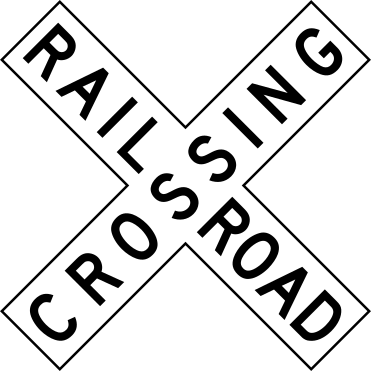
7. What should a driver do at a railroad crossing marked by a crossbuck?
- Approach cautiously and make sure all tracks are clear before crossing
- Accelerate so the vehicle is over the tracks quickly
- Stop only if another vehicle is already on the tracks
- Cross immediately because the crossbuck gives the driver priority
Show answer
Approach cautiously and make sure all tracks are clear before crossing. A crossbuck identifies the railroad crossing and demands careful observation before the vehicle enters the tracks. The driver should approach with caution and confirm that every track is clear. Speeding up, waiting for another vehicle to react, or assuming priority ignores the hazard. Scan both directions and account for a train that may be hidden by darkness, weather, or a nearby obstruction.
Study this in the handbook: Railroad crossings
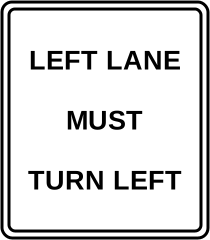
8. A LEFT LANE MUST TURN LEFT sign is posted ahead. Which driver must follow it?
- Only a driver who is making a U-turn
- Every driver approaching, including those in the right lane
- A driver traveling in the left lane
- Only a driver who has already entered the intersection
Show answer
A driver traveling in the left lane. The instruction applies to traffic occupying the left lane, which must turn left at the upcoming intersection. It does not force the right lane to turn, and it has nothing to do with a U-turn or vehicles already inside the junction. Move into a permitted lane early if you need a different movement. Lane position is the key cue, not merely the presence of the sign overhead.
Study this in the handbook: Sign types, regulatory signs and four way stops
9. What may a 14 or 15 year old operate with an Alabama motor driven cycle license?
- Any motorcycle
- A motor driven cycle weighing no more than 200 pounds and not exceeding 150cc
- A moped only on private roads
- A car with a supervising adult
Show answer
A motor driven cycle weighing no more than 200 pounds and not exceeding 150cc. Any person 14 or 15 years of age may obtain a restricted license to operate a motor driven cycle weighing not more than 200 pounds and not exceeding 150cc engine displacement. The examination comes from the Alabama Motorcycle Manual, and the successful applicant receives a Class M license with the restriction. The B restriction means the holder may operate a motor driven cycle only, so larger motorcycles wait for the Class M license available at 16.
Study this in the handbook: The learner license and graduated license rules
10. How often does the Alabama manual advise taking breaks on a long drive?
- Every 300 miles
- Every four hours
- Only when you feel tired
- Every 100 miles or every two hours
Show answer
Every 100 miles or every two hours. Alabama advises taking regular breaks every 100 miles or every two hours, getting out to walk, stretch and relax. Three hundred miles and four hours are longer than the manual suggests. Waiting until you feel tired is not the plan, though the manual also says to stop when drowsy rather than fight it. A pre-trip nap and moving your eyes around the road also help against highway hypnosis.
Study this in the handbook: Losing your license, points and phone laws
11. At what distance must Alabama drivers dim headlights for an oncoming vehicle?
- Within 100 feet
- Within 200 feet
- Within 300 feet
- Within 500 feet
Show answer
Within 500 feet. Headlights must be dimmed within 500 feet of an oncoming vehicle. The 200-foot figure applies when following another vehicle, so using it for an approaching vehicle leaves high beams on too close to the other driver. Lower beams reduce glare and help prevent temporary blindness. Make the change before the vehicles meet, even if the other driver has not dimmed yet. Remember the paired numbers: 500 feet for oncoming traffic and 200 feet when following.
Study this in the handbook: Night and winter driving
12. At an uncontrolled Alabama intersection, which driver yields when both vehicles arrive at about the same time?
- The driver on the right
- The driver traveling faster
- The driver on the left
- The driver in the larger vehicle
Show answer
The driver on the left. When two vehicles enter an uncontrolled intersection from different roadways at about the same time, the driver on the left yields to the driver on the right. Vehicle size and speed do not replace this right-of-way rule. The driver on the left should slow or stop, allow the vehicle to the right to proceed, and continue only when the path is safe. Also remember that entering at an unlawful speed can remove a right of way that might otherwise apply.
Study this in the handbook: Right of way and yielding
13. What extra reinstatement fee does Alabama charge after a drug related conviction?
- An additional $500
- No extra fee
- An additional $25
- An additional $1,000
Show answer
An additional $25. Reinstatement resulting from drug related convictions requires an additional $25 fee, and suspensions for non payment of child support require an additional $50 fee when reinstating the license. Failing to surrender the license within the time allowed after a cancellation, revocation or suspension also adds a $50 fee. These are added to the standard reinstatement fee, so the total depends on the reason for the suspension.
Study this in the handbook: Losing your license, points and phone laws
14. A blue-and-white guide sign most likely identifies:
- Motorist directions
- Driver services
- A public recreational or cultural point
- A regulatory requirement
Show answer
Driver services. Blue and white guide signs identify services for drivers, such as a hospital, gas, food, or lodging. Green and white belongs to motorist directions, so that choice confuses the directional color with the service color. Brown and white marks public recreational or cultural points, making the option “A public recreational or cultural point” a destination category with a different color. A regulatory requirement is communicated by a regulatory sign, not by the blue service color. When reading a guide sign, use the color first, then the words or symbol to identify the kind of help or destination ahead.
Study this in the handbook: Warning, construction and guide signs
15. When may you cross the centerline to pass on an Alabama curve or hill?
- Whenever you sound the horn before moving left
- Whenever the vehicle ahead is below the speed limit
- When the road has a broken line somewhere behind you
- Only when a clear passing distance of at least 500 feet is visible
Show answer
Only when a clear passing distance of at least 500 feet is visible. Alabama prohibits crossing the centerline to pass on a curve or hill when the driver cannot see a clear passing distance of at least 500 feet. A slow vehicle ahead does not remove the visibility requirement, and a broken line behind the vehicle says nothing about the road ahead. Sounding the horn can warn another driver but cannot legalize a blind maneuver. Before passing, look far enough ahead to confirm the required view, check behind for another passer, signal, and complete the movement without exceeding the speed limit.
Study this in the handbook: Passing, backing, lane changes and loads
16. How far before the track is Alabama's round railroad warning sign placed?
- 100 feet
- 2,000 feet
- 750 feet
- Directly at the crossing
Show answer
750 feet. The round railroad warning sign is yellow with a black X and the letters RR. It means a highway railroad crossing is ahead and is placed 750 feet before the track. The pavement may also be marked with a large X and two RR's, a yellow line in advance of the crossing means no passing, and white lines beside the track show where to stop.
Study this in the handbook: Railroad crossings
17. What color should the centerline be on an Alabama two-lane highway?
- Yellow
- White
- Blue
- Orange
Show answer
Yellow. Alabama uses yellow centerlines on two-lane highways because the line separates traffic moving in opposite directions. Under the same rule, white centerlines appear on multi-lane highways and one way streets. The white choice therefore describes a different road type. Blue and white appear on guide signs for services, and orange is the construction warning color, so neither describes the ordinary opposing-traffic separator. When reading pavement, first determine whether vehicles travel toward or alongside one another, then interpret the line color in that context.
Study this in the handbook: Pavement markings
18. What does Alabama's basic speed law require?
- Always drive at the posted limit regardless of weather
- Never drive faster than is reasonable under existing conditions
- Drive exactly 55 mph on every state road
- Use the highest speed the vehicle can safely reach
Show answer
Never drive faster than is reasonable under existing conditions. Alabama's basic speed law requires a driver to choose a speed that is reasonable for the conditions, never exceeding what the road, weather, vehicle, and driver condition support. A posted limit is not an instruction to maintain that speed during rain, poor visibility, congestion, or a mechanical problem. The fixed-speed choices ignore the manual's emphasis on changing circumstances, while the vehicle-capability choice confuses mechanical potential with lawful judgment. Reduce speed when conditions reduce traction, sight distance, or the time available to respond to hazards.
Study this in the handbook: Speed limits
19. How much of the front windshield may be tinted in Alabama?
- The entire windshield at 32 percent
- The lower half
- None at all
- Only the upper 6 inches, with a transparent material
Show answer
Only the upper 6 inches, with a transparent material. On all vehicles regardless of classification, only the upper 6 inches of the front windshield may be tinted with a transparent material. On passenger cars all side and rear windows may have tinting that allows at least 32 percent light transmission, and on SUVs, trucks and vans the front seat side windows follow the same 32 percent rule with darker tint allowed behind the driver.
Study this in the handbook: Traffic stops, insurance and window tint
20. Which 16 year olds are exempt from Alabama's graduated driver license restrictions?
- Those who are married or the head of a household, or legally relieved of minority status
- Those who completed driver education
- Those with a job
- Those with a parent's written note
Show answer
Those who are married or the head of a household, or legally relieved of minority status. The graduated driver license restrictions do not apply to individuals 16 or older who are married or the head of household, to those legally relieved of minority status, or to drivers 17 or older who have held a valid license for six months or longer. Everyone else who is 16, or 17 with a license under six months, faces the passenger, hours and phone restrictions.
Study this in the handbook: The learner license and graduated license rules
QualitySpace is expanding to Alabama
We are a California-based independent insurance brokerage working on licensing in more states. We cannot help with Alabama insurance yet. Leave your email and we will let you know when we can.
Every question is written from the official Alabama Driver Manual. Need paper? Printable AL practice test with answer key.
Last verified 2026-10-05. How we check every question · Study all 200 as flashcards
Frequently asked questions
How many questions are on this Alabama practice test?
This fixed set has 20 questions. It is test 8 of 10 from the 200 question Alabama bank.
How does this fixed test relate to the full Alabama bank?
Each numbered test is a fixed set of questions in a fixed order, so you can retake the same test later and compare. Every test mixes road signs and the other topics in about the same proportion as the full bank. Tests 1 to 10 together cover every question in the Alabama bank once. The full practice page mixes the whole bank at random.
Last verified 2026-10-05. See the Alabama DMV facts page for sourced state details.