
Test 7 of 10 · 20 questions · Free 2026
AL Permit Practice Test 7
Jump to the test ↓A fixed 20 question set from the Alabama bank with answers and plain English explanations.
Question 1 of 20 · 0 right so far
All 20 questions in test 7
Every question below comes from the Alabama question bank on this page. Open a question to see the correct answer and the explanation. Nothing here is hidden behind a signup.
1. What does an Alabama school-zone sign indicate during the hours shown on the sign?
- Drivers may ignore the sign when its flashing lights are off
- A statewide 20 mph limit applies at every school
- The ordinary road speed limit applies until children enter the roadway
- The posted school-zone speed limit applies during those indicated hours
Show answer
The posted school-zone speed limit applies during those indicated hours. A school-zone sign identifies the speed limit that governs during the hours printed on the sign. The manual also notes that the limit may appear on a lighted sign with flashing amber lights. The statewide 20 mph choice invents a single number that this passage does not establish. Waiting for children to enter the road is unsafe because the restriction is tied to the displayed hours, not to a child’s location. A useful roadside cue is to look for the hours or amber flash before choosing your speed, then obey the posted school-zone limit while it applies.
Study this in the handbook: Speed limits
2. At what blood alcohol concentration does the manual say all individuals are definitely impaired?
- .02 percent
- .04 percent
- .05 percent
- .08 percent
Show answer
.08 percent. The manual states that at .08 percent, all individuals are definitely impaired. That figure also appears in Alabama’s rule making it unlawful for an ordinary driver to operate with .08 percent or more alcohol in the blood. The .05 percent option is described as impairing most individuals to some degree, but it is not the explicit all individuals threshold asked about here. The two lower figures do not match either statement. Use .08 as the cue for the definite impairment point, while remembering that a driver’s ability can decline well before reaching it.
Study this in the handbook: Alcohol and the DUI law
3. Even with a steady green arrow, to whom must a driver yield while entering the intersection?
- No one, because a green arrow gives absolute priority
- Only vehicles approaching from behind
- Other traffic lawfully using the intersection
- Only vehicles stopped at the opposite curb
Show answer
Other traffic lawfully using the intersection. A green arrow permits the indicated movement, but vehicles entering on that arrow must still yield to other traffic lawfully using the intersection. The absolute priority option removes an explicit limitation from the rule. Traffic behind the driver is not the only group that matters, and the opposite curb description is narrower than the manual. Treat the arrow as permission to proceed in a particular direction, then scan for lawful road users already occupying or entering the intersection. If another user has the right to be there, wait rather than forcing the movement.
Study this in the handbook: Right of way and yielding
4. On a two-lane Alabama road posted at 20 mph or less, what speed must a driver use when unable to change lanes around a stopped emergency vehicle?
- 10 mph
- 5 mph below the posted limit
- The posted speed limit plus 10 mph
- A complete stop in every case
Show answer
10 mph. For a two-lane road with a posted speed limit of 20 mph or less, the move-over provision requires travel at 10 mph when a lane change is unsafe or not possible. This is a fixed speed in the manual's low-limit condition, not a five-mph reduction from whatever sign is present. Increasing speed defeats the protective purpose, while an automatic complete stop is not the stated requirement. Also move as far away from the emergency vehicle or wrecker as possible within the lane. The low posted limit is the cue for the 10-mph rule.
Study this in the handbook: The Move Over Law
5. When entering an Alabama roundabout, which movement is required?
- Turn left across the circulating lane
- Turn right through a safe gap in traffic
- Stop at the entrance until every approach is empty
- Enter straight ahead without yielding to traffic already inside
Show answer
Turn right through a safe gap in traffic. The manual directs drivers to enter a roundabout when there is a safe gap and to turn right to join the counterclockwise flow. The left-turn choice would move against the intended circulation. Waiting until every approach is empty is unnecessary and can disrupt traffic because the instruction calls for a safe gap, not total emptiness. A driver must also yield to traffic already in the roundabout, so entering straight through without yielding is unsafe. Slow down, check for pedestrians and bicyclists, yield, then turn right into the open gap.
Study this in the handbook: Roundabouts
6. At what age may an Alabama resident obtain a vessel license, and when may a licensed operator boat alone?
- Age 12 for the license, and alone at 14 or older
- Age 16 for both
- Age 18 for both
- Age 10 for the license, alone at 12
Show answer
Age 12 for the license, and alone at 14 or older. Under the Alabama Boating Safety Reform Act, persons 12 years old and older may obtain a vessel license, and a licensed operator 14 years old or older may operate alone. Licensed operators aged 12 and 13 need an adult 21 or older with a vessel license aboard and able to take control. Persons born before April 28, 1954 are exempt from the exam but must have the vessel class issued.
Study this in the handbook: Renewal, address changes and license classes
7. Which vehicles may follow an emergency vehicle on an emergency run within 500 feet?
- Any vehicle with headlights on
- Any vehicle traveling below the speed limit
- Only vehicles on necessary official business
- Any vehicle that stays in the right lane
Show answer
Only vehicles on necessary official business. Alabama reserves the 500 foot following distance during an emergency run for vehicles on necessary official business. A private driver cannot create an exception by traveling slowly, turning on headlights, or remaining in the right lane. Those actions may improve visibility or lane discipline, but they do not change who may use the restricted space. When an emergency vehicle is responding, stay well back and leave room for its movements. The key cue is the qualification of official business, not a special speed, lighting, or lane choice.
Study this in the handbook: Stopping rules, school buses and emergency vehicles
8. What is required when you approach an Alabama regulatory sign?
- Obey it without hesitation
- Treat it only as a suggestion
- Follow it only when another vehicle is nearby
- Ignore it unless it is fluorescent yellow
Show answer
Obey it without hesitation. Regulatory signs control traffic and must be obeyed without hesitation. Treating one as a suggestion removes the legal force described in the manual. Waiting for another vehicle is also wrong because the duty applies whenever the sign regulates your movement, whether the road is busy or empty. Fluorescent yellow is associated with pedestrian crossings and school zones, not a condition that determines whether a regulatory sign counts. A practical cue is the word regulatory: it signals a rule governing movement, speed, turns, stopping, or other required conduct.
Study this in the handbook: Sign types, regulatory signs and four way stops
9. What does Alabama require of a vehicle's muffler and exhaust system?
- A muffler only on vehicles newer than 2000
- No muffler if the vehicle is a truck
- A muffler in good working order with no cutouts or bypasses, and no carbon monoxide leaking into the interior
- Bypasses allowed off the interstate
Show answer
A muffler in good working order with no cutouts or bypasses, and no carbon monoxide leaking into the interior. Every vehicle must be equipped with a muffler in good working order that eliminates excessive or unusual noise such as sharp popping or cracking. Muffler cutouts, bypasses and similar devices are forbidden, and the exhaust system must not leak carbon monoxide fumes into the interior of the vehicle. Bells, sirens and exhaust whistles are reserved for emergency vehicles, and needless horn use can lead to arrest.
10. What minimum light transmission must Alabama passenger car window tint allow?
- At least 5 percent
- At least 32 percent
- At least 90 percent
- At least 70 percent
Show answer
At least 32 percent. On passenger cars such as sedans, coupes and station wagons, all side and rear windows may have tinting that allows at least 32 percent light transmission. Front seat side windows of SUVs, trucks, vans and RVs are subject to the same 32 percent restriction, with darker tint permitted behind the driver. Only the upper 6 inches of the windshield may be tinted.
Study this in the handbook: Traffic stops, insurance and window tint
11. Under Alabama's child restraint law, how long must a child use a forward-facing child seat?
- Until 3 years of age
- Until at least 5 years of age or 40 pounds
- Until 15 years of age
- Until 20 pounds
Show answer
Until at least 5 years of age or 40 pounds. After the rear-facing stage, Alabama requires a convertible seat in the forward position or a forward-facing seat until the child is at least 5 years of age or 40 pounds. A booster seat is then used until age 6, and a seat belt through age 15. Three years is not the rule. Fifteen is the end of the child restraint law's coverage, and 20 pounds is the rear-facing threshold.
Study this in the handbook: Parking, safety belts and child restraints
12. What fine range does Alabama list for a third DUI conviction?
- $2,100 to $10,100
- $600 to $2,100
- $1,100 to $5,100
- $4,100 to $10,100
Show answer
$2,100 to $10,100. Alabama's fines step up with each DUI: $600 to $2,100 for a first conviction, $1,100 to $5,100 for a second within 10 years, $2,100 to $10,100 for a third, and $4,100 to $10,100 for a fourth or later conviction, which is a Class C felony. So the other three ranges belong to the first, second and fourth convictions. A third conviction also brings a three year revocation.
Study this in the handbook: Alcohol and the DUI law
13. A driver with a valid license from another state moves to Alabama. How long may the driver use that license after becoming a resident?
- 90 days
- 30 days
- 60 days
- One year
Show answer
30 days. Alabama lets a non-resident who holds a valid license from the previous state of residence drive without an Alabama license for 30 days after becoming a resident. Ninety days is the limit for a non-resident whose home country does not license drivers, and it counts days per calendar year. Sixty days is the grace period after an Alabama license expires. One year is not a rule for new residents.
Study this in the handbook: Who needs a license, and the knowledge and road tests
14. What minimum insurance coverage for bodily injury to one person is listed in Alabama’s manual?
- $10,000
- $15,000
- $50,000
- $25,000
Show answer
$25,000. The manual lists at least $25,000 for death or bodily injury to one person under Alabama’s Mandatory Liability Insurance Law. The $50,000 figure applies to death or bodily injury involving two or more persons, so it is not the single-person amount. The lower figures do not meet the listed minimum. When reviewing an insurance policy, distinguish the person-count limits from the separate $25,000 property-damage limit, and keep proof available for a traffic stop.
Study this in the handbook: Traffic stops, insurance and window tint
15. At an Alabama four-way stop, which vehicle generally leaves first when two vehicles arrive together?
- The vehicle furthest to the right
- The vehicle on the left
- The vehicle with the larger engine
- The vehicle that entered the intersection without stopping
Show answer
The vehicle furthest to the right. At a four-way stop, vehicles should leave in the order they reached a complete stop. When two arrive at the same time, the vehicle furthest to the right goes first. Engine size has no role in right of way, and entering without stopping is a violation rather than a priority rule. The left-side choice reverses the tie-breaker. Even when it is your turn, pause long enough to confirm that other drivers are yielding because not everyone follows the rule. The practical cue is arrival order first, right side for a tie.
Study this in the handbook: Sign types, regulatory signs and four way stops
16. After receiving notice of an Alabama license suspension, what hearing may the driver request?
- A vehicle inspection hearing at the nearest repair shop
- A criminal jury trial in any state county
- A pre-suspension or administrative hearing in the county of residence
- A permit renewal hearing only after the suspension ends
Show answer
A pre-suspension or administrative hearing in the county of residence. After notice that a driver license will be suspended, Alabama allows the driver to request a pre-suspension or administrative hearing in the county of residence before an Alabama Law Enforcement Agency agent. The process gives the driver an opportunity to address the suspension before it takes effect. A criminal jury trial is not the hearing described in this passage, and a repair shop has no role in the licensing review. Waiting until the suspension ends would miss the timing identified by the manual. Keep the notice and act within the available administrative process.
Study this in the handbook: Losing your license, points and phone laws
17. How far does a freight train at 55 mph need to stop, according to the Alabama manual?
- About a quarter mile
- About 500 feet
- About one football field
- A mile or more, the length of 18 football fields
Show answer
A mile or more, the length of 18 football fields. Trains cannot stop quickly. A freight train traveling at 55 mph takes a mile or more to stop, the length of 18 football fields, so a train that comes upon a car on the crossing cannot pull up in time. If your vehicle stalls on the tracks, get everyone out of the vehicle immediately and away from the tracks, then call your local law enforcement agency for assistance. Always expect a train.
Study this in the handbook: Phones, fatigue, following distance and crashes
18. What does a RIGHT LANE ENDS warning require a driver to anticipate?

- The roadway will become a one-way ramp with no merging traffic
- The left lane will disappear and traffic must stop on the shoulder
- A new lane will open for passing on the right
- The number of highway lanes changes, so the driver must merge into the adjacent lane
Show answer
The number of highway lanes changes, so the driver must merge into the adjacent lane. The right lane ends when the number of highway lanes changes, so a driver using it must merge into the adjacent lane. Waiting until the markings vanish can create a sudden conflict. The sign is not an instruction to stop on the shoulder or a promise that a passing lane will open. Check the next lane early, signal, yield to vehicles already there, and merge when a safe gap appears.
19. What does this sign require?
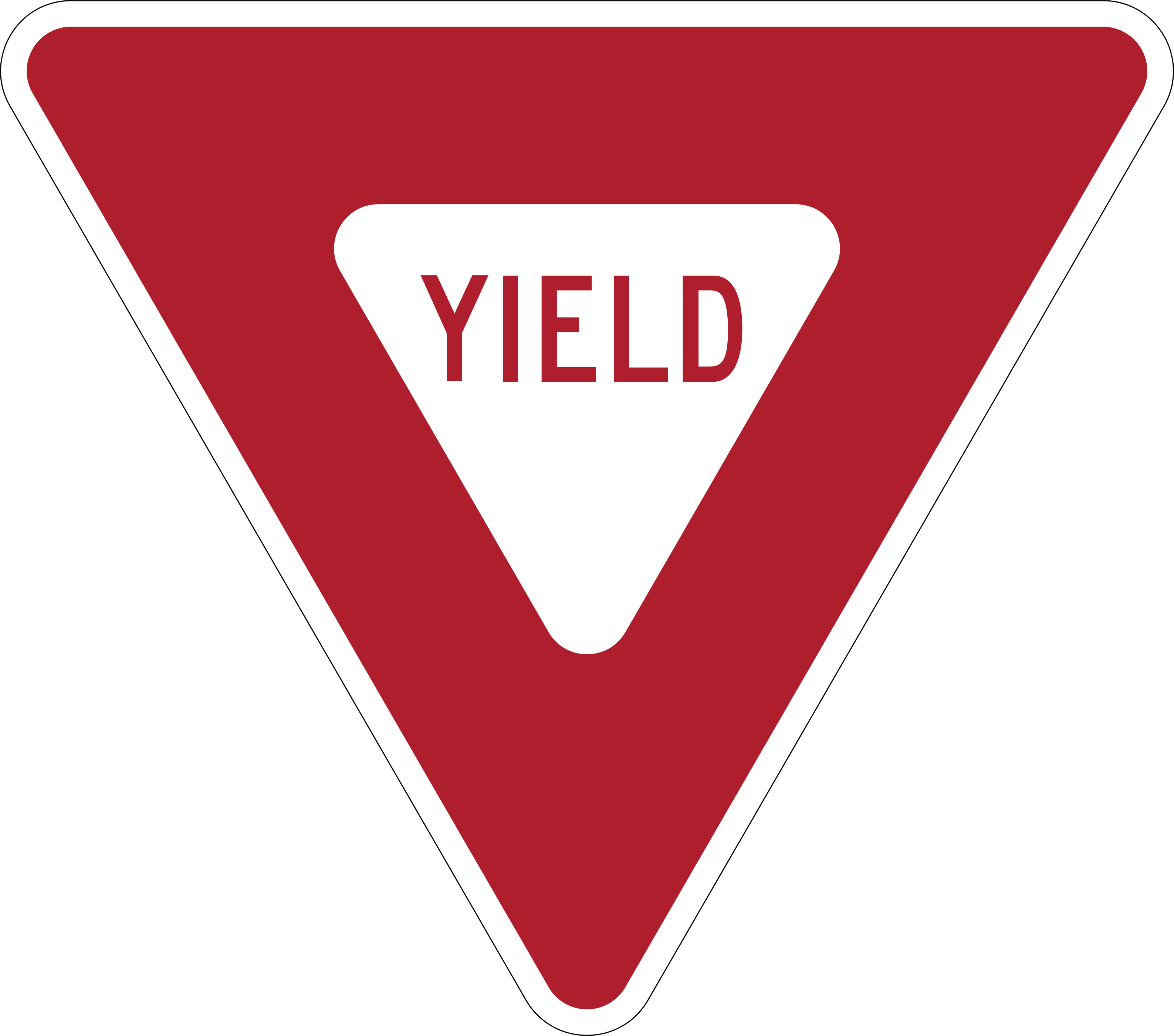
- A complete stop in all cases
- Slow down and yield to crossing traffic and pedestrians; stop if necessary
- Speed up before entering the intersection
- Proceed without checking for pedestrians
Show answer
Slow down and yield to crossing traffic and pedestrians; stop if necessary. A YIELD sign calls for reduced speed and yielding to vehicles and pedestrians legally crossing the roadway. The driver stops if necessary, but a complete stop in every case is not the sign's universal command. Speeding up would make yielding harder, and proceeding without a pedestrian check abandons the right-of-way rule. Approach slowly enough to assess the crossing path, then stop when traffic or a pedestrian requires it. The image identifies the sign, while the controlling cue is the conditional stop tied to another road user's lawful movement.
Study this in the handbook: Right of way and yielding
20. When does Alabama require headlights because of windshield wiper use?
- Whenever the vehicle is parked outdoors
- Only when wipers are used intermittently
- When the wipers are in use because of rain, sleet, or snow
- Only when the driver uses high beams
Show answer
When the wipers are in use because of rain, sleet, or snow. Alabama requires headlights when windshield wipers are in use because of rain, sleet, or snow. The manual specifically says intermittent wiper use does not require headlight usage, so the choice “Only when wipers are used intermittently” reverses the stated exception. Parking outdoors and selecting high beams are unrelated triggers. Use low beams as the practical choice when weather reduces visibility, while remembering that the legal rule described here connects headlights to weather-related wiper use. The cue is precipitation, not merely the presence of wipers or darkness alone.
Study this in the handbook: Night and winter driving
QualitySpace is expanding to Alabama
We are a California-based independent insurance brokerage working on licensing in more states. We cannot help with Alabama insurance yet. Leave your email and we will let you know when we can.
Every question is written from the official Alabama Driver Manual. Need paper? Printable AL practice test with answer key.
Last verified 2026-10-05. How we check every question · Study all 200 as flashcards
Frequently asked questions
How many questions are on this Alabama practice test?
This fixed set has 20 questions. It is test 7 of 10 from the 200 question Alabama bank.
How does this fixed test relate to the full Alabama bank?
Each numbered test is a fixed set of questions in a fixed order, so you can retake the same test later and compare. Every test mixes road signs and the other topics in about the same proportion as the full bank. Tests 1 to 10 together cover every question in the Alabama bank once. The full practice page mixes the whole bank at random.
Last verified 2026-10-05. See the Alabama DMV facts page for sourced state details.